
Procrastination is not just laziness. It’s a complex emotional response rooted in self-regulation, motivation, and often, deep-seated fears. When a deadline looms but you find yourself scrolling through social media, reorganizing your desk, or suddenly deciding it’s the perfect time to deep-clean the kitchen, something deeper than poor time management is at play. The most common culprit? Fear of failure — a silent force that undermines productivity even when consequences are clear.
Understanding why we delay tasks despite knowing the stakes can transform how we approach work, creativity, and personal growth. This article explores the psychology behind procrastination, particularly its link to fear of failure, and offers practical, evidence-based solutions to help you move forward with clarity and confidence.
The Hidden Psychology Behind Procrastination
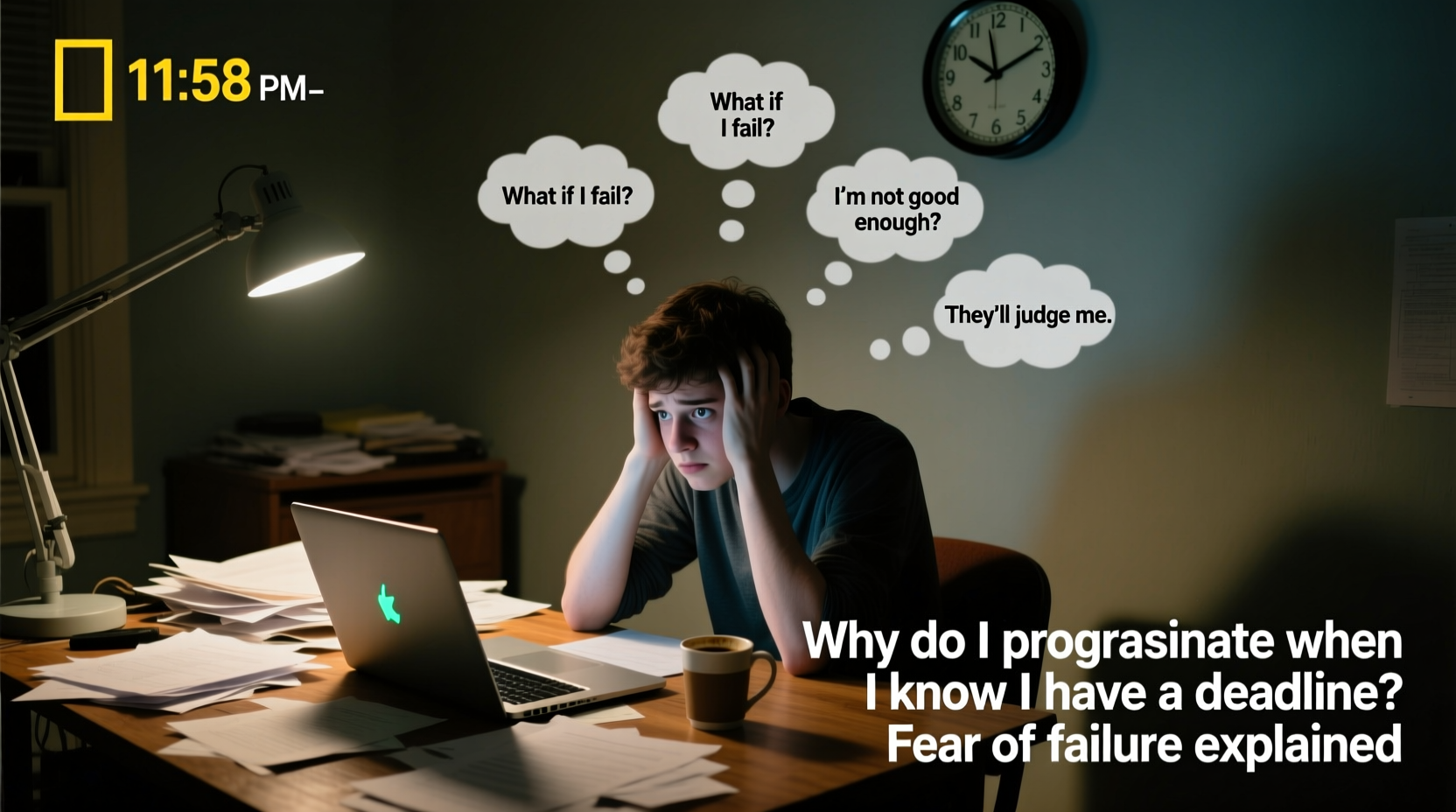
At first glance, procrastination appears to be about poor planning or lack of discipline. But research consistently shows it's primarily an emotional regulation problem, not a time management one. Dr. Tim Pychyl, a leading researcher on procrastination at Carleton University, explains: “We don’t put things off because we’re lazy. We put them off because we feel anxious, afraid, or overwhelmed.”
When faced with a task that triggers discomfort — such as writing a report, preparing a presentation, or starting a creative project — the brain seeks immediate relief. Delaying the task provides short-term emotional comfort by reducing anxiety. However, this relief is fleeting. As the deadline approaches, stress intensifies, creating a vicious cycle of avoidance and guilt.
Fear of failure amplifies this pattern. It doesn’t mean you expect to fail outright; rather, it reflects a dread of falling short of expectations — your own or others’. This fear activates the amygdala, the brain’s threat detection center, which interprets the task not as a challenge, but as a danger to self-worth.
“We avoid the task not because it’s hard, but because we’re afraid of what failing (or even succeeding) might say about us.” — Dr. Fuschia Sirois, Professor of Psychology, University of Sheffield
How Fear of Failure Fuels Procrastination
Fear of failure isn’t always obvious. It often masquerades as perfectionism, over-preparation, or hyper-busyness. You might tell yourself you’re waiting for the “right moment” or need more information before starting. In reality, these are protective mechanisms designed to shield your ego from potential criticism or disappointment.
Consider this scenario: A graphic designer has two weeks to complete a client logo. Instead of beginning early, they spend days researching design trends, tweaking their workspace, or redoing thumbnails endlessly. On the surface, it looks like diligence. But beneath lies a fear: “If this logo isn’t perfect, the client will think I’m untalented. My reputation could suffer.” To avoid confronting that possibility, the brain chooses delay.
This form of procrastination is self-sabotaging yet psychologically protective. By delaying, the individual preserves a fallback excuse: “I didn’t do well because I started late, not because I’m incapable.” In this way, procrastination becomes a defense against identity threat.
Common Triggers of Failure-Based Procrastination
Not all tasks provoke the same level of anxiety. Certain conditions make fear of failure more likely to trigger delay. Recognizing these can help you anticipate and manage your response.
- High personal significance: Tasks tied to identity (e.g., applying for dream jobs, publishing creative work) increase pressure to perform.
- Unclear outcomes: When success isn’t guaranteed or feedback is subjective, uncertainty breeds fear.
- Past negative experiences: Previous failures or harsh criticism can condition the brain to associate effort with pain.
- Perfectionist standards: Believing anything less than flawless is unacceptable sets an impossible bar.
- Public visibility: Work that will be judged by peers, managers, or audiences feels riskier.
These factors don’t cause procrastination directly, but they heighten emotional arousal around a task. The brain then defaults to avoidance as a coping mechanism.
Breaking the Cycle: A Step-by-Step Approach
Overcoming procrastination rooted in fear of failure requires more than willpower. It demands structural changes to how you engage with tasks and interpret setbacks. The following five-step process helps rebuild your relationship with work and reduce avoidance.
- Reframe the Task: Shift focus from outcome (“I must create a perfect proposal”) to process (“Today, I’ll draft three bullet points”). This reduces performance pressure and makes starting easier.
- Set Micro-Goals: Break large projects into 5–10 minute actions. Example: “Open document and write one sentence.” Small wins build momentum and confidence.
- Practice Self-Compassion: Replace self-criticism with kind acknowledgment. Instead of “I should’ve started earlier,” try “It’s okay — I’m doing my best right now.”
- Use Implementation Intentions: Plan exactly when and where you’ll work. Say: “After breakfast, I’ll sit at my desk and write for 15 minutes.” Specificity increases follow-through.
- Normalize Imperfection: Intentionally submit a small, low-stakes task that’s “good enough.” Notice that the world doesn’t end. This weakens the fear-response loop.
Each step targets a different aspect of the procrastination-failure cycle: cognitive framing, behavioral activation, emotional regulation, and belief restructuring.
Do’s and Don’ts When Facing Deadline Pressure
| Do’s | Don’ts |
|---|---|
| Start with the easiest part of the task to build momentum | Wait for motivation to strike before beginning |
| Allow yourself to write a “bad” first draft | Expect perfection in early stages |
| Take short breaks using the Pomodoro technique (25 min work, 5 min rest) | Work until exhaustion, then crash |
| Reflect on past successes to boost self-efficacy | Ruminate on previous failures |
| Seek feedback early to reduce uncertainty | Isolate yourself and assume you’ll be judged harshly |
Mini Case Study: From Paralysis to Progress
Sarah, a junior marketing analyst, was assigned her first solo campaign report due in ten days. Despite having all the data, she found herself checking emails repeatedly, attending optional meetings, and even volunteering for unrelated tasks. By day seven, panic set in. She stayed up all night finishing a rushed, subpar report — and received polite but lukewarm feedback.
After reflecting with her manager, Sarah realized her delay wasn’t about workload. It stemmed from fear: “If this report flops, they’ll realize I’m not cut out for this role.” With coaching, she adopted a new strategy for her next assignment:
- Day 1: Wrote a messy outline in 12 minutes.
- Day 2: Shared it with her manager for quick input.
- Days 3–5: Added one section daily, no editing allowed.
- Day 6: Revised lightly, then submitted.
The result? A stronger report, less stress, and positive feedback. More importantly, Sarah learned that imperfection didn’t lead to catastrophe — and that starting, even poorly, was better than waiting for ideal conditions.
Actionable Checklist to Overcome Procrastination
Use this checklist the next time you feel stuck before a deadline:
- Identify the underlying fear: “What am I really afraid of?”
- Break the task into the smallest possible first step.
- Commit to working for just 5 minutes — no more.
- Write down one compassionate thing to say to yourself if you struggle.
- Schedule the work session like a non-negotiable appointment.
- Remove distractions (e.g., phone in another room, website blockers).
- After starting, reward yourself — even briefly — to reinforce action.
FAQ: Addressing Common Concerns
Isn’t procrastination just a sign of poor discipline?
No. While discipline plays a role, chronic procrastination is more closely linked to emotional regulation than laziness. People who procrastinate often have high standards and care deeply about their work — which is why failure feels so threatening.
Can fear of failure ever be beneficial?
In small doses, yes. Healthy concern about performance can motivate preparation. But when fear becomes paralyzing — causing delay, avoidance, or burnout — it crosses into unhelpful territory. The goal isn’t to eliminate fear, but to prevent it from controlling your behavior.
What if I keep relapsing into old habits?
Change takes time. Relapses are normal. Instead of judging yourself, analyze what triggered the delay: Was the task too vague? Were expectations unrealistic? Use each setback as data to refine your approach.
Conclusion: Move Forward, Not Perfectly
Procrastination in the face of deadlines isn’t a character flaw — it’s a signal. It tells you that something feels emotionally risky. When fear of failure drives delay, the solution isn’t to push harder, but to get smarter about your inner landscape. By reframing tasks, reducing pressure, and practicing self-compassion, you can disrupt the cycle and reclaim your agency.
You don’t need to eliminate fear to take action. You just need to act alongside it. Start small. Be kind to yourself. And remember: done is better than perfect, especially when perfection is the enemy of progress.




 浙公网安备
33010002000092号
浙公网安备
33010002000092号 浙B2-20120091-4
Comments
No comments yet. Why don't you start the discussion?