
It’s a familiar scenario: you have a quick email to send, a form to fill out, or a five-minute chore that needs doing. Logically, it should take no time at all. Yet, instead of acting, you find yourself scrolling through social media, reorganizing your desk, or convincing yourself that now isn’t the “right moment.” This paradox—procrastinating on tasks that are objectively easy—is not a sign of laziness or poor discipline. It’s a deeply rooted psychological response shaped by emotion regulation, self-perception, and cognitive distortions.
Understanding why we delay even the simplest responsibilities requires peeling back layers of emotional resistance, fear, and misaligned motivation. The truth is, ease of execution doesn’t always correlate with willingness to act. In fact, the simpler a task appears, the more likely our minds may rebel against it—not because it’s hard, but because of what it represents emotionally.
The Emotional Roots of Procrastination
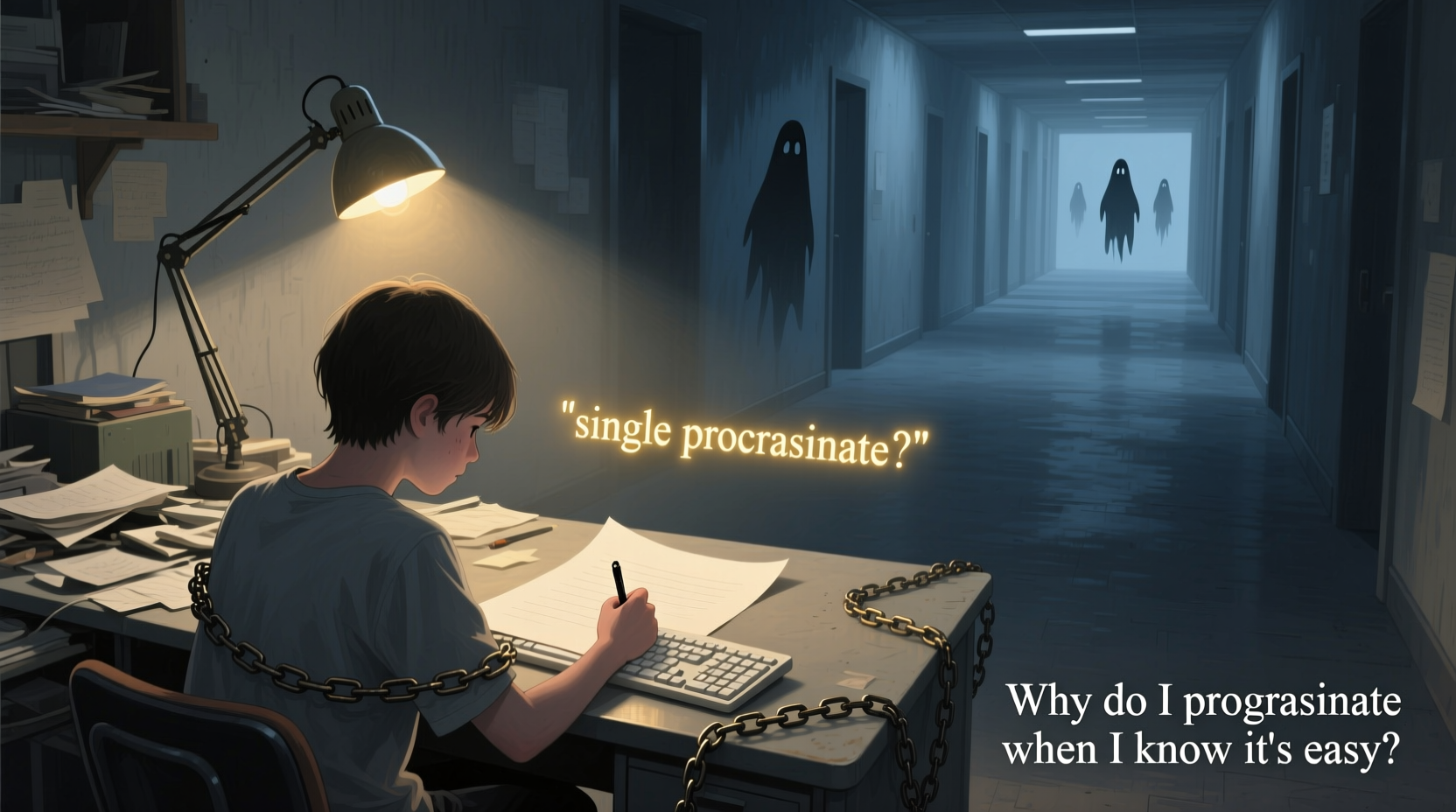
Procrastination is rarely about time management. Research consistently shows that people who delay tasks aren’t lacking in planning skills; they’re struggling with emotional regulation. When faced with a task—even an easy one—the brain often evaluates it based on how it feels, not how long it will take. If the task triggers discomfort, boredom, anxiety, or a sense of inadequacy, the limbic system (the brain’s emotional center) overrides logical reasoning from the prefrontal cortex.
This emotional hijacking explains why someone might put off replying to a low-stakes email. On paper, it’s simple. But if the sender is someone they feel intimidated by, or if the message carries subtle pressure (“just checking in”), the brain registers threat—not effort. Avoidance becomes a short-term relief strategy, offering immediate emotional comfort at the cost of long-term stress.
“Procrastination is an emotion regulation problem, not a time management problem.” — Dr. Timothy Pychyl, psychologist and author of *Solving the Procrastination Puzzle*
The irony is that the easier the task, the more shame we may feel for avoiding it. That shame then fuels further avoidance, creating a feedback loop where the task grows heavier in our mind, not because of its complexity, but because of the emotional weight we’ve attached to it.
Cognitive Distortions That Fuel Avoidance
Our brains use mental shortcuts—cognitive distortions—that can sabotage action, especially on tasks we perceive as trivial. These distortions make procrastination feel rational, even when it clearly isn’t.
- Moral licensing: “I did something productive this morning, so I’ve earned the right to avoid this small task.”
- Overgeneralization: “If I didn’t reply yesterday, I’m already late—might as well wait until I can do it perfectly.”
- Minimization: “It’s just a quick thing—I’ll do it later,” which leads to repeated deferral.
- Emotional reasoning: “I don’t feel like doing it, so it must not be important.”
These patterns are particularly insidious with easy tasks because they seem harmless. But over time, unchecked avoidance erodes self-trust. Each delayed email, unmade phone call, or unsigned permission slip chips away at our confidence in our own reliability.
The Paradox of Task Simplicity
Counterintuitively, the simplicity of a task can make it harder to start. Here’s why:
Easy tasks often lack intrinsic reward or clear closure. A complex project has milestones, visible progress, and a sense of accomplishment. But replying to an email or filing a document offers no such satisfaction. Because the outcome feels negligible, motivation wanes. Our brains prefer activities that promise dopamine hits—completion, praise, novelty—and mundane tasks deliver none of those.
Additionally, simple tasks are frequently embedded within larger systems of responsibility. Signing a form might mean acknowledging a financial obligation. Sending a message could reopen a conversation you’d rather avoid. The task itself is easy, but what it symbolizes—a relationship, a commitment, a reminder of unfinished business—can be emotionally loaded.
In some cases, avoidance stems from identity conflict. For example, a creative professional may resist administrative work because it clashes with their self-image as an “artist” or “visionary.” Even though the task is simple, doing it feels like betraying their identity. So they delay—not due to difficulty, but due to internal dissonance.
Breaking the Cycle: A Step-by-Step Approach
Escaping chronic procrastination on easy tasks requires reframing both the task and your relationship to it. Here’s a practical, evidence-based sequence to regain control:
- Identify the emotional trigger: Before labeling yourself lazy, ask: What emotion arises when I think about this task? Anxiety? Boredom? Resentment? Naming the feeling reduces its power.
- Reframe the task: Instead of “I have to send an email,” try “I choose to communicate clearly.” Shifting from obligation to agency increases willingness.
- Use the two-minute rule: If a task takes less than two minutes, do it immediately. This prevents small items from piling up and becoming overwhelming.
- Pair with a habit: Attach the task to an existing routine. For example, “After I pour my morning coffee, I’ll check and respond to urgent messages.” Habit stacking builds consistency without relying on willpower.
- Lower the bar for perfection: Many avoid easy tasks because they want to do them “at the right time” or “with full focus.” But done is better than perfect. Aim for completion, not excellence.
- Review weekly: Set aside 15 minutes each week to scan for lingering micro-tasks. Clearing these prevents accumulation and restores mental clarity.
This approach isn’t about forcing productivity. It’s about aligning behavior with values. When you act on small commitments, you reinforce self-integrity—the belief that you follow through on what you say you’ll do.
Checklist: How to Stop Avoiding Easy Tasks
Use this actionable checklist to build momentum and reduce resistance:
- ☑️ Identify one easy task you’ve been avoiding
- ☑️ Write down the emotion it triggers (e.g., boredom, guilt, anxiety)
- ☑️ Commit to doing it within the next hour
- ☑️ Use a timer: Work on it for just 90 seconds
- ☑️ Reward yourself immediately after (e.g., stretch, take a breath, acknowledge the win)
- ☑️ Reflect: How did it feel to complete it? Was it as bad as expected?
- ☑️ Repeat with another small task tomorrow
Consistency here builds self-efficacy. Over time, the pattern shifts from avoidance to action—even when motivation is low.
Real Example: Maria’s Email Dilemma
Maria, a freelance designer, prided herself on meeting big deadlines. But she routinely avoided responding to client emails, even brief ones asking for confirmation or file delivery. She knew they were easy—most took under three minutes. Yet, she’d leave them for days, sometimes weeks.
During coaching, she realized the root wasn’t busyness. It was fear. Replying meant confirming project details, which reminded her of past misunderstandings with clients. The emails weren’t hard—they were emotionally charged. By delaying, she avoided confronting her anxiety about being misunderstood or criticized.
She started using the two-minute rule: whenever an email arrived, she set a timer and responded immediately. At first, it felt forced. But within two weeks, her inbox stayed under control, and her clients reported improved communication. More importantly, Maria noticed a shift in her self-perception: she was no longer someone who “forgot” things—she was someone who followed through.
Do’s and Don’ts of Managing Low-Effort Tasks
| Do’s | Don’ts |
|---|---|
| Do acknowledge the emotion behind avoidance | Don’t label yourself as lazy or undisciplined |
| Do complete micro-tasks immediately when possible | Don’t let small tasks accumulate into mental clutter |
| Do link easy tasks to existing habits | Don’t rely solely on motivation to act |
| Do celebrate small completions | Don’t dismiss minor wins as insignificant |
| Do reflect on how avoidance affects self-trust | Don’t ignore the long-term cost of chronic delay |
The distinction between these behaviors isn’t about effort—it’s about mindset. Small actions, consistently taken, rebuild the foundation of personal reliability.
Frequently Asked Questions
Why do I procrastinate on easy tasks but manage complex ones?
Complex tasks often come with structure, deadlines, and external accountability, which provide built-in motivation. Easy tasks lack these drivers and rely entirely on self-initiation. Additionally, complex work may feel more meaningful, while simple tasks can trigger feelings of drudgery or insignificance, making them easier to avoid despite their low effort.
Is avoiding simple tasks a sign of ADHD?
Not necessarily—but it can be a symptom. People with ADHD often struggle with task initiation, especially for low-stimulation activities, regardless of difficulty. If you consistently avoid routine tasks, have trouble starting projects, or experience time blindness, consider speaking with a healthcare professional. However, occasional procrastination on easy tasks is common and does not indicate a disorder.
How can I stop feeling guilty about delaying small things?
Guilt often persists because avoidance breaks self-trust. The most effective way to reduce guilt is to act—starting with one small, overdue task. Each completed action repairs your internal contract with yourself. Over time, consistent follow-through diminishes guilt and builds self-respect.
Conclusion: Reclaim Your Agency, One Small Task at a Time
Procrastinating on easy tasks isn’t irrational—it’s human. It reflects the complex interplay between emotion, identity, and motivation. But recognizing the psychology behind avoidance is only the first step. Lasting change comes from action, not insight alone.
Start today. Pick one task you’ve been putting off—one that takes less than two minutes. Do it now, without waiting for the “right mood.” Notice how the resistance fades once the task is complete. Then repeat tomorrow. These tiny victories accumulate into a stronger sense of self-efficacy, where doing what you say you’ll do becomes the default, not the exception.




 浙公网安备
33010002000092号
浙公网安备
33010002000092号 浙B2-20120091-4
Comments
No comments yet. Why don't you start the discussion?