
During the holiday season, few decorations capture attention like icicle lights. Their cascading strands mimic frozen waterfalls along rooflines, creating a magical winter aesthetic. But anyone who has installed them knows one common frustration: they move—sometimes dramatically—when the wind picks up. Unlike traditional string lights that stay relatively still, icicle lights often dance wildly in even mild gusts. This behavior isn’t random; it’s rooted in physics, design, and installation methods. Understanding why icicle lights sway more reveals insights into aerodynamics, material choices, and structural stability.
The Design of Icicle Lights: Form Meets Function (and Motion)
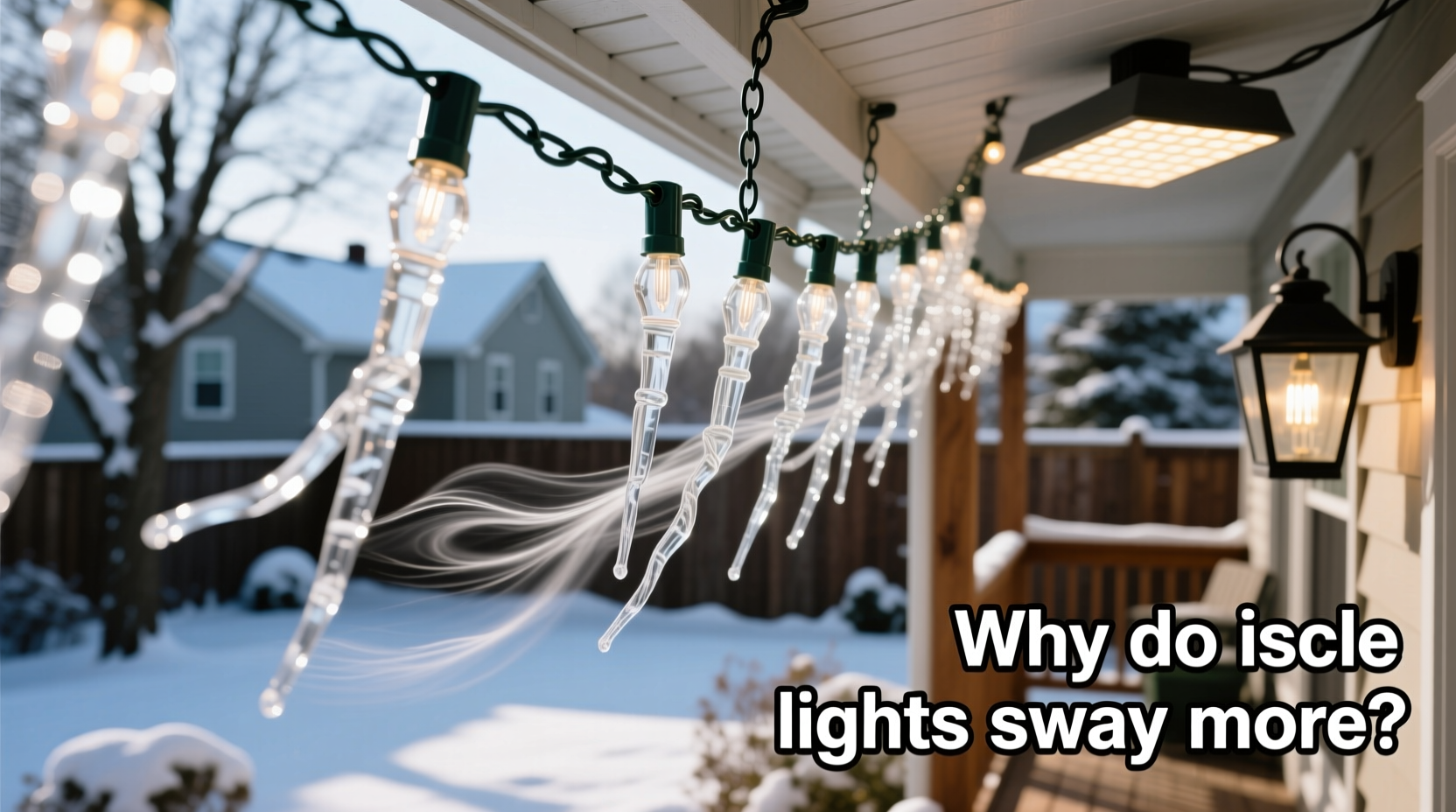
Icicle lights are engineered to resemble hanging ice formations. They typically consist of a horizontal main wire with multiple vertical drops—shorter strands of lights suspended at intervals, usually 6 to 12 inches long. These drops range from 3 to 10 inches in length and end in a bulb or decorative tip. While visually appealing, this multi-tiered structure introduces several dynamic properties that increase susceptibility to wind.
The primary reason for increased sway lies in the **pendulum effect** created by each drop. When mounted along an eave or gutter, the main wire acts as an anchor point, while each vertical strand behaves like a pendulum. Wind applies lateral force unevenly across these drops, causing them to oscillate independently. Because there are dozens—or even hundreds—of these small pendulums on a single set, their combined motion amplifies the overall visual movement.
In contrast, standard string lights run in a straight line with minimal vertical variation. Without protruding elements, they present a smaller cross-sectional area to the wind and lack the free-swinging components that drive oscillation. The difference is similar to comparing a flat flag flapping in the breeze versus a tassel-covered curtain fluttering in all directions.
Aerodynamic Profile and Wind Resistance
Wind resistance, or drag, plays a major role in how much any object moves when exposed to air currents. Objects with larger surface areas perpendicular to the wind experience greater force. Icicle lights inherently have a higher effective surface area due to their three-dimensional structure.
Each vertical drop captures wind from multiple angles. Even light breezes can initiate movement because the individual strands are lightweight and loosely suspended. Once motion begins, it can be self-reinforcing—oscillations grow due to resonance if the frequency of wind pulses matches the natural swing rate of the drops.
This phenomenon is well-documented in engineering. For example, suspension bridges use dampers to prevent resonant vibrations caused by wind. Similarly, tall buildings incorporate tuned mass dampers to counteract sway. Icicle lights lack such stabilization mechanisms, making them prone to exaggerated motion under certain wind conditions.
Comparative Wind Load: Icicle vs. String Lights
| Light Type | Vertical Elements | Wind Cross-Section | Pendulum Effect | Typical Sway Level |
|---|---|---|---|---|
| Standard String Lights | None | Low (linear profile) | Negligible | Minimal |
| Icicle Lights (Short Drops) | Multiple (every 6–8\") | Moderate | High | High |
| Icicle Lights (Long Drops) | Multiple (every 6–8\") | High | Very High | Extreme |
| Bulb-Only Curtain Lights | Full panel | Very High | Moderate (connected) | Moderate-High |
The table illustrates how structural complexity correlates with movement. While curtain lights also feature vertical elements, their wires are often connected at the bottom, reducing independent motion. Icicle lights, however, allow each drop to move freely, increasing unpredictability and visible sway.
Weight Distribution and Center of Gravity
Another critical factor is weight distribution. In most lighting systems, stability improves when mass is concentrated near the mounting point. Traditional string lights achieve this with evenly spaced bulbs along a taut wire. The center of gravity remains close to the support line, minimizing torque when wind pushes against them.
Icicle lights shift the center of gravity downward. Each vertical strand adds mass below the main wire, effectively turning the entire setup into a series of low-hanging weights. When wind pushes horizontally on these lower points, it creates rotational force (torque) around the attachment point. This causes both the drop and the main wire to pivot slightly, contributing to wobbling along the entire length.
Additionally, the materials used in icicle lights are intentionally lightweight—plastic-coated wires, small LED bulbs, and thin housings. While beneficial for energy efficiency and ease of installation, low mass means less inertia to resist movement. Light objects accelerate faster under the same wind force, leading to quicker onset of sway.
“Any悬挂 system with distributed low-mass pendulums will exhibit amplified response to transient wind forces. It’s basic harmonic motion.” — Dr. Alan Reyes, Structural Dynamics Engineer, University of Colorado Boulder
Installation Methods That Influence Movement
How icicle lights are installed significantly affects their behavior in wind. Most homeowners drape them over gutters, hang them from clips attached to shingles, or suspend them from eaves using plastic hooks. These methods rarely provide rigid anchoring.
Flexible mounting allows micro-movements at each attachment point. When one section shifts, it transfers motion to adjacent segments. Over time, especially in continuous runs exceeding 25 feet, this creates a wave-like effect—similar to a rope being shaken at one end.
Spacing between drops also influences dynamics. Closer spacing increases density but may dampen motion slightly through interference between neighboring strands. Wider spacing allows each drop more room to swing, potentially increasing amplitude.
Step-by-Step: How to Minimize Icicle Light Sway
- Choose a sheltered location: Install lights under overhangs or beneath covered porches where wind exposure is reduced.
- Secure the main wire tightly: Use durable clips or staples to minimize lateral movement of the horizontal support line.
- Add stabilizing ties: Attach fishing line or clear zip ties from the bottom of select drops to fixed points below (e.g., window frames).
- Limit drop length: Opt for shorter icicle strands (3–5 inches) instead of longer ones (8+ inches), which catch more wind and swing farther.
- Use dual-anchor clips: Some specialty clips grip both the gutter and the light wire, reducing pivot potential.
- Install during calm weather: Wind can stretch or misalign wires during setup, leading to imbalance later.
- Group sets closely: Running multiple strands side by side can create mutual damping through slight contact.
Real-World Example: The Case of the Flapping Eaves
In suburban Chicago, homeowner Maria Thompson installed two identical sets of LED holiday lights—one standard string, one icicle style—along adjacent sides of her two-story home. Both were mounted at the same height, using similar clip spacing and purchased from the same retailer.
Over the course of December, she observed stark differences. On windy nights, the icicle lights would ripple violently, drawing complaints from neighbors about noise and distraction. The standard lights remained nearly motionless. Curious, she contacted a local electrician who specializes in seasonal installations.
Upon inspection, he noted that the icicle lights had been clipped loosely to aging gutters that flexed slightly in high winds. Each drop acted independently, and without any bottom stabilization, they entered resonant oscillation at around 15 mph wind speeds. He recommended securing every third drop with nylon thread anchored to the fascia board. After implementing the fix, visible sway decreased by over 70%, confirmed by side-by-side video comparison.
This case underscores that while design contributes significantly to sway, proper installation techniques can mitigate much of the issue—even after initial mounting.
Material and Environmental Factors
Temperature and humidity also influence performance. Cold weather makes plastic coatings brittle, reducing flexibility and increasing snap-back after wind displacement. In regions with frequent freeze-thaw cycles, repeated stress can weaken wire joints, leading to sagging or uneven alignment—both of which exacerbate swaying.
Rain or snow accumulation adds temporary mass to the drops. Initially, this extra weight may dampen movement. However, once precipitation melts or sheds unevenly, sudden shifts in balance can trigger erratic swinging. Ice buildup is particularly problematic, transforming lightweight decor into heavy, unbalanced pendulums capable of damaging gutters or pulling loose connections.
Urban environments introduce additional challenges. Buildings create wind tunnels and turbulence zones, especially on upper floors. Rooftop HVAC units, chimneys, and nearby trees alter airflow patterns, subjecting lights to unpredictable gusts. Rural homes, though more exposed, often face steadier winds that may not induce resonance as easily as turbulent urban eddies.
Frequently Asked Questions
Do LED icicle lights sway less than incandescent ones?
Not necessarily. While LEDs are generally lighter due to smaller bulbs and efficient wiring, this reduced mass can actually increase responsiveness to wind. However, many modern LED sets use stiffer wire cores and better-balanced designs, which may offset the advantage. Overall, construction quality matters more than bulb type.
Can I prevent icicle lights from swaying completely?
Complete elimination is unlikely without altering their fundamental design. However, significant reduction is achievable through tighter mounting, strategic anchoring of drop ends, and choosing sheltered locations. Using adhesive-backed clips instead of hook-style hangers also improves stability.
Are longer icicle drops more prone to damage in wind?
Yes. Longer drops have greater leverage and momentum when swinging, increasing strain on connection points. Over time, this can lead to broken wires, detached sockets, or pulled mounts. For high-wind areas, experts recommend sticking to drop lengths under six inches.
Checklist: Secure Your Icicle Lights Against Wind
- ☐ Inspect clips/hangers for firm attachment before installation
- ☐ Tighten main wire to eliminate slack
- ☐ Choose shorter drop lengths (3–6\") for exposed areas
- ☐ Anchor every 4–5 drops with clear support lines
- ☐ Avoid installing near vents, corners, or roof peaks where wind accelerates
- ☐ Check for ice buildup weekly during winter months
- ☐ Replace frayed or kinked sections immediately
Conclusion: Embrace the Motion—or Control It
Icicle lights sway more than other holiday lights because of their unique combination of vertical drops, low mass, flexible mounting, and exposure to wind forces. Their beauty lies in mimicking nature—but ironically, that same natural inspiration makes them vulnerable to real-world weather conditions.
Understanding the science behind their movement empowers you to make smarter choices—from product selection to placement and reinforcement. Whether you accept some motion as part of the charm or take steps to stabilize your display, knowledge ensures your holiday lights remain safe, functional, and festive.




 浙公网安备
33010002000092号
浙公网安备
33010002000092号 浙B2-20120091-4
Comments
No comments yet. Why don't you start the discussion?