
Icicle lights are a holiday favorite, adding a sparkling, wintry charm to homes, storefronts, and trees. But anyone who’s seen them fluttering wildly in a breeze knows they behave differently from standard string lights. While both types illuminate with equal brightness, icicle lights tend to sway dramatically even in mild winds. This isn’t just an illusion—it’s rooted in physics, design, and structural dynamics. Understanding why this happens can help you install them more securely, reduce wear, and preserve their festive appeal season after season.
The Design Difference: Form Follows Function—And Movement
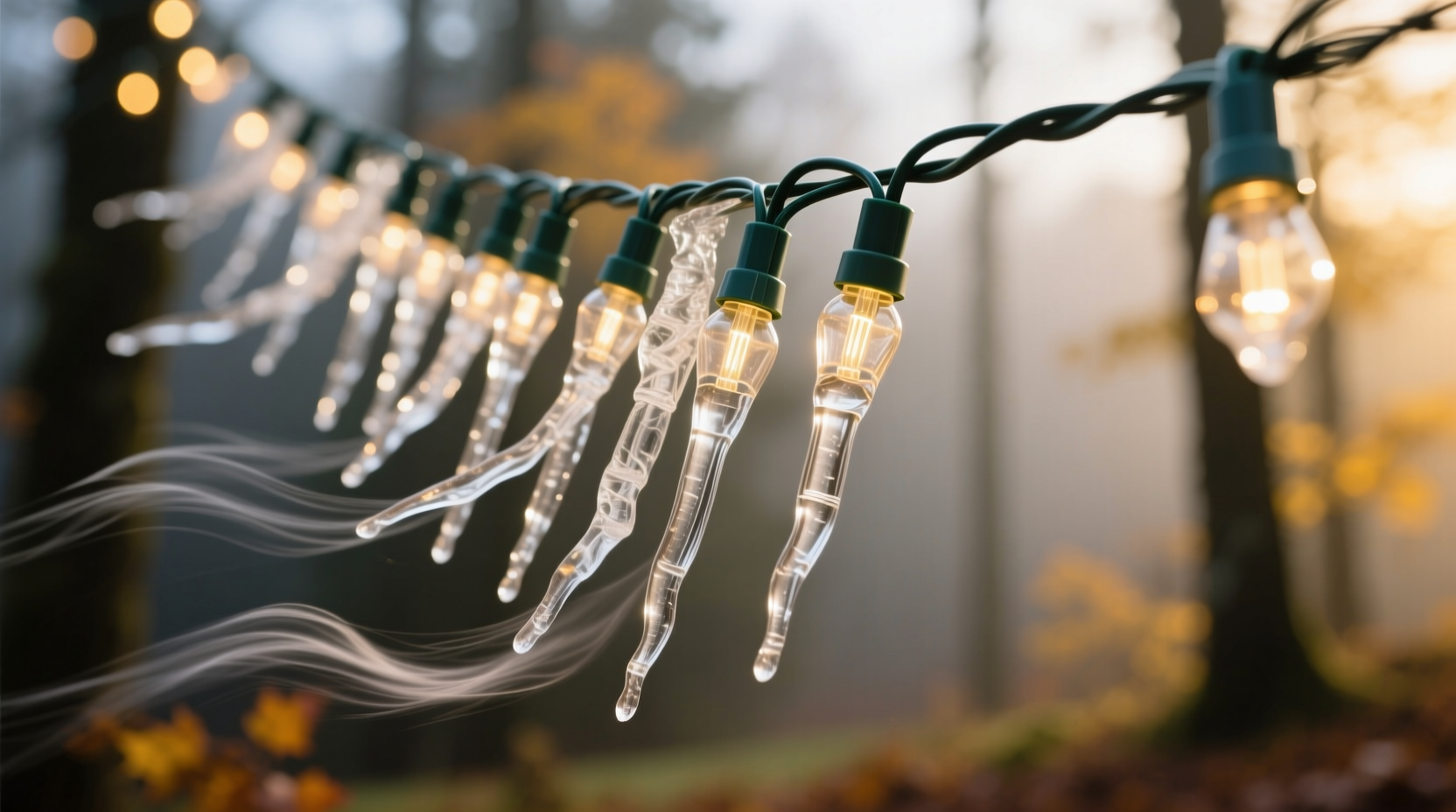
At first glance, the distinction between icicle lights and traditional string lights seems purely aesthetic. Regular string lights consist of evenly spaced bulbs along a single horizontal wire, typically draped in straight lines or wrapped around objects. Icicle lights, on the other hand, mimic frozen droplets by extending vertical strands of varying lengths from a central horizontal wire. This creates a cascading effect that visually resembles melting ice formations.
However, this decorative design has mechanical consequences. The multiple hanging segments act like individual pendulums, each free to oscillate independently when exposed to air currents. In contrast, standard string lights have fewer loose ends and less vertical extension, reducing their surface area and pivot points for wind interaction.
The increased number of dangling elements in icicle lights amplifies their responsiveness to airflow. Even a light gust can initiate motion in one strand, which then transfers energy to adjacent ones through the shared support wire, creating a ripple effect across the entire display.
Physics of Pendulum Motion and Wind Resistance
The swaying of icicle lights is best understood through basic principles of physics—specifically, pendulum dynamics and fluid resistance.
Each vertical drop in an icicle light set functions as a simple pendulum. A pendulum's period—the time it takes to swing back and forth—depends primarily on its length. Longer strands swing more slowly but with greater amplitude when disturbed. Since icicle lights often feature drops ranging from 6 to 24 inches, they create a variety of oscillation frequencies within the same fixture, leading to complex, overlapping movements that appear chaotic.
Wind adds another layer of complexity. As air flows past the lights, it creates pressure differentials around the wires and bulbs. These differences generate lift and drag forces, similar to how wind affects flags or power lines. Because icicle lights present a larger effective cross-sectional area perpendicular to the wind due to their vertical orientation, they catch more airflow than compactly arranged string lights.
In engineering terms, this makes icicle lights more susceptible to vortex shedding—a phenomenon where alternating vortices form behind an object in a fluid flow, producing periodic lateral forces. If the frequency of these vortices matches the natural frequency of a light strand, resonance occurs, dramatically increasing sway amplitude.
“Any flexible structure with multiple hanging masses will exhibit enhanced dynamic response under wind loading. Icicle lights are essentially arrays of coupled oscillators.” — Dr. Alan Prescott, Structural Dynamics Engineer, University of Colorado Boulder
Comparison: Icicle Lights vs. Standard String Lights
To illustrate the performance gap, consider the following comparison based on physical characteristics and environmental behavior:
| Feature | Icicle Lights | Regular String Lights |
|---|---|---|
| Vertical Drop Length | Multiple lengths (6–24 in) | None (flat layout) |
| Pendulum Effect | High – many independent oscillators | Low – minimal free-hanging mass |
| Wind Profile | Large frontal area; high drag | Compact; low exposure |
| Installation Stability | Requires frequent anchoring | Stable with end-point fastening |
| Motion in 10 mph Wind | Noticeable to severe swaying | Slight vibration only |
| Lifespan Under Stress | Reduced due to connector fatigue | Generally longer |
This table highlights why icicle lights are inherently less stable. Their design prioritizes visual impact over aerodynamic efficiency, making them more vulnerable to environmental stressors.
Real-World Example: The Coastal Home Dilemma
Consider a homeowner in Cape May, New Jersey, who decorates her seaside porch annually with LED icicle lights. Each winter, despite secure initial mounting, she notices increasing flickering and occasional outages by mid-season. After two years, nearly half the strands fail prematurely.
An electrician inspecting the setup observes excessive flexing at the connection points between the main wire and vertical drops. Salt-laden coastal breezes, common in the area, exacerbate metal fatigue in the thin copper leads inside the connectors. The constant back-and-forth motion breaks microscopic solder joints over time—a failure mode rarely seen in inland installations using the same product.
The solution? She switches to shorter icicle drops (under 12 inches), installs secondary support clips every foot, and angles the entire array slightly downward to reduce wind capture. Over the next three seasons, failure rates drop to zero, and the lights remain steady even during nor’easters.
This case underscores a key point: while all lights can be affected by wind, icicle designs demand proactive mitigation in exposed environments.
How Installation Impacts Sway and Longevity
Even the best-designed lights can underperform if installed improperly. With icicle lights, placement and anchoring play a decisive role in minimizing unwanted motion.
Most people attach icicle lights at the ends and maybe one midpoint, assuming that’s sufficient. But because the weight and wind load are distributed vertically along the span, unsupported sections can act like trampolines, bouncing and twisting with every gust. This not only increases visibility of movement but also strains internal wiring.
Proper installation involves more than just hanging lights—it requires treating them like tensioned systems. Using clips, hooks, or adhesive mounts at regular intervals prevents sagging and reduces harmonic buildup. Additionally, positioning the top wire closer to a wall or eave shields the lower strands from direct wind exposure.
Step-by-Step Guide to Secure Icicle Light Installation
- Measure and plan spacing: Determine how far apart each vertical drop should hang based on your home’s architecture. Aim for uniformity to distribute stress evenly.
- Pre-stretch the strand: Lay the lights out on the ground for several hours before installation. This reduces coil memory and prevents post-installation sagging.
- Mark anchor points: Use a level and tape measure to mark clip locations every 12 inches along the intended path.
- Install support hardware: Attach plastic clips, gutter hooks, or adhesive mounts firmly to the surface. For wood, use small nails; for vinyl siding, use S-hooks in the grooves.
- Thread the lights carefully: Place the horizontal wire into each clip, ensuring no sharp bends or pinching.
- Secure drop bases (optional): For high-wind zones, lightly anchor the bottom bulb of longer drops using clear fishing line tied to a fixed point below.
- Test and adjust: Turn on the lights and observe for flickering or strain. Make micro-adjustments to relieve tension.
Checklist: Minimizing Wind-Induced Sway in Icicle Lights
- ✅ Choose shorter drop lengths for exposed locations
- ✅ Space support clips no more than 12 inches apart
- ✅ Install parallel to prevailing wind direction when possible
- ✅ Use reinforced connector models rated for outdoor use
- ✅ Avoid mixing old and new strands (differing flexibility causes uneven stress)
- ✅ Inspect connections mid-season for signs of fraying or loosening
- ✅ Remove promptly after the holiday season to limit weather exposure
Frequently Asked Questions
Do LED icicle lights sway less than incandescent ones?
Not significantly. While LED bulbs are lighter, reducing gravitational pull on the wires, the overall structure remains the same. The primary factor in sway is the number and length of hanging strands, not bulb type. However, LEDs generate less heat, which helps preserve wire insulation integrity over time, indirectly improving durability under repeated motion.
Can I convert regular string lights into icicle-style displays?
Technically yes, but not safely. Attempting to add custom drops using extension wires or DIY connectors often violates electrical safety standards and increases fire risk. Pre-made icicle sets are engineered for balanced load distribution and weather resistance. It’s better to purchase purpose-built products than modify existing ones.
Why do some icicle lights tangle easily when stored?
The multiple dangling strands naturally entwine during removal and coiling. To prevent this, detach the lights from supports carefully, gather them section by section, and wrap around a cardboard reel or storage spool. Label and store in a breathable container away from extreme temperatures.
Conclusion: Balancing Beauty and Stability
Icicle lights sway more than regular string lights because their design introduces multiple pendulum-like elements that interact dynamically with wind. This movement, while sometimes charming, accelerates wear and poses long-term reliability risks—especially in exposed or coastal environments. By understanding the physics behind their motion and applying strategic installation techniques, you can enjoy their visual magic without sacrificing performance.
The key lies in respecting their structural vulnerability. Treat icicle lights not just as decorations, but as delicate suspended systems requiring thoughtful support. With proper planning, anchoring, and maintenance, they can remain a safe, vibrant part of your seasonal tradition for years to come.




 浙公网安备
33010002000092号
浙公网安备
33010002000092号 浙B2-20120091-4
Comments
No comments yet. Why don't you start the discussion?