
Icicle lights are a holiday favorite, draping homes in festive elegance with their cascading strands of shimmering bulbs. Yet, few things bring more frustration than pulling them out of storage only to find an impenetrable knot of wires, plugs, and tangled filaments. This annual struggle is not just bad luck—it's rooted in physics, material design, and human behavior. The good news? With the right understanding and techniques, you can stop the tangle cycle for good.
The Science Behind Why Icicle Lights Tangle
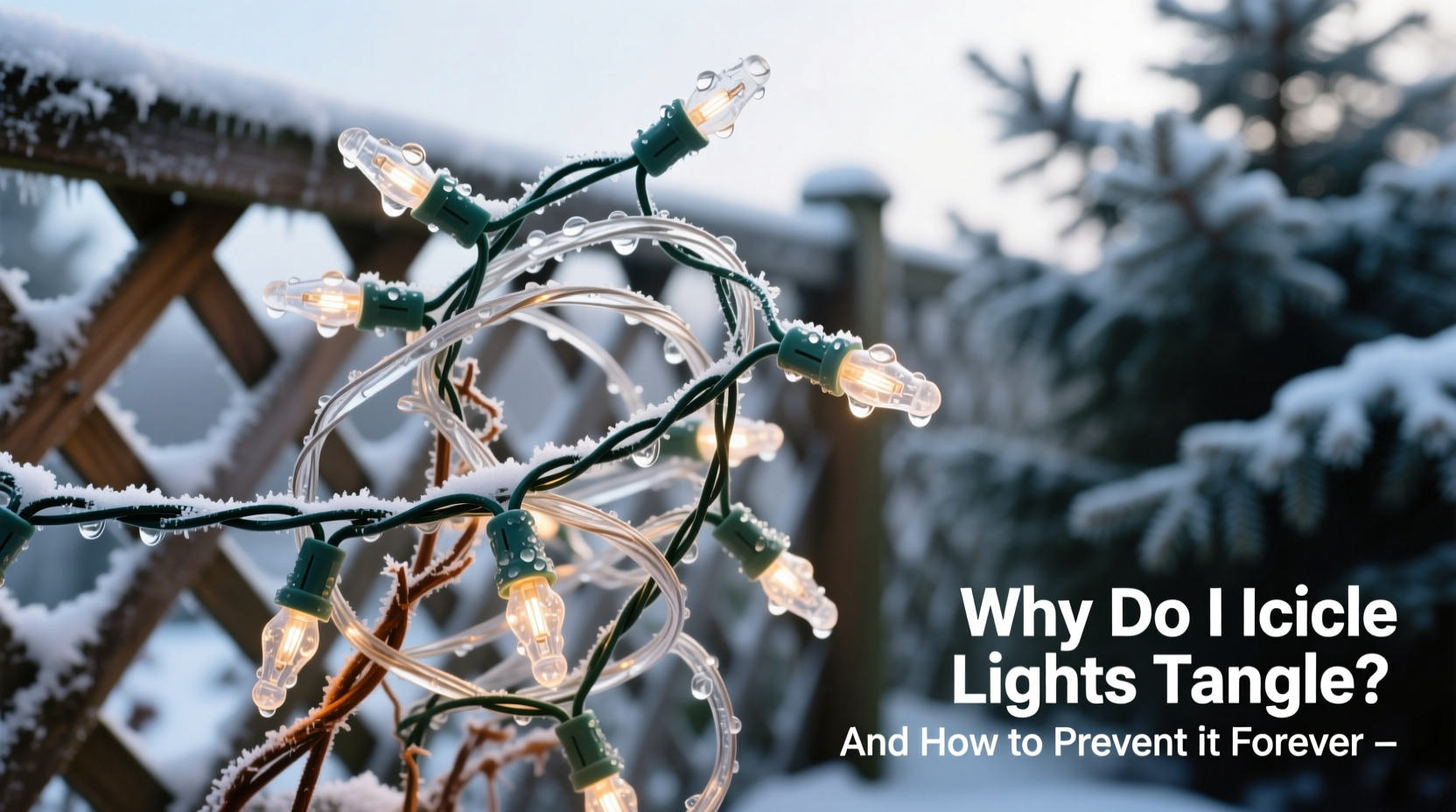
At first glance, the tendency of long, flexible strands to tangle seems like random chaos. But research shows otherwise. In 2007, physicists Dorian Raymer and Douglas Smith published a study in the Proceedings of the National Academy of Sciences demonstrating that any string longer than about 1.5 feet, when agitated, has a high probability of forming knots. Icicle lights—often stretching 6 to 9 feet or more with multiple droplets—fall squarely into this category.
The primary culprit is entropy: the natural tendency of systems to move toward disorder. When your lights are tossed into a box, jostled during transport, or simply stored loosely on a shelf, the movement creates opportunities for loops to form and catch on adjacent wires. Once one knot forms, it acts as a nucleus for further entanglement.
Additionally, icicle lights have unique structural challenges:
- Asymmetrical weight distribution: The downward-drooping bulbs create uneven tension along the strand, increasing the chance of loops catching.
- Multiple connection points: Unlike simple string lights, icicle sets often feature secondary wires hanging at intervals, multiplying potential snag points.
- Fine-gauge wiring: Thinner wires are more flexible and prone to coiling, which encourages spontaneous knotting.
“Any linear object subjected to motion in a confined space will eventually knot itself. It’s not magic—it’s math.” — Dr. Raymond Goldstein, Professor of Physics, University of Cambridge
The Real Cost of Tangled Lights
Tangles aren’t just annoying—they have real consequences. A survey by the National Electrical Manufacturers Association (NEMA) found that over 30% of decorative light failures are due to physical damage from untangling efforts, including broken sockets, severed wires, and cracked bulbs.
Beyond safety risks, time spent unknotting adds up. The average homeowner spends between 15 to 45 minutes per set trying to detangle lights each season. For families with multiple displays, that can mean several hours lost annually—time that could be spent enjoying the holidays instead of wrestling with cords.
How to Prevent Icicle Light Tangles: A Step-by-Step Guide
Prevention starts the moment you take down your lights. The key is controlling movement and minimizing contact points where tangles can form. Follow this timeline-based method each year:
- Turn off and unplug all lights. Wait until they’re cool to the touch before handling.
- Inspect each strand. Replace any broken bulbs or frayed sections before storage.
- Clean gently with a dry microfiber cloth. Dust buildup can increase friction between wires.
- Begin coiling from the plug end. This ensures the heaviest part (the plug) stays secure and doesn’t swing during wrapping.
- Use the “over-under” technique: Alternate the direction of each loop (over one time, under the next) to reduce internal tension and prevent twisting.
- Secure every 12–18 inches with soft fabric ties, Velcro straps, or twist ties covered in tape to avoid cutting the wire.
- Store vertically in a rigid container to prevent compression and shifting.
This method works because it eliminates slack, controls rotational forces, and isolates the strand from external disturbances. Over time, consistent use of this process trains the wire to retain its shape, much like memory wire.
Best Storage Methods Compared
Not all storage solutions are equally effective. Here’s a comparison of common methods based on tangle resistance, ease of access, durability, and cost:
| Method | Tangle Resistance | Ease of Use | Durability | Cost |
|---|---|---|---|---|
| Cardboard box (loose) | ★☆☆☆☆ | ★★★★★ | ★☆☆☆☆ | $ |
| Plastic bin with dividers | ★★★☆☆ | ★★★☆☆ | ★★★★☆ | $$ |
| Reel-style cord organizer | ★★★★☆ | ★★☆☆☆ | ★★★☆☆ | $$ |
| Socks or fabric sleeves (hand-wrapped) | ★★★★★ | ★★★☆☆ | ★★★★☆ | $ |
| Custom foam inserts in tool case | ★★★★★ | ★★☆☆☆ | ★★★★★ | $$$ |
For most households, the sweet spot lies between effectiveness and practicality. Fabric sleeves or divided plastic bins offer excellent protection without requiring specialized tools.
A Real Example: How One Family Eliminated Tangles for Good
The Reynolds family in Portland, Oregon, used to spend nearly two full days every December untangling lights. With three large trees, a roofline display, and a front-yard snowman, they relied on 17 separate icicle strands. Each year, the process led to frustration—and at least one broken set.
In 2021, after reading about coil dynamics, Sarah Reynolds, a mechanical engineer, applied principles from cable management in robotics. She began using the over-under coiling method, storing each strand in individual cotton pillowcases labeled by zone. She placed them upright in a plastic toolbox with compartments.
The result? In the past three years, they’ve had zero major tangles. Setup time dropped from 18 hours to under 6. “It felt like we got our weekends back,” she said. “And the kids actually enjoy helping now because there’s no yelling over knots.”
Essential Checklist for Tangle-Free Storage
Follow this checklist every time you pack away your icicle lights:
- ✅ Unplug and inspect for damage
- ✅ Replace any burnt-out bulbs
- ✅ Wipe down wires and bulbs with a dry cloth
- ✅ Start coiling from the plug end
- ✅ Use the over-under method (no continuous looping in one direction)
- ✅ Secure every foot with soft ties
- ✅ Store in a rigid, labeled container
- ✅ Keep in a cool, dry place away from rodents
Consistency is key. Doing this right once sets the foundation—but doing it every year builds a system that compounds in effectiveness.
Common Mistakes That Guarantee Tangles
Even well-intentioned efforts can backfire. Avoid these common pitfalls:
- Tossing lights into a bin loose: This maximizes movement and knot formation.
- Using rubber bands: They degrade over time, become brittle, and can cut into insulation.
- Hanging strands on nails or hooks: Creates stress points and allows swaying that leads to snags.
- Storing in attics or garages without climate control: Heat warps plastic sockets; cold makes wires brittle.
- Wrapping around cardboard boxes: The sharp edges wear down wires, and the method encourages tight coiling that stores tension.
“The biggest mistake people make is treating decorative lights like extension cords. They’re more delicate and require thoughtful handling.” — Mark Tran, Electrical Safety Inspector, NFPA
Frequently Asked Questions
Can I use zip ties to secure my icicle lights?
No. Zip ties are too rigid and can compress or nick the wire insulation over time, creating fire hazards. Opt for fabric strips, Velcro, or padded twist ties instead.
What if my lights are already badly tangled?
Start by laying the strand flat on a clean surface like a garage floor or large table. Identify the outermost loop and work inward. Gently loosen knots with your fingers—never pull. If a section is hopelessly knotted, consider cutting it out and replacing that segment if possible.
Do LED icicle lights tangle less than incandescent ones?
Not inherently. While LED strands are often lighter and more flexible, they still follow the same physical laws. However, their lower heat output means less expansion/contraction stress, which can slightly reduce long-term deformation.
Final Thoughts: Make This the Last Year You Fight the Knot
The battle against tangled icicle lights isn’t won with brute force—it’s won with preparation, consistency, and a bit of physics-savvy strategy. By understanding why tangles form and applying structured storage techniques, you transform a chaotic chore into a smooth, repeatable ritual.
Every minute invested in proper coiling and storage saves ten minutes—or more—next holiday season. More importantly, you protect your investment, reduce electrical hazards, and preserve the joy of decorating without frustration.
This isn’t about perfection. It’s about progress. Start with one strand. Master the over-under method. Find a storage solution that fits your space. Build the habit. Before long, you’ll open your holiday box and find something rare: perfectly ready-to-hang lights, waiting to shine.




 浙公网安备
33010002000092号
浙公网安备
33010002000092号 浙B2-20120091-4
Comments
No comments yet. Why don't you start the discussion?