
Icicle lights add a magical, wintry charm to homes during the holiday season. Their cascading strands mimic frost-laden branches, transforming porches, windows, and trees into festive displays. But once the decorations come down, many people face the same frustrating problem: tangled wires that take longer to untangle than it took to decorate in the first place. Why do these delicate strings of light become such stubborn knots? And more importantly, what can you do to store them properly and avoid the mess next year?
The answer lies in physics, design, and human behavior. Understanding the root causes of tangling helps inform smarter storage habits. With the right techniques, you can preserve your lights’ condition, reduce setup time, and even extend their lifespan.
The Science Behind Tangled Icicle Lights
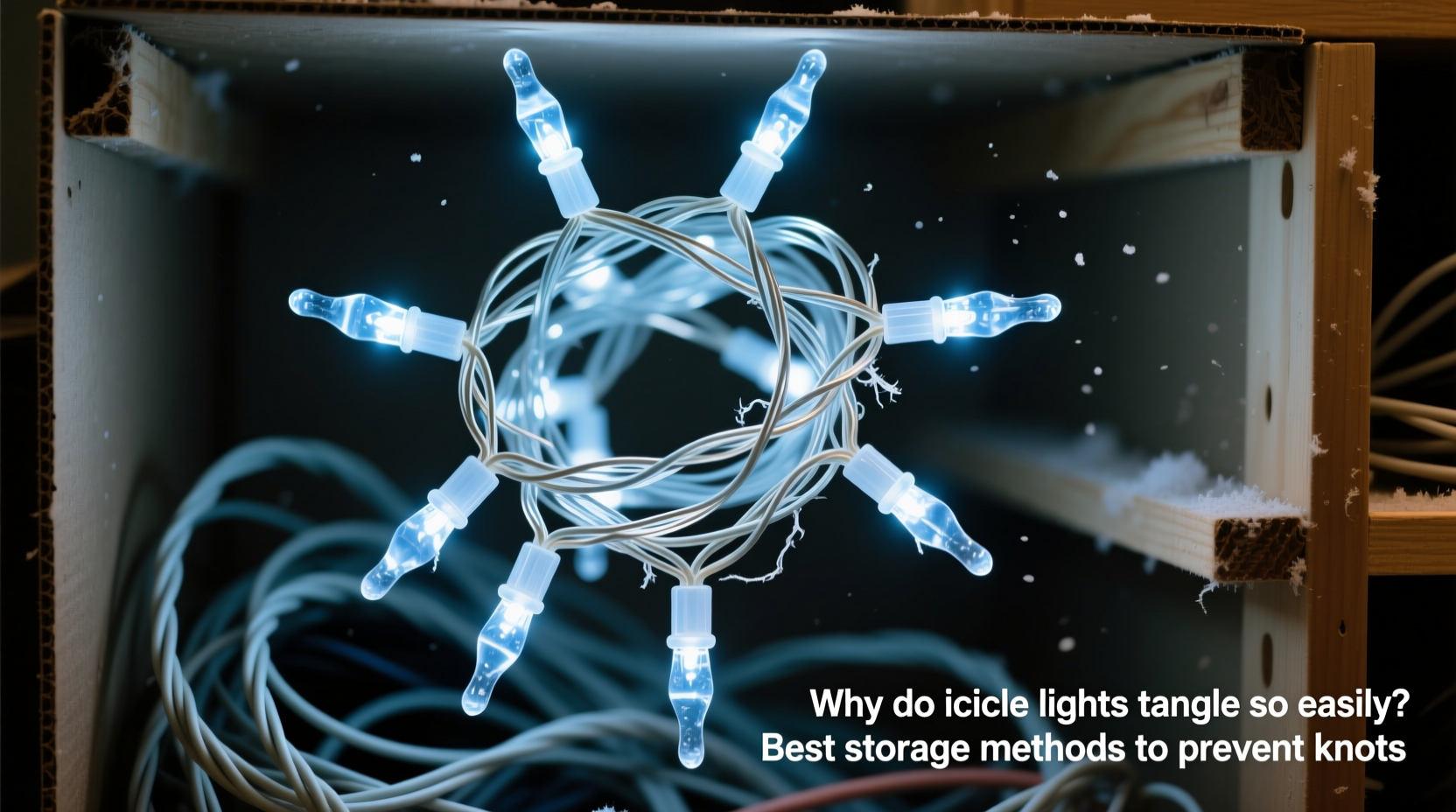
Icicle lights are uniquely prone to tangling due to their structure. Unlike standard string lights, which have evenly spaced bulbs on a single line, icicle lights feature multiple drop lines—shorter strands hanging at intervals along a main wire. This creates a complex topology with numerous crossing points, increasing the likelihood of loops catching and twisting around each other.
When stored loosely, even minor movement can initiate knot formation. Researchers at UC San Diego who studied spontaneous knotting in strings found that the probability of knotting increases with length, flexibility, and agitation. Icicle lights check all three boxes: they’re long (often 25–100 feet), made from pliable copper wiring, and frequently jostled when stuffed into bins or boxes.
Additionally, the weight distribution plays a role. The lower ends of the “icicles” act like tiny pendulums. As the lights shift during storage, these weighted tips swing and wrap around adjacent strands, creating snarls that tighten over time.
“Any system with multiple intersecting flexible elements is inherently unstable when unsecured. Icicle lights are a textbook example of high-tangle risk design.” — Dr. Alan Prescott, Materials Physicist, University of Colorado Boulder
Best Storage Methods to Prevent Knots
Preventing tangles isn’t about luck—it’s about method. The key is minimizing movement, eliminating loose loops, and maintaining consistent alignment between strands. Below are proven techniques used by professional decorators and electricians.
1. Use the Spool-and-Secure Method
This technique involves wrapping the lights around a rigid object to maintain tension and order.
- Select a flat, non-abrasive spool such as a piece of cardboard, plastic reel, or purpose-built light winder.
- Start at the plug end and hold it securely against the spool.
- Wrap the main wire tightly and evenly, ensuring each loop lies flat without overlapping.
- As you reach each icicle drop, gently fold it back toward the main strand and tuck it slightly under the previous wrap to keep it aligned.
- Once fully wrapped, use twist ties, Velcro straps, or reusable zip clips to secure the bundle at two or three points.
2. The Paper Towel Roll Hack
A low-cost, accessible solution uses empty paper towel or toilet paper rolls.
- Cut slits at one end of the roll to feed the plug through and anchor it.
- Thread each icicle strand through the center of the roll, letting the drops hang inside.
- Wind the main wire around the outside of the roll in a spiral pattern.
- Store upright in a bin to prevent crushing.
This method keeps drops separated and prevents lateral movement. It’s especially effective for shorter sets (under 30 feet).
3. Invest in LightGuardian Reels or Plastic Storage Reels
Commercial-grade reels designed specifically for holiday lights offer durability and organization.
| Feature | Cardboard Spool | Plastic Reel | LightGuardian System |
|---|---|---|---|
| Durability | Poor (crushes easily) | Good | Excellent (weather-resistant) |
| Drop Protection | Moderate (with tucking) | High (slots guide strands) | Maximum (individual channels) |
| Cost | $ (DIY) | $$ | $$$ |
| Storage Space | Compact | Moderate | Bulkier but stackable |
While more expensive, dedicated reels pay off over time by reducing damage and saving hours of untangling.
Step-by-Step Guide: How to Store Icicle Lights Without Tangling
Follow this detailed process after removing lights from display:
- Inspect and Test: Plug in the lights before storing to identify burnt-out bulbs or frayed wires. Replace or repair as needed.
- Clean Gently: Wipe down the wires and bulbs with a dry microfiber cloth. If outdoors, remove dust and bird residue with a damp cloth and let dry completely.
- Choose Your Storage Tool: Decide whether to use a spool, reel, or cardboard tube based on length and budget.
- Anchor the Plug: Secure the male plug end to prevent slippage during winding.
- Wind with Control: Wrap slowly and deliberately. Keep tension consistent—too loose invites slack; too tight risks wire fatigue.
- Manage Drops: Fold each icicle section neatly back toward the main line, avoiding crisscrossing.
- Secure and Label: Fasten the bundle and tag it with details like location used (“Front Porch”), color, and wattage.
- Store Upright in Dry Area: Place in a climate-controlled space away from rodents, moisture, and extreme temperatures.
Common Mistakes That Lead to Tangles
Even well-intentioned efforts can go wrong. These common errors sabotage storage efforts:
- Stuffing lights into bins: Loose tossing allows free movement, promoting knot formation.
- Ignoring drop alignment: Letting icicles dangle freely during winding leads to interlacing.
- Using twist ties too tightly: Metal ties or over-tightened plastic ones can cut into insulation.
- Storing in attics or garages: Temperature swings and humidity degrade wires and attract pests.
- Not labeling sets: Next year, you’ll waste time testing mismatched strands.
“We had a client spend eight hours untangling 200 feet of premium LED icicle lights. All because they were thrown into a trash bag with garden tools. A $10 reel would’ve saved them a weekend.” — Mark Delaney, Holiday Lighting Consultant, BrightPath Designs
Mini Case Study: From Chaos to Order in One Season
Sarah Thompson, a homeowner in Portland, Oregon, had decorated her two-story home with 300 feet of dual-row icicle lights for five consecutive years. Each November, she faced a daunting ritual: spreading lights across her garage floor, cutting knots with scissors, and replacing damaged sections.
In 2023, she invested in four plastic light reels and followed the step-by-step winding method. She also labeled each set by installation zone (eaves, balcony, staircase). When she retrieved them in November 2024, every strand was ready to hang—no tangles, no repairs.
Her setup time dropped from 14 hours to under 4. More importantly, she noticed fewer bulb failures, likely due to reduced stress on solder joints during storage.
Checklist: Year-End Icicle Light Storage Routine
Use this checklist annually to ensure proper care:
- ✅ Test all strands for functionality
- ✅ Replace burned-out bulbs or fuses
- ✅ Clean lights with a dry or slightly damp cloth
- ✅ Allow lights to air-dry completely
- ✅ Choose appropriate storage reel or spool
- ✅ Wind main wire with consistent tension
- ✅ Align and secure icicle drops during winding
- ✅ Fasten bundle with soft ties (Velcro or fabric)
- ✅ Label each set clearly
- ✅ Store in a cool, dry, rodent-free area
Frequently Asked Questions
Can I use regular tape to secure wrapped lights?
Avoid standard adhesive tapes. They lose stickiness over time and leave residue that attracts dirt. Instead, use reusable fasteners like Velcro straps or fabric ties that won’t damage the insulation.
Is it safe to store lights in vacuum-sealed bags?
No. Compressing lights can deform sockets, crush bulbs, and weaken internal wiring. Plus, if moisture is present, sealing it in promotes mold and corrosion. Always allow some airflow and avoid compression.
How long do icicle lights last with proper storage?
With careful handling and correct storage, LED icicle lights can last 7–10 seasons or more. Incandescent versions typically last 3–5 years. Proper storage reduces physical stress, which is a leading cause of premature failure.
Conclusion: Turn Frustration into Efficiency
Tangled icicle lights don’t have to be an annual inevitability. By understanding why they tangle—complex design, flexible materials, and improper storage—you gain the power to change the outcome. Simple tools like reels, cardboard spools, or even repurposed tubes can make a dramatic difference. Pair those with disciplined winding techniques, and you’ll save time, reduce waste, and protect your investment.
Next time you take down your holiday display, resist the urge to toss the lights in a box. Spend those extra ten minutes doing it right. Your future self—standing on a ladder in December, trying to beat the darkening sky—will thank you.




 浙公网安备
33010002000092号
浙公网安备
33010002000092号 浙B2-20120091-4
Comments
No comments yet. Why don't you start the discussion?