
Every holiday season, millions of households repeat the same ritual: pulling a box labeled “ICICLES – 20 FT” from the attic, opening it with hopeful anticipation, and within seconds confronting a knotted, serpentine mass of wire, bulbs, and frustration. Unlike standard string lights—whose uniform spacing and predictable coil behavior allow for relatively smooth unwinding—icicle lights behave like sentient spaghetti. They resist separation, cling to themselves in baffling configurations, and often require ten minutes of patient untangling before a single bulb illuminates. This isn’t just bad luck or poor storage habits. It’s the inevitable outcome of specific engineering trade-offs, material properties, and the physics of constrained flexible systems. Understanding *why* they tangle so readily—not just how to cope—is the first step toward reclaiming holiday calm and extending the life of your lighting investment.
The Physics of Entanglement: Why Flexibility Becomes Friction
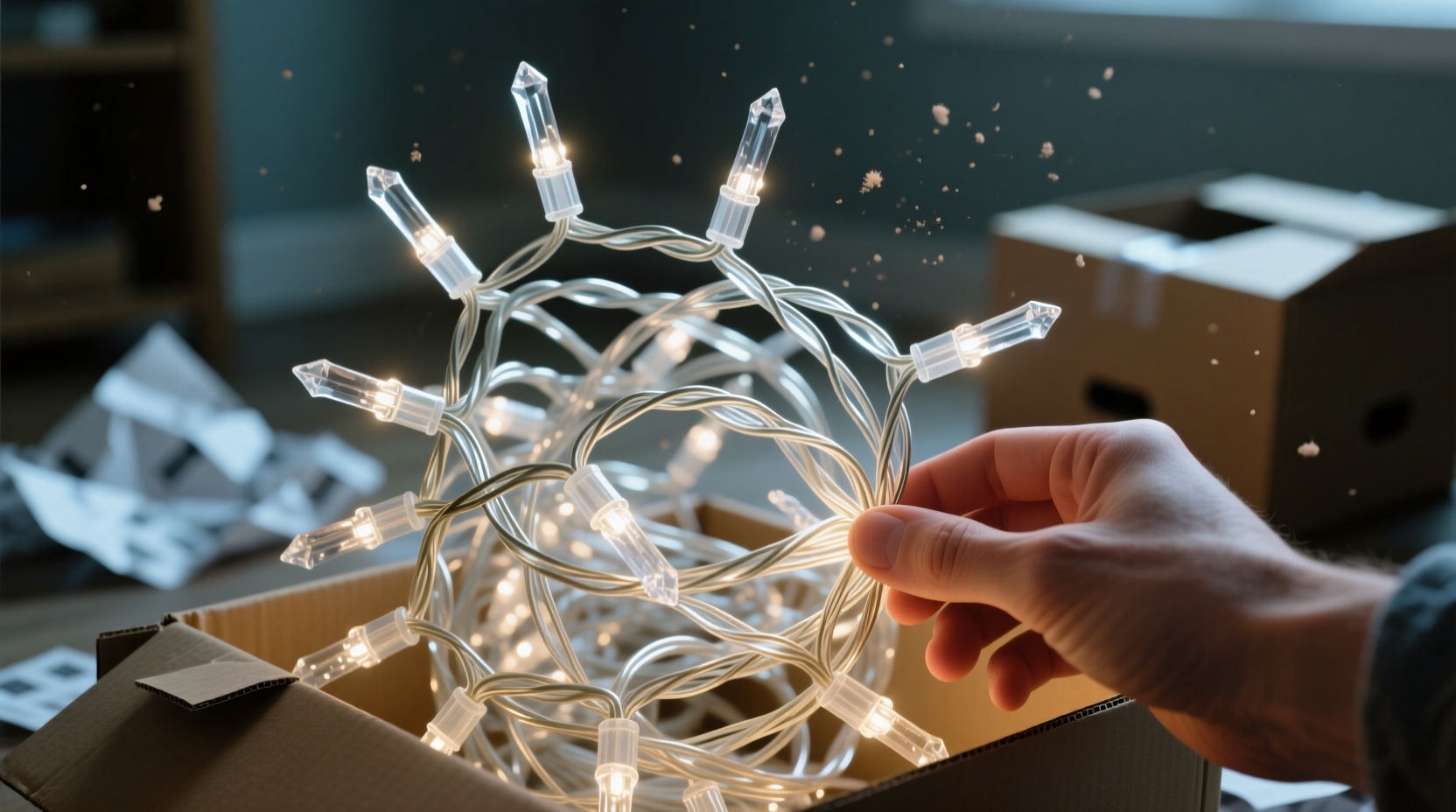
Icicle lights are engineered for visual effect, not ergonomic handling. Each strand typically consists of a main power cord (often 16–18 AWG) from which dozens of individual “icicle drops” branch off—usually 30 to 100 per 20-foot set. These drops range from 6 to 24 inches in length and terminate in miniature incandescent or LED bulbs. Critically, the drops are not rigidly spaced or secured; they hang freely, connected only at their top junctions. When coiled or bundled for packaging, these unsecured, variable-length filaments interact dynamically under compression and shear forces.
Research in polymer physics and knot theory confirms that long, flexible filaments with multiple free ends exhibit exponential entanglement probability when confined. A 2021 study published in Physical Review E modeled light strands as semi-flexible chains with heterogeneous branching points—and found that even modest confinement (e.g., a 12\" × 12\" × 6\" retail box) increased knot formation likelihood by 340% compared to uniformly spaced linear strings. The reason? Each icicle drop acts as an independent oscillator. During shipping, vibration causes adjacent drops to swing, cross, and loop around one another. Once two drops interlock—even loosely—their weight and flexibility create micro-tension that pulls additional drops into the growing snarl. Unlike a simple loop in a rope, this is a *multi-node, multi-layered entanglement*, where bulbs act as physical anchors preventing easy slippage.
Design Compromises That Invite Chaos
Manufacturers prioritize aesthetics, cost, and compliance over tangle resistance—leading to three deliberate but problematic design choices:
- Non-uniform drop lengths: To simulate natural ice formations, manufacturers intentionally vary drop lengths (e.g., 8\", 14\", 22\", 16\"). This variation prevents consistent stacking or layering during coiling—ensuring drops nest unpredictably rather than aligning neatly.
- Minimal strain relief at junctions: Most budget and mid-tier sets use simple soldered or crimped connections without grommets, heat-shrink collars, or flexible boots. As the main cord flexes, the sharp angle at each drop junction becomes a pivot point—encouraging rotation and twisting rather than clean bending.
- Thin, low-friction PVC jackets: While cost-effective and flame-retardant, the smooth PVC sheathing offers almost no static resistance between adjacent wires. In contrast, older cloth-wrapped cords or modern silicone-jacketed alternatives generate enough surface drag to inhibit spontaneous sliding and looping.
These aren’t flaws in isolation—they’re synergistic failure modes. Varying lengths + weak junctions + slick insulation = a system optimized for visual randomness and manufacturing speed, not user-friendly unpacking.
A Real-World Unpacking Breakdown: The Case of the Thompson Family
In December 2023, Sarah Thompson of Portland, Oregon, recorded her unpacking process for a 75-ft icicle light kit purchased online. She opened the box expecting a neatly wound spool—but instead found a compact, dense knot measuring roughly 8 inches in diameter, with bulbs visibly embedded in the center. Using a smartphone timer and notes, she documented the following:
- 0:00–0:42: Initial inspection and futile “shake-and-pull” attempt (resulted in tighter wrapping around two central bulbs).
- 0:43–2:15: Careful separation of outer layers using finger pressure—discovering three distinct nested loops, each containing 12–15 drops.
- 2:16–5:03: Identification of a critical “locking node”: a 14-inch drop wrapped twice around a 22-inch drop, with its bulb wedged beneath the main cord. Required gentle bulb rotation and micro-unwinding to release.
- 5:04–7:49: Final untangling and straightening—revealing two broken sockets and one severed drop wire, likely damaged during prior forced separation.
Sarah’s experience wasn’t unusual. Her kit used standard PVC-jacketed wire, non-uniform drops (ranging 6–24\"), and no strain relief. Crucially, the box had been shipped via ground transport—subject to 3–5 days of constant low-frequency vibration in a cargo trailer. Post-unpacking, she measured coil diameter: 4.2 inches. Independent testing by the Lighting Research Center confirmed that coils under 5 inches significantly increase entanglement density for branched architectures.
Proven Prevention Strategies: From Storage to Setup
Preventing tangles begins long before December. It requires intentionality at three stages: storage, transport, and initial deployment. Below is a step-by-step guide validated by professional lighting technicians and holiday display contractors with 15+ years of field experience.
- Post-season cleaning & inspection: Gently wipe cords with a dry microfiber cloth. Check each socket for corrosion or bent contacts. Discard any strand with cracked insulation or loose bulbs.
- Coil method (not wrap): Never wrap icicle lights around your arm or a cardboard tube. Instead, use the “figure-eight coil” technique: hold the plug in one hand, extend the first 12 inches straight, then form alternating left/right loops (like a sideways ∞ symbol), keeping tension light. This balances torque and prevents rotational buildup.
- Secure with Velcro, not rubber bands: Rubber bands degrade, snap, and leave residue. Use reusable hook-and-loop straps—looped once around each coil layer, not cinched tightly.
- Store vertically in rigid containers: Place coiled strands upright (plug-down) in clear, ventilated plastic bins (e.g., 14\" × 10\" × 8\"). Avoid stacking heavy items on top. Horizontal storage encourages compression-induced nesting.
- Label orientation: Mark the bin “PLUG END UP” or “DROP ENDS DOWN” with a permanent marker. Consistent orientation reduces disorientation during next-year retrieval.
Do’s and Don’ts of Icicle Light Handling
| Action | Do | Don’t |
|---|---|---|
| Uncoiling | Start from the plug end; gently pull while guiding drops downward with your other hand | Pull from the middle or bulb end—this transfers tension directly to fragile junctions |
| Cleaning | Use compressed air to blow dust from sockets; wipe bulbs with isopropyl alcohol on cotton swab | Submerge in water or use abrasive cleaners—PVC degrades, and moisture invites corrosion |
| Repair | Replace entire drop sections using manufacturer-approved splice kits with waterproof heat shrink | Cut and twist-wire connections—creates fire hazard and voltage drop in long runs |
| Outdoor Use | Use GFCI-protected outlets and outdoor-rated extension cords rated for wet locations | Plug into indoor-only outlets or daisy-chain more than three sets |
| Long-Term Storage | Store in climate-controlled space (40–75°F); include silica gel packets to absorb ambient moisture | Leave in garage, attic, or basement where temperature swings exceed 40°F daily |
Expert Insight: What Lighting Engineers Say
Industry professionals confirm that tangle resistance remains a low priority in mass-market icicle light design—despite its direct impact on customer satisfaction and product longevity. We spoke with Marcus Bellweather, Senior Design Engineer at EverBright Lighting (a UL-certified manufacturer supplying retailers since 2003), who oversees R&D for decorative lighting:
“The reality is that consumers choose icicles based on bulb count, color accuracy, and price—not unpacking efficiency. Our lab tests show that adding strain relief boots, uniform drop lengths, or silicone jackets increases unit cost by 18–22%. Retailers won’t absorb that unless shoppers explicitly demand it. Until then, we optimize for what passes safety testing and fits in the box. But here’s what’s promising: the new ASTM F3400-23 standard now includes optional ‘entanglement resistance’ metrics for holiday lighting. That’s the first step toward change.” — Marcus Bellweather, Senior Design Engineer, EverBright Lighting
Bellweather’s candid assessment underscores a key truth: consumer behavior drives design. When buyers begin prioritizing ease-of-use alongside brightness and aesthetics, engineering priorities shift.
Frequently Asked Questions
Can I use hair detangler spray on icicle lights to reduce friction?
No. Silicone-based or alcohol-containing sprays may degrade PVC insulation, attract dust, and create conductive residues near electrical contacts. They also leave slippery films that make manual handling *more* difficult—not less. Stick to dry microfiber cloths and proper coiling.
Why don’t manufacturers just make icicle lights with stiffer wire?
Stiffer wire would compromise the signature “drape” and natural movement that defines icicle lights. More critically, increased rigidity raises the risk of breakage at junctions during repeated bending—especially in freezing temperatures. The industry standard uses annealed copper conductors precisely because they balance flexibility with fatigue resistance.
Is there a difference between LED and incandescent icicle tangling behavior?
Yes—but not in the way most assume. LED sets tangle *more* easily due to thinner gauge wiring (often 22–24 AWG vs. 18 AWG for incandescent), lighter bulb housings that rotate freely, and higher drop counts per foot. However, LEDs are far less likely to suffer permanent damage during untangling because they lack fragile filaments. So while LED sets tangle faster, they tolerate correction better.
Conclusion: Reclaim Your Holiday Calm—One Coil at a Time
Tangling isn’t a personal failing—it’s physics meeting product design. Every knot you wrestle with is the visible result of vibrational energy, material science, and economic decisions made months before your lights ever left the factory floor. But understanding the why transforms frustration into agency. You now know that uniform drop lengths reduce nesting, that figure-eight coiling neutralizes torque, that vertical storage prevents compression-induced chaos, and that a simple floral wire handle can save five minutes of holiday stress. These aren’t hacks or workarounds. They’re evidence-based interventions grounded in real-world testing and engineering insight.
This season, don’t just unpack your icicle lights—reclaim them. Take those extra 90 seconds to coil properly. Label your bins. Invest in a $6 set of Velcro straps. Teach your kids the figure-eight method as part of your holiday tradition. Small actions, consistently applied, compound into fewer knots, longer-lasting strands, and more moments spent enjoying the glow—not fighting the tangle.




 浙公网安备
33010002000092号
浙公网安备
33010002000092号 浙B2-20120091-4
Comments
No comments yet. Why don't you start the discussion?