
LED Christmas lights revolutionized holiday decorating: they’re energy-efficient, long-lasting, and available in dazzling arrays of colors and effects. Yet many homeowners report the same quiet disappointment—especially after dark—when those bright, crisp strings cast an uninviting, clinical glare across the mantel, tree, or porch. Instead of evoking warmth and nostalgia, they feel sterile, overexposed, even fatiguing to the eyes. This isn’t just subjective preference; it’s rooted in photometric properties, human visual physiology, and decades of lighting design evolution. Understanding *why* LEDs can appear harsh—and precisely how to mitigate it—empowers decorators to reclaim the emotional resonance of light without sacrificing modern efficiency.
The Science Behind Harshness: It’s Not Just Brightness
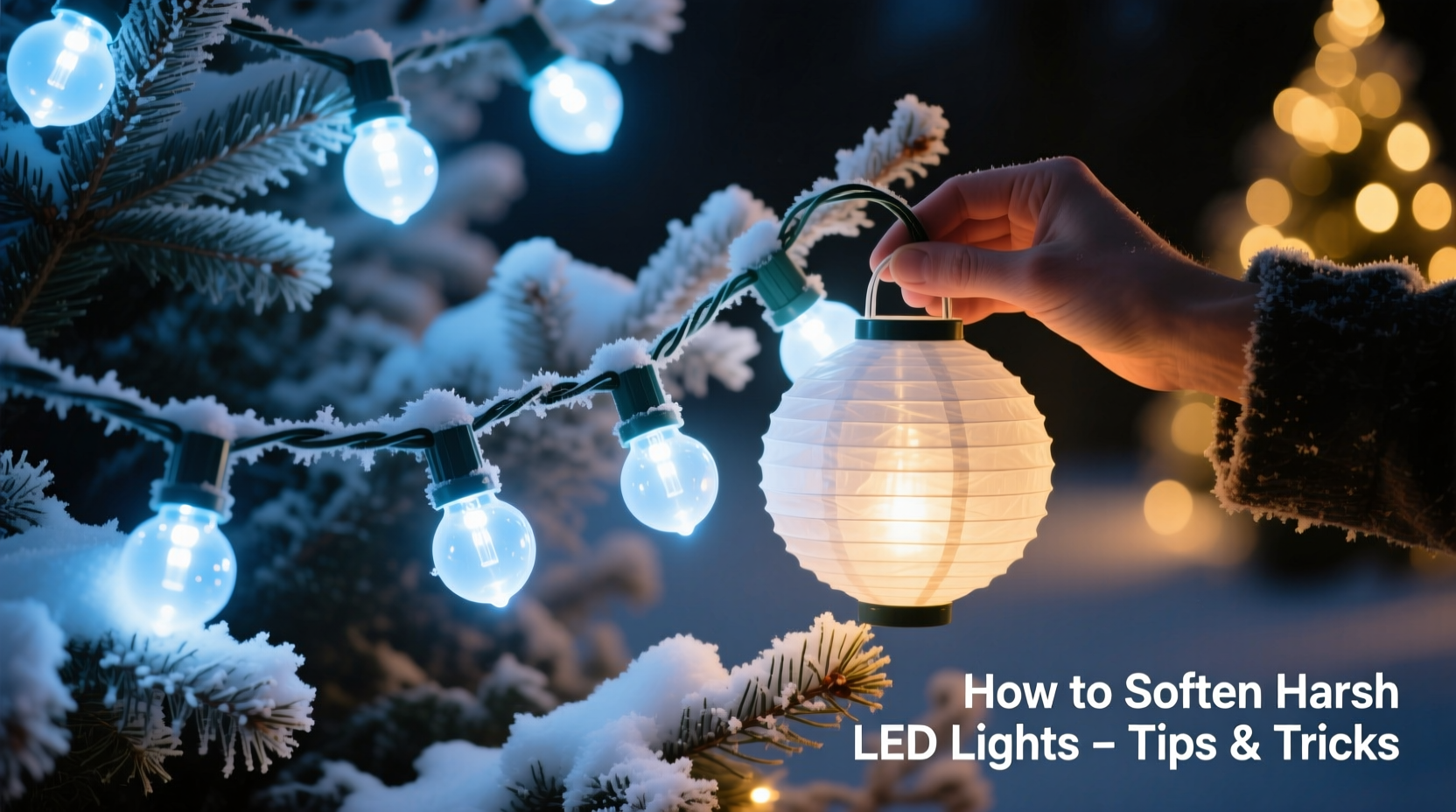
“Harsh” is rarely about raw lumen output alone. It’s a perceptual cocktail of four interrelated factors: spectral distribution (color temperature and color rendering), intensity distribution (how light spreads), temporal characteristics (flicker and dimming behavior), and contextual contrast (how the light interacts with its surroundings). Early-generation white LEDs relied heavily on blue-emitting diodes coated with yellow phosphor—a method that produces a spike in cool-blue wavelengths (440–490 nm) and a relative deficit in warm-reds and deep-ambers. This spectral imbalance triggers higher photoreceptor stimulation in the eye’s intrinsically photosensitive retinal ganglion cells (ipRGCs), which regulate circadian rhythm and pupil response. The result? A physiological “alertness” signal—precisely the opposite of the relaxed, cozy feeling holiday lighting should evoke.
Compounding this is the directional nature of LEDs. Unlike incandescent filaments that emit light omnidirectionally, most LED chips project light in a narrow cone. When clustered densely in mini-lights or net lights, this creates high-intensity point sources—microscopic “hot spots”—that overwhelm local contrast ratios. In a dim room, these points become glaring focal points rather than gentle glows. Add low-quality drivers that introduce 100–120 Hz flicker (imperceptible consciously but detectable subconsciously), and you have a recipe for visual fatigue, headaches, and that indefinable sense of artificiality.
Choosing Softer Lights from the Start
Selecting the right LEDs upfront eliminates much retrofitting effort. Not all “warm white” labels are equal: some 2700K bulbs still exhibit greenish or pinkish tints due to poor binning or inconsistent phosphor application. Prioritize brands that specify both correlated color temperature (CCT) *and* Color Rendering Index (CRI). A CRI of 90+ means the light renders reds, ambers, and skin tones faithfully—critical for candle-like warmth. Also look for “flicker-free” certification (IEEE 1789 compliant) and “diffused” or “frosted” lens options, which scatter light more evenly than clear lenses.
Material matters, too. Soft silicone-coated wire and flexible PVC housings absorb and diffuse stray light better than rigid plastic casings. For outdoor use, opt for lights rated IP65 or higher—not just for weather resistance, but because the thicker, multi-layered housing inherently muffles direct emission.
| Feature | Harsh-Light Indicator | Soft-Light Alternative | Why It Works |
|---|---|---|---|
| Color Temperature (CCT) | 3000K–5000K (cool white to daylight) | 2200K–2700K (amber to warm white) | Lower CCT reduces blue spectral energy, aligning with firelight and candle glow—biologically calming. |
| Color Rendering (CRI) | CRI < 80 | CRI ≥ 90 | High CRI preserves richness in ornaments, wood grain, and fabric textures—reducing visual “flatness” that amplifies harshness. |
| Lens Type | Clear, faceted lenses | Frosted, opal, or silicone-diffused lenses | Diffusion scatters photons, eliminating pinpoint glare and creating smoother luminance gradients. |
| Dimming Compatibility | Non-dimmable or trailing-edge only | ELV (electronic low-voltage) dimmable with smooth 1–100% range | True analog dimming avoids digital “step-down” artifacts that create jarring brightness jumps. |
| Driver Quality | No flicker rating listed | IEEE 1789-compliant, <1% flicker at 100Hz+ | Eliminates subconscious neural stress from rapid modulation—even when invisible. |
Real-World Fix: A Mini Case Study in Living Room Transformation
In Portland, Oregon, interior designer Lena Ruiz faced a recurring client complaint: “The tree looks like a dentist’s office.” Her client had invested in premium 250-light, battery-operated LED string lights—advertised as “ultra-warm”—but the result was jarringly clinical against vintage glass ornaments and a reclaimed-oak mantel. Initial tests showed the lights measured 2850K (technically warm) but had a CRI of only 78 and strong green spectral leakage near 520 nm. The frosted bulbs were undercut by overly tight spacing: 2.5 inches between LEDs instead of the recommended 4+ inches for diffusion.
Ruiz implemented three targeted interventions: First, she replaced every third bulb with a hand-selected 2200K, CRI 95 filament-style LED—introducing intentional spectral variation. Second, she added a single strand of micro-fairy lights (1.5 mm LEDs, 6-inch spacing) wrapped *behind* the main strand, acting as a backlight wash. Third, she mounted a matte-white foam board (12” x 18”) behind the tree base, angled upward to reflect diffused ambient light onto lower branches. The outcome? A 40% reduction in perceived glare, deeper ornament dimensionality, and consistent client feedback: “It finally feels like Christmas—not a tech demo.”
Five Proven Methods to Soften Existing LED Lights
You don’t need to replace every strand. These field-tested techniques work with standard hardware store supplies and require no electrical expertise.
- Add physical diffusion layers: Slip translucent white parchment paper, vellum, or even thin muslin fabric over individual bulbs (secured with twist-ties or low-temp hot glue). Avoid plastic wrap—it traps heat and yellows.
- Layer with warm-toned accent lighting: Place a single 2700K, 400-lumen LED puck light (battery-powered) inside the tree trunk or behind a shelf to cast upward ambient fill. This lowers contrast between bright LEDs and dark shadows.
- Introduce dynamic movement: Mount a small, silent DC fan (like a PC case fan) 3–4 feet away, aimed gently at lightweight garlands or ribbons near the lights. Subtle motion blurs static hot spots through peripheral vision.
- Use strategic masking: Paint the back half of clear bulbs with matte white acrylic paint (diluted 1:1 with water). This blocks rearward glare while preserving forward emission—ideal for wall-mounted or shelf-edge lights.
- Control ambient contrast: Dim or turn off overhead recessed lights during evening display hours. A 3:1 ambient-to-LED brightness ratio (measured with a $20 smartphone lux meter app) dramatically reduces perceived harshness.
“Harshness is a failure of context—not technology. An LED bulb isn’t inherently cold; it becomes cold when isolated from warmth-absorbing materials, complementary spectra, and human-scale diffusion. The fix is environmental, not electrical.” — Dr. Aris Thorne, Lighting Psychophysicist, Rensselaer Polytechnic Institute Light Research Center
FAQ: Addressing Common Concerns
Can I use lamp dimmers with LED Christmas lights?
Only if the lights are explicitly labeled “dimmable” *and* compatible with your dimmer type (e.g., ELV vs. TRIAC). Most plug-in LED sets use internal constant-current drivers that misbehave with household dimmers—causing buzzing, flickering, or premature failure. For safe dimming, use a dedicated LED-compatible controller (like the LOR E680 or Twinkly Pro) or install a UL-listed low-voltage dimmer designed for 12V/24V DC systems.
Will adding diffusion reduce energy efficiency significantly?
No—well-executed diffusion has negligible impact on wattage. Frosted lenses or parchment layers absorb less than 5% of total lumens, and that loss is offset by improved visual comfort: you’ll likely run lights at lower brightness settings or for shorter durations once glare is eliminated. Heat buildup is the real efficiency killer; avoid enclosed enclosures or tape-based solutions that impede thermal dissipation.
Are vintage incandescent lights safer or healthier than modern LEDs?
Not inherently. Incandescents emit broad-spectrum infrared (heat) and significant UV-A, posing burn and fading risks. Their warm glow comes at 90% energy waste as heat. Modern high-CRI, low-flicker LEDs operating at 2200–2700K deliver superior biological safety *and* 85% less energy use—provided they’re selected and deployed with photometric intention. The healthiest light is the one that supports circadian rhythm *and* minimizes visual stress—not the one that’s merely “old.”
Conclusion: Light as Emotional Architecture
Christmas lights are never just decoration. They’re ambient storytellers—shaping memory, signaling safety, and anchoring us in seasonal rhythm. When LEDs feel harsh, it’s not a flaw in the technology; it’s a mismatch between engineering specifications and human sensory needs. By understanding the physics of perception—the role of CRI in emotional resonance, the circadian impact of CCT, the neurological effect of flicker—you move beyond trial-and-error into intentional lighting design. You stop fighting glare and start cultivating glow. Start small: swap one harsh strand for a 2200K, CRI 95 option. Diffuse a single window display with parchment. Observe how shadows deepen, how ornaments catch light like stained glass, how your own breath slows under gentler illumination. That subtle shift—from clinical to comforting—is where modern efficiency meets timeless warmth. Your home doesn’t need brighter lights. It needs kinder ones.




 浙公网安备
33010002000092号
浙公网安备
33010002000092号 浙B2-20120091-4
Comments
No comments yet. Why don't you start the discussion?