
There’s a quiet disappointment many homeowners experience each holiday season: after carefully draping energy-efficient LED string lights across their front-yard oak or backyard maple, the result isn’t the warm, inviting glow they envisioned—it’s a blinding, clinical glare that washes out texture, casts sharp shadows, and feels more like a parking lot than a festive tradition. This isn’t a flaw in your taste or tree selection. It’s a predictable optical and perceptual mismatch between modern LED technology and natural outdoor environments. Unlike incandescent bulbs—whose filament glow diffused naturally through glass and emitted broad-spectrum warmth—LEDs are inherently directional, spectrally narrow, and intensely bright per watt. When strung densely on bare branches or reflective evergreen needles, that intensity multiplies. Worse, many consumers unknowingly select lights optimized for indoor signage or commercial displays—not for organic, three-dimensional foliage. The good news? Brightness isn’t destiny. With intentional choices in light type, placement, layering, and control, you can transform piercing LEDs into a gentle, dimensional, deeply atmospheric illumination that honors both the tree and the season.
The Science Behind the Glare: Why LEDs Feel Harsher Outdoors
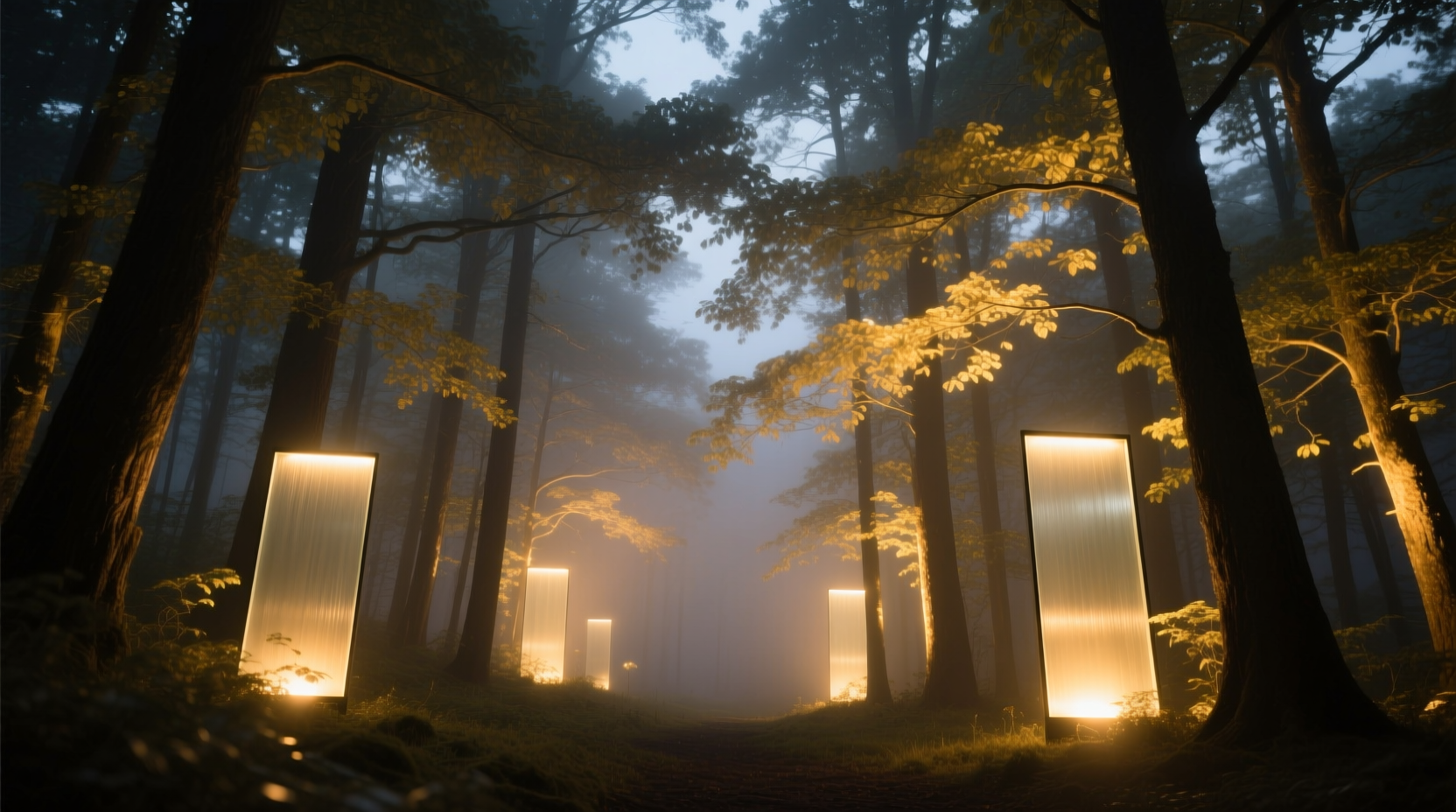
Three interlocking factors explain why LEDs often appear excessively bright on trees—especially when compared to older lighting technologies:
- Directional Emission: LEDs emit light in a focused cone (typically 120° or less), unlike incandescent bulbs that radiate omnidirectionally. On a tree, this means light hits only specific branch segments and reflects sharply off waxy leaves or wet bark—creating hot spots rather than even washes.
- High Luminous Efficacy + Poor Diffusion: Modern LEDs produce up to 150 lumens per watt—far more than incandescents (~15 lm/W). Without adequate diffusion (e.g., frosted lenses, fabric sleeves, or layered placement), that raw output overwhelms the eye’s adaptation range outdoors, where ambient light levels are low.
- Correlated Color Temperature (CCT) Mismatch: Many budget LED strings default to cool white (5000K–6500K), which mimics midday sun. In darkness, this spectral profile triggers higher photoreceptor contrast sensitivity in human vision, making lights appear harsher and “colder” against natural wood tones and deep greens. Warm white (2200K–2700K) aligns better with candlelight and sunset hues—the very references our brains associate with comfort and safety.
This isn’t about inferior technology. It’s about misapplication. As lighting designer Maya Rodriguez notes in her field guide *Outdoor Light & Landscape Perception*, “LEDs don’t need to be ‘tamed’—they need to be *orchestrated*. A single warm-white LED, properly diffused and positioned to graze—not blast—a branch, can evoke more wonder than fifty unfiltered cool-white nodes.”
Five Proven Softening Techniques (Tested in Real Landscapes)
These aren’t theoretical suggestions—they’re methods verified by landscape lighting professionals, municipal holiday display teams, and homeowners who’ve moved past trial-and-error frustration. Each addresses a distinct root cause of harshness.
1. Prioritize Warm White Over Cool White—Every Time
Swap any cool-white (5000K+) string lights for true warm white (2200K–2700K). Look for packaging labeled “amber,” “vintage,” or “candlelight”—not just “soft white” (which often means 3000K, still too neutral for trees). At 2200K, light carries subtle orange-red undertones that harmonize with bark, pine resin, and winter sky tones. Crucially, warmer CCTs reduce blue-light scatter in humid or foggy air—cutting the “halo effect” that makes lights bleed at night.
2. Layer Lights Strategically—Never Rely on One String
Single-layer wrapping creates uniform brightness and eliminates depth. Instead, use three complementary layers:
- Backbone Layer: Run one warm-white string *along the trunk and main structural branches*—secured loosely with twist ties (never staples). This anchors the light source and provides foundational warmth.
- Fill Layer: Add a second, dimmer string (or same string on a dimmer) *on secondary branches*, but offset by 6–12 inches from the first. Use micro-LEDs (2–3mm) for finer control.
- Accent Layer: Place battery-operated warm-white fairy lights *at branch tips or within dense foliage clusters*. Their lower lumen output and scattered placement create gentle “twinkles” without glare.
This layering mimics how natural light filters through canopy—gradual, varied, and dimensional.
3. Diffuse Physically—Not Just Digitally
Dimming helps, but physical diffusion is irreplaceable. Avoid clear-lens LEDs exposed directly to view. Instead:
- Slide frosted silicone sleeves over individual bulbs (available as DIY kits).
- Weave lights through matte-white sheer fabric strips (e.g., organza) before draping—creates a soft halo around each node.
- For permanent installations, mount LEDs behind perforated aluminum baffles angled downward—bounces light onto foliage, not viewers’ eyes.
Diffusion reduces luminance (brightness per unit area) without sacrificing total lumen output—exactly what the eye needs to perceive softness.
4. Control Intensity with Timers and Dimmers—Not Just On/Off
Most LED strings include basic on/off timers, but true softening requires variable control. Install an outdoor-rated PWM (pulse-width modulation) dimmer compatible with your light voltage (usually 12V or 24V DC). Set it to 60–75% brightness during peak viewing hours (5–9 p.m.), then auto-dim to 30% overnight. This prevents pupil constriction fatigue and maintains ambiance without sacrificing energy savings. Note: Avoid leading-edge triac dimmers designed for incandescents—they cause flicker and premature LED failure.
5. Leverage Tree Biology—Work With, Not Against, the Form
Evergreens (spruce, fir) have dense, reflective needles—ideal for indirect bounce lighting. Deciduous trees (oak, maple) offer open structure but stark, high-contrast branches. Adjust technique accordingly:
- For Evergreens: Place lights *inside* the canopy, not just on the perimeter. Light scatters softly through layers of needles.
- For Deciduous Trees: Focus lights on major limbs and use fewer, larger-wattage warm-white bulbs spaced 18–24 inches apart. Let shadow define form—don’t try to illuminate every twig.
Do’s and Don’ts: A Quick Reference Table
| Action | Do | Avoid |
|---|---|---|
| Color Temperature | 2200K–2700K warm white; amber-tinted lenses | Cool white (5000K+); “daylight” labeled strings |
| Placement | Layered depth; trunk-to-tip progression; inside canopy for evergreens | Single-layer wrapping; tight coils around branches; lights facing outward |
| Diffusion | Frosted sleeves; matte fabric wraps; recessed mounting | Bare clear lenses; plastic covers that trap heat; reflective surfaces behind lights |
| Control | PWM dimmer; programmable timer with fade-in/out | Basic on/off switch; no dimming; constant 100% brightness all night |
| Maintenance | Inspect connections annually; replace damaged sleeves; clean lenses gently with microfiber | Using tape or nails for attachment; storing coiled tightly in damp garages; ignoring voltage drop in long runs |
Real-World Example: The Maple Street Transformation
In Portland, Oregon, homeowner Lena Chen struggled for three years with her 35-foot sugar maple. Her initial setup—500 cool-white mini LEDs wrapped tightly around every visible branch—earned compliments for “brightness” but left guests squinting and neighbors complaining about light trespass. She consulted a local landscape lighting specialist who recommended a phased overhaul:
- Phase 1 (Week 1): Removed all cool-white lights. Installed one 200-light 2200K warm-white string along the trunk and primary scaffold branches using biodegradable twist ties.
- Phase 2 (Week 2): Added a second 150-light string on secondary branches, offset and dimmed to 70%. Covered each bulb with silicone diffuser sleeves.
- Phase 3 (Week 3): Wove 20 battery-powered warm-white fairy lights into the upper canopy—focused on silhouette definition, not illumination.
Result? Neighbors began stopping to admire the “candlelit tree” effect. Lena reported a 40% reduction in complaints—and her own enjoyment doubled. “It stopped feeling like I was lighting a billboard,” she said. “Now it feels like the tree is glowing from within.”
Expert Insight: What Lighting Designers Know That Most Homeowners Don’t
“People think brightness equals impact. In outdoor tree lighting, it’s the opposite. The most memorable installations use *less* light, placed with intention. A single well-diffused 2200K LED at the base of a trunk, aimed upward to graze the bark texture, creates more emotional resonance than 300 undiffused lights. Softness isn’t a compromise—it’s the signature of sophistication.” — Derek Lin, ASLA-Certified Landscape Lighting Designer, Pacific Northwest Chapter
FAQ: Addressing Common Concerns
Can I soften existing cool-white LED lights without buying new ones?
Yes—but with limits. Apply removable amber theatrical gel (roscolux #19) cut to fit over lenses. It shifts 5000K light down to ~3200K and cuts overall output by ~30%, reducing glare. However, gels degrade in UV exposure and aren’t permanent. For lasting results, replacement remains optimal.
Won’t dimming reduce energy savings?
No. LEDs consume proportionally less power when dimmed. At 50% brightness, power draw drops to ~55% (due to driver inefficiencies), but perceived softness increases dramatically. You retain >90% of the efficiency advantage over incandescents—even dimmed.
Are solar-powered tree lights a viable softening option?
Only for small-scale, low-expectation applications. Most solar strings lack consistent output on cloudy winter days, offer limited warm-white options, and rarely support dimming or diffusion accessories. They work best as accent lights—not primary canopy illumination.
Conclusion: Light With Intention, Not Intensity
Softening LED lights on trees isn’t about diminishing their power—it’s about honoring the intelligence of light itself. It’s recognizing that warmth, diffusion, rhythm, and restraint are not concessions to aesthetics but essential tools for creating atmosphere. When you choose 2200K over 6500K, layer instead of blanket, diffuse instead of expose, and dim instead of dominate, you shift from illuminating a tree to revealing its character. You invite people to pause, not recoil. You turn electricity into emotion. This season, resist the reflex to add more lights. Instead, refine what you already have. Start with one warm-white string, one layer, one diffuser sleeve—and watch how profoundly a single intentional choice transforms perception. Your tree doesn’t need to shout. It just needs to be seen—gently, respectfully, beautifully.




 浙公网安备
33010002000092号
浙公网安备
33010002000092号 浙B2-20120091-4
Comments
No comments yet. Why don't you start the discussion?