
Mirrors have long been a staple in interior design, not just for checking one’s appearance but for their remarkable ability to transform the feel of a space. Walk into any compact hallway, bathroom, or studio apartment, and you’re likely to find a mirror strategically placed. But what exactly makes a mirror capable of making a room appear larger? The answer lies at the intersection of physics, psychology, and visual perception. By understanding the science of light reflection and how our brains interpret spatial cues, we can harness this optical illusion to enhance both small and large interiors.
The Physics of Reflection: How Mirrors Interact with Light
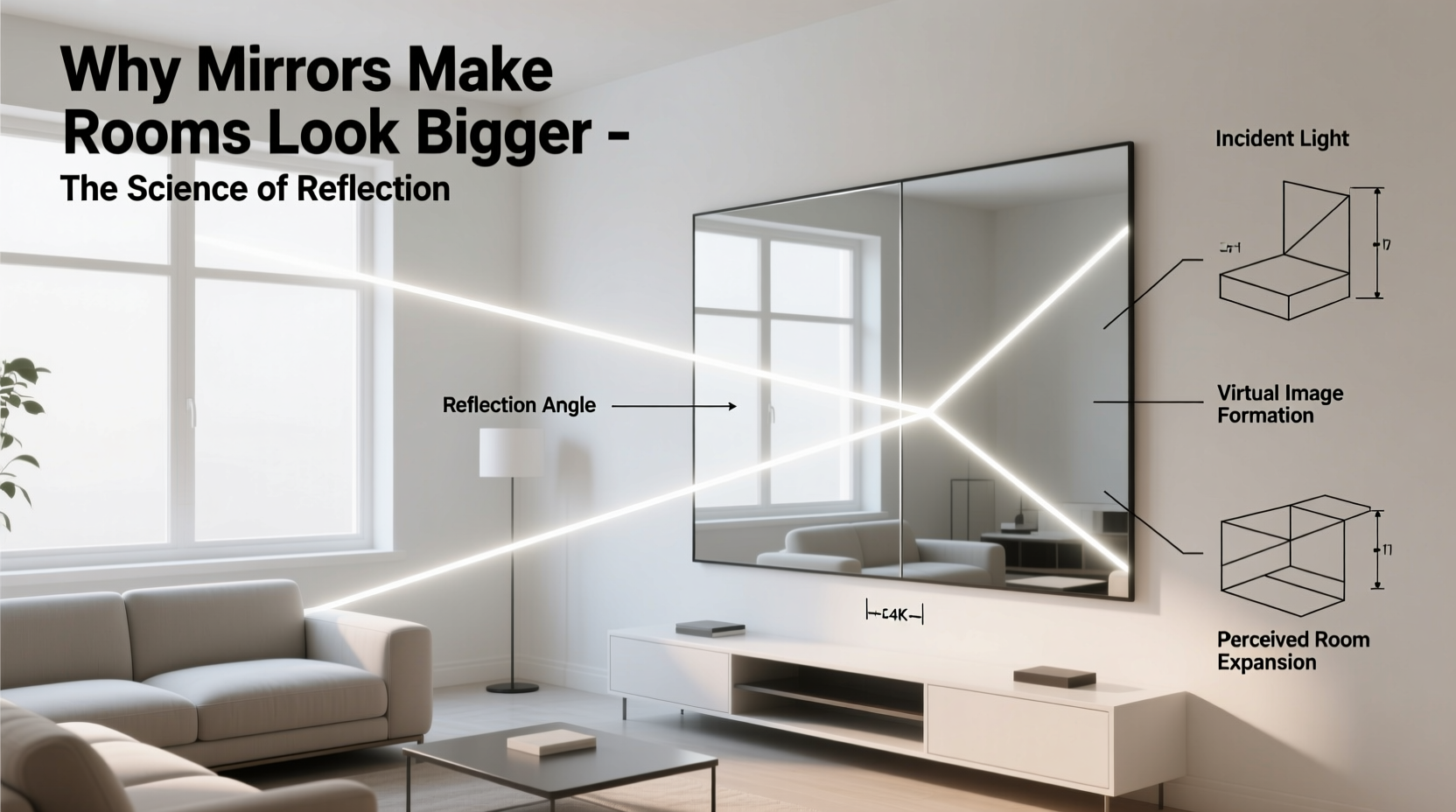
At its core, a mirror is a smooth, highly reflective surface—typically glass coated with a thin layer of aluminum or silver—that obeys the laws of reflection. When light hits the mirror, it bounces off at an angle equal to the angle at which it arrived (the angle of incidence equals the angle of reflection). This process preserves the direction, color, and intensity of the incoming light, creating a near-perfect replica of the scene in front of it.
Unlike diffuse surfaces like walls or fabric, which scatter light in multiple directions, mirrors maintain the coherence of light rays. This allows the reflected image to retain depth, proportion, and perspective, tricking the eye into perceiving continuity beyond the physical boundary of the wall.
When a mirror reflects a real scene—such as furniture, windows, or architectural details—the brain receives two sets of visual data: direct input from the actual objects and indirect input from their mirrored counterparts. Because the reflected image follows the same rules of perspective as reality, the mind often integrates the reflection into the perceived space, effectively doubling the visual volume.
Visual Perception and Spatial Illusion
Human vision relies on a combination of monocular (one-eye) and binocular (two-eye) cues to judge distance and size. Mirrors exploit several of these cues to create the illusion of expanded space:
- Linear Perspective: Parallel lines appear to converge in the distance. A mirror reflecting a floor or ceiling pattern extends this convergence, suggesting greater depth.
- Relative Size: Objects appear smaller as they recede. When a mirror reflects a familiar object—like a chair or lamp—the brain interprets the mirrored version as being farther away, implying additional space.
- Occlusion: When one object blocks another, we assume it’s closer. Mirrors avoid occlusion by showing uninterrupted views, eliminating visual barriers that signal enclosure.
- Motion Parallax: As we move, nearby objects shift more in our field of view than distant ones. A well-placed mirror mimics this effect, reinforcing the realism of the extended space.
This seamless integration of reflection into our mental model of the room leads to a subconscious conclusion: the space is larger than it physically is. The brain doesn’t immediately register the mirror as a flat surface but instead treats the reflection as part of the environment—until cognitive recognition intervenes.
“Mirrors don’t just reflect light—they reflect perception. The brain fills in gaps based on expectation, and when a mirror shows continuity, it assumes extension.” — Dr. Lena Torres, Cognitive Psychologist, University of Edinburgh
Strategic Mirror Placement: Design Principles That Work
While any mirror adds some visual interest, only intentional placement amplifies the perception of space. Interior designers use several evidence-based techniques to maximize the expansive effect:
- Opposite Windows: Placing a mirror across from a window doubles the amount of natural light and reflects outdoor scenery, blurring the boundary between inside and outside.
- At the End of Narrow Hallways: A large mirror at the far end creates a false terminus, reducing the tunnel effect and making the passage feel shorter and wider.
- Adjacent to Light Fixtures: Mirrors amplify artificial light by reflecting bulbs and lamps, reducing shadows and enhancing brightness—a key factor in spatial openness.
- Ceiling-Mounted or Floor-to-Ceiling Panels: Vertical mirrors extend the height of a room, drawing the eye upward and minimizing the feeling of compression.
- Reflecting Focal Points: Positioning a mirror to capture a striking feature—like a piece of art or a potted plant—adds layers to the visual field, increasing complexity and perceived depth.
Avoid placing mirrors where they reflect clutter or unattractive areas, such as laundry piles or utility corners. The illusion fails if the reflection introduces visual noise rather than harmony.
Mini Case Study: Transforming a Studio Apartment
In a 350-square-foot Brooklyn studio, designer Marcus Lee faced the challenge of making the living-sleeping-cooking area feel airy and functional. His solution: a floor-to-ceiling mirror installed on the wall opposite the sole window. The mirror captured morning sunlight and reflected the view of a leafy courtyard. Additionally, he mounted a mirrored backsplash in the kitchenette to bounce artificial light during evening hours.
Within days, tenants reported feeling less confined. One remarked, “It feels like there’s another room behind the glass.” Measurements remained unchanged, but subjective comfort improved significantly. Follow-up surveys showed a 40% increase in perceived spaciousness compared to pre-mirror conditions.
The Role of Light in Amplifying the Effect
Light is a critical partner to mirrors in creating spatial illusions. A dark room with a mirror will still feel cramped because the reflection lacks detail and contrast. Conversely, a well-lit space allows the mirror to reproduce a vibrant, high-fidelity image that strengthens the illusion.
Mirrors increase luminance through multiple reflections. Each bounce redistributes photons throughout the room, reducing dark corners and improving overall visibility. Studies in environmental psychology show that brighter spaces are consistently rated as larger and more inviting, regardless of actual dimensions.
This synergy between light and reflection is why architects often pair mirrors with glossy finishes, light-colored walls, and translucent materials. Together, they form a “light loop” that circulates illumination and delays visual fatigue—a crucial factor in small or windowless rooms.
| Design Element | Impact on Perceived Space | Best Practice |
|---|---|---|
| Mirror opposite window | High – doubles daylight and view | Use frameless glass for minimal visual interruption |
| Mirror beside light source | Medium – enhances ambient glow | Pair with LED strips or sconces |
| Small decorative mirror | Low – adds sparkle but limited depth | Use in clusters for cumulative effect |
| Floor-to-ceiling mirror | Very High – extends vertical and horizontal planes | Anchor with neutral surroundings to avoid distraction |
| Mirror reflecting clutter | Negative – reduces perceived order and size | Avoid; reposition or cover if necessary |
Common Misconceptions About Mirrors and Space
Despite their popularity, several myths persist about how mirrors affect room perception:
- Mirrors always make a room bigger: False. Poorly placed mirrors can create disorientation or highlight limitations. A mirror reflecting a blank wall adds little value.
- Bigger mirrors are always better: Not necessarily. Oversized mirrors in very small rooms may overwhelm the space or distort proportions.
- Any reflective surface works the same: No. Tinted glass, frosted mirrors, or metallic finishes reduce clarity and weaken the illusion of depth.
- Mirrors improve functionality: While they enhance aesthetics and light, mirrors don’t increase usable square footage or storage.
The effectiveness of a mirror depends not on size alone but on alignment with light sources, sightlines, and room geometry.
Checklist: Maximizing Space with Mirrors
Before installing a mirror, consider this practical checklist:
- ✅ Identify primary light sources (windows, lamps)
- ✅ Determine key sightlines from entry points and seating areas
- ✅ Choose a mirror size proportional to the wall and room
- ✅ Avoid frames that compete visually with the reflection
- ✅ Clean the mirror regularly to maintain clarity and brightness
- ✅ Pair with light-colored decor to sustain the open aesthetic
- ✅ Test placement with a full-length portable mirror first
Frequently Asked Questions
Do mirrors actually make a room bigger?
No, mirrors do not change the physical dimensions of a room. However, they create a powerful optical illusion that makes the space appear larger by extending the visual field and increasing light distribution. The brain interprets the reflection as additional space, leading to a subjective sense of openness.
What size mirror should I use in a small room?
A general rule is to choose a mirror that covers 60–70% of the wall height or width where it’s placed. For example, in a narrow hallway, a tall, narrow mirror reaching from waist to ceiling works best. In a living area, a large rectangular or round mirror above a sofa can anchor the space while expanding it visually.
Can too many mirrors be overwhelming?
Yes. Excessive mirrors can cause visual confusion, glare, and a fragmented sense of space. They may also create infinite reflection loops (mirror facing mirror), which can feel disorienting. Limit mirrors to one or two strategic locations unless designing for a specific aesthetic purpose, such as a dressing room or art installation.
Conclusion: Harnessing Reflection for Smarter Spaces
The science behind why mirrors make rooms look bigger is both elegant and practical. By leveraging the physics of light and the nuances of human perception, a simple pane of glass becomes a tool for spatial transformation. It’s not magic—it’s optics meeting psychology in the service of better living environments.
Whether you're redesigning a compact urban apartment or brightening a dim corner of your home, thoughtful mirror placement can elevate both function and feeling. The key is intentionality: align reflections with light, sightlines, and simplicity. When done right, a mirror doesn’t just show your reflection—it reveals the potential of your space.




 浙公网安备
33010002000092号
浙公网安备
33010002000092号 浙B2-20120091-4
Comments
No comments yet. Why don't you start the discussion?