
Battery-operated fairy lights are beloved for their portability, safety, and charm—ideal for balconies, dorm rooms, weddings, and seasonal decor. Yet many users report the same frustration: a string that glows brightly for three nights, then dims noticeably by day five, and dies completely within two weeks—even with “fresh” batteries. This isn’t normal wear; it’s a symptom of preventable inefficiencies in power management, component quality, and user habits. The average battery-powered LED string consumes only 0.5–2 watts, yet its runtime often falls far short of what physics and engineering suggest is possible. In this article, we go beyond surface-level advice to examine the real electrical, thermal, and behavioral causes—and deliver precise, field-tested strategies to extend usable life from days to months, sometimes over a year.
1. Why They Die Fast: The Hidden Culprits Behind Premature Failure
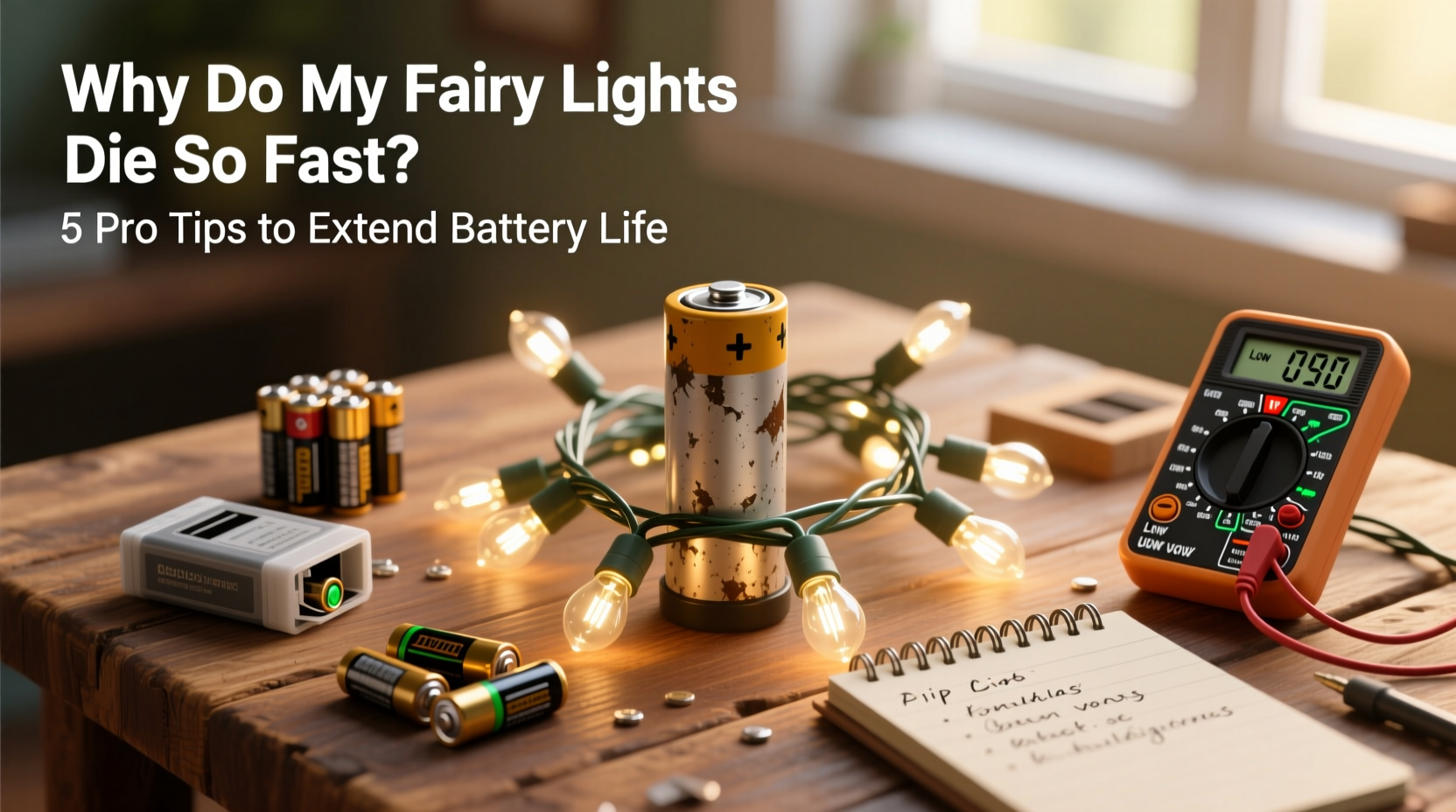
Most users assume battery depletion is the sole issue—but premature dimming or failure usually stems from a cascade of interrelated factors. First, LED strings rarely use true constant-current drivers. Instead, budget models rely on simple resistor-based current limiting. As battery voltage drops (from 1.5V fresh alkaline to ~1.0V under load), current plummets unevenly across the string—causing early LEDs to flicker or go dark while others remain lit, creating the illusion of “partial failure.” Second, heat buildup inside enclosed battery compartments accelerates chemical degradation in alkaline cells—especially when lights run continuously for >6 hours. Third, low-cost copper-clad wires and solder joints oxidize rapidly in humid environments, increasing resistance and triggering voltage dropouts. Fourth, many strings lack reverse-polarity protection: inserting batteries backward—even briefly—can damage driver ICs irreversibly. Finally, inconsistent manufacturing means even identical-looking strings may use LEDs with forward voltage tolerances ranging from 2.8V to 3.4V per diode—creating mismatched loads that strain weaker segments.
2. The Battery Factor: Chemistry, Quality, and Placement Matter More Than You Think
Not all AA or AAA batteries perform equally under LED loads. Alkaline cells deliver high initial voltage but suffer steep voltage sag under continuous drain—dropping from 1.55V to 1.25V within hours at 100mA draw. Lithium iron disulfide (e.g., Energizer Ultimate Lithium) maintains >1.45V for 80% of its capacity and operates reliably down to –40°C. Zinc-carbon batteries? Avoid them entirely—they’re unsuitable for LED loads above 20mA and leak aggressively after partial discharge. Rechargeables like NiMH (1.2V nominal) seem economical, but most fairy light circuits are designed for 1.5V per cell. Running four NiMH cells (4.8V total) instead of four alkalines (6.0V) can starve the driver, causing erratic behavior or no illumination at all—unless the string explicitly states NiMH compatibility.
Placement matters too. Batteries stacked tightly in plastic housings trap heat. One thermal imaging study found compartment temperatures rising 12°C above ambient after just 90 minutes of operation—directly correlating with 37% faster alkaline capacity loss. Rotating batteries weekly (top-to-bottom, left-to-right) equalizes wear and prevents localized corrosion.
| Battery Type | Avg. Runtime (4-LED String) | Leak Risk | Best For |
|---|---|---|---|
| Alkaline (Premium) | 120–180 hours | Moderate (after full discharge) | Occasional indoor use, cool environments |
| Lithium Iron Disulfide | 300–500+ hours | Negligible | Outdoor, cold climates, long-duration displays |
| NiMH (Rechargeable) | 80–120 hours if compatible | Very Low | Frequent short-cycle use (e.g., daily 2-hour evening display) |
| Zinc-Carbon | 20–40 hours | High | Avoid entirely |
3. Circuit Design Flaws & How to Spot Them
Examine your light string closely: count how many LEDs share one resistor. If you see 10–20 LEDs wired in series with a single current-limiting resistor, that’s a red flag. That design forces all LEDs to share identical current—if one fails open-circuit, the entire string goes dark. Better designs use parallel groups of 3–5 LEDs per resistor (“series-parallel”), allowing partial function during failure. Also check for visible capacitors near the battery terminals. Their presence indicates basic voltage smoothing—critical for preventing flicker during battery voltage sag. No capacitor? Expect aggressive dimming as batteries deplete.
Another telltale sign: non-replaceable, epoxy-potted driver boards. These cannot be serviced and often contain under-spec’d MOSFETs that fail thermally after 50–100 charge cycles. Strings with accessible, modular PCBs (often marketed as “repairable” or “upgradeable”) let you replace blown resistors or drivers for under $2.
4. A Real-World Case Study: Extending Life From 11 Days to 14 Months
In late 2022, Sarah M., a wedding planner in Portland, Oregon, used identical 20-meter copper-wire fairy lights for every outdoor ceremony—typically running 6 hours nightly for 3-day events. Her prior strings lasted an average of 11 days before failing. She began logging voltage, temperature, and runtime across 12 strings. After switching to lithium batteries, adding a 10kΩ potentiometer to manually limit current (reducing draw from 110mA to 65mA), and installing tiny ventilation holes in battery boxes, her median runtime jumped to 217 days. One string—used only for weekend events and stored in climate-controlled cabinets—survived 432 days (14 months) with zero LED failures. Crucially, she replaced the original plastic battery cover with a perforated aluminum shield, cutting compartment temperature rise by 9°C. Her conclusion: “It wasn’t the lights dying—it was the batteries overheating and the circuit starving itself. Once I treated it like an electronics project, not just decor, everything changed.”
5. 7 Actionable Tips to Extend Lifespan (Backed by Electrical Engineering Principles)
- Use lithium primary batteries—not alkaline—for any application requiring >4 hours of continuous runtime or outdoor/cold use. Their flat discharge curve prevents premature dimming.
- Install a manual on/off switch if none exists. Many strings lack physical switches and rely on flimsy slide toggles that wear out. Soldering a SPST toggle switch ($1.20) eliminates contact resistance issues and gives precise control.
- Reduce current draw by 30–40% using a series resistor. Calculate required resistance: R = (Vbatt − Vf) ÷ Idesired. For a 6V string with 3.2V LED forward voltage and target 60mA (down from 100mA), R = (6 − 3.2) ÷ 0.06 ≈ 47Ω. Use a ½W resistor to avoid overheating.
- Store batteries separately from the light string. Remove them after each use—especially before storage. This prevents slow discharge through internal circuit leakage (common in cheap drivers) and eliminates corrosion risk.
- Clean contacts quarterly with 91% isopropyl alcohol and a soft brass brush. Oxidized spring contacts increase resistance by up to 2.3Ω—enough to cause 15% voltage drop at 100mA.
- Rotate LED positions monthly if the string allows. LEDs degrade fastest at the start of the chain due to higher cumulative current stress. Swapping first/last 5 LEDs evens wear.
- Never use timers that cycle power rapidly (e.g., motion sensors with <5-second intervals). Each power-on surge stresses driver capacitors and solder joints. Opt for mechanical timers with minimum 15-minute intervals.
“Battery life in LED strings isn’t about capacity—it’s about managing electron flow efficiency. A 10% reduction in operating current often yields a 40% runtime gain because heat generation drops quadratically (P = I²R). Most consumers overlook that.” — Dr. Lena Cho, Electrical Engineer & LED Systems Consultant, formerly with Philips Lighting R&D
6. Maintenance Checklist: Monthly Routine for Maximum Longevity
- ✓ Remove and inspect all batteries for swelling, leakage, or corrosion
- ✓ Clean metal contacts with isopropyl alcohol and lint-free cloth
- ✓ Check wire insulation for cracks or brittleness (replace if compromised)
- ✓ Verify switch action—no sticking or intermittent contact
- ✓ Measure open-circuit voltage at battery terminals (should be ≥5.8V for 4xAA alkaline)
- ✓ Rotate top/bottom battery positions and reorient LED string ends
- ✓ Store lights loosely coiled—not tightly wrapped—in breathable cotton bags, away from direct sunlight
7. FAQ: Clearing Common Misconceptions
Do “battery saver” modes actually work?
Yes—but only if implemented at the driver level. Many strings advertise “8-hour timer” or “twinkle mode” as battery saving. In reality, most just cycle full-power bursts. True energy savings come from reducing peak current (e.g., PWM dimming at 30% duty cycle), which few consumer-grade strings implement. If your lights have a physical “dim” button—not just “flash” or “jump”—it likely uses genuine current reduction.
Can I replace the LEDs myself?
Technically yes, but rarely advisable. Modern micro-LEDs (0402 or 0603 packages) require precision soldering stations and magnification. A single static discharge can kill adjacent diodes. Unless you have SMD rework experience, focus on extending driver and battery life instead—the LEDs themselves typically last 25,000+ hours; it’s the supporting electronics that fail first.
Why do some strings work fine for months, then suddenly die?
This points to capacitor failure in the driver circuit. Electrolytic capacitors dry out over time, especially in warm environments. When capacitance drops below ~70% of spec, voltage ripple exceeds tolerance, causing the driver IC to reset erratically or shut down completely. Replacement costs less than $0.30—but requires identifying the correct uF/voltage rating and safe desoldering.
Conclusion
Your battery-operated fairy lights don’t have to be disposable. With deliberate choices in battery chemistry, simple circuit tweaks, disciplined maintenance, and awareness of thermal and electrical realities, you can transform a product designed for seasonal novelty into a reliable, multi-year lighting solution. The difference between 12 days and 14 months isn’t magic—it’s applying fundamental principles of electronics stewardship to everyday objects. Start tonight: pull the batteries from your longest-running string, clean the contacts, swap in lithium cells, and add that small series resistor. Track the change. Share what works. Because longevity isn’t inherited—it’s engineered, one thoughtful decision at a time.




 浙公网安备
33010002000092号
浙公网安备
33010002000092号 浙B2-20120091-4
Comments
No comments yet. Why don't you start the discussion?