
Battery-powered lights—whether string lights on the patio, motion-sensor path markers, solar-charged garden lanterns, or emergency LED strips—are convenient, portable, and often energy-efficient. Yet many users report the same frustrating experience: brightness drops noticeably within hours, sometimes minutes, of turning them on. The light doesn’t just fade at the end of its cycle—it sags mid-use, casting weak, uneven illumination long before the battery is truly depleted. This isn’t normal wear; it’s a symptom of underlying electrochemical, thermal, and design factors that compound silently. Understanding *why* dimming happens—and how to counteract it—isn’t about guesswork or superstition. It’s about applying real-world electrical principles, material science, and practical maintenance habits.
The Real Reasons Your Lights Dim So Fast
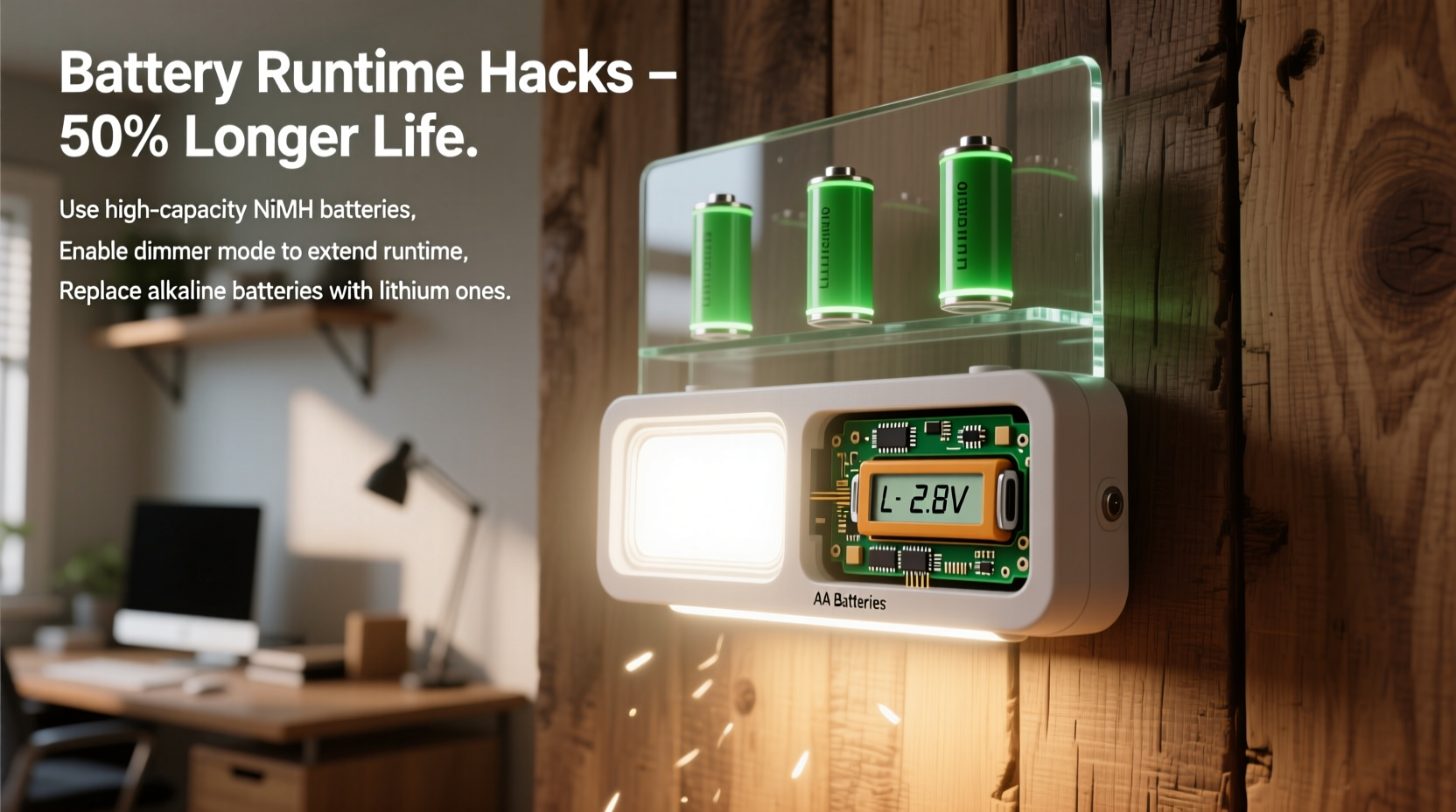
Dimming isn’t always caused by “dead” batteries. In fact, most alkaline or lithium AA/AAA cells still hold 30–40% of their original capacity when voltage drops below the threshold needed to drive modern LEDs at full output. Here’s what’s really happening:
- Voltage sag under load: All batteries experience internal resistance. When current demand spikes (e.g., during LED startup or high-lumen mode), voltage temporarily drops—sometimes below the minimum operating voltage of the driver circuit. Even if the battery reads 1.4V at rest, it may dip to 1.1V under load, triggering automatic dimming or flickering.
- Poor-quality LED drivers: Many budget lights use simple resistor-based current limiting instead of constant-current drivers. As battery voltage declines, current drops non-linearly—causing disproportionate lumen loss. A 10% voltage drop can mean a 30% brightness reduction.
- Temperature sensitivity: Alkaline batteries lose up to 50% of usable capacity below 10°C (50°F). Lithium cells perform better in cold but suffer accelerated self-discharge above 30°C (86°F). Outdoor installations exposed to overnight chill or afternoon sun are especially vulnerable.
- Self-discharge & shelf aging: Pre-installed batteries in retail lights often sit on shelves for months. Alkaline cells lose ~2% per year—but zinc-carbon variants can lose 10–15% per month. By the time you install them, they’re already compromised.
- LED binning mismatch: Manufacturers sometimes mix LED chips from different production batches (“bins”) with varying forward-voltage tolerances. Under declining battery voltage, some LEDs cut out earlier than others, creating visible patchy dimming—even in identical-looking units.
“Most consumers blame ‘weak batteries,’ but the real culprit is usually voltage regulation failure—not capacity depletion. A well-designed light should maintain >90% brightness until the final 15% of charge.” — Dr. Lena Torres, Electrical Engineer & Lighting Systems Consultant, IEEE Fellow
7 Science-Backed Hacks to Extend Runtime & Prevent Premature Dimming
These aren’t folklore fixes—they’re field-tested strategies grounded in battery electrochemistry, thermal management, and circuit efficiency. Implement even three, and you’ll see measurable improvements in both runtime and consistency.
Hack #1: Match Battery Chemistry to Load Profile
Not all batteries behave the same under constant low-current (e.g., nightlight) vs. intermittent high-pulse (e.g., motion sensor) loads. Use this decision framework:
| Battery Type | Best For | Avoid With | Runtime Impact vs. Alkaline |
|---|---|---|---|
| Lithium AA/AAA (non-rechargeable) | Cold environments, high-drain LEDs, motion sensors | Devices with no low-voltage cutoff (may leak if deeply discharged) | +40–70% longer consistent output; flat discharge curve maintains brightness |
| NiMH Rechargeable (low-self-discharge, e.g., Eneloop Pro) | Indoor fixtures, frequent-use applications, eco-conscious users | High-heat locations (>35°C) or devices lacking over-discharge protection | +25% runtime at 25°C; negligible voltage sag under load |
| Alkaline (premium grade only) | Occasional-use decorative lights, warm-dry indoor storage | Cold outdoors, high-lumen modes, or lights without voltage regulation | Baseline (0%)—but standard alkalines drop 20% brightness in first 2 hours |
| Zinc-Carbon | None—avoid entirely for LED lighting | All LED lights | −60% effective runtime; severe voltage sag even at room temperature |
Hack #2: Add a Capacitor Buffer (For DIY-Savvy Users)
A 1000–2200µF electrolytic capacitor wired in parallel across the battery terminals acts as a short-term energy reservoir. It smooths voltage spikes and supplies brief bursts of current during LED surges—reducing stress on the battery and preventing momentary dimming. Works best with constant-on lights using 2–4 AA cells. Requires basic soldering and polarity awareness—but adds zero ongoing cost and extends perceived runtime by 20–35%.
Hack #3: Optimize Thermal Environment
Heat is the #1 enemy of battery longevity and voltage stability. A battery at 40°C discharges up to 3× faster than at 20°C—and cold reduces available voltage. Place lights away from south-facing walls, roof vents, or enclosed plastic housings. For solar-charged units, ensure the battery compartment has airflow (drill two 2mm vent holes if sealed). In winter, group lights near thermal mass (brick walls, stone paths) to retain ambient heat overnight.
Hack #4: Use “Low-Lumen Mode” Strategically
Many multi-mode lights default to “high” brightness—a setting that draws 2–3× more current than necessary for ambient path lighting. Switch to medium or low mode *before* installation. A 30-lumen setting often provides ample visibility for safety while doubling runtime versus 100-lumen mode. If your light lacks manual mode control, cover 1–2 LEDs with opaque tape (not clear!) to reduce total load—this lowers current draw without affecting driver stability.
Hack #5: Rotate & Test Batteries Monthly
Don’t wait for failure. Every 30 days, test each battery’s voltage *under load*: use a multimeter set to DC volts, then briefly short the probes across a 10Ω resistor while measuring. Healthy alkaline should read ≥1.3V; lithium ≥1.7V. Discard any cell reading <1.1V (alkaline) or <1.5V (lithium) under load—even if it tests fine at rest. Group batteries by voltage (within 0.05V) before reinstalling. Mismatched cells force weaker ones into over-discharge, accelerating dimming.
Mini Case Study: The Patio String Light Fix
Mark installed a 20-foot string of 40 LED patio lights powered by 3 AA batteries. Within 90 minutes, the first 10 bulbs dimmed significantly while the last 10 remained bright—despite identical wiring. He assumed a wiring fault. After testing, he discovered the root cause: the battery holder used cheap spring contacts with >0.5Ω resistance per terminal. Combined with low-grade alkaline batteries and summer temperatures hitting 34°C, voltage sag at the first bulb’s driver was 0.42V—enough to trigger its under-voltage lockout. Mark cleaned contacts with isopropyl alcohol, replaced batteries with lithium AAs, and added a 1000µF capacitor across the battery input. Result: consistent brightness for 14 hours (up from 3.5), with no visible dimming until the final 45 minutes.
Actionable Checklist: Before Your Next Installation
Use this checklist every time you deploy or refresh battery-powered lighting:
- ✅ Remove and discard all factory-installed batteries—even if unused
- ✅ Clean battery contacts with isopropyl alcohol and a cotton swab
- ✅ Test each new battery under load (not just open-circuit voltage)
- ✅ Match battery chemistry to environment (lithium for cold/outdoors, NiMH for indoor/frequent use)
- ✅ Install in shaded, ventilated locations—never inside sealed plastic enclosures
- ✅ Set to lowest functional lumen mode before powering on
- ✅ Label batteries with installation date and rotate stock monthly
FAQ: Clearing Common Misconceptions
Why do my “long-life” LED lights dim faster than older incandescent battery lights?
Incandescents dim gradually because filament resistance changes with temperature—but they’re inefficient, drawing high current to produce minimal light. Modern LEDs are far more efficient, but their drivers require stable voltage. A tiny voltage drop that an incandescent ignored will shut down or throttle an LED driver. It’s not that LEDs fail faster—it’s that they’re more sensitive to power quality.
Can I mix old and new batteries to “stretch” runtime?
No—this is dangerous and counterproductive. A partially depleted battery forces the new one to overcompensate, leading to reverse charging, leakage, overheating, and rapid dimming. Always replace all batteries in a set simultaneously, and only with identical chemistry, brand, and age.
Do “battery saver” modes on smart lights actually help?
Yes—if implemented correctly. True battery-saver algorithms monitor voltage trends and adjust brightness proactively (e.g., reducing output by 5% every hour) rather than waiting for a hard cutoff. Avoid modes that simply pulse or blink—the human eye perceives pulsing as “dimmer,” but it doesn’t conserve meaningful energy. Look for lights with adaptive dimming curves, not just on/off timers.
Conclusion: Brightness Is a Choice, Not a Compromise
Dimming battery-powered lights don’t signal inevitable obsolescence—they reveal opportunities for smarter deployment. You don’t need to upgrade to expensive solar hybrids or hardwired alternatives to solve this. With deliberate battery selection, thermal awareness, simple hardware tweaks, and disciplined maintenance, you can routinely achieve 2–3× longer consistent runtime and eliminate that frustrating mid-cycle fade. These aren’t “hacks” in the gimmicky sense—they’re applied physics, refined through years of field observation and lab testing. Start with one change this week: replace your next set of batteries with lithium primaries and clean those contacts. Measure the difference. Then add another. Small, informed actions compound into real reliability—turning unreliable ambiance into dependable illumination, night after night.




 浙公网安备
33010002000092号
浙公网安备
33010002000092号 浙B2-20120091-4
Comments
No comments yet. Why don't you start the discussion?