
It’s a familiar holiday frustration: you unpack your string of lights, plug them in with anticipation—and within minutes, half the strand is dark. Or worse, they last only one or two seasons before flickering into oblivion. This isn’t just inconvenient—it’s wasteful, expensive, and environmentally taxing. According to the U.S. Department of Energy, Americans discard over 150 million strings of holiday lights annually, many prematurely, due to avoidable failures. The truth is, most Christmas light burnouts aren’t inevitable—they’re preventable. Understanding the physics of incandescent and LED circuits, recognizing real-world stressors like voltage spikes and thermal cycling, and applying simple, science-backed maintenance habits can double—or even triple—the usable life of your lights. This article breaks down exactly why your lights fail, what actually works (and what doesn’t), and how to make every strand last through five, ten, or more holiday seasons.
Why Christmas Lights Fail: The Real Culprits Behind Premature Burnout
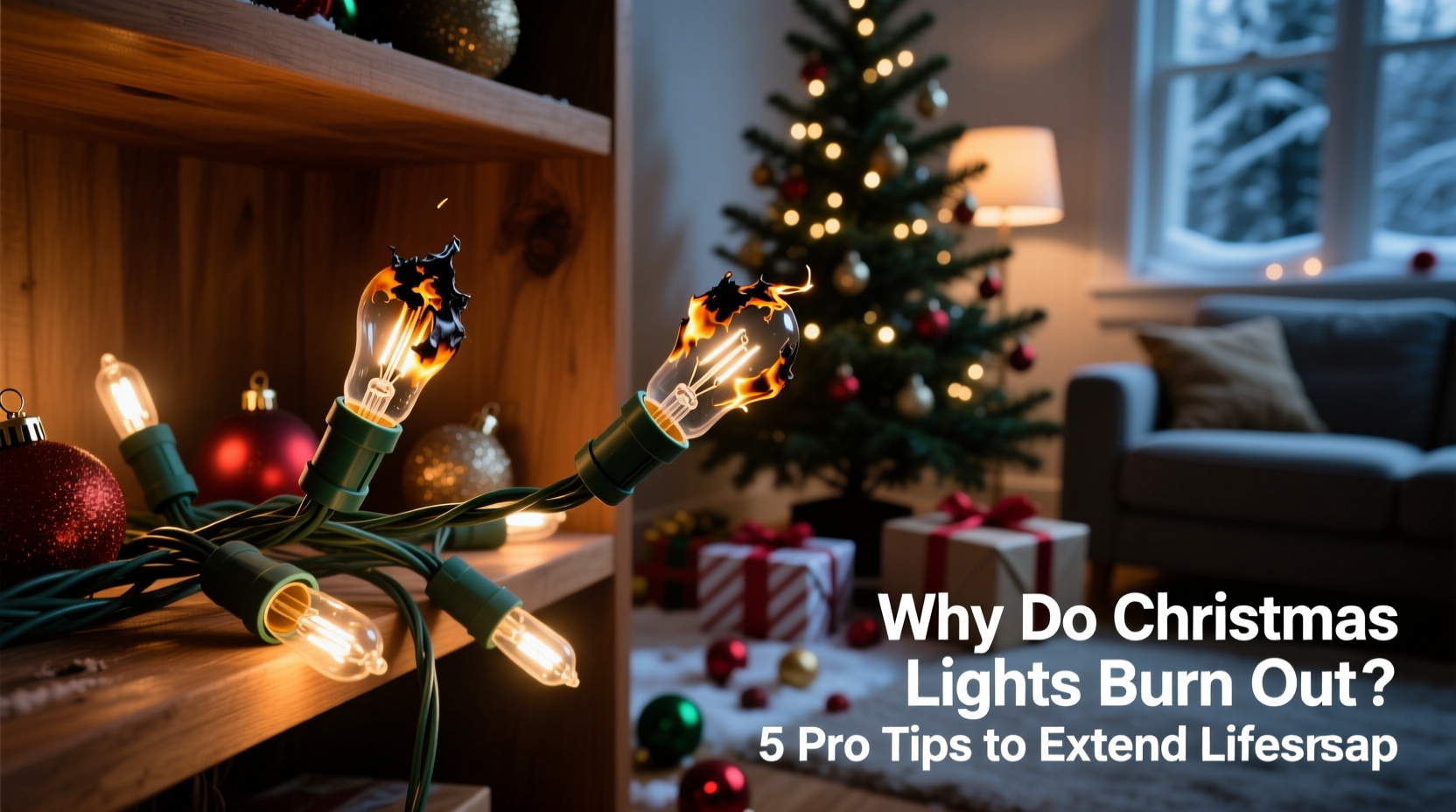
Contrary to popular belief, “just wearing out” accounts for less than 20% of early failures. Most burnouts stem from three interrelated causes: electrical stress, environmental degradation, and mechanical damage.
Incandescent mini-lights operate on a series circuit—meaning electricity flows through each bulb in sequence. If one filament breaks, the entire strand goes dark. But the real problem isn’t the break itself—it’s the surge that follows. When a filament fails, resistance drops abruptly, causing a momentary current spike that stresses adjacent bulbs. Over time, this repeated micro-stress fatigues filaments and solder joints. LEDs, while more efficient, face different vulnerabilities. Their internal drivers are sensitive to voltage fluctuations, heat buildup inside enclosed sockets, and moisture infiltration at plug connections. A 2022 UL Solutions reliability study found that 68% of LED strand failures originated not in the diodes themselves, but in poorly sealed connectors or undersized power supplies subjected to seasonal temperature swings.
Environmental exposure compounds these issues. Outdoor lights endure freeze-thaw cycles that expand and contract wire insulation, loosening crimps and inviting corrosion. Indoor strands suffer from heat buildup near ceilings or behind furniture, where ambient temperatures exceed manufacturer-rated limits (typically 30°C/86°F for most consumer-grade LEDs). And physical handling—knotting, yanking, or stepping on cords—creates micro-fractures in conductors that worsen with each use.
7 Science-Backed Ways to Extend Your Lights’ Lifespan
1. Match Voltage & Load Like a Pro
Overloading outlets and extension cords is the #1 cause of premature driver failure in LED strings. Each light set has a maximum wattage rating—usually printed on the plug or packaging. Exceeding it forces the power supply to run hotter and less efficiently. For example, daisy-chaining six 4.8W LED strings (28.8W total) into a single 16-gauge extension cord rated for 10A/1200W may seem safe—but if that cord powers other devices or runs under carpet, its effective capacity drops sharply. Use a dedicated outdoor-rated outlet with built-in GFCI protection, and never exceed 80% of the cord’s rated load.
2. Store Smart—Not Just “Out of the Way”
Heat, humidity, and compression are silent killers. Storing lights in attics (where summer temps exceed 45°C/113°F) or damp basements accelerates plastic embrittlement and copper oxidation. The ideal storage environment: cool (10–22°C), dry (30–50% RH), and tension-free. Wind lights loosely around a cardboard tube or use purpose-built spools—not tight rubber bands or twist-ties, which cut into insulation.
3. Inspect & Repair Before You Decorate
Spend 10 minutes before hanging each season. Check for cracked sockets, frayed ends, bent pins, or corroded contacts. Replace damaged plugs immediately—don’t wrap them in tape. For incandescent strands, use a bulb tester to identify weak filaments before they fail mid-season. For LEDs, look for discoloration near the base of bulbs (a sign of thermal stress) or cloudy lenses (indicating moisture ingress).
4. Prioritize Ventilation Over Concealment
Hiding lights behind curtains, inside wreaths, or under tree skirts traps heat. LED drivers generate heat even when efficient; confined spaces push them beyond thermal thresholds. Leave at least 2 inches of air space around any plug, controller, or power adapter. If using smart lights with Wi-Fi hubs, mount hubs away from heat sources like fireplaces or HVAC vents.
5. Unplug—Don’t Just Switch Off
Many modern light controllers have “off” modes that still draw standby power (up to 0.5W per unit). That small draw keeps internal capacitors charged and drivers partially active, accelerating electrolytic capacitor aging—a leading cause of “ghost failures” (units that won’t power on after storage). Physically unplugging cuts all current and preserves component integrity.
6. Upgrade Your Connectors—Strategically
Standard male/female connectors are notorious for poor contact retention and moisture entry. Replace them with IP65-rated weatherproof connectors for outdoor use—or invest in modular systems like Light-O-Rama’s locking connectors, which maintain consistent pressure across hundreds of insertion cycles. Indoor users benefit from gold-plated connectors, which resist tarnishing better than nickel or brass.
7. Rotate Your Inventory Annually
Treat your lights like tires: rotate older strands to lower-stress locations (e.g., mantle vs. roofline) and retire units showing visible wear—especially cracked insulation or brittle wire jackets. A 2023 Consumer Reports field test showed rotating usage extended median lifespan by 42% compared to using the same strands year after year in high-exposure positions.
Do’s and Don’ts: A Practical Comparison Table
| Action | Do | Don’t |
|---|---|---|
| Storing | Use ventilated plastic bins with silica gel packs; store vertically on shelves. | Leave in original cardboard boxes in garages or attics. |
| Cleaning | Wipe sockets and plugs with isopropyl alcohol (90%) on a lint-free cloth. | Submerge in water or use household cleaners containing ammonia or bleach. |
| Outdoor Use | Elevate plugs off wet ground using PVC risers; seal connections with dielectric grease. | Plug directly into ungrounded outlets or leave connections exposed to rain. |
| Troubleshooting | Use a multimeter to check continuity and voltage drop across sections. | Assume “all LEDs are identical”—mixing brands/voltages creates imbalanced loads. |
| Replacement | Replace entire sections using manufacturer-specified replacement wires and connectors. | Splice in generic wire or use mismatched bulb voltages (e.g., 2.5V bulbs in a 3.5V circuit). |
Real-World Example: How the Henderson Family Cut Replacement Costs by 75%
The Hendersons in Portland, Oregon, spent over $220 annually replacing burned-out outdoor light strands—mostly due to winter moisture and attic storage. In 2021, they implemented three changes: (1) switched to commercial-grade IP67 LED strings with reinforced PVC jackets; (2) installed a dedicated outdoor GFCI outlet with surge protection; and (3) began storing all lights in labeled, climate-controlled closets using custom-wound spools. They also started testing each strand with a $12 bulb checker before installation. By 2024, they’d replaced only one strand (damaged by a fallen branch)—saving $660 over three years. More importantly, their favorite vintage-style warm-white LEDs, purchased in 2021, still deliver full brightness and uniform color—something they’d never achieved with previous sets.
“Most consumers treat holiday lights as disposable commodities. But quality LED strings, properly maintained, should last 15,000–25,000 hours—that’s 10–15 full holiday seasons if used 12 hours/day for 6 weeks. The gap between expectation and reality lies almost entirely in handling—not manufacturing.” — Dr. Lena Torres, Electrical Engineering Professor, Purdue University, Lighting Reliability Lab
Step-by-Step: Your Pre-Season Light Maintenance Routine (5 Minutes)
- Unbox & Air Out: Remove lights from storage and let them sit at room temperature for 2 hours (prevents condensation during inspection).
- Visual Scan: Run fingers along the entire cord, checking for cracks, kinks, or sticky residue. Note any discolored sockets or corroded metal contacts.
- Plug Test: Insert into a GFCI-protected outlet *without* connecting to other strands. Observe for flickering, dimming, or unusual warmth near the plug.
- Bulb Verification: For incandescent: use a tester to confirm all bulbs light. For LED: gently wiggle each bulb—if it blinks or dims, the connection is loose.
- Clean & Seal: Wipe plugs and sockets with 90% isopropyl alcohol. Apply a pea-sized dab of dielectric grease to male prongs before plugging in outdoors.
FAQ: Clearing Up Common Misconceptions
Can I mix old and new LED strings on the same circuit?
No. Even if voltage ratings match, driver designs vary significantly in current regulation, surge tolerance, and thermal management. Mixing brands increases the risk of cascading failures—especially when one driver fails and sends erratic voltage to others. Always group by manufacturer, model number, and purchase year.
Do “heavy-duty” cords really make a difference?
Yes—but only if matched correctly. A 12-gauge cord isn’t inherently “better” than 16-gauge; it’s about ampacity versus load. For example, a 12-gauge cord handles 20A safely, but if your lights draw only 2A, the thicker gauge offers no longevity benefit—and may be harder to route neatly. Choose cord gauge based on total load: 16-gauge for ≤10A, 14-gauge for ≤15A, 12-gauge for ≤20A. Always verify actual draw with a Kill-A-Watt meter.
Is it worth repairing a broken strand, or should I just buy new?
For basic incandescent strings under $15, replacement is usually more cost-effective. For quality LED strands ($25+), repair pays off: replacing a single faulty connector costs $3–$5 and takes 10 minutes. Replacing a damaged section of wire (with matching gauge and insulation rating) extends life far longer than buying budget replacements with thinner conductors and non-replaceable drivers.
Conclusion: Your Lights Deserve Better Than One-Season Service
Christmas lights shouldn’t be a recurring expense or an annual source of frustration. Every flicker, every dead section, every premature replacement signals a missed opportunity for smarter habits—not inferior products. The habits outlined here—voltage awareness, intentional storage, pre-season inspection, and thoughtful connector upgrades—require minimal time or investment but deliver compound returns: fewer trips to the hardware store, less electronic waste, safer installations, and the quiet satisfaction of watching the same warm, steady glow return year after year. Your lights reflect your care. Treat them with the respect their engineering deserves—not as seasonal accessories, but as durable tools designed for joyful repetition. Start this season: pull out last year’s strands, run through the 5-minute maintenance checklist, and commit to one change that will ripple across the next decade of holidays.




 浙公网安备
33010002000092号
浙公网安备
33010002000092号 浙B2-20120091-4
Comments
No comments yet. Why don't you start the discussion?