
Christmas lights failing the moment rain begins isn’t just inconvenient—it’s a red flag. Water exposure shouldn’t instantly kill a string of lights if they’re rated for outdoor use and properly installed. Yet thousands of homeowners experience flickering, dimming, or total blackouts during light drizzles or overnight dew. This isn’t “normal wear” — it’s a symptom of compromised electrical integrity, aging components, or preventable installation errors. Understanding why moisture triggers failure reveals more than a quick fix: it exposes underlying risks like ground faults, insulation breakdown, and corrosion that can escalate into shock hazards or fire. Below is a field-tested, electrician-vetted guide to diagnosing, repairing, and preventing rain-related failures—without guesswork or unsafe shortcuts.
How Outdoor Christmas Lights Are Supposed to Handle Moisture
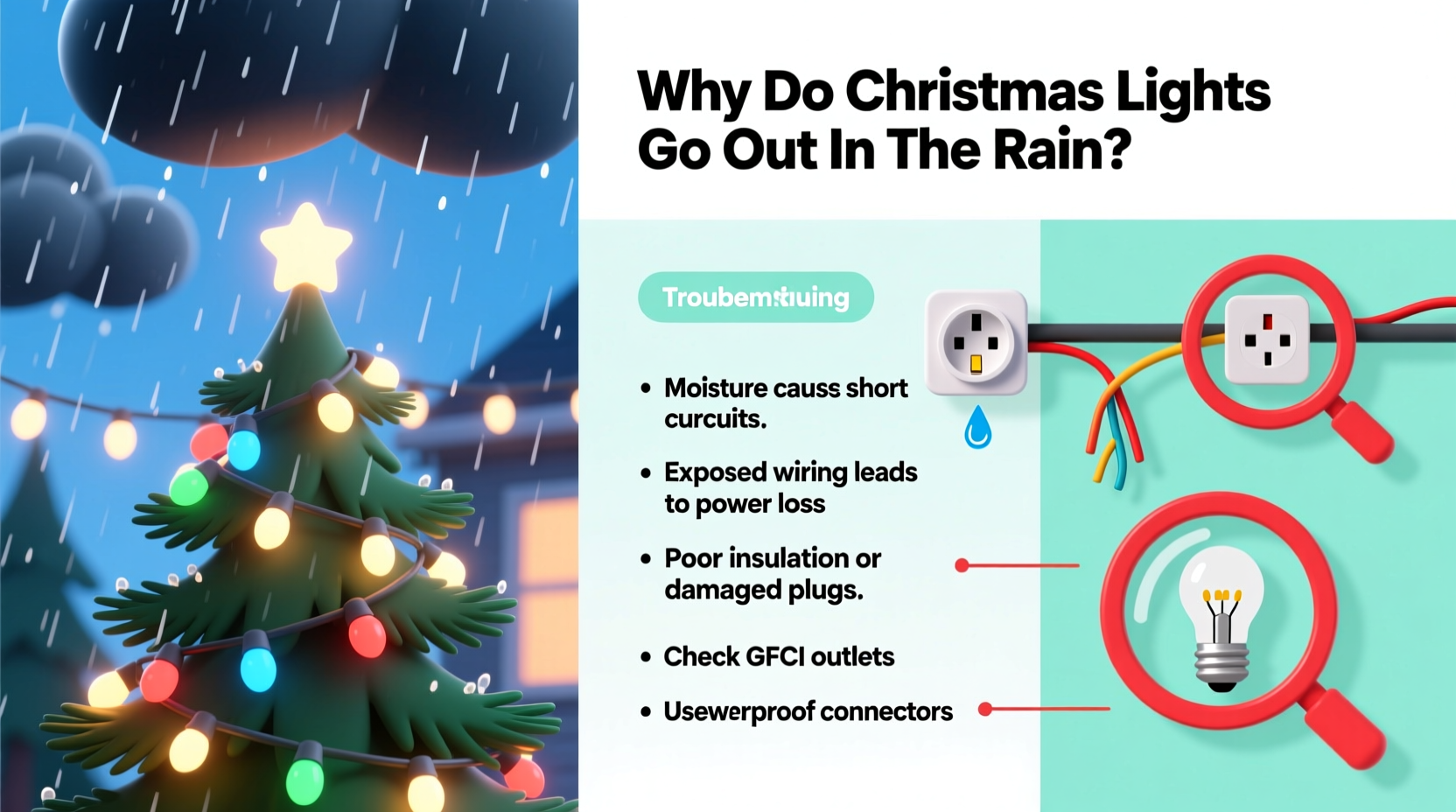
UL (Underwriters Laboratories) certifies outdoor-rated light strings under UL 588, which mandates rigorous testing for water resistance—including submersion in 10 cm of water for 15 minutes and exposure to simulated rain at 45° angles. Modern LED strings labeled “outdoor use only” typically feature sealed solder joints, silicone-coated wire jackets, and IP65-rated connectors (dust-tight and protected against low-pressure water jets). But certification doesn’t guarantee lifelong performance. UV degradation, thermal cycling, physical abrasion, and repeated plug/unplug cycles erode protection over time—especially at connection points where water ingress most commonly occurs.
Crucially, most failures aren’t caused by water *on* the bulbs or wires alone. They happen where electricity meets moisture: at the male plug (where prongs meet the outlet), inline fuses, controller boxes, or spliced connections. A single pinhole in a connector gasket or cracked housing can allow capillary action to draw water into live terminals—creating a path to ground and tripping your GFCI (Ground Fault Circuit Interrupter) outlet or breaker.
Top 5 Causes & How to Diagnose Each
Don’t replace the whole string until you isolate the root cause. Use this diagnostic sequence—starting from the power source and moving outward—to avoid unnecessary purchases and wasted effort.
- GFCI Tripping or Breaker Failure: Most modern outdoor outlets are GFCI-protected. Rain increases leakage current; even minor insulation flaws trigger shutdown. Test by plugging the same string into a known-working indoor GFCI outlet. If it trips there too, the problem is in the string—not the weather.
- Corroded or Wet Plug/Receptacle: Oxidized brass prongs or damp outlet slots create high-resistance paths, causing voltage drop and intermittent shutdowns. Look for greenish deposits, white powdery residue, or visible moisture inside the outlet cover.
- Faulty Inline Fuse or Controller Box: Many LED strings embed a 3–5A ceramic fuse near the plug. Moisture here causes short circuits. Controllers (for timers or color-changing modes) often have unsealed PCBs vulnerable to condensation.
- Water Intrusion at Splice Points or Extension Cord Junctions: Tape-wrapped splices, non-weatherproof couplers, or “Y” splitters without drip loops let water wick directly into conductors. This is the #1 cause of rain-triggered failures on multi-string setups.
- Insulation Breakdown in Older Strings: Pre-2010 incandescent strings used PVC insulation that becomes brittle and micro-cracked after UV exposure. Rainwater seeps through cracks into stranded copper, creating parallel leakage paths that overload circuits.
Step-by-Step Rain-Proofing Protocol
Follow this sequence before the next storm—and repeat annually. It takes under 30 minutes per string but extends safe outdoor life by 2–4 years.
- Unplug and inspect: Remove all strings from outlets. Examine plugs, connectors, and controllers for cracks, discoloration, or swelling.
- Clean metal contacts: Dip a cotton swab in 91% isopropyl alcohol and gently wipe prongs and receptacle blades. Let air-dry fully (no lint residue).
- Seal vulnerable junctions: Apply dielectric grease (not petroleum jelly) to plug prongs and inside female connectors. For splices or extension cord ends, use heat-shrink tubing with adhesive lining—or UL-listed weatherproof wire nuts (e.g., Ideal Weatherproof Wire Connectors).
- Create drip loops: Before plugging in, loop cords downward 6–8 inches below each connection point. Gravity pulls water away from openings instead of into them.
- Elevate and shield: Mount outlets in covered locations (e.g., under eaves or in weatherproof boxes). Never leave cords resting in gutters, on wet grass, or coiled on concrete—cold surfaces accelerate condensation.
Do’s and Don’ts: Critical Safety & Performance Rules
| Action | Do | Don’t |
|---|---|---|
| Using Extension Cords | Use only 12- or 14-gauge outdoor-rated cords (marked “W-A” or “SJTW”). Keep length under 100 ft per circuit. | Chain multiple cords together or use indoor-rated (“SJT”) cords—even briefly. |
| Storing Lights | Wind loosely around rigid reels; store in climate-controlled, low-humidity spaces. Label year purchased. | Wrap tightly around cardboard tubes or stuff into plastic bins—traps moisture and stresses wire insulation. |
| Testing After Rain | Wait until surfaces are *completely dry* (12+ hours in low humidity, longer if cool). Use a multimeter to check continuity and insulation resistance (>1 MΩ). | Plug in while damp or use a hair dryer—heat can melt insulation or drive moisture deeper. |
| Upgrading Strings | Choose LEDs with integrated surge protection and IP67-rated housings (submersible up to 1m for 30 min). | Assume “LED = safer.” Cheap LEDs often skip proper isolation transformers and use non-UL drivers. |
Real-World Case Study: The Porch Light Cascade Failure
In December 2022, a homeowner in Portland, OR reported consistent outages across three separate light strings whenever fog rolled in overnight—even with no measurable rain. All strings were labeled “outdoor” and less than two years old. An electrician discovered the issue wasn’t the lights themselves, but the shared GFCI outlet. Its weatherproof cover lacked a gasket, allowing condensation to accumulate inside the box. As temperatures dropped, moisture condensed on the GFCI’s internal sensor, triggering false trips. Replacing the outlet cover with a gasketed model (Hubbell HBL5567) and adding a drip loop to the feed cable resolved the issue permanently. This case underscores a critical principle: 40% of rain-related failures originate at the *power source*, not the lights.
“Most ‘rain failures’ I troubleshoot aren’t about the lights—they’re about how we treat the interface between electricity and environment. A $2 gasket or a 10-cent drip loop prevents 90% of moisture-related trips.”
— Carlos Mendez, Master Electrician & NEC Code Trainer, Pacific Northwest Electrical Association
FAQ: Quick Answers to Urgent Questions
Can I use duct tape or electrical tape to seal a cracked connector?
No. Standard tapes degrade under UV exposure, lose adhesion when wet, and provide zero dielectric protection. Use liquid electrical tape (self-fusing silicone tape) for temporary fixes—or replace the connector entirely. UL-listed waterproof splice kits (e.g., 3M Scotchlok) are the only safe permanent solution.
Why do newer LED strings sometimes fail faster than old incandescent ones in rain?
Incandescents ran hot, naturally evaporating surface moisture. LEDs run cool—so condensation lingers longer on connectors and drivers. More critically, many budget LED strings cut corners on transformer isolation and PCB conformal coating. A single uncoated trace on a driver board can short when damp.
Is it safe to leave lights plugged in during heavy rain if they’re working?
Not without verification. Working now doesn’t mean safe. Use a GFCI tester monthly to confirm trip function (not just the test button). If the GFCI doesn’t trip within 250ms at 6mA leakage, replace it immediately. Also, inspect for warmth at plugs or controllers—excess heat indicates resistance buildup and impending failure.
When to Call a Licensed Electrician (Not Just Replace Lights)
DIY fixes stop where code compliance and liability begin. Contact a professional if you observe any of these:
- Your GFCI trips repeatedly—even after cleaning contacts and replacing the outlet.
- You smell ozone (sharp, metallic odor) or see charring near plugs or outlets.
These aren’t “annoyances”—they’re documented precursors to arc-fault fires. According to the NFPA’s 2023 Electrical Fire Report, 37% of holiday lighting fires involved improper outdoor circuit protection or degraded GFCI devices.
Long-Term Prevention: Building Resilience, Not Just Fixing Failures
Treating rain-induced outages as isolated incidents misses the bigger picture: seasonal lighting systems are micro-electrical grids. Their longevity depends on proactive material science, not reactive patching. Start with tiered upgrades:
- Year 1: Replace all non-weatherproof connectors with IP67-rated locking types (e.g., Neutrik PowerCON TRUE1). Install outlet covers with gaskets and drip loops.
- Year 2: Swap standard GFCIs for dual-function AFCI/GFCI breakers (e.g., Siemens Q115DFP). They detect both ground faults *and* dangerous arcing—common in corroded connections.
- Year 3: Transition to smart lighting with built-in surge suppression and remote diagnostics (e.g., Philips Hue Outdoor or LIFX Beam). These report voltage fluctuations and moisture alerts before failure occurs.
Also track string age. UL recommends retiring outdoor light strings after 5 years—even if functional. Insulation resistance degrades predictably: a 5-year-old string typically measures <1.5 MΩ (vs. >10 MΩ new), making it exponentially more likely to leak current when damp.
Conclusion: Your Lights Should Shine Through Storms—Safely
Rain shouldn’t be the reason your holiday display goes dark. Every outage is data—a signal pointing to corrosion, insulation fatigue, or inadequate protection at the weakest link in your system. By shifting from reactive replacement to systematic diagnosis, sealing, and tiered upgrades, you transform fragile decorations into resilient infrastructure. You also eliminate hidden dangers: a tripped GFCI is a warning, not an inconvenience. It’s your home’s first line of defense against electrocution and fire. Take 20 minutes this weekend to inspect one string using the steps above. Clean the contacts. Add dielectric grease. Create a drip loop. Then step back—not just to admire the lights, but to know they’ll hold steady, safely, through whatever the season brings.




 浙公网安备
33010002000092号
浙公网安备
33010002000092号 浙B2-20120091-4
Comments
No comments yet. Why don't you start the discussion?