
Every holiday season, thousands of homeowners face the same frustrating ritual: string up the lights, plug them in—and *pop*. The fuse trips or the breaker flips. The tree stays dark. The porch remains shadowed. You replace the fuse, try again, and within minutes, it happens once more. It’s not bad luck. It’s not faulty bulbs (though those can contribute). It’s almost always a fundamental mismatch between what your lights demand and what your circuit can safely supply.
This isn’t just an annoyance—it’s a warning. Repeated tripping indicates sustained electrical stress that can degrade wiring insulation, overheat outlets, and increase fire risk. Yet most people respond with temporary fixes: swapping fuses for higher-rated ones (dangerous), daisy-chaining power strips (worse), or unplugging half the display to “make it work.” These approaches ignore the root cause: circuit load imbalance. Understanding how residential circuits operate—and how to measure, calculate, and distribute your lighting load—is the only reliable way to eliminate fuse blowouts and enjoy safe, brilliant holiday lighting for years to come.
How household circuits actually work—and why they trip
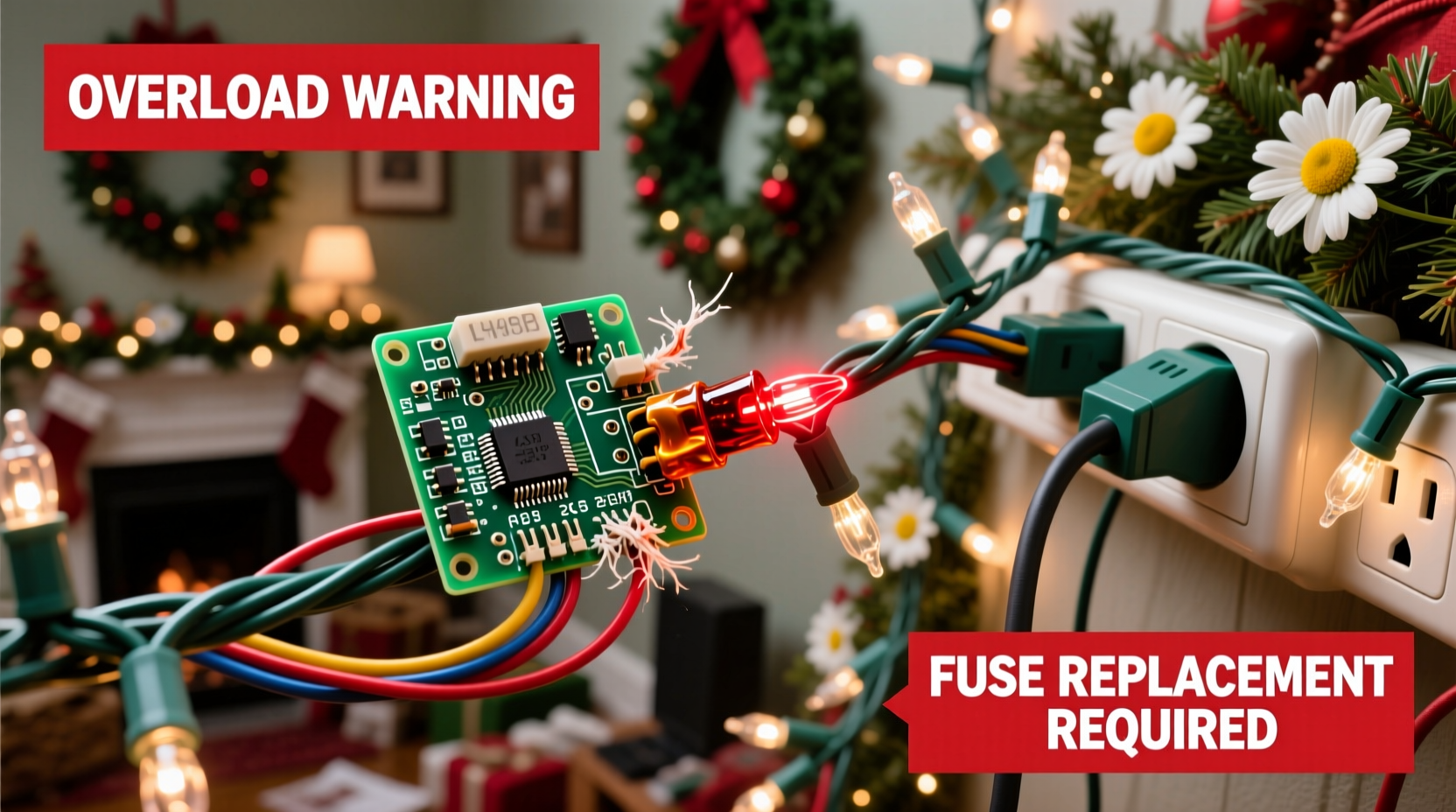
Your home’s electrical system is divided into discrete circuits, each protected by a fuse or circuit breaker rated for a specific amperage—typically 15A or 20A for standard branch circuits in living areas and exterior outlets. This rating isn’t arbitrary; it reflects the maximum continuous current the circuit’s wiring (usually 14-gauge for 15A, 12-gauge for 20A) can carry without overheating.
A circuit breaker trips—or a fuse blows—when current exceeds its rating for more than a fraction of a second. Modern breakers are thermal-magnetic: they respond to both sustained overloads (thermal element) and sudden surges (magnetic element). A slow, repeated tripping under load points to thermal overload—not a short circuit. That means your lights are collectively drawing more amps than the circuit is designed to handle.
Crucially, many homeowners mistakenly assume “outlet = unlimited power.” In reality, a single 15A circuit serves multiple outlets—often six to ten—on the same wall, hallway, or even garage. Plugging your lights into one outlet doesn’t isolate the load; it adds to everything else already running on that circuit: refrigerators, entertainment systems, sump pumps, or even a space heater in the next room. That hidden cumulative draw is frequently the silent culprit behind seasonal fuse failures.
Calculate your actual light load—step by step
You cannot fix what you don’t measure. Guessing wattage or relying on package claims leads to errors. Here’s how to determine your true load—accurately and safely:
- Identify every light string connected to the same circuit. Trace cords back to outlets, then map which outlets share the same breaker (flip breakers one at a time while checking outlets with a lamp or voltage tester).
- Find the wattage of each string. Look for the UL label near the plug—this lists actual operating watts, not “max bulb count” or marketing terms. If missing, use a clamp meter or plug-in power meter (like a Kill A Watt) for precise measurement.
- Add all wattages together. Include extension cords, timers, and controllers—they draw 1–3W each, but add up.
- Convert total watts to amps. Use the formula: Amps = Watts ÷ Volts. In North America, standard voltage is 120V. So 1,440W ÷ 120V = 12A.
- Compare to circuit capacity. A 15A circuit should never exceed 80% continuous load (NEC 210.20(A))—so 12A is its safe limit. A 20A circuit allows 16A continuous.
Most pre-lit trees alone consume 200–400W. A 100-bulb incandescent string? 400–500W. Even LED strings vary widely: basic mini-LEDs run ~4–7W per 100 bulbs, but high-output warm-white or color-changing sets can draw 25–45W per string. A common mistake is assuming “LED = low power” without verifying actual specs—especially with newer smart lights featuring Wi-Fi modules and amplifiers.
Do’s and Don’ts for safe, stable holiday lighting
| Action | Do | Don’t |
|---|---|---|
| Circuit Allocation | Assign lights to dedicated circuits—or at least circuits with minimal background load (e.g., unused bedrooms, not the kitchen). | Plug lights into the same circuit as refrigerators, microwaves, or HVAC systems. |
| Extension Cords | Use outdoor-rated, 12-gauge or 10-gauge cords for runs over 50 feet or high-wattage loads. Keep cord length under 100 feet per run. | Chain multiple lightweight 16-gauge extension cords—voltage drop and heat buildup accelerate failure. |
| Daisy-Chaining | Follow manufacturer limits (e.g., “max 3 sets end-to-end”)—and reduce that number by 30% if using long cords or older strings. | Ignore daisy-chain warnings. Exceeding the rated number multiplies resistance and heat at each connection point. |
| Fuse Replacement | Replace blown fuses only with identical type and amp rating (e.g., 15A AGC glass fuse). | Install a 20A fuse in a 15A circuit—this defeats safety protection and risks fire. |
| Outdoor Safety | Use GFCI-protected outlets for all exterior lighting. Test GFCIs monthly. | Power outdoor lights from indoor non-GFCI outlets via open windows or doors. |
Real-world case study: The Tripping Porch Problem
The Hendersons in Portland, Oregon, installed new LED icicle lights along their roofline and front porch—six 24-foot strands totaling 1,080W. They plugged them into a single outdoor GFCI outlet. On the first night, the breaker tripped after 22 minutes. They replaced the fuse, tried again, and it blew in under 10 minutes.
An electrician visited and discovered the outlet was fed from a shared 15A circuit also powering their garage door opener, landscape lighting transformer, and a Wi-Fi router in the adjacent utility closet. Using a clamp meter, he measured 3.2A of constant background load before any lights were connected. The six light strings drew 9.2A combined. Total: 12.4A—within theoretical capacity, but the circuit was aging, and connections at the panel were slightly corroded, increasing resistance and heat.
The solution wasn’t rewiring the house. It was strategic redistribution: moving the garage door opener to a different circuit, installing a dedicated 20A GFCI outlet for the lights (with 12-gauge wiring), and replacing two older LED strings with newer, lower-wattage models. Total load dropped to 7.8A. No more tripping—just consistent, bright illumination.
“Most ‘blown fuse’ complaints I see aren’t about faulty equipment—they’re about load stacking on undersized or shared circuits. Holiday lighting exposes existing weaknesses in home wiring that go unnoticed year-round.” — Carlos Mendez, Master Electrician & NEC Code Trainer, IBEW Local 124
Troubleshooting checklist: Diagnose before you replace
- ✅ Verify the breaker/fuse rating (15A or 20A) and confirm it matches the circuit’s wire gauge (check panel labeling or consult an electrician).
- ✅ Map all devices on the circuit using a circuit tracer or manual breaker test—don’t assume outlets are isolated.
- ✅ Measure actual wattage of each light string with a plug-in power meter—not packaging estimates.
- ✅ Inspect all plugs, sockets, and connectors for discoloration, melting, or warmth after 10 minutes of operation.
- ✅ Test GFCI outlets monthly—press TEST, then RESET. A failing GFCI may trip prematurely or not trip when needed.
- ✅ Check for damaged insulation on cords, especially where they contact gutters, railings, or sharp edges.
- ✅ Confirm timer and controller compatibility—some older mechanical timers can’t handle LED inrush current and fail unpredictably.
FAQ: Clear answers to persistent questions
Can I use a power strip to spread out my lights?
No—not unless it’s specifically rated for continuous outdoor use and has built-in circuit protection. Most indoor power strips lack adequate wire gauge, thermal cutoffs, or weather resistance. They concentrate load at a single outlet and create a fire hazard. Instead, use a UL-listed outdoor-rated multi-outlet hub wired directly to a dedicated circuit.
Why do my lights blow fuses only after being on for 15–20 minutes?
This is classic thermal overload behavior. As connections warm up—especially at daisy-chain plugs or corroded outlets—resistance increases, causing more heat and higher current draw for the same wattage (due to voltage drop). The breaker’s thermal element eventually triggers. It’s a sign of marginal capacity, poor connections, or aging wiring—not necessarily a defective fuse.
Will switching entirely to LED lights solve the problem?
Not automatically. While LEDs use far less energy per bulb, many consumers compensate by adding *more* lights—longer runs, denser spacing, animated effects—pushing total load back into the danger zone. Also, cheap LED strings often use inefficient drivers that generate excess heat and draw disproportionate reactive power, confusing some breakers. Always verify total measured wattage—not just bulb count.
Conclusion: Light safely, celebrate confidently
Blown fuses during the holidays aren’t a rite of passage—they’re a solvable engineering problem. You don’t need to be an electrician to understand circuit load, nor do you need to sacrifice brilliance for safety. With a multimeter, a few minutes of mapping, and disciplined load management, you can transform frustration into reliability. Start by auditing one circuit this weekend: unplug everything, measure baseline draw, then add lights one string at a time while watching the amp reading climb. Notice where it crosses 80% capacity. That’s your actionable threshold—not a guess, not a hope, but data you control.
When your lights stay lit through Christmas Eve, when your tree glows steadily past midnight, when your neighbor asks how you “got it all working so perfectly”—you’ll know it wasn’t magic. It was measurement. It was respect for physics. It was choosing safety over spectacle, and finding that the two don’t compete—they coexist, brilliantly.




 浙公网安备
33010002000092号
浙公网安备
33010002000092号 浙B2-20120091-4
Comments
No comments yet. Why don't you start the discussion?