
Nothing kills holiday momentum faster than a string of lights going dark—and then another, and another—followed by the unmistakable *pop* of a blown fuse or tripped breaker. You’re not dealing with bad luck or faulty bulbs alone. A repeatedly blowing fuse is your circuit’s urgent warning signal: something is drawing too much current, creating excessive heat, or introducing a dangerous fault. Ignoring it risks damaged wiring, melted sockets, fire hazards, or even electrical shock. This isn’t just about convenience—it’s about safety, longevity, and preserving the joy of the season without constant frustration.
This guide cuts through seasonal guesswork. Drawing on National Electrical Code (NEC) standards, field reports from licensed residential electricians, and decades of holiday lighting service data, we break down *exactly why* fuses blow—not just what to do when they do. You’ll learn how to diagnose root causes (not symptoms), calculate safe load limits, spot hidden dangers like moisture intrusion or socket corrosion, and implement lasting fixes that go beyond swapping fuses. No jargon without explanation. No assumptions about your toolset. Just actionable, code-informed insight you can apply tonight.
Why Fuses Blow: The Physics Behind the Pop
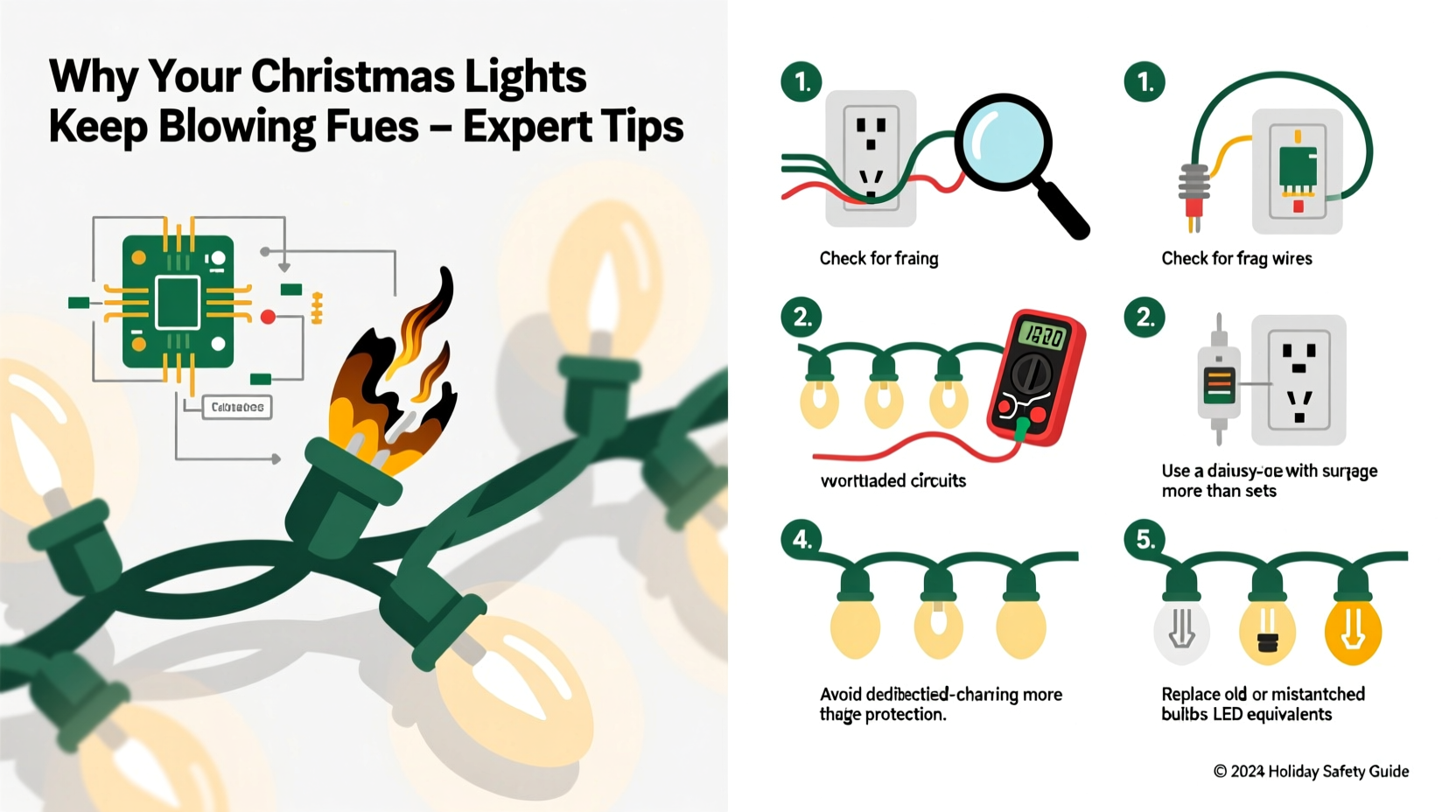
A fuse is a deliberate weak link—a thin strip of metal designed to melt and break the circuit when current exceeds its rated capacity. For Christmas lights, this typically means 3–5 amps for standard mini-light sets (120V). When that threshold is crossed—even briefly—the fuse sacrifices itself to protect the wiring downstream. It’s not a design flaw; it’s critical safety engineering.
The most common triggers fall into three categories:
- Overload: Too many strings daisy-chained together exceed the circuit’s total amperage capacity.
- Short Circuit: A direct path between hot and neutral wires—caused by pinched insulation, cracked sockets, or water ingress—bypasses the resistance of the bulbs and creates a massive, instantaneous current surge.
- Ground Fault: Current leaks from the hot wire to a grounded surface (like a wet metal gutter or damp soil), often tripping GFCI outlets or causing thermal stress on fuses.
Crucially, repeated fuse failures *even after replacement* indicate an underlying problem—not a defective fuse. Replacing a 3-amp fuse with a 5-amp “fix” is extremely dangerous and violates NEC Article 240.4. It invites overheating and fire.
Step-by-Step Diagnostic Protocol
Follow this sequence methodically. Skipping steps leads to misdiagnosis and wasted time.
- Unplug everything. Disconnect all light strings from outlets, extension cords, and each other. Let them cool for 5 minutes.
- Inspect the fuse itself. Remove the fuse cap (usually at the plug end). Hold it up to light: a broken, blackened, or cloudy filament means it blew. A clear, intact filament suggests a different issue (e.g., open circuit or GFCI trip).
- Test one string at a time. Plug in *only one* string directly into a known-good outlet (no extension cords, no timers). If the fuse blows immediately, that string has a hard short. If it works, proceed.
- Add strings incrementally. After confirming the first string works, add a second—plugged into the first’s female end. Wait 30 seconds. Repeat until the fuse blows. The *last added string* is your primary suspect.
- Isolate the suspect string. Unplug it. Use a multimeter on continuity mode: touch probes to the two prongs of its plug. If it beeps (continuity), there’s a short. If silent, the short may be intermittent or elsewhere.
- Check environmental factors. Are lights near sprinklers, rain gutters, or unsealed outdoor outlets? Is the outlet a GFCI? Reset it before testing again.
This process identifies whether the problem is isolated (one faulty string) or systemic (overloaded circuit, poor outlet, or moisture).
Do’s and Don’ts: Holiday Lighting Safety Checklist
| Action | Do | Don’t |
|---|---|---|
| Circuit Loading | Calculate total wattage: Add labels on all strings (e.g., “48W”). Divide total by 120V = amps. Keep under 80% of circuit rating (e.g., ≤12A on a 15A circuit). | Assume “if it fits, it’s fine.” Daisy-chain more than 3–5 standard mini-light strings without verifying ratings. |
| Outdoor Use | Use only lights labeled “For Outdoor Use” and UL-listed extension cords rated for exterior use (14 AWG or thicker). | Run indoor-only lights outside—even under eaves—or use indoor extension cords outdoors. |
| Moisture Protection | Seal plug connections with waterproof electrical tape or commercial cord connectors. Elevate plugs off wet ground. | Leave plugs exposed to rain/snow or tuck them into damp mulch or wet soil. |
| Socket & Bulb Care | Replace missing bulbs *immediately* with exact voltage/wattage matches. Check for cracked sockets or bent contacts. | Insert bulbs forcefully, mix LED and incandescent strings on one circuit, or leave empty sockets open. |
| Storage & Handling | Coil lights loosely around a cardboard spool. Store in climate-controlled, dry space away from rodents. | Wrap tightly around a broomstick, store in damp garage, or leave outdoors year-round. |
Real-World Case Study: The Garage Gutter Short
Mark in Portland installed new LED icicle lights along his garage roofline. Within 48 hours, the 15A breaker tripped daily. He replaced the breaker, reset GFCIs, and swapped fuses—nothing held. An electrician discovered the root cause during a rainy inspection: water was running from the roof into a section of gutter where the light string’s male plug rested. The plug wasn’t rated for immersion, and moisture had bridged the prongs inside the housing. Corrosion had also formed on the copper contacts, increasing resistance and heat buildup. The solution wasn’t more fuses—it was relocating the plug to a covered junction box, sealing the cord entry with silicone, and installing a weatherproof outlet cover. Total fix time: 45 minutes. Cost: $12 in materials. Lesson: Environmental exposure is often the silent culprit behind “mystery” trips.
Expert Insight: What Licensed Electricians See Most
“Ninety percent of recurring fuse issues I troubleshoot aren’t about the lights—they’re about *how* people connect them. Overloading circuits with cheap extension cords, using indoor-rated gear outside, and ignoring GFCI warnings are the top three avoidable mistakes. A single 14-gauge outdoor cord can safely handle 1,800 watts. But if you run five 200-watt strings through a 16-gauge indoor cord rated for 1,200 watts, you’re asking for thermal failure—even if the fuse hasn’t blown yet.” — Carlos Mendez, Master Electrician & NEC Code Trainer, Pacific Northwest Electrical Association
Mendez emphasizes that heat—not just current—is the real enemy. Poor connections, undersized wires, and corroded contacts generate heat that degrades insulation over time, eventually leading to shorts. His team sees a 300% spike in emergency calls between December 15–23, almost exclusively tied to last-minute, unverified installations.
Troubleshooting Table: Symptoms, Causes, and Fixes
| Symptom | Most Likely Cause | Immediate Fix | Preventive Measure |
|---|---|---|---|
| Fuse blows instantly on plug-in | Hard short: crushed wire, cracked socket, water in plug | Discard or repair the string. Do not reuse. | Inspect all cords before installation. Avoid stepping on or pinching lights. |
| Fuse blows after 10–30 minutes | Overload or high-resistance connection (corroded socket, loose bulb) | Reduce number of strings. Tighten all bulbs. Replace any with darkened or bulging bases. | Use a power meter to verify actual load. Install a dedicated outdoor circuit for heavy displays. |
| Only blows when rain/snow falls | Moisture ingress at plug, socket, or splice point | Unplug, dry thoroughly with compressed air. Seal with dielectric grease and waterproof tape. | Use IP65-rated outdoor connectors. Mount plugs upward-facing or in covered enclosures. |
| Blows only when timer activates | Inrush current overload (common with older incandescents) or failing timer relay | Replace mechanical timer with a digital one rated for lighting loads. Or stagger start times across multiple timers. | Switch to ENERGY STAR–certified LED lights (lower inrush current). Use timers with “soft start” features. |
| Works fine indoors but blows outside | Ground fault (wet outlet, damaged cord, improper grounding) | Test outlet with a GFCI tester. Replace if faulty. Inspect cord for nicks near ground contact points. | Install a GFCI-protected outlet *before* the first light string. Use only grounded, 3-prong cords outdoors. |
FAQ: Quick Answers to Common Concerns
Can I mix LED and incandescent lights on the same circuit?
No—especially not on the same string or daisy chain. Incandescents draw significantly more current (e.g., 40W per 100-bulb string vs. 4.8W for comparable LEDs). Mixing them skews load calculations and can cause voltage drops, overheating, and premature fuse failure. Even if the total wattage seems safe, the differing electrical characteristics create instability. Use one technology per circuit.
My lights worked last year but blow fuses now—what changed?
Three likely culprits: (1) Corrosion: Moisture exposure over storage degraded socket contacts, increasing resistance and heat; (2) Physical damage: Bending, crushing, or rodent chewing compromised insulation; (3) Outlet degradation: The receptacle itself may have worn contacts or loose wiring, raising impedance. Test the outlet with another device first.
Are LED lights immune to fuse problems?
No—though they’re far less prone. LEDs still require drivers and rectifiers that can fail. Cheap, non-UL-listed LEDs often lack proper surge protection or thermal cutoffs. A lightning-induced surge or sustained voltage spike can destroy internal components and create a short. Always choose UL/ETL-listed LED sets and consider whole-house surge protection.
Conclusion: Light Up Safely, Not Just Brightly
Your Christmas lights should evoke warmth, nostalgia, and quiet wonder—not anxiety over tripped breakers and burnt smells. Understanding *why* fuses blow transforms you from a frustrated consumer into a confident, safety-conscious homeowner. You now know that a blown fuse is never random—it’s diagnostic data. It tells you where resistance is too high, where moisture is creeping in, where connections are failing, or where capacity has been exceeded. Armed with the step-by-step protocol, the safety checklist, and real-world context, you can resolve issues decisively—not reactively.
Start tonight: unplug every string, inspect each fuse, and test one light set at a time. Calculate your actual load—not the “up to 210 strings” claim on the box. Seal those plugs. Replace that frayed cord. If your display consistently pushes circuit limits, invest in a dedicated outdoor outlet. These aren’t holiday inconveniences—they’re acts of care for your home, your family, and the traditions you uphold.




 浙公网安备
33010002000092号
浙公网安备
33010002000092号 浙B2-20120091-4
Comments
No comments yet. Why don't you start the discussion?