
Every holiday season, thousands of homeowners face the same frustrating ritual: string up the lights, plug them in—and instantly hear the sharp click of a tripped breaker. It’s not just inconvenient; it’s a warning sign. Circuit breakers trip to prevent overheating, insulation damage, and fire risk—not to spoil your festive mood. Yet most people respond by unplugging one strand and plugging in another, repeating the cycle until they’ve exhausted every outlet—or their patience. The real issue isn’t faulty lights or bad luck. It’s a mismatch between modern lighting demands and legacy home wiring designed for incandescent bulbs, vacuum cleaners, and radios. This article explains exactly why breakers trip under holiday loads, how to calculate safe capacity for your circuits, and—most importantly—how to decorate beautifully without compromising safety or convenience.
Why Breakers Trip: It’s Not Magic—It’s Physics
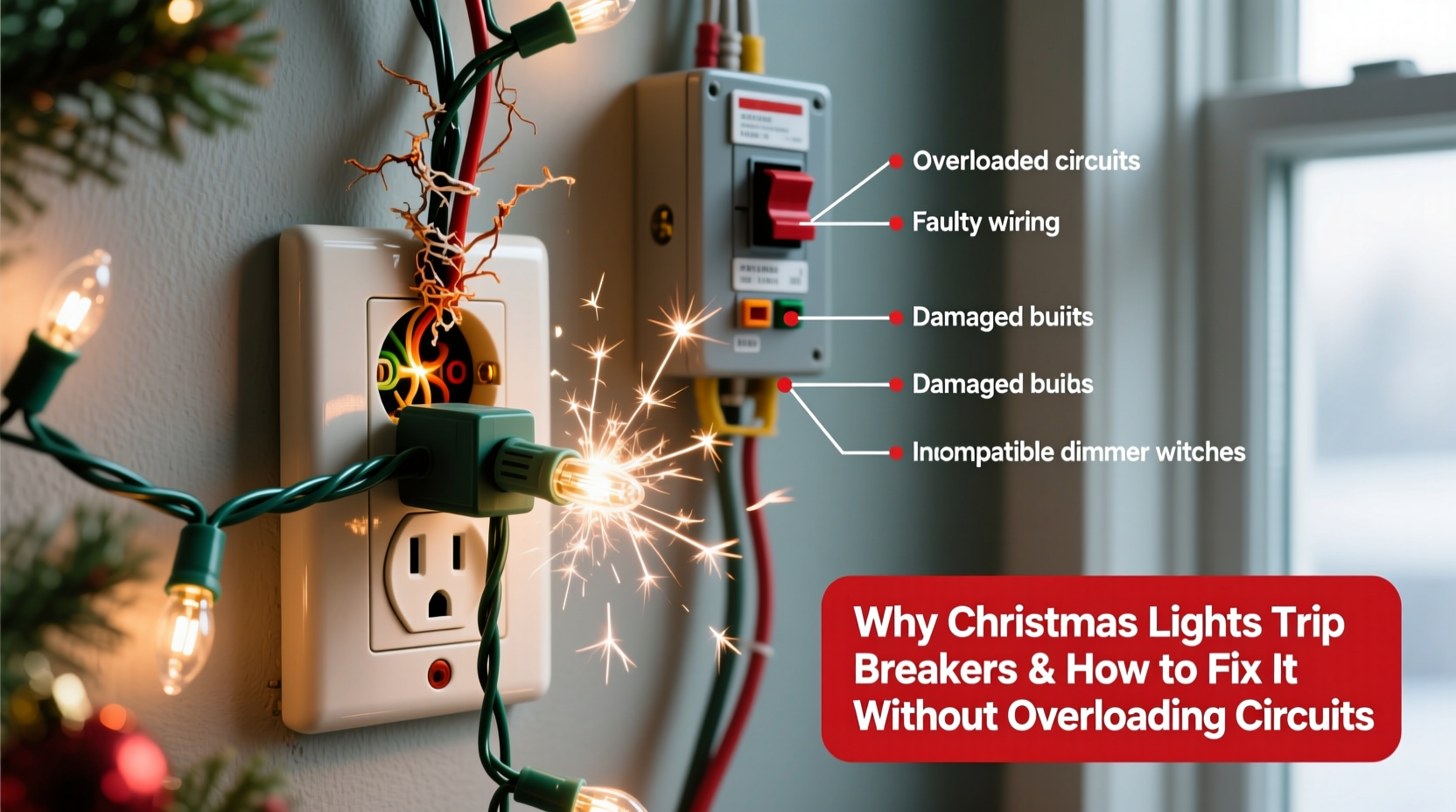
A circuit breaker is an automatic safety switch that interrupts power when current exceeds its rated capacity. Standard residential circuits in North America are typically 15-amp or 20-amp, supplying 120 volts. That means a 15-amp circuit can handle up to 1,800 watts (15 × 120), while a 20-amp circuit handles up to 2,400 watts. But here’s what most people miss: electrical codes require circuits to operate at no more than 80% of their rated capacity for continuous loads—and holiday lighting qualifies as continuous if left on for more than three hours. So a “15-amp circuit” should realistically carry only 1,440 watts (80% of 1,800). Exceed that—even by 50 watts—and heat builds in wires and connections, triggering thermal-magnetic protection inside the breaker.
Trouble starts when people chain dozens of light strands together. A single 100-light mini-incandescent string draws about 40–45 watts. Chain ten of those? That’s 400–450 watts—still safe. But add four more strings (for 14 total), include two 6-foot LED icicle lights (each ~12 watts), a pre-lit wreath (18 watts), and a lighted outdoor sculpture (35 watts), and you’re suddenly at 675+ watts—plus the refrigerator, Wi-Fi router, and hallway sconce already sharing that same circuit. Now you’re flirting with 1,440 watts. One loose connection, one aging outlet, or one strand with compromised insulation can push resistance down, current up, and temperature over the threshold.
How to Diagnose the Real Culprit (Not Just the Symptom)
Tripping isn’t always about wattage overload. Four distinct failure modes cause repeated trips—and each requires a different fix:
- Overload: Too many devices drawing too much current on one circuit.
- Short circuit: A hot wire contacts neutral or ground—often due to damaged cord insulation, moisture intrusion, or crushed sockets.
- Ground fault: Current leaks from hot to ground (e.g., via wet soil, metal gutters, or frayed wire touching a nail). Common outdoors—and protected by GFCI outlets, not standard breakers.
- Breaker fatigue: Older breakers (15+ years) lose calibration and trip prematurely, even within safe limits.
To isolate the cause, start with a process of elimination. Unplug everything on the affected circuit. Reset the breaker. Then plug in devices one at a time—waiting 60 seconds between each—until the breaker trips again. If it trips with only one strand plugged in (and nothing else), inspect that strand for visible damage: cracked insulation, bent pins, darkened sockets, or warm sections when lit. If it only trips when multiple strands are connected, you’re dealing with overload. If it trips only outdoors during rain or high humidity, suspect a ground fault or moisture ingress.
Step-by-Step: Calculate Your Safe Lighting Load—No Guesswork
Forget “how many strands can I plug in?” Ask instead: What’s the actual wattage draw of my entire display—and which circuits support it? Follow this sequence:
- Identify the circuit: Turn off the suspected breaker. Test outlets and lights room-by-room until you find all devices powered by it. Label them (e.g., “Front Porch + Living Room East Outlets”).
- Determine breaker rating: Check your panel. Look for “15A” or “20A” stamped on the switch handle.
- Calculate 80% safe capacity: Multiply amps × 120V × 0.8. Example: 15A × 120V = 1,800W → × 0.8 = 1,440W max continuous.
- Add known loads: Refrigerator (700W), Wi-Fi router (12W), LED table lamp (9W), digital clock (3W). Total so far: ~724W.
- Reserve remaining wattage for lights: 1,440W − 724W = 716W available.
- Sum light wattages: Use labels or manufacturer specs. Don’t rely on “up to 210 lights per string”—check actual wattage. Modern LED strings range from 4.8W (50-light warm white) to 28W (200-light multicolor with built-in controller).
This method prevents assumptions. One homeowner in Portland discovered his “porch circuit” also powered the garage door opener (550W) and attic fan (220W)—leaving only 670W for lights. His 12-strand display totaled 890W. No wonder the breaker tripped.
Do’s and Don’ts: Wiring Lights Safely on Shared Circuits
| Action | Do | Don’t |
|---|---|---|
| String chaining | Follow manufacturer limits (e.g., “max 43 sets end-to-end”). Verify voltage drop—use shorter runs if lights dim at the end. | Chain more than labeled—even if they “fit.” Each added set increases resistance, heat, and fire risk. |
| Outdoor use | Use only UL-listed “For Outdoor Use” lights. Plug into GFCI-protected outlets. Elevate cords off wet grass or snow. | Use indoor-only lights outside—even under eaves. Never run cords under rugs or through windowsills. |
| Power distribution | Spread displays across multiple circuits. Run extension cords from different rooms (e.g., front porch from living room circuit, backyard from garage circuit). | Plug multiple power strips into one outlet or daisy-chain power strips (“daisy-chaining” violates NEC 210.21(B)(2)). |
| Inspection | Test each strand before installation. Discard any with broken sockets, exposed wire, or inconsistent brightness. | Repair damaged cords with tape or twist-ties. Damaged insulation must be replaced—not patched. |
Real-World Fix: How Sarah in Austin Solved Her Annual Tripping Crisis
Sarah had battled tripped breakers every December for seven years. Her display included 800 LED lights on the roofline, 400 on the porch railing, and 200 on the front door. She’d reset the breaker 12 times one night—until her electrician husband measured the circuit load with a clamp meter. He found three issues: First, her “porch circuit” was actually feeding the upstairs bathroom (including a 1,200W hair dryer used daily). Second, two strands had internal shorts masked by intermittent operation—they’d work for 20 minutes, then overheat and trip the breaker. Third, her outdoor GFCI outlet hadn’t been tested in four years and was failing silently. They re-routed the roofline lights to a dedicated 20-amp garage circuit, replaced the two faulty strands, and installed a new weather-rated GFCI. Total cost: $89. No trips since 2021.
“People treat holiday lighting like decoration—not electricity. But every strand is a live conductor. Respect the math, respect the wire gauge, and respect the breaker’s job: it’s not being fussy. It’s doing its only job—keeping your family safe.” — Rafael Mendoza, Master Electrician & NEC Code Trainer, IBEW Local 44
Expert-Approved Fixes That Actually Work
Here’s what seasoned electricians recommend—not quick fixes, but durable solutions:
- Upgrade to low-wattage LEDs: Replace any incandescent or C7/C9 bulbs with UL-listed LED alternatives. A 100-light LED string uses 4–7 watts vs. 40+ for incandescent—cutting load by 80–90%.
- Install dedicated circuits: For large displays (500+ lights), hire a licensed electrician to add a 15- or 20-amp circuit from your panel directly to the porch or garage. Cost: $350–$650—but eliminates shared-load conflicts permanently.
- Use smart timers with load monitoring: Devices like the TP-Link Kasa Smart Plug Mini report real-time wattage. Set alerts at 1,300W to avoid tripping.
- Adopt “zoned lighting”: Group lights by location and circuit. Assign porch lights to Circuit A, tree lights to Circuit B, and window lights to Circuit C. Label outlets and breakers clearly.
- Replace aging breakers: If your panel is original to a 1970s–1990s home, consider whole-panel evaluation. Breakers degrade; AFCI/GFCI upgrades add layers of protection.
FAQ
Can I use an extension cord rated for 15 amps with a 20-amp circuit?
No. Extension cords must match or exceed the circuit’s amperage rating. A 15-amp cord on a 20-amp circuit becomes the weakest link—it will overheat before the breaker trips, creating a fire hazard. Use only 12-gauge (for 20A) or 14-gauge (for 15A) cords rated for outdoor use and the full length needed.
Why do my lights trip the breaker only at night?
Because other high-wattage devices—space heaters, ovens, dishwashers, or HVAC systems—are likely running simultaneously. Nighttime is peak household energy use. Track when trips occur and cross-reference with appliance schedules.
Is it safe to replace a tripped breaker with a higher-amp one?
Never. A 20-amp breaker on wiring sized for 15 amps (14-gauge) will allow dangerous overheating before tripping. This is a leading cause of residential electrical fires. Breaker size must match wire gauge—full stop.
Conclusion
Your Christmas lights shouldn’t be a hazard—or a source of seasonal stress. Tripping breakers aren’t a quirk of the holidays; they’re precise, physics-based warnings. By calculating actual loads, respecting circuit limits, inspecting equipment, and distributing demand intelligently, you reclaim control—and peace of mind. You don’t need fewer lights. You need smarter infrastructure. Start tonight: map one circuit, measure one strand’s wattage, and test one GFCI. Small actions compound. Within two hours, you’ll know exactly where your limits lie—and how to celebrate safely, brilliantly, and without compromise.




 浙公网安备
33010002000092号
浙公网安备
33010002000092号 浙B2-20120091-4
Comments
No comments yet. Why don't you start the discussion?