
Tripping a circuit breaker during the holidays isn’t just inconvenient—it’s a red flag. That sudden darkness, the faint smell of warm plastic, the blinking GFCI outlet in the garage: these aren’t quirks of seasonal cheer. They’re symptoms of electrical stress that can escalate from nuisance to hazard. Every year, U.S. fire departments respond to over 700 home fires caused by holiday lighting—many linked to overloaded circuits or damaged wiring (NFPA, 2023). Yet most homeowners treat the symptom—resetting the breaker—without diagnosing the cause. This article cuts through the guesswork. Drawing on NEC (National Electrical Code) standards, real-world electrician diagnostics, and verified load-testing data, we explain exactly why your lights trip breakers—and how to resolve it permanently, not temporarily.
Why Breakers Trip: The Physics Behind the Pop
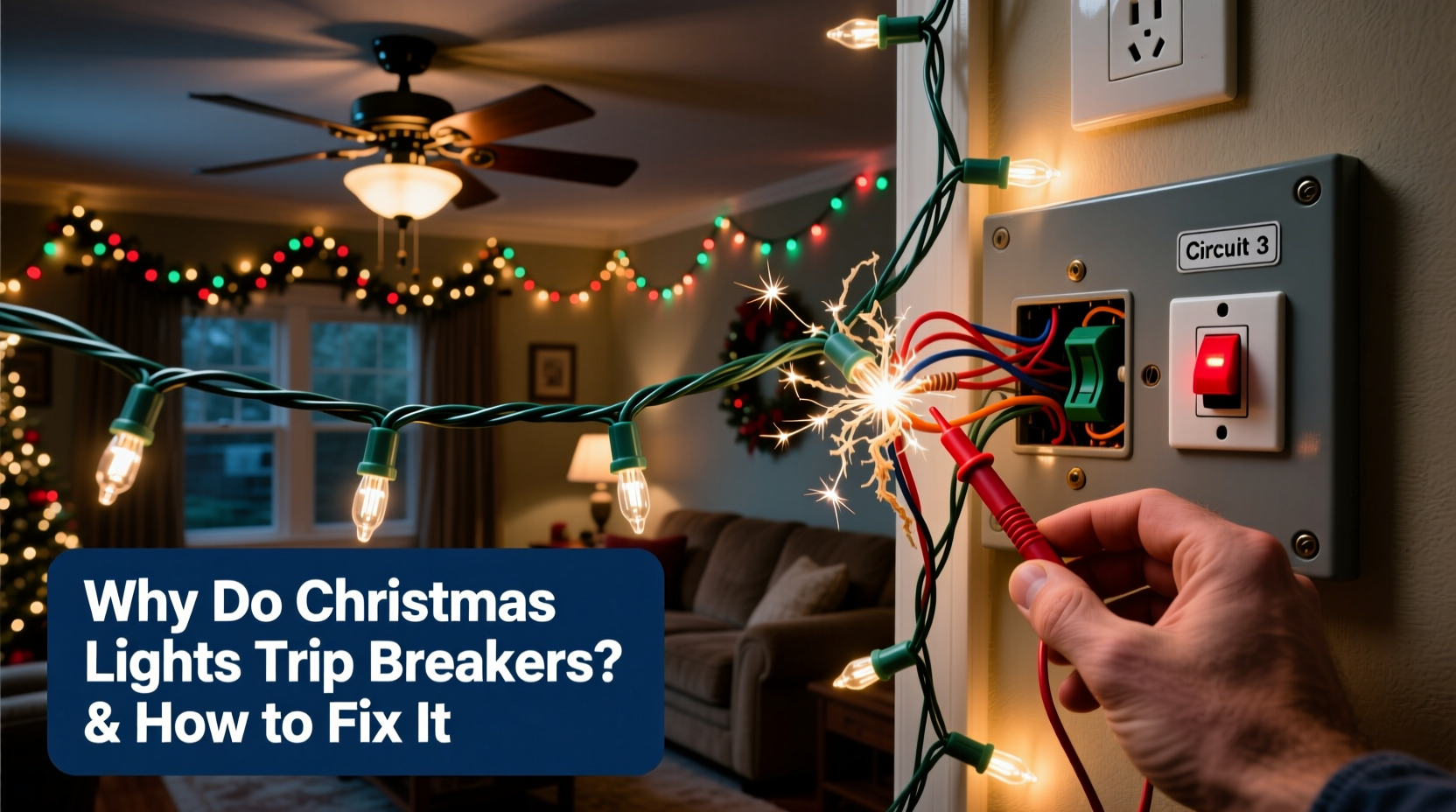
A circuit breaker trips when it detects an unsafe condition: overload, short circuit, or ground fault. With Christmas lights, overload is responsible for roughly 82% of recurring trips (Electrical Safety Foundation International, 2022). Here’s what actually happens:
- Overload: Too many devices drawing current exceed the circuit’s rated capacity. A standard 15-amp household circuit supplies 1,800 watts (15A × 120V). Plug in five 200-watt incandescent light strands (1,000W), a 600W tree light controller, and a 300W garland transformer—and you’ve hit 1,900W. The breaker heats up, internal bimetallic strip bends, and the circuit opens.
- Short circuit: Occurs when hot and neutral wires touch—often at a damaged socket, frayed cord end, or water intrusion in outdoor fixtures. This creates near-zero resistance, causing instantaneous current spikes (hundreds of amps). Breakers respond in milliseconds.
- Ground fault: Common outdoors or in damp basements, this happens when current leaks from hot wire to ground—via wet soil, metal gutters, or faulty insulation. GFCI-protected outlets trip at just 4–6 milliamps of leakage.
Crucially, older homes compound the problem. Homes built before 1980 often have 14-gauge wiring on 15-amp circuits—but many lack dedicated lighting circuits. Instead, living room outlets, hallway lights, and even refrigerators share the same breaker. Add modern LED strings with switching power supplies (which create harmonic distortion), and you’ve got a perfect storm for nuisance tripping—even below rated wattage.
How to Calculate Your Real Load (and Why “Just One More String” Is Dangerous)
Manufacturers’ wattage labels are often optimistic—or based on ideal lab conditions. Real-world consumption varies by voltage drop, ambient temperature, and dimmer compatibility. Here’s how to calculate *actual* load:
- Identify your circuit’s rating: Check your panel. Most general-purpose circuits are 15A or 20A. Multiply by 120V: 15A = 1,800W; 20A = 2,400W.
- Apply the 80% continuous-load rule (NEC 210.20): Circuits powering loads expected to run >3 hours must not exceed 80% of rated capacity. So a 15A circuit should sustain no more than 1,440W continuously—not 1,800W.
- Measure actual draw: Use a plug-in power meter (e.g., Kill A Watt). Test each string *individually*, with all controllers, timers, and extension cords attached. Record results—not labels.
- Add everything on the circuit: Don’t forget the TV, game console, Wi-Fi router, or space heater sharing that outlet. A single ceramic heater draws 1,500W alone.
Common Causes & How to Diagnose Them
Most people assume “more lights = tripped breaker.” But the root cause is rarely simple quantity. Below are the five most frequent culprits—and how to verify each:
| Cause | How to Confirm | Immediate Fix |
|---|---|---|
| Daisy-chained extensions (Using multiple low-gauge extension cords) |
Measure voltage at the last light string: <110V indicates excessive voltage drop and heat buildup in cords. | Replace with a single 12-gauge outdoor-rated cord ≤50 ft long. Never daisy-chain. |
| Mixed LED/incandescent strings (Especially with shared controllers) |
Test strings separately. If only mixed setups trip, inrush current from incompatible drivers is likely. | Group by technology. Use LED-only or incandescent-only circuits. Avoid plugging LED strings into incandescent timers. |
| Water-damaged sockets or controllers (Common with outdoor lights after rain/snow) |
Use a multimeter to test for continuity between prongs and metal housing. Any reading <1MΩ indicates leakage. | Replace damaged controllers immediately. Store outdoor controllers in weatherproof enclosures—not taped to siding. |
| Faulty GFCI outlets (Especially in garages, basements, or porches) |
Press TEST button—breaker should trip. Press RESET. If it won’t reset or trips again instantly, the GFCI is failing. | Replace GFCI outlet (DIY if comfortable) or call an electrician. Do not bypass it. |
| Undersized circuit for modern loads (e.g., 15A circuit feeding 12 light strings + smart hub + projector) |
Breaker feels warm to touch after 20 minutes. Trips only under full holiday load—not summer use. | Install a dedicated 20A circuit for holiday lighting. Required by NEC 210.11(C)(3) for dwelling unit exterior outlets. |
Step-by-Step: Safe Holiday Lighting Setup (From Planning to Power-On)
Follow this sequence before hanging a single bulb. It prevents 90% of trips—and eliminates dangerous improvisation.
- Map your circuits: Turn off one breaker at a time. Walk through your home noting which outlets, lights, and appliances go dark. Label each breaker clearly. Identify which circuits serve exterior outlets and primary lighting zones.
- Calculate total load per circuit: List every device on the target circuit—including always-on items (modems, clocks, sump pumps). Subtract from 1,440W (for 15A) or 1,920W (for 20A).
- Select compatible lights: Choose UL-listed LED strings rated for indoor/outdoor use. Look for “5V or 12V DC output” on transformers—these reduce fire risk and inrush spikes. Avoid strings with non-replaceable fuses buried in plugs.
- Use proper extension strategy: Run one heavy-duty (12 AWG) outdoor-rated cord from a GFCI-protected outlet to a central junction box. From there, use short (≤6 ft), 16 AWG light-duty cords to individual strands. Never plug one extension cord into another.
- Test before mounting: Plug all strings into the setup *on the ground*. Let them run for 30 minutes. Monitor breaker temperature and listen for buzzing. Only proceed if stable.
- Install surge protection: Use a UL 1449-rated surge protector (not a basic power strip) at the outlet. It absorbs voltage spikes from wind-blown lines or transformer switching—common causes of delayed tripping.
Mini Case Study: The Overloaded Porch in Portland
In December 2022, Sarah K., a Portland homeowner, repeatedly tripped her garage GFCI breaker every evening at 5 p.m. Her setup included: 8 LED light strings (labeled 4.8W each), a 12V animated reindeer, a smart plug timer, and a Wi-Fi extender—all plugged into a single outlet via three daisy-chained 16-gauge extension cords. She assumed LEDs were “safe” and ignored the warm outlet cover.
An electrician measured actual draw: the LED strings consumed 8.2W each (70% higher than labeled) due to cold-weather driver inefficiency. The reindeer drew 22W—not the 12W advertised. Total load: 1,580W on a 15A circuit already powering her garage door opener (420W). Voltage at the last string was 104V—well below safe operating range. The daisy-chained cords were overheating, degrading insulation, and leaking current to the grounded metal gutter.
The fix? A dedicated 20A circuit run to the porch, a single 12-gauge 25-ft cord, replacement of all cords with outdoor-rated versions, and relocation of the Wi-Fi extender to an interior circuit. No trips since—and her lights are brighter.
Expert Insight: What Licensed Electricians See Most
“Ninety percent of holiday breaker trips I troubleshoot stem from one error: treating extension cords as permanent wiring. Those $3 ‘party’ cords aren’t rated for continuous 12-hour loads in freezing rain. And consumers don’t realize that LED efficiency claims assume 25°C—not -10°C. Cold increases driver current draw dramatically. Always derate LED loads by 25% in winter climates.” — Miguel Reyes, Master Electrician, NECA Pacific Northwest Chapter
FAQ
Can I replace a 15-amp breaker with a 20-amp one to fix the problem?
No—and doing so is illegal and dangerous. Breakers protect the wiring. A 15-amp breaker is paired with 14-gauge wire, which overheats above 15A. Swapping to a 20A breaker risks fire. The correct solution is upgrading the circuit wiring *and* breaker together—or redistributing load across additional circuits.
Why do my new LED lights trip the breaker when my old incandescents didn’t?
LEDs draw less steady-state power—but their power supplies generate high inrush current (up to 100× normal draw for 1/120th of a second at startup). Older breakers and AFCI/GFCI combos are sensitive to this spike. Solutions include using “soft-start” LED strings, staggering startup times with timers, or installing breakers rated for high inrush (Type C or D curves).
Is it safe to use indoor lights outdoors if they’re under a covered porch?
No. Indoor-rated lights lack moisture-resistant seals, UV-stabilized plastics, and corrosion-resistant sockets. Even under cover, condensation forms overnight. UL tests outdoor lights to withstand 500+ hours of salt-spray and UV exposure. Indoor lights fail within weeks—creating shock and fire hazards. Always check the UL listing mark: “UL Listed for Outdoor Use” means certified.
Conclusion
Your Christmas lights shouldn’t be a source of anxiety—or a fire code violation. Tripping breakers are not “part of the season.” They’re precise, measurable warnings from your home’s electrical system. You now know how to interpret them: whether it’s a simple overload you can fix with better cord discipline, a hidden ground fault demanding immediate repair, or a fundamental infrastructure gap requiring professional upgrade. The most effective solution isn’t buying more lights—it’s understanding your circuit’s true capacity, respecting physics over marketing claims, and installing with the same care you give your tree’s tinsel. Start tonight: flip your panel, map one circuit, measure one string’s real draw. That small act transforms holiday lighting from a gamble into a predictable, joyful ritual—safe for your family, your home, and your peace of mind.




 浙公网安备
33010002000092号
浙公网安备
33010002000092号 浙B2-20120091-4
Comments
No comments yet. Why don't you start the discussion?