
Every year, as the holiday season approaches, millions of homes are adorned with twinkling Christmas lights. But nothing dampens the festive spirit faster than plugging in a string of lights only to find half of them dark. This common issue — where a strand works partially — is frustrating but usually solvable. Most modern incandescent mini-light strings are wired in series, meaning if one bulb fails or becomes loose, it can interrupt the circuit for the entire section. Understanding why this happens and how to fix it saves time, money, and stress.
The good news: you don’t need an electrician to troubleshoot this. With a systematic approach and a few simple tools, you can identify and replace the problematic bulb or component. This guide walks through the causes, detection methods, repair techniques, and preventive measures so your lights shine fully again — both this season and the next.
How Christmas Light Circuits Work
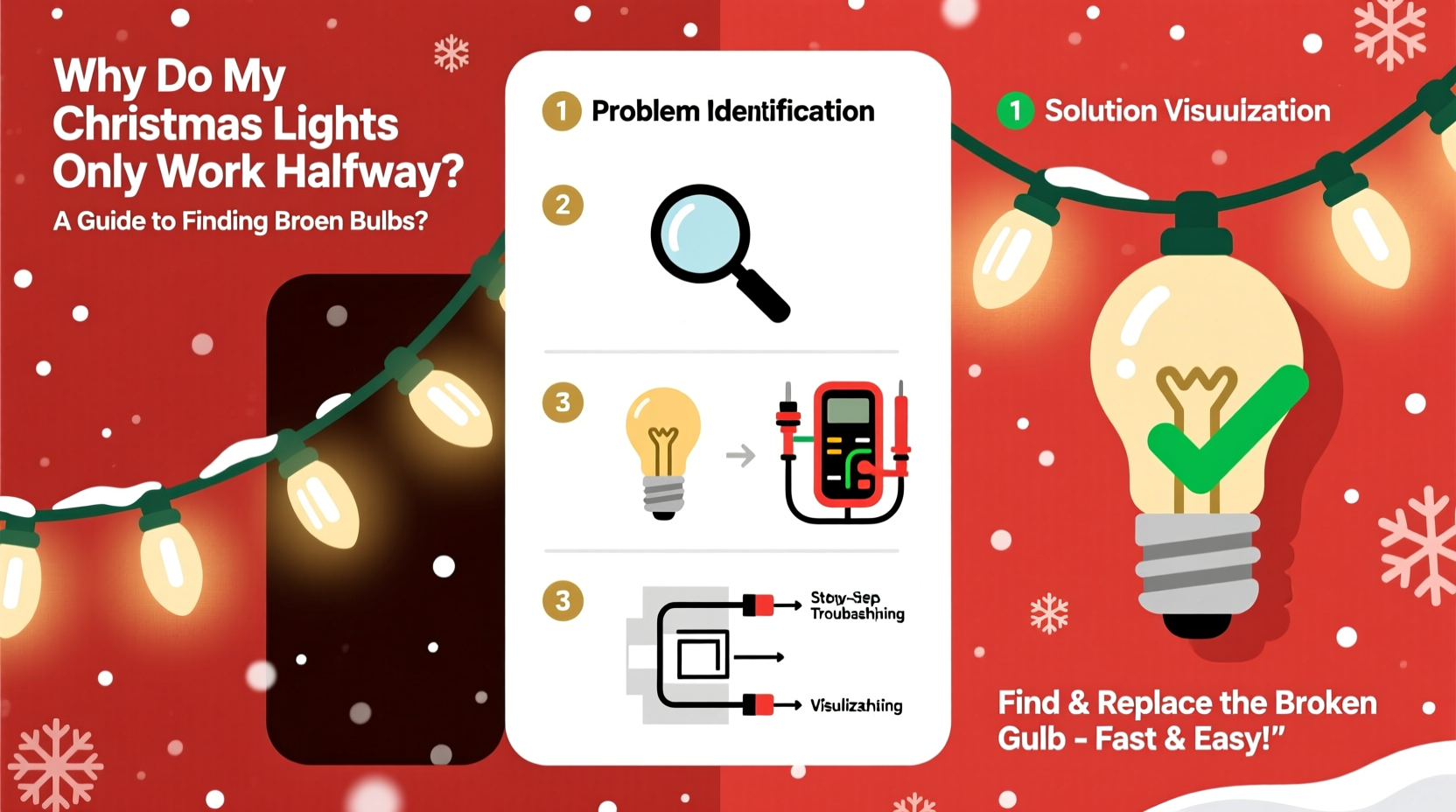
To understand why only half your lights come on, it’s essential to know how most traditional light strings are wired. Unlike household circuits that use parallel wiring (where each bulb operates independently), many older and budget-friendly Christmas light strands use **series wiring**. In a series circuit, electricity flows from the plug, through each bulb in sequence, and back to complete the circuit. If one bulb burns out, loosens, or develops a broken filament, the current stops flowing beyond that point.
However, modern light sets often include **shunt wires** — tiny backup conductors inside each bulb socket. When a filament breaks, the shunt activates and reroutes current around the dead bulb, allowing the rest of the strand to stay lit. But shunts don’t always work reliably, especially after repeated use or exposure to moisture. That’s why sometimes only part of the strand lights up — the break occurs before the shunt can engage properly.
Additionally, some light strings are divided into two or more independent circuits within the same cord. These “dual-wave” or segmented strands may have one side working while the other remains dark due to a localized failure. Always check whether your strand is a single continuous circuit or has multiple zones.
Step-by-Step Guide to Finding the Broken Bulb
Finding the culprit behind a half-lit string doesn’t require guesswork. Follow this methodical process to locate and resolve the issue efficiently.
- Unplug the lights — Safety first. Never handle electrical components while powered.
- Inspect visually — Run your fingers along the strand, checking for obvious signs: missing bulbs, cracked sockets, frayed wires, or browned discoloration indicating overheating.
- Check connections between sections — If using multiple connected strands, disconnect them and test each individually. A faulty connection or overloaded circuit can mimic a bulb problem.
- Plug in the strand — Observe which portion lights up. Mark the last working bulb just before the dark section begins.
- Use a light tester — A non-contact voltage detector or specialized Christmas light tester (like the LightKeeper Pro) can detect current flow without removing bulbs. Slide it over each bulb in the dark zone; when the signal drops, you’re near the fault.
- Remove and inspect bulbs — Starting from the first unlit socket, take out each bulb and examine the filament. Replace any with broken filaments or loose metal bases.
- Test after each replacement — Reinsert one known-good bulb at a time and retest. Often, simply reseating a loose bulb restores continuity.
- Replace fuses if necessary — Some plugs contain small glass fuses. If no part of the strand lights, check these with a multimeter or replace them with spares found in the plug compartment.
This process typically takes 10–20 minutes per strand but dramatically increases success rates compared to random bulb swapping.
Common Causes of Half-Lit Strings
While a single burned-out bulb is the usual suspect, several other issues can cause partial illumination:
- Loose bulb — Vibration during storage or handling can cause bulbs to shift slightly, breaking contact even if the filament is intact.
- Faulty shunt — The internal wire meant to bypass a dead filament may fail due to age or corrosion, especially in older strands.
- Damaged socket — Cracked or warped plastic sockets prevent proper electrical contact.
- Cut or pinched wire — Accidental damage from staples, nails, or foot traffic can sever internal conductors.
- Water intrusion — Moisture inside sockets leads to short circuits or corrosion, particularly in outdoor setups.
- Overloading — Connecting too many strands end-to-end exceeds manufacturer limits, causing thermal cutoffs or fuse blowouts.
One often-overlooked factor is **voltage drop**. In long runs of series-wired lights, resistance builds up, dimming bulbs toward the end. While not the same as a total failure, it can create the illusion of malfunction.
“About 70% of ‘dead’ light strings we see at repair clinics actually just have one loose bulb. Taking time to inspect thoroughly makes all the difference.” — Mark Reynolds, Holiday Lighting Technician, Midwest Electric Displays
Tips and Tools for Faster Diagnosis
Speed up troubleshooting with these expert-backed strategies and tools:
| Tool | Use Case | Effectiveness |
|---|---|---|
| Non-contact voltage tester | Detects live current in wires and sockets without disassembly | High – ideal for narrowing down zones |
| Christmas light tester (e.g., LightKeeper Pro) | Sends a pulse to clear shunt failures and tests bulb continuity | Very High – fixes many issues instantly |
| Multimeter | Tests individual bulbs, fuses, and wire continuity | Moderate – requires technical knowledge |
| Splice connector or replacement socket kit | Repairs damaged wires or broken sockets | Essential for permanent fixes |
Affordable testers like the LightKeeper Pro cost under $20 and can revive seemingly dead strands by clearing stuck shunts — a feature most people don’t realize exists.
Mini Case Study: Reviving a Family Heirloom Strand
Carol from Vermont inherited a set of red-and-gold mini-lights from her grandmother, used every Christmas since 1985. Last year, only the first 35 bulbs lit. She tried replacing visible burnouts, but the second half stayed dark. Frustrated, she brought the strand to a local holiday repair event.
The technician used a LightKeeper Pro to send a surge through the dark section. A faint click was heard inside one middle bulb — the shunt had fused shut due to heat buildup over decades. After activating the shunt, the full strand lit up. Two additional loose bulbs were reseated, and Carol left with her tradition restored.
This example shows that age alone doesn’t doom a strand. Many vintage lights outperform modern ones in build quality — they just need proper care.
Preventive Maintenance Checklist
Extend the life of your Christmas lights and reduce future headaches with this seasonal checklist:
- ✅ Carefully remove lights from displays — avoid yanking or twisting cords.
- ✅ Inspect each strand before storing — replace flickering or dim bulbs immediately.
- ✅ Clean sockets gently with compressed air or a dry brush to remove dust and debris.
- ✅ Store coiled loosely on a cardboard reel or in a dedicated light keeper box — never crumpled in a bin.
- ✅ Keep in a cool, dry place — basements and garages expose lights to humidity and pests.
- ✅ Label strands by location (e.g., “Front Porch,” “Tree Top”) for easier setup next year.
- ✅ Test all strands before decorating — catch issues early when replacements are easier to find.
Frequently Asked Questions
Can LED Christmas lights have the same half-lit problem?
Yes, though less commonly. While LEDs are more energy-efficient and durable, many still use series wiring. A single failed diode or driver issue can cause partial failure. However, LEDs often have built-in rectifiers and better fault tolerance. If half a modern LED strand isn’t working, check the power adapter or controller first.
Is it worth fixing old light strings, or should I just buy new ones?
It depends. High-quality incandescent strands with thick wire gauges and robust sockets are often more reliable than today’s mass-market versions. Fixing a well-made older strand can save money and reduce waste. However, if the wire insulation is brittle or more than three bulbs show damage, replacement may be safer and more efficient. Consider upgrading to commercial-grade or LED versions for longevity.
Why do my lights work when I wiggle a certain bulb?
This indicates a loose connection — either the bulb isn’t seated fully, the socket contacts are bent, or internal wire strands are broken. Wiggle testing helps isolate the weak point. Once located, replace or reseat the bulb and ensure snug fit. For recurring issues, consider adding a small dot of electrical contact grease to prevent oxidation.
Conclusion: Shine Brighter This Season
A half-lit Christmas light strand isn’t a lost cause — it’s a puzzle waiting to be solved. With basic knowledge of series circuits, a few simple tools, and a patient approach, you can restore full brightness and preserve your holiday ambiance. More importantly, practicing careful storage and annual maintenance reduces future failures and keeps beloved decorations glowing for years.
Don’t let a single bad bulb dim your spirit. Take action tonight: pull out those boxes, test each strand, and fix what’s broken. Your future self — standing in the cold December night trying to decorate — will thank you.




 浙公网安备
33010002000092号
浙公网安备
33010002000092号 浙B2-20120091-4
Comments
No comments yet. Why don't you start the discussion?