
It’s a familiar holiday frustration: you plug in your string of Christmas lights, and nothing happens—until you press down on a particular bulb, twist a section near the plug, or gently bend the wire near a socket. Suddenly, the whole strand flickers to life. Release the pressure? Darkness returns. This isn’t magic—it’s physics revealing a failing connection. Unlike modern LED strings with built-in diagnostics, traditional incandescent mini-lights (and many budget LED sets) rely on fragile, daisy-chained wiring where one compromised point can break the entire circuit. Understanding *why* physical pressure restores function is the first step toward a permanent fix—not just a seasonal bandage.
The Core Problem: Why Pressure “Fixes” the Lights
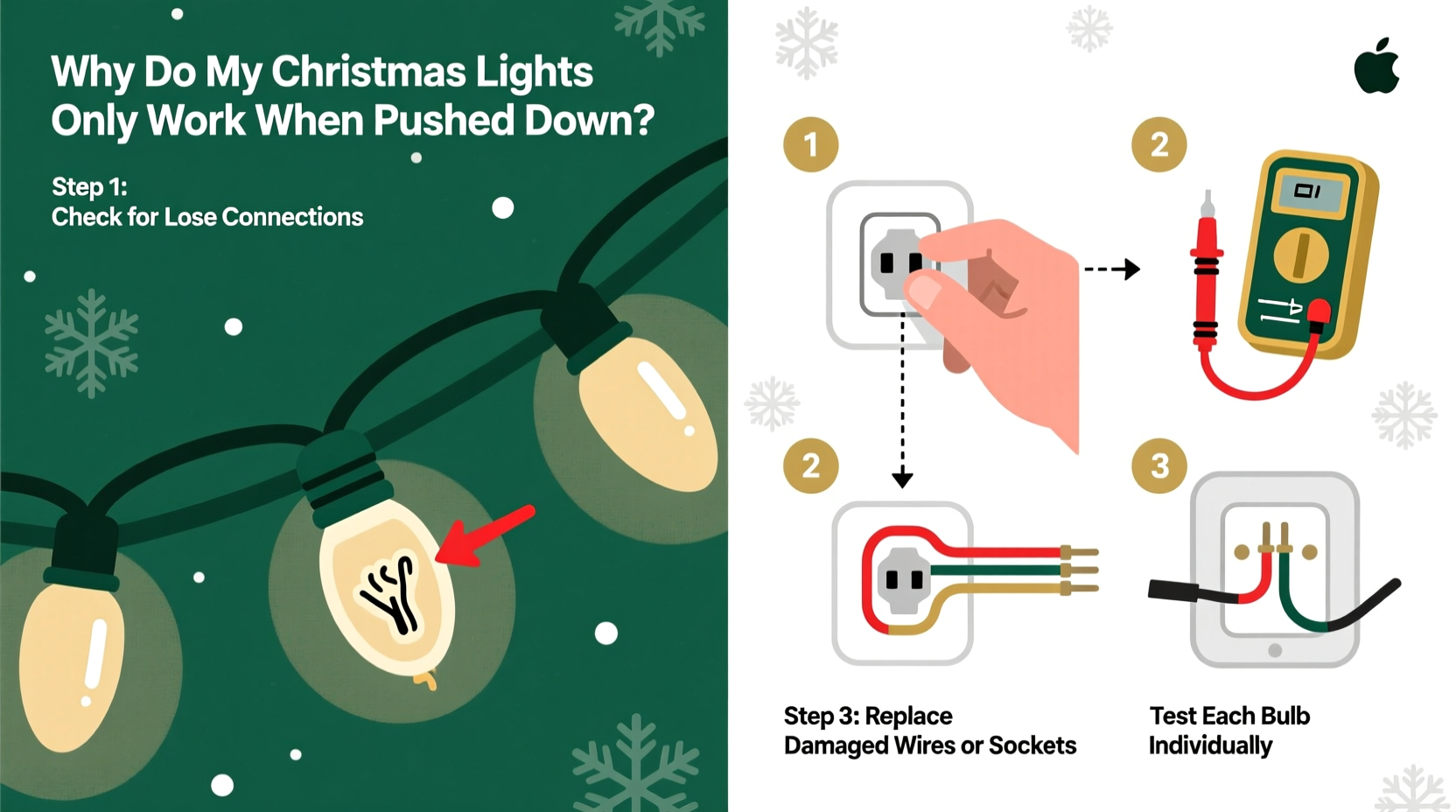
Christmas light strings operate as a single electrical loop: current flows from the plug, through each bulb’s filament or LED driver, and back to the source. In incandescent sets, bulbs are wired in series—meaning if one bulb fails open-circuit, the entire string goes dark. In many LED strings, especially older or value-tier models, manufacturers use hybrid wiring: groups of LEDs in parallel, but those groups connected in series. Either way, an interruption anywhere along the conductive path halts operation.
When pressing down on a bulb, socket, or wire segment restores illumination, it indicates a mechanical failure—not a burnt-out component. The pressure temporarily bridges a gap caused by one or more of these issues:
- Loose or corroded bulb contact: The metal base of the bulb isn’t making full contact with the spring-loaded socket terminals due to oxidation, bent contacts, or thermal expansion/contraction over time.
- Fatigued or cracked socket housing: Plastic sockets become brittle with age and temperature swings. Micro-fractures allow internal terminals to shift, losing contact until pressure realigns them.
- Broken or fractured wire strand: Internal copper wires—especially near solder joints, plugs, or tight bends—can develop hairline breaks. Bending compresses the gap, allowing current to jump across momentarily.
- Failed shunt in incandescent bulbs: Many mini-incandescent bulbs contain a tiny wire shunt that bypasses a burnt filament. If the shunt itself is oxidized or misaligned, pressure may force contact long enough for current to flow.
- Loose plug or end connector: The male/female plug assembly may have internal solder joint cracks or loose crimp connections that only seat under manual pressure.
This isn’t a sign the lights are “almost working.” It’s a clear diagnostic signal: electricity is trying to flow, but the path is intermittently compromised at a specific physical location.
Step-by-Step Diagnostic & Repair Protocol
Follow this sequence methodically. Skipping steps wastes time and risks overlooking the root cause. Always unplug the lights before handling.
- Unplug and inspect visually: Look for obvious damage—melted plastic, exposed copper, kinked wires, or blackened sockets. Note where pressure restored function (e.g., “3rd bulb from the plug,” “near the female connector”).
- Test with a multimeter (if available): Set to continuity mode. Place one probe on the metal screw shell of the suspect bulb socket, the other on the adjacent socket’s shell. No continuity? The break is between them. Continuity present? The issue is likely in the bulb itself or its contact.
- Isolate the faulty bulb: Remove each bulb one at a time, starting from the end nearest the plug. After removing a bulb, plug in the strand. If the rest illuminate, that bulb was the weak link—or its socket is compromised. If the strand stays dark, continue downstream.
- Check socket integrity: With the bulb removed, examine the socket’s two internal metal contacts. Are they flattened, corroded (white/green residue), or bent outward? Use needle-nose pliers to gently lift the center contact upward 1–2 mm. For side contacts, pinch inward slightly to restore spring tension.
- Examine wire junctions: Focus on the 6 inches before and after the problem zone. Flex the wire slowly while watching for flicker. If lights blink during flexing, cut the wire 1 inch before and after the suspected break, strip ¼ inch of insulation, and splice with a waterproof wire nut or solder + heat-shrink tubing.
Do’s and Don’ts: Handling Holiday Lighting Safely & Effectively
Many well-intentioned fixes actually accelerate failure or create hazards. This table clarifies safe practices versus common misconceptions:
| Action | Do | Don’t |
|---|---|---|
| Bulb replacement | Use bulbs rated for the same voltage and wattage; match base type (E12, E17, wedge) exactly. | Substitute higher-wattage bulbs—even if they fit—to “brighten” the strand. This overheats wiring and sockets. |
| Cleaning contacts | Wipe socket contacts with isopropyl alcohol on a cotton swab to dissolve oxidation. | Use steel wool, sandpaper, or vinegar—these leave conductive residue or scratch protective plating. |
| Storage | Wind lights loosely around a cardboard tube or use a dedicated light-reel; store in a cool, dry place away from UV exposure. | Stuff lights into plastic bags or boxes where heat and moisture trap, accelerating corrosion and plastic embrittlement. |
| Repair materials | Use UL-listed wire nuts or solder with rosin-core solder and heat-shrink tubing rated for outdoor use. | Wrap splices with electrical tape alone—it degrades in cold, loses adhesion, and offers no moisture protection. |
| Troubleshooting tools | Use a non-contact voltage tester to confirm power reaches the plug, or a bulb tester to verify individual bulb function. | Rely solely on visual inspection—oxidation and micro-fractures are often invisible to the naked eye. |
Real-World Case Study: The “Third-Bulb-From-the-Plug” Syndrome
Sarah, a property manager in Chicago, managed holiday lighting for six historic apartment buildings. Each November, her team installed identical 100-light incandescent strands on exterior railings. By mid-December, 40% of strands exhibited the “press-to-work” symptom—consistently at the third bulb from the plug. Her maintenance logs revealed a pattern: all affected strands were from the same 2019 batch, stored in an unheated basement over summer.
Her technician dissected a failed strand and discovered the root cause: the third socket’s internal brass contact had oxidized and lost spring tension due to humidity exposure. Worse, the plastic housing had micro-cracks from repeated freeze-thaw cycles, allowing the contact to shift laterally. When pressed, the contact snapped back into alignment. Replacing the first five sockets (a known stress point near the plug) and applying dielectric grease to contacts reduced repeat failures by 92% the following season.
This case underscores a critical insight: failure points aren’t random. They cluster at locations of mechanical stress (near plugs, bends, or ends) and environmental vulnerability (exposed to moisture, temperature extremes, or UV).
Expert Insight: What Industry Technicians See Most Often
With over 25 years repairing commercial and residential lighting, Mike Torres leads the technical support team at LuminaStrand, a U.S.-based holiday lighting manufacturer. His team processes over 12,000 service inquiries annually—most involving intermittent operation. He emphasizes a fundamental truth often overlooked by consumers:
“The ‘press-to-work’ behavior is rarely about the bulb—it’s almost always about the socket or wire junction. Bulbs fail catastrophically (burnt-out filament, visible break). Intermittent function means the infrastructure holding the bulb is failing. That’s why replacing bulbs without checking socket integrity solves less than 15% of these cases.” — Mike Torres, Senior Lighting Technician, LuminaStrand
Torres also notes that LED strands aren’t immune: cheap drivers and undersized wiring cause similar symptoms. “We see the same pressure-dependent behavior in $8 LED strings where the PCB trace under the third bulb has cracked from thermal cycling. The fix is identical—locate the fracture, reinforce the trace, or replace the section.”
FAQ: Addressing Common Concerns
Can I just replace the entire string instead of troubleshooting?
Yes—but consider longevity and sustainability. A quality string costs $25–$45 and lasts 5–7 seasons with proper care. Replacing annually adds up to $150–$300 over five years. Diagnosing and repairing one or two problem points typically takes under 20 minutes and costs under $5 in parts. Plus, you retain sentimental or vintage strands that can’t be replicated.
Why do newer LED lights sometimes show the same issue?
While LEDs last longer, many budget LED strings use the same socket designs and thin-gauge wiring as incandescent sets. The difference is in failure mode: instead of a burnt filament, it’s a cracked solder joint on the LED’s driver board or a fatigued wire lead. Pressure temporarily reconnects the fractured trace. Higher-end LED strings use rigid PCB boards and reinforced strain relief—making them far less prone to this issue.
Is it safe to splice wires outdoors?
Only if done correctly. Standard indoor wire nuts are unsafe for outdoor use—they absorb moisture and corrode. Use waterproof, gel-filled wire connectors rated for direct burial (UL 486C) or solder joints sealed with marine-grade heat-shrink tubing. Never splice near the plug end where water ingress is most likely. If the break is within 12 inches of the plug, replace the entire plug assembly using a UL-listed replacement kit.
Prevention Strategies for Long-Term Reliability
Troubleshooting fixes today’s problem—but prevention avoids next year’s frustration. Implement these habits before storing lights away:
- Test before storage: Plug in each strand for 15 minutes before boxing. Note any dim bulbs or flickering sections and address them immediately.
- Apply dielectric grease: A tiny dab on socket contacts prevents oxidation. Use only silicone-based dielectric grease—not petroleum jelly, which degrades plastic.
- Label problem zones: Use a permanent marker to dot the base of bulbs or sockets that required adjustment. Next season, inspect those points first.
- Replace aging plugs: After 3–4 seasons, replace male/female plugs. Internal springs weaken, and solder joints fatigue—making them the most common “pressure-required” failure point.
- Upgrade strategically: Replace the oldest 20% of your strands every year with commercial-grade lights featuring reinforced sockets and thicker gauge wire (e.g., 22 AWG instead of 24 AWG).
Conclusion: From Temporary Fix to Lasting Function
That moment when pressing down on a bulb restores light isn’t a quirk—it’s your lights sending a precise diagnostic message. It tells you exactly where the electrical pathway is fraying, where materials are fatiguing, and where design limitations meet real-world wear. Treating it as a mere inconvenience misses an opportunity: to understand the physics of your lighting, extend its functional life, and reduce seasonal waste. Every repaired socket, every cleaned contact, every properly spliced wire is a small act of intentionality—transforming disposable decor into durable, reliable tradition. Your lights don’t need to be replaced. They need to be understood, maintained, and respected for what they are: intricate, interconnected systems built to withstand joy, not just survive it.




 浙公网安备
33010002000092号
浙公网安备
33010002000092号 浙B2-20120091-4
Comments
No comments yet. Why don't you start the discussion?