
It’s a familiar holiday ritual: you plug in your string of Christmas lights, only for most of them to stay dark. Then, almost magically, they flicker to life when you twist or wiggle a certain section. While this temporary fix might get you through another season, it's not a solution—it’s a sign of an underlying electrical issue that worsens over time. Understanding why this happens—and how to address it properly—can save you from seasonal frustration, potential fire hazards, and wasted money on repeated replacements.
Christmas lights, especially older incandescent strands, are vulnerable to wear, corrosion, and manufacturing flaws. The “twist-to-work” phenomenon is rarely random; it’s typically caused by loose connections, broken filaments, or degraded wiring within individual bulbs or sockets. Left unaddressed, these problems can spread across the strand or even affect other connected strings. More importantly, repeatedly manipulating fragile wiring increases the risk of short circuits or overheating.
The Science Behind the Wiggle: Why Twisting Makes Lights Work
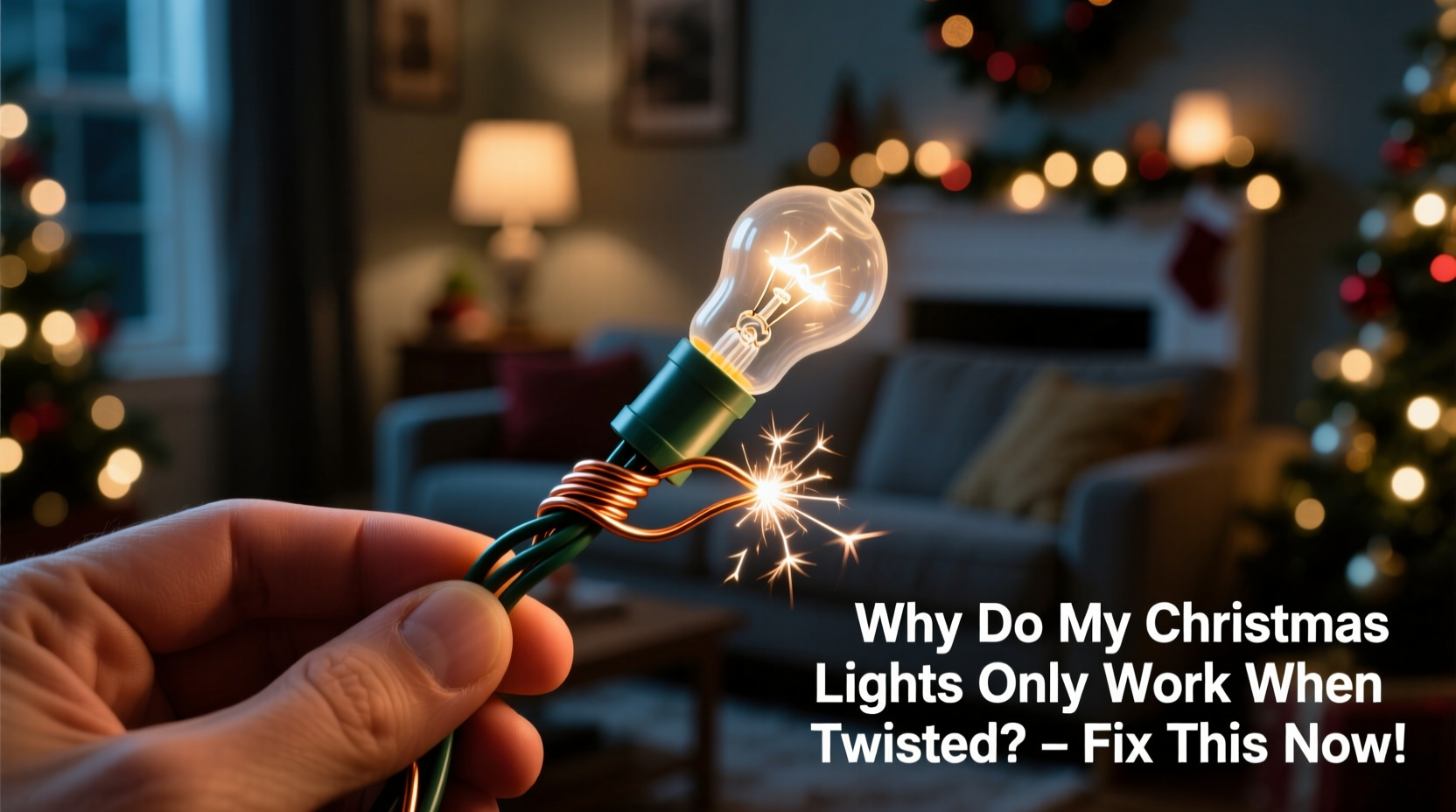
When you twist or bend a section of Christmas lights and they suddenly illuminate, you’re temporarily restoring an interrupted electrical circuit. Most traditional mini-light strings are wired in series, meaning electricity flows from one bulb to the next in a single path. If any point in that path breaks—due to a loose bulb, corroded contact, or wire fracture—the entire circuit fails.
Twisting the strand momentarily realigns misaligned metal contacts inside a socket or reconnects a nearly severed internal wire. This allows current to pass again, at least until movement or temperature changes break the tenuous connection once more. It’s akin to tapping an old television to get the picture back—functional in the moment, but a clear signal that something is failing.
“Intermittent lighting due to physical manipulation indicates a compromised circuit. It may seem harmless, but such instability can lead to arcing, overheating, and increased fire risk.” — Dr. Alan Reeves, Electrical Safety Engineer, National Home Electronics Institute
Common Causes of Intermittent Light Failure
Several mechanical and environmental factors contribute to lights working only when twisted. Identifying the root cause is essential before attempting repairs.
- Loose or improperly seated bulbs: Over time, vibration or improper storage can cause bulbs to shift slightly in their sockets, breaking contact with the live terminals.
- Corroded or oxidized socket contacts: Exposure to moisture—even ambient humidity—can create a thin layer of oxidation on metal contacts, inhibiting conductivity.
- Frayed or broken shunt wires: Many mini-lights use shunts (small bypass wires) to keep the rest of the strand lit if one filament burns out. If the shunt is damaged or disconnected, the entire circuit fails unless jostled into temporary contact.
- Internal wire fractures: Thin copper wires inside the strand can develop micro-fractures from repeated bending, especially near plug ends or connectors.
- Poor manufacturing quality: Budget light sets often use thinner gauge wires, weak solder joints, and low-grade plastics, making them prone to early failure.
Step-by-Step Guide to Diagnose and Fix Problematic Light Strings
Before discarding a strand, follow this systematic approach to determine whether it can be safely repaired or should be replaced.
- Unplug and visually inspect the entire strand. Look for cracked bulbs, melted sockets, exposed wires, or sections with visible kinks or crushing. Discard immediately if damage is severe.
- Test the power source. Plug the lights into a known-working outlet. Use a circuit tester to confirm the outlet delivers consistent voltage.
- Check the fuse (if applicable). Most plug-end caps contain two small fuses. Use a multimeter to test continuity. Replace with identical-rated fuses only—typically 3–5 amps for standard sets.
- Inspect each bulb. Remove bulbs one by one and examine the filament. A broken or sagging filament means the bulb must be replaced. Also check for darkened glass, which indicates overheating.
- Wiggle-test systematically. With the strand plugged in (and hands dry), gently bend each section while observing for flickering. Mark problem zones with tape for closer inspection.
- Clean socket contacts. Use a cotton swab dipped in isopropyl alcohol to wipe inside each socket. Let dry completely before reinserting bulbs.
- Replace faulty bulbs. Use manufacturer-matched replacements. Mismatched voltages or wattages can overload the circuit.
- Test after repair. Reassemble and plug in. If lights remain inconsistent, the issue likely lies in internal wiring—not just bulbs.
If the strand still requires twisting to function after these steps, internal conductor damage is probable. At this stage, repair becomes impractical and potentially unsafe.
Do’s and Don’ts When Repairing or Using Faulty Light Strings
| Action | Recommended? | Reason |
|---|---|---|
| Use needle-nose pliers to adjust socket tabs | ✅ Yes | Gently spreading the bottom contact tab improves bulb grip and conductivity. |
| Splice broken wires with electrical tape | ❌ No | Tape degrades over time and doesn’t provide secure insulation or strain relief. |
| Connect multiple strands beyond manufacturer limit | ❌ No | Overloading circuits causes overheating and increases fire risk. |
| Store lights coiled loosely around a cardboard template | ✅ Yes | Prevents kinking and reduces internal wire stress during storage. |
| Use outdoor-rated lights indoors | ✅ Yes | Safer than using indoor-only lights outside, but never vice versa. |
| Keep wiggling malfunctioning lights season after season | ❌ No | Escalates risk of short circuits and undermines long-term safety. |
Real Example: How One Homeowner Fixed Recurring Light Issues
Sarah M., a homeowner in Vermont, had used the same set of icicle lights on her eaves for seven years. Each November, she’d spend 20 minutes twisting and adjusting until all sections lit. Last year, one segment began sparking faintly when touched. Concerned, she unplugged the strand and took it to a local electrician for evaluation.
The technician discovered that repeated bending had fractured the neutral wire inside the connector housing. When Sarah twisted the cord, she was intermittently reconnecting the broken ends—creating brief arcs. He advised immediate retirement of the set and recommended upgrading to commercial-grade LED lights with parallel wiring, which are less prone to cascading failures.
After switching, Sarah reported zero issues during the following holiday season. Her total investment was $42—less than half what she’d spent replacing failed sets over the prior five years. More importantly, her home became safer during a high-risk electrical usage period.
Upgrade Smart: Choosing Lights That Won’t Fail Mid-Twist
Modern LED light strings offer significant advantages over older incandescent models, particularly in reliability and energy efficiency. Unlike series-wired incandescents, many LEDs use partial-series or parallel configurations, so one dead bulb won’t kill the whole strand. They also generate far less heat, reducing insulation degradation and fire hazards.
When shopping for durable holiday lighting, look for the following features:
- Shunted vs. non-shunted sockets: Shunted sockets have built-in bypasses, helping maintain circuit continuity if a filament fails. Ideal for series strings.
- UL certification: Ensures compliance with U.S. safety standards for both indoor and outdoor use.
- Wire gauge (AWG): Lower numbers mean thicker wires. Aim for 22 AWG or lower (e.g., 20 or 18) for better durability.
- Replaceable fuses: A small detail, but critical for troubleshooting and extending lifespan.
- Modular design: Some premium brands allow section replacement instead of discarding the entire strand.
FAQ: Common Questions About Flickering and Twist-Dependent Lights
Can I permanently fix a light string that only works when twisted?
In rare cases, yes—if the issue is limited to a single corroded socket or loose bulb. However, if the problem stems from internal wire fractures or degraded insulation, permanent repair isn't feasible or safe. Such strands should be retired.
Why do only some sections come on when I twist the lights?
This usually indicates a break between sections. In series wiring, if one segment loses continuity, everything downstream goes dark. Twisting may briefly restore contact at the break point, illuminating the affected zone until movement disrupts it again.
Are LED Christmas lights immune to this problem?
Not entirely, but they’re far less susceptible. LEDs consume less power, produce minimal heat, and often feature better build quality. Many use redundant pathways so that a single point failure doesn’t extinguish the whole string.
Conclusion: Stop Twisting, Start Solving
Relying on twisting or wiggling to make Christmas lights work is a temporary workaround masking a growing safety concern. What begins as a minor inconvenience can evolve into a fire hazard, especially when frayed wires arc or overheated sockets melt. By understanding the electrical principles behind light string failures, conducting methodical diagnostics, and knowing when to replace rather than repair, you protect both your holiday ambiance and your home.
Investing in higher-quality, UL-listed LED strings may cost more upfront, but it pays off in longevity, safety, and peace of mind. Combine smart purchasing with proper storage and annual inspections, and you’ll spend less time troubleshooting and more time enjoying the glow.




 浙公网安备
33010002000092号
浙公网安备
33010002000092号 浙B2-20120091-4
Comments
No comments yet. Why don't you start the discussion?