
If you spend hours in front of a screen, you’ve likely experienced that uncomfortable, sandy sensation in your eyes—like there’s dust or an eyelash trapped under your lids. You reach for artificial tears, apply them diligently, and yet the grittiness returns within minutes. This is a common frustration, especially among office workers, students, and remote professionals. The truth is, while artificial tears offer temporary relief, they often fail to address the root causes of persistent dry, gritty eyes in digital environments.
Digital eye strain affects over 60% of screen users, according to the American Optometric Association. And for many, dryness isn’t just a minor annoyance—it impacts focus, comfort, and long-term eye health. Artificial tears are a helpful tool, but they’re not a cure-all. Understanding why your eyes still feel gritty requires looking beyond surface lubrication and into how prolonged screen exposure disrupts your natural tear system, blink mechanics, and ocular surface integrity.
The Hidden Mechanics Behind Gritty Eyes
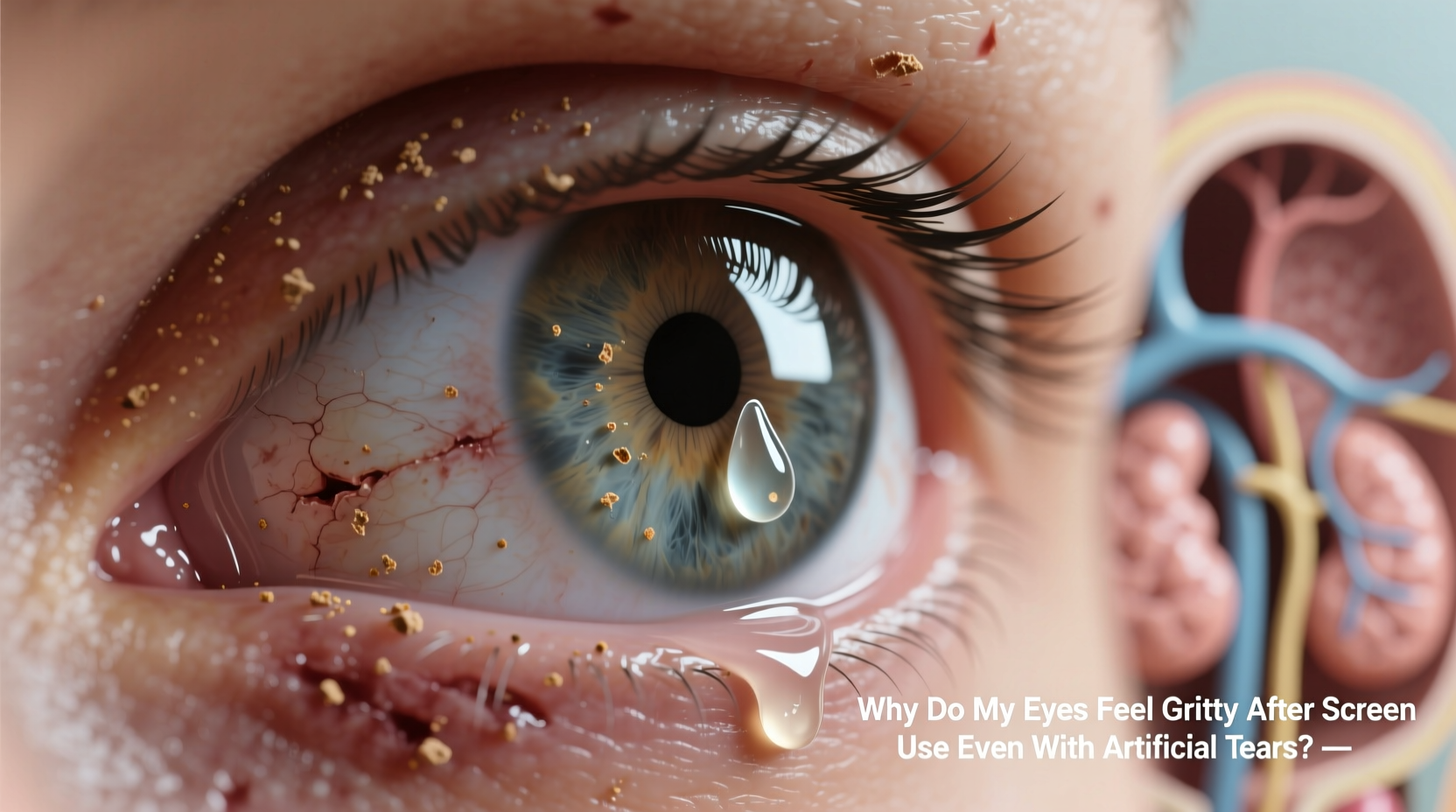
Your eyes stay moist and comfortable thanks to a complex, three-layered tear film: the mucin layer (closest to the cornea), the aqueous (water) layer, and the lipid (oil) layer on top. Each plays a vital role. The lipid layer, produced by meibomian glands in your eyelids, prevents evaporation. When this oily layer breaks down, tears evaporate too quickly—even if you're producing enough moisture.
Screen use drastically reduces blink rate. While we normally blink 15–20 times per minute, studies show this drops to 5–7 during focused screen work. Worse, many of these blinks are “partial”—your eyelids don’t fully close. This means the meibomian glands aren’t properly expressed, oils aren’t distributed across the eye, and the tear film destabilizes. Over time, this leads to evaporative dry eye, the most common form of dry eye disease.
Artificial tears typically replenish only the aqueous layer. They don’t restore oil production or improve blink quality. That’s why relief is short-lived. You’re treating a symptom, not the dysfunction.
“Most patients come in using artificial tears multiple times a day but still feel discomfort. The real issue isn’t lack of water—it’s rapid tear evaporation due to poor lid hygiene and dysfunctional blinking.” — Dr. Lena Patel, Optometrist and Dry Eye Specialist
Why Artificial Tears Fall Short
Not all artificial tears are created equal, and their limitations become clear when used as a standalone solution:
- Preservatives: Many over-the-counter drops contain preservatives like benzalkonium chloride (BAK), which can irritate the ocular surface with frequent use, worsening inflammation.
- Short residence time: Most drops drain from the eye within minutes, offering fleeting relief without stabilizing the tear film.
- No lipid support: Few formulations include lipids or promote oil secretion, leaving the critical evaporation barrier unaddressed.
- Over-reliance: Frequent use can disrupt natural tear production feedback loops, leading to dependency.
Common Environmental and Behavioral Triggers
Even with perfect tear drops, external factors sabotage eye comfort:
| Factor | Impact on Eyes | Solution |
|---|---|---|
| Air conditioning / heating | Dries ambient air, accelerating tear evaporation | Use a humidifier; keep vents directed away from face |
| Blue light exposure | May contribute to oxidative stress on ocular surface | Use blue light filters; follow 20-20-20 rule |
| Poor monitor positioning | Forces wider eye opening, increasing exposure and drying | Position screen 20° below eye level |
| Dehydration | Reduces overall fluid availability, including tear production | Drink at least 2 liters of water daily |
Case Study: Sarah, Software Developer
Sarah, 32, worked 10-hour days coding with two monitors. She used artificial tears four times a day but still woke up with burning, gritty eyes. Her optometrist diagnosed her with meibomian gland dysfunction (MGD). Despite normal tear volume, her glands were clogged, preventing oil release. She was advised to stop relying solely on drops and instead adopt warm compresses twice daily, lid scrubs, and conscious blinking exercises. Within three weeks, her symptoms improved dramatically. “I didn’t realize I wasn’t blinking properly,” she said. “Now I set hourly reminders to close my eyes fully for five seconds.”
Effective Strategies Beyond Artificial Tears
To truly resolve gritty eyes, you need a multi-pronged approach targeting both function and environment.
1. Improve Blink Quality
Conscious blinking retrains your neuromuscular patterns. Try this exercise every hour:
- Pause your work.
- Close your eyes slowly, letting the lids meet gently.
- Hold for 2 seconds.
- Open slowly.
- Repeat 5 times.
2. Apply Warm Compresses Daily
Heat melts thickened oils in the meibomian glands. Use a clean microfiber cloth soaked in hot (not scalding) water, or a reusable heated eye mask. Apply for 10–15 minutes daily, ideally before bed. Follow with gentle lid massage: press along the upper and lower lash lines with clean fingertips to express oils.
3. Upgrade Your Artificial Tears
Look for products that go beyond basic saline:
- Lipid-based sprays: Such as those containing castor oil or mineral oil, applied to closed eyelids to supplement the lipid layer.
- Hyaluronic acid drops: Offer longer-lasting hydration due to high water retention.
- Preservative-free formulations: Reduce risk of irritation with frequent use.
4. Optimize Your Workspace
Small adjustments make a big difference:
- Position your screen so the top is at or slightly below eye level.
- Keep screens about an arm’s length away (20–26 inches).
- Use matte screen protectors to reduce glare.
- Add a desk humidifier, especially in winter or dry climates.
5. Address Underlying Health Factors
Certain conditions exacerbate dry eye:
- Autoimmune diseases like Sjögren’s syndrome, rheumatoid arthritis, or lupus directly affect tear production.
- Hormonal changes, especially in women during menopause, reduce oil gland function.
- Medications such as antihistamines, antidepressants, and acne treatments (e.g., isotretinoin) can dry out the eyes.
- Dietary deficiencies in omega-3 fatty acids impair oil quality.
Step-by-Step Daily Routine for Grit-Free Eyes
Follow this practical routine to break the cycle of dryness:
- Morning: Wash eyelids with a gentle cleanser or pre-moistened lid wipe to remove overnight debris.
- Before Work: Apply a lipid-containing eye spray to closed lids.
- Every Hour: Perform 5 full, slow blinks. Set a reminder if needed.
- Lunch Break: Step away from screens for 10 minutes. Close your eyes completely.
- Evening: Apply a warm compress for 10 minutes, followed by gentle lid massage.
- At Bedtime: Use a preservative-free lubricating drop or ointment if eyes feel dry.
Checklist: Are You Doing Enough?
Use this checklist to evaluate your current habits:
- ✅ I blink fully and frequently during screen use
- ✅ I use preservative-free or lipid-enhanced eye drops
- ✅ I apply warm compresses at least once daily
- ✅ My screen is positioned correctly (below eye level)
- ✅ I stay hydrated throughout the day
- ✅ I’ve ruled out medications or health issues contributing to dryness
- ✅ I use a humidifier in dry environments
Frequently Asked Questions
Can staring at screens permanently damage my eyes?
No, screen use does not cause permanent structural damage to the eyes. However, chronic dry eye and unresolved meibomian gland dysfunction can lead to long-term discomfort, corneal surface changes, and reduced quality of life if left untreated. Early intervention is key to preventing progression.
Are blue light glasses effective for reducing eye grittiness?
Blue light glasses may help reduce eye strain and improve sleep, but they do little to address dryness or grittiness directly. Their benefit lies in improving visual comfort and reducing glare. For dry eye, focus on blink quality, humidity, and lid hygiene first.
How long does it take to see improvement in gritty eyes?
With consistent care—warm compresses, proper blinking, and environmental adjustments—most people notice improvement within 2 to 4 weeks. Severe meibomian gland dysfunction may require professional treatments like thermal pulsation (LipiFlow) or intense pulsed light (IPL) therapy, which can take several sessions to show results.
Conclusion: Move Beyond Temporary Fixes
Artificial tears are a useful part of dry eye management, but they’re not designed to solve the underlying issues caused by modern screen lifestyles. Gritty eyes after screen use signal a breakdown in your tear film stability—often due to poor blinking, clogged oil glands, or environmental stressors. By addressing these root causes with targeted habits and informed product choices, you can achieve lasting relief.
Your eyes aren’t meant to endure endless focus without rest. Small, consistent actions—like closing your eyes fully every hour or warming your lids each evening—can restore comfort and prevent long-term complications. Don’t settle for temporary fixes when sustainable solutions are within reach.




 浙公网安备
33010002000092号
浙公网安备
33010002000092号 浙B2-20120091-4
Comments
No comments yet. Why don't you start the discussion?