
It happens to nearly everyone: you let out a big yawn, and suddenly your eyes start to tear up. You didn’t feel emotional. There was no irritant in the air. So why did your eyes water? This seemingly odd reaction is actually a perfectly normal physiological response rooted in human anatomy and reflex systems. Understanding why your eyes water when you yawn involves exploring how facial muscles work, how nerves communicate, and how your body manages fluid balance around the eyes. In this article, we’ll break down the science in straightforward terms, explore related bodily functions, and answer some frequently asked questions about this curious phenomenon.
The Anatomy Behind the Yawn
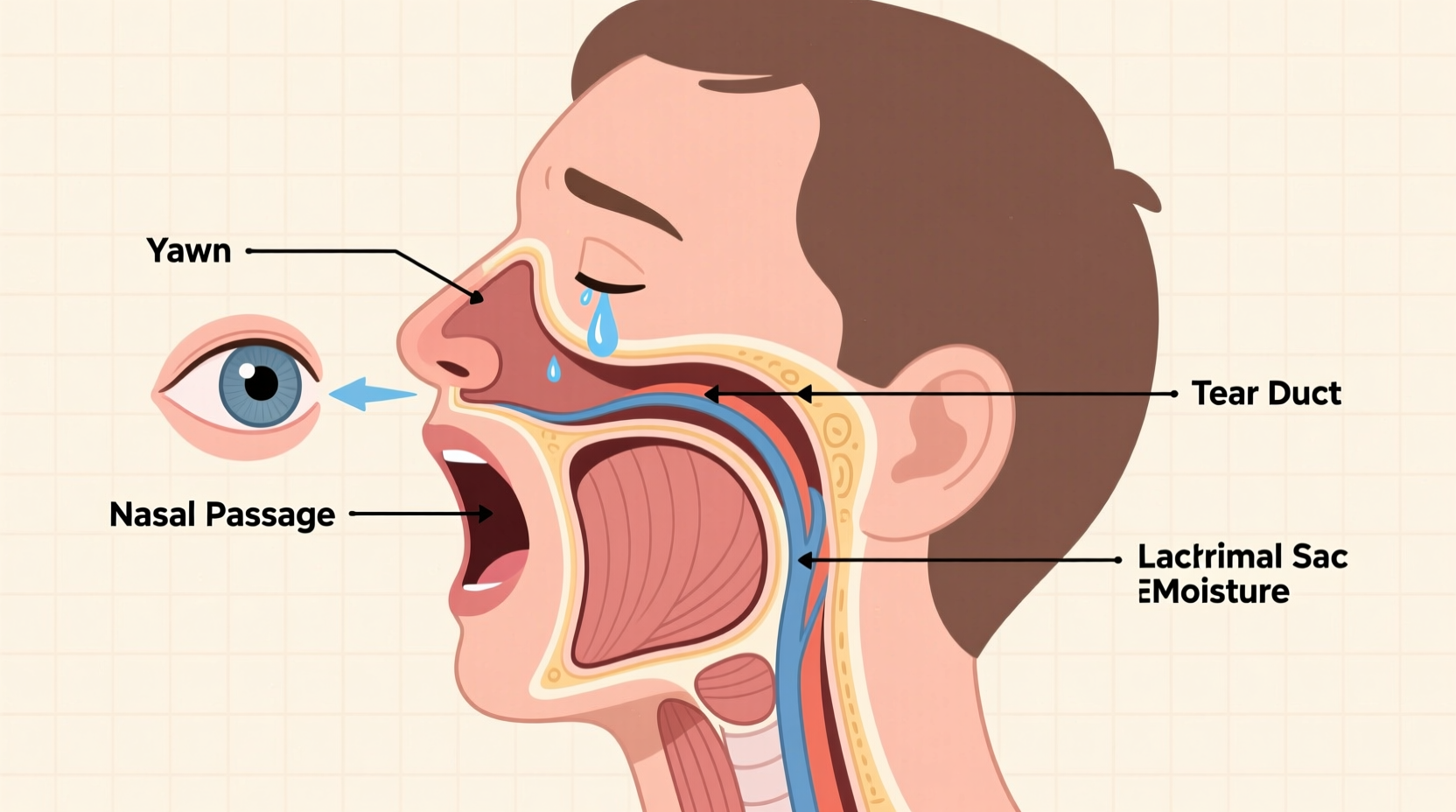
Yawning is more than just a sign of tiredness. It’s a complex motor action involving multiple muscle groups, nerves, and even brain regions. When you yawn, your mouth opens wide, your jaw drops, your chest expands, and your facial muscles contract. These movements are coordinated by the nervous system and involve several key anatomical structures:
- Masseter and temporalis muscles: Control jaw movement.
- Digastric and mylohyoid muscles: Help lower the jaw.
- Facial nerve (cranial nerve VII): Coordinates muscle contractions in the face.
- Oculomotor system: Controls eye movement and eyelid function.
As these muscles stretch and contract during a yawn, they exert pressure on surrounding tissues—including those near the eyes. This mechanical pressure plays a crucial role in triggering tear production.
How Facial Pressure Triggers Tear Production
The act of yawning stretches the muscles around your eyes and compresses the lacrimal apparatus—the system responsible for producing and draining tears. This apparatus includes the lacrimal glands (which produce tears), the puncta (tiny openings that drain tears into ducts), and the nasolacrimal duct (which carries tears into the nasal cavity).
When you yawn:
- Your facial muscles contract forcefully.
- This contraction puts pressure on the lacrimal glands located above your eyes.
- The pressure can stimulate the glands to release a small amount of tears.
- Simultaneously, the widening of your jaw may temporarily disrupt normal tear drainage through the nasolacrimal duct.
- With drainage slightly impaired and tear production stimulated, excess fluid accumulates—causing your eyes to water.
Think of it like squeezing a sponge (the gland) while partially blocking its outlet (the duct). The result? Fluid spills out—even if only briefly.
Nerve Cross-Talk: The Vagus and Facial Nerves
Another factor contributing to watery eyes during yawning involves neural signaling. The vagus nerve (cranial nerve X), which regulates involuntary bodily functions including heart rate and digestion, is heavily involved in yawning. Interestingly, it interacts with the facial nerve, which controls both facial expressions and tear production.
According to Dr. Laura Mitchell, a neurologist specializing in autonomic responses:
“Yawning activates a broad network of cranial nerves. The stimulation isn't isolated—it creates a ripple effect. When the brain signals a yawn, nearby nerves, including those linked to tear secretion, can get caught in the crossfire. This ‘neural spillover’ explains why unrelated actions like tearing occur simultaneously.” — Dr. Laura Mitchell, Neurology Department, Boston General Hospital
This concept, known as **reflex联动** (reflex coupling), means that one reflex (yawning) can inadvertently trigger another (lacrimation, or tear production) due to shared neurological pathways.
Is This Reaction Normal?
Yes, absolutely. Occasional eye watering during yawning is experienced by the vast majority of people and is considered a normal variant of human physiology. It does not indicate disease or dysfunction unless accompanied by other symptoms such as chronic dryness, pain, redness, or blurred vision.
In fact, the same mechanism explains why some people cry when they sneeze, laugh hard, or blow their nose vigorously—all actions that increase pressure in the facial region and affect the tear drainage system.
Common Misconceptions About Watery Eyes and Yawning
Despite being common, several myths persist about why eyes water during yawning:
| Misconception | Reality |
|---|---|
| Watery eyes mean allergies or infection. | Not necessarily. Transient tearing during yawning is usually mechanical, not pathological. |
| Only tired people experience this. | No—people yawn for many reasons (boredom, oxygen regulation), and the tearing effect occurs regardless of fatigue level. |
| Excessive tearing indicates weak eye muscles. | There’s no evidence linking this reflex to muscle strength. It’s more about nerve sensitivity and anatomy. |
| Children don’t experience this. | They do, though they may be less aware of it. The reflex develops early in life. |
When to Be Concerned: Red Flags
While occasional eye watering during yawning is normal, certain signs suggest the need for medical evaluation:
- Persistent tearing without trigger: Could indicate blocked tear ducts or chronic irritation.
- Pain or swelling around the eyes: May point to infection or inflammation.
- Blurry vision after yawning: Uncommon and warrants assessment.
- Frequent crusting or discharge: Suggests possible conjunctivitis or blepharitis.
If any of these symptoms accompany routine tearing during yawning, consider consulting an ophthalmologist or ENT specialist.
Mini Case Study: Sarah’s Experience
Sarah, a 34-year-old teacher, began noticing that her right eye watered excessively every time she yawned—more than her left. At first, she dismissed it as normal. But over several months, she also started experiencing mild discomfort and occasional mucus buildup in the same eye.
She visited an optometrist, who performed a dye test and found a partial blockage in the right nasolacrimal duct. The doctor explained that while yawning normally causes slight tearing, the blockage amplified the effect on one side. After a minor outpatient procedure to clear the duct, Sarah reported immediate improvement—not just in tearing during yawning, but in overall eye comfort.
Her case highlights how a benign reflex can sometimes reveal an underlying condition when it becomes unbalanced or persistent.
Step-by-Step: What Happens in Your Body When You Yawn and Cry?
To fully grasp the connection, here’s a chronological breakdown of the process:
- Initiation: Your brain triggers a yawn, often due to fatigue, boredom, or low oxygen levels.
- Muscle Activation: Jaw muscles contract, stretching the cheeks and temples.
- Pressure Build-Up: Contraction presses against the lacrimal glands above the eyes.
- Tear Secretion: Glands respond by releasing a small volume of tears onto the eye surface.
- Drainage Disruption: The wide jaw opening compresses the nasolacrimal duct, slowing tear flow into the nose.
- Overflow: Tears accumulate faster than they drain, leading to visible watering.
- Recovery: Within seconds, pressure normalizes, drainage resumes, and excess tears evaporate or are reabsorbed.
This entire sequence takes less than 10 seconds but demonstrates the intricate coordination between muscular, neural, and fluid systems in the face.
Do All People Experience This?
Most do—but to varying degrees. Some individuals barely notice any tearing, while others find their eyes noticeably moist after a deep yawn. Differences depend on several factors:
- Anatomical variation in tear duct size or position
- Sensitivity of the lacrimal glands
- Facial muscle tone and strength
- Hydration levels and baseline tear production
A small percentage of people report no eye watering during yawning at all. This doesn’t indicate a problem—it simply reflects natural diversity in human physiology.
FAQ: Common Questions About Yawning and Eye Watering
Why don’t my eyes water every time I yawn?
The intensity of the yawn matters. Shallow or suppressed yawns may not generate enough muscle tension or nerve activation to stimulate tear release. Only full, deep yawns tend to produce noticeable effects.
Can dry eye syndrome cause more tearing during yawning?
Paradoxically, yes. People with dry eye often have unstable tear films, prompting the body to overproduce tears in response to minor stimuli. A yawn might be enough to trigger a compensatory flood of reflex tears.
Is there a way to stop my eyes from watering when I yawn?
Not practically—and it’s unnecessary. Since the response is brief and harmless, trying to suppress it (e.g., by keeping eyes closed) won’t prevent the internal pressure changes. Accepting it as a normal quirk is the best approach.
Checklist: Is Your Eye Watering During Yawning a Cause for Concern?
Use this quick checklist to assess whether your experience falls within the normal range:
- ✅ Occurs only during or immediately after yawning
- ✅ Affects both eyes equally
- ✅ Lasts only a few seconds
- ✅ No pain, redness, or vision changes
- ✅ No discharge or crusting
- ✅ No history of eye injury or surgery
If all apply, your tearing is likely normal. If you answered “no” to two or more, consider discussing it with a healthcare provider.
Conclusion: Embrace the Quirks of Human Biology
The human body is full of fascinating, interconnected systems that often surprise us with their complexity. That a simple yawn can lead to teary eyes is not a flaw—it’s a testament to how finely tuned our nerves, muscles, and glands are. Far from being random, this reaction illustrates the elegance of biological coordination, where one action can ripple through multiple systems in a split second.
Understanding the science behind everyday phenomena empowers us to distinguish between normal function and potential warning signs. Next time you catch yourself blinking away tears after a good yawn, remember: it’s not sadness. It’s physiology.




 浙公网安备
33010002000092号
浙公网安备
33010002000092号 浙B2-20120091-4
Comments
No comments yet. Why don't you start the discussion?