
It’s a familiar holiday frustration: your cheerful LED string lights glow steadily—until the furnace blower engages with a low hum, and suddenly, the lights stutter, dim, or pulse like a nervous firefly. The timing is too precise to be coincidence. This isn’t faulty bulbs or aging wiring in the lights themselves. It’s a telltale sign of an underlying electrical interaction between two high-demand appliances sharing infrastructure you likely never thought about: your furnace and your holiday lighting.
Unlike incandescent bulbs, which tolerate minor voltage fluctuations with subtle brightness shifts, LEDs are highly sensitive to even brief dips in voltage or momentary noise on the circuit. Their drivers—tiny internal power supplies—require stable input to maintain consistent current. When your furnace’s inducer motor, blower fan, or ignition system powers up, it draws a sudden surge of current (often 3–5 amps for a fraction of a second). That surge can momentarily compress voltage across the entire circuit—or even ripple through your home’s main panel—causing nearby LED loads to react visibly.
This article explains precisely what’s happening behind the flicker, walks you through diagnostic steps you can perform safely without opening panels, identifies which fixes deliver real results (and which ones just waste time), and outlines when to call a licensed electrician—not as a last resort, but as a necessary step toward long-term safety and reliability.
What’s Really Happening: The Physics Behind the Flicker
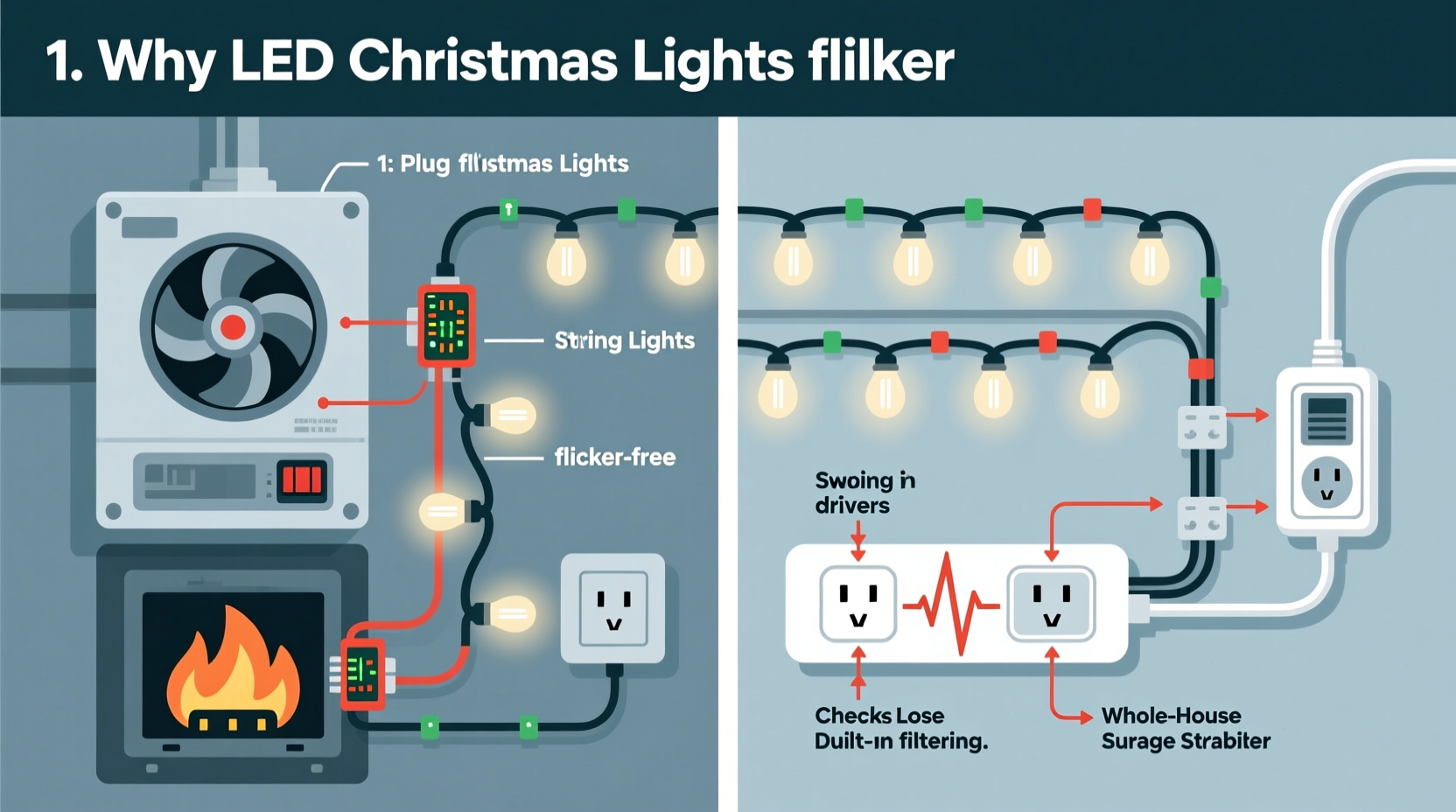
The core issue is voltage sag, also known as a “brownout event.” When your furnace starts, its blower motor requires significant inrush current—typically 300% to 600% of its running amperage—for 100–300 milliseconds. A typical 1/2-horsepower furnace blower may draw 4.5 amps while running, but briefly pull 18–22 amps at startup. If that motor shares a circuit—or worse, shares a neutral wire or undersized branch with your Christmas lights—the sudden demand causes voltage at the outlet to dip from 120V to as low as 105–112V.
LED light strings use switching-mode power supplies (SMPS) that convert AC to low-voltage DC. These drivers have minimum operating voltages—usually around 108–110V. When line voltage drops below that threshold, the driver either shuts down momentarily (causing a visible blink) or enters unstable regulation mode (causing rapid pulsing or color shifting). Because the furnace cycle repeats every 10–20 minutes during cold weather, the flicker becomes rhythmic and predictable.
Crucially, this is rarely a sign of danger—but it *is* a diagnostic signal. It reveals hidden strain on your home’s electrical system: overloaded circuits, shared neutrals, loose connections, or outdated service capacity. Ignoring it won’t cause immediate failure, but over time, repeated voltage stress degrades LED drivers and increases the risk of premature light failure or nuisance tripping.
Step-by-Step Diagnostic Protocol (No Tools Required)
Before purchasing new lights or rewiring anything, confirm the root cause with this practical, safe sequence:
- Isolate the lights: Unplug all other devices from the same outlet and adjacent outlets on the same wall. Plug *only* the LED lights into that outlet. Turn on the furnace manually (set thermostat 5°F above room temp) and observe. If flicker persists, the issue is circuit-level—not device interference.
- Test another circuit: Move the lights to an outlet on a different breaker—ideally one fed from the opposite leg of your panel (e.g., if lights were on breaker #3, try #17). Run the furnace test again. No flicker? You’ve confirmed shared-circuit sensitivity.
- Check outlet proximity: Measure distance from the outlet to your furnace’s electrical disconnect or control board. If within 15 feet and on the same wall, shared conduit or bundled NM cable could allow magnetic coupling—inducing noise directly into the lighting circuit.
- Listen and time: Note *exactly* when flickering occurs relative to furnace sounds. Does it coincide with the *first click* (ignition relay), the *whirring start* (inducer motor), or the *deep hum* (main blower)? Most often, it’s the blower—confirming motor inrush as the culprit.
- Verify light quality: Check the packaging or manufacturer specs. Low-cost, non-UL-listed, or unbranded LED strings often omit robust under-voltage lockout (UVLO) circuitry. Name-brand lights (e.g., NOMA Pro, GE Enbrighten, Twinkly) include tighter voltage regulation and are less prone to this behavior—even on marginal circuits.
Proven Fixes—Ranked by Effectiveness & Safety
Not all solutions are equal. Some address symptoms; others resolve root causes. Below is a tiered approach, starting with immediate, no-cost actions and progressing to permanent upgrades:
| Solution | Effectiveness | Cost | DIY-Friendly? | Notes |
|---|---|---|---|---|
| Relocate lights to dedicated circuit | ★★★★★ | $0–$5 (extension cord) | Yes | Most reliable short-term fix. Use a heavy-duty 12-gauge outdoor-rated cord to a kitchen or laundry circuit (not GFCI-protected if lights lack GFCI rating). |
| Install whole-house surge protector | ★★★☆☆ | $250–$450 + electrician | No | Stabilizes voltage spikes and noise—but won’t prevent deep sags from motor inrush. Best paired with other fixes. |
| Upgrade LED lights with wide-input drivers | ★★★★☆ | $15–$40/string | Yes | Look for “90–305V AC input” or “universal voltage” specs. These handle sags gracefully without blinking. |
| Add an inline AC line conditioner | ★★★☆☆ | $85–$180 | Yes | Units like Tripp Lite LC1200 filter noise and smooth minor sags. Avoid cheap “voltage regulators”—most are ineffective for motor inrush. |
| Correct shared neutral or loose connection | ★★★★★ | $150–$400 | No — Licensed electrician required | Most critical fix if diagnostics show voltage drop >8V. Loose neutrals at the panel are a fire hazard and must be addressed immediately. |
Mini Case Study: The Suburban Bungalow with 1970s Wiring
Sarah in Toledo installed new LED icicle lights along her front eaves in November. By early December, she noticed consistent flickering every 12–15 minutes—always timed with her oil furnace’s blower kick-on. She tried replacing the string, adding a power strip, and even unplugging her coffee maker—nothing helped. Using the diagnostic steps above, she discovered the outlet was on the same 15-amp circuit as the furnace’s control board (a common but outdated practice in homes built before 1985). Her Kill A Watt meter showed voltage dropping to 107.3V for 220ms during blower startup.
Her electrician inspected the panel and found two issues: (1) the furnace control circuit and living room outlets shared a neutral wire—a code violation in modern installations, and (2) the neutral lug was slightly corroded. After separating the circuits onto dedicated breakers and tightening the neutral bar, voltage sag dropped to 114.8V (within safe tolerance), and the flicker vanished. Sarah kept her original lights—no replacement needed—because the problem wasn’t the lights. It was the infrastructure.
“Flickering LED lights triggered by HVAC startup are among the most reliable field indicators of circuit stress. They’re not just an annoyance—they’re your home’s electrical system sending an early warning.”
— James R. Delaney, PE, Senior Electrical Inspector, National Fire Protection Association (NFPA) Code Committee
FAQ: Your Top Questions Answered
Can this flickering damage my LED lights or furnace?
Repeated voltage sags accelerate wear on LED driver capacitors and reduce overall lifespan—typically by 20–40% over a season. However, it does not harm the furnace motor or controls. The greater risk is to your home’s electrical integrity: sustained low voltage can overheat wires, degrade insulation, and increase fire risk if underlying issues (like loose neutrals) go unaddressed.
Will a UPS (uninterruptible power supply) solve this?
Not practically. Most consumer UPS units are designed for computers—not continuous lighting loads—and lack the instantaneous response needed for motor inrush events. They also introduce their own switching noise, which can worsen flicker. A true sine-wave, double-conversion UPS rated for >300W would work—but costs $400+ and is over-engineered for this use case.
Why don’t my incandescent lights do this?
Incandescent filaments have thermal inertia. Even if voltage drops 15% for 200ms, the filament stays hot enough to emit visible light without perceptible dimming. LEDs, by contrast, respond to voltage changes in microseconds. Their efficiency comes at the cost of sensitivity—making them excellent diagnostic tools for electrical health.
When to Call a Licensed Electrician (Don’t Skip This)
Take action now if any of these apply:
- You measure voltage sag exceeding 10 volts (e.g., from 120V to 110V or lower) using a multimeter or plug-in monitor;
- Flickering occurs on multiple circuits—not just the one with lights—when the furnace runs;
- You hear buzzing, sizzling, or popping from outlets, switches, or your electrical panel during furnace startup;
- Outlets feel warm to the touch, or breakers trip intermittently;
- Your home was built before 1990 and has Federal Pacific, Zinsco, or Sylvania panels (known fire hazards requiring immediate evaluation).
A qualified electrician will perform a load calculation, inspect neutral connections, verify grounding integrity, and test for shared neutrals using a clamp meter. They’ll also check if your service panel is undersized for modern loads (many 100-amp services struggle with heat pumps, EV chargers, and holiday lighting simultaneously). This isn’t about “fixing lights”—it’s about verifying the safety margin of your home’s most critical system.
Conclusion: Flicker Is Feedback—Use It Wisely
Your LED Christmas lights aren’t misbehaving. They’re functioning exactly as designed—revealing subtle but meaningful truths about your home’s electrical condition. That rhythmic flicker is data, not drama. It tells you where capacity is thin, where connections may be aging, and where modern efficiency demands meet legacy infrastructure. Addressing it doesn’t require replacing every string or rewiring your house overnight. Start with smart diagnostics, implement targeted, low-cost fixes, and escalate only when evidence points to deeper issues.
Most importantly: never ignore persistent flickering as mere “holiday charm.” In electrical systems, consistency is safety. Variability is vulnerability. By treating this symptom with technical respect—not seasonal resignation—you protect not just your lights, but your home, your family, and your peace of mind all winter long.




 浙公网安备
33010002000092号
浙公网安备
33010002000092号 浙B2-20120091-4
Comments
No comments yet. Why don't you start the discussion?