
If your garage lights turn on reliably while outdoor fixtures—porch lights, pathway lamps, or security floodlights—fail during cold snaps, temperature is likely the culprit. This isn’t just inconvenient; it’s a telltale sign of underlying vulnerabilities in your outdoor electrical system. Unlike the insulated, climate-buffered environment of a garage, exterior lighting operates at the mercy of ambient conditions: freezing moisture, thermal contraction, voltage fluctuations, and material fatigue. When temperatures drop below 32°F (0°C), components that function flawlessly in warmer months begin to misbehave—not because they’re “broken,” but because they’re operating outside their engineered tolerances. Understanding why cold triggers this failure is the first step toward a lasting fix—not a seasonal bandage.
How Cold Weather Disrupts Outdoor Lighting Circuits
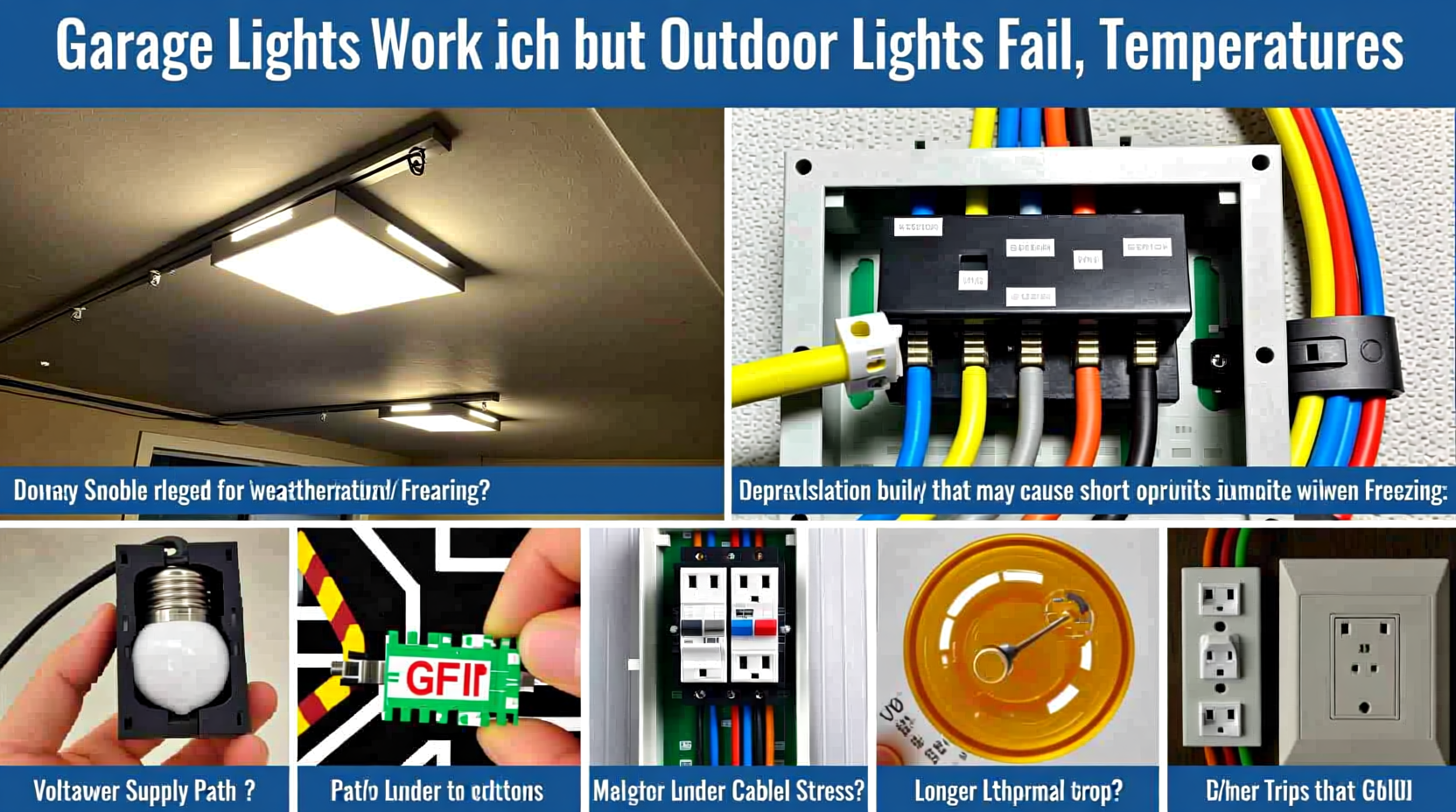
Cold doesn’t “kill” electricity—but it changes how electricity behaves in real-world installations. Outdoor lighting systems involve more than just bulbs and wires. They include junction boxes, photocells, motion sensors, GFCI outlets, dimmer switches, and low-voltage transformers—all with distinct thermal limits. As air temperature falls, conductors contract, insulation becomes brittle, condensation freezes inside enclosures, and semiconductor response times slow. A photocell rated for -20°F may still activate at -5°F—but only if its lens is free of frost and its internal capacitor hasn’t degraded from prior thermal cycling. Similarly, LED drivers—especially cheaper, non-rated models—often derate output or shut down entirely below 14°F (-10°C) due to thermal protection circuitry. The garage works because it’s thermally isolated: even unheated garages rarely dip below 25°F overnight, while an exposed soffit-mounted fixture may see -15°F with wind chill. That 40-degree gap is enough to expose latent weaknesses.
Five Temperature-Sensitive Components & Their Failure Modes
Below is a breakdown of the most common cold-affected elements in residential outdoor lighting—and what each failure looks like in practice:
| Component | Typical Cold Failure Mode | Why It Happens |
|---|---|---|
| Photocell Sensors | Lights stay on all day or won’t turn on at dusk | Frost buildup on lens scatters light; internal thermistors drift out of calibration; electrolytic capacitors lose capacitance below freezing |
| LED Drivers / Power Supplies | Flickering, delayed start-up, or complete shutdown below 20°F | Capacitors shrink, reducing energy storage; thermal cutoffs engage prematurely; poor-quality drivers lack wide-temp-grade components |
| GFCI Outlets & Breakers | Tripping at random, especially after temperature drops overnight | Moisture ingress + freezing expands micro-cracks in housing; internal relays stick when lubricants thicken; ground-fault sensitivity increases in cold-damp conditions |
| Wiring Connections (splices, wire nuts, terminals) | Intermittent operation—works after warming up, fails again next morning | Thermal expansion/contraction loosens connections; aluminum-to-copper oxidation accelerates in cold-damp cycles; corrosion forms invisible high-resistance barriers |
| Motion Sensors (PIR) | No response to movement, or false triggers (e.g., reacting to frozen foliage shifting) | Polymer lens contracts, distorting IR field; pyroelectric sensor output drops sharply below 15°F; firmware algorithms misread thermal noise as motion |
A Real-World Diagnostic Case Study: The Frost-Locked Porch Light
In late December 2023, a homeowner in Minneapolis reported that her front-porch LED fixture—installed in 2021—worked perfectly from spring through early November. By mid-December, however, it failed every morning before sunrise, only to “wake up” around noon as ambient temps rose above 28°F. Garage lights (on the same circuit, fed from the same panel) operated without issue. An electrician inspected the fixture and found no visible damage, no tripped breakers, and correct voltage at the junction box. The breakthrough came when he removed the fixture’s lens: a thin, transparent layer of ice had formed *inside* the sealed housing, directly over the photocell’s aperture. That ice wasn’t blocking light—it was refracting ambient dawn light *away* from the sensor’s detection zone. More critically, the ice layer created a thermal barrier that prevented the sensor’s internal temperature compensation circuit from stabilizing. Once the ice melted at midday, the sensor recalibrated and resumed normal operation. Replacing the fixture with an IP66-rated, cold-start certified model (rated to -40°F) resolved the issue permanently. This case underscores a key truth: cold-related failures are rarely about “failure”—they’re about environmental mismatch.
Step-by-Step Cold-Weather Diagnostic Protocol
Follow this sequence before calling an electrician. Most issues can be identified—and often resolved—in under 45 minutes:
- Verify ambient temperature and timing: Use a min/max thermometer near the non-working fixture for 24 hours. Note exact failure onset (e.g., “fails consistently below 27°F, recovers above 31°F”).
- Isolate the circuit: Turn off the garage circuit breaker. If outdoor lights remain dead, they’re on a separate circuit—eliminating shared wiring as the cause.
- Inspect the fixture housing: Look for frost, condensation, or ice behind lenses or gaskets. Wipe dry and reseal any compromised gasket seams with silicone rated for low-temp flexibility.
- Bypass the control device: Temporarily disconnect the photocell or motion sensor and wire the fixture directly to power (using proper wire nuts and junction box). If it works, the sensor is the weak link.
- Test voltage at the fixture terminals: With a multimeter, measure voltage across hot and neutral *while the fixture should be on*. Readings below 108V (on a 120V circuit) indicate voltage drop from undersized wire, loose connections, or transformer issues—exacerbated by cold-induced resistance rise.
- Check GFCI status: Press “TEST” and “RESET” on any upstream GFCI outlet—even if the reset button appears engaged. Cold can cause mechanical sticking.
- Swap a known-good bulb or module: Use an identical LED bulb from a working indoor fixture. If it works, the original bulb’s driver failed due to cold stress.
Expert Insight: Why “Outdoor-Rated” Isn’t Enough
“Most homeowners buy ‘outdoor’ fixtures based on aesthetics or price—not thermal specs. But a fixture rated IP65 and UL Wet Location doesn’t guarantee it will start at 5°F. You need the minimum operating temperature listed in the technical datasheet—not the packaging. And even then, installation matters: mounting a cold-rated fixture in a recessed soffit traps cold air, while an open-arm bracket allows convective warming. Thermal design is part of electrical design.” — Carlos Mendez, P.E., Senior Lighting Engineer, National Electrical Manufacturers Association (NEMA)
Cold-Weather Lighting Maintenance Checklist
- ✅ Seal all outdoor junction boxes with low-temperature silicone (rated to -40°F)
- ✅ Replace standard wire nuts with cold-rated, gel-filled connectors (e.g., Ideal Twister® Cold Weather Series)
- ✅ Install photocells and motion sensors in shaded, ventilated locations—not directly under eaves where frost accumulates
- ✅ Use only LED fixtures with drivers explicitly rated for your region’s lowest recorded temperature (not just “cold climate” marketing copy)
- ✅ Inspect GFCI outlets quarterly: test/reset functionality and check for hairline cracks in housing
- ✅ For low-voltage landscape lighting: upgrade transformers to models with built-in thermal overload protection and cold-start capability
- ✅ Avoid aluminum wiring outdoors—its expansion/contraction cycle accelerates cold-weather connection failure
FAQ: Addressing Common Cold-Lighting Questions
Can I use a space heater to warm up my outdoor fixture and make it work?
No. Applying external heat creates dangerous thermal gradients that crack lenses, degrade seals, and accelerate component aging. It also risks melting wire insulation or triggering thermal runaway in LED drivers. If a fixture requires heating to operate, it’s improperly specified—not temporarily “stuck.”
Why do my LED string lights work fine in the garage but flicker outside when it’s below freezing?
String lights often use low-cost, non-regulated drivers with minimal thermal management. Below 32°F, the driver’s electrolytic capacitors lose up to 30% of their effective capacitance, causing voltage ripple that manifests as flicker. Garage-installed strings avoid this because ambient temperature stays above the driver’s functional threshold—even without active heating.
Will upgrading to smart lighting (like Wi-Fi or Zigbee fixtures) solve cold-weather reliability?
Not inherently—and sometimes it worsens the problem. Many smart modules add extra circuitry (radios, microcontrollers) with narrower thermal tolerances than basic LED drivers. Unless the smart fixture is explicitly rated for sub-zero operation (e.g., Philips Hue Outdoor, rated to -4°F), you’re adding failure points. Prioritize thermal certification over connectivity features.
Conclusion: Build Resilience, Not Workarounds
When your outdoor lights fail in the cold while garage lights shine steadily, it’s not a quirk—it’s diagnostic feedback. Temperature exposes what design, installation, and product selection overlooked. Fixing it isn’t about brute-force solutions like covering fixtures with tarps or rewiring entire circuits. It’s about matching components to your climate’s reality: choosing drivers with wide-temp-grade capacitors, sealing connections against freeze-thaw cycles, and installing controls where physics supports—not fights—thermal behavior. Start with the diagnostic protocol. Audit one fixture this week. Replace one failing photocell with a cold-certified model. Seal one junction box. These aren’t repairs—they’re resilience upgrades. Your lights shouldn’t wait for spring to work. They should perform, predictably and safely, from the first snowflake to the last frost. Take action now—not when winter tightens its grip again.




 浙公网安备
33010002000092号
浙公网安备
33010002000092号 浙B2-20120091-4
Comments
No comments yet. Why don't you start the discussion?