
It’s a familiar holiday frustration: your outdoor lights shine brightly on dry, crisp December evenings—then, the moment rain begins to fall, they start stuttering, dimming, or blinking erratically. You check the breaker (it’s fine), swap bulbs (no change), and even unplug and replug the strand (still flickers). This isn’t random failure—it’s a precise diagnostic clue. Rain-induced flickering points directly to moisture intrusion at specific weak points in your lighting system: compromised connections, degraded insulation, corroded contacts, or inadequate grounding. The good news? In over 90% of residential cases, this issue is solvable without cutting into walls, replacing entire circuits, or hiring an electrician. What’s needed is targeted intervention—not wholesale rewiring.
The Physics Behind Rain-Only Flickering
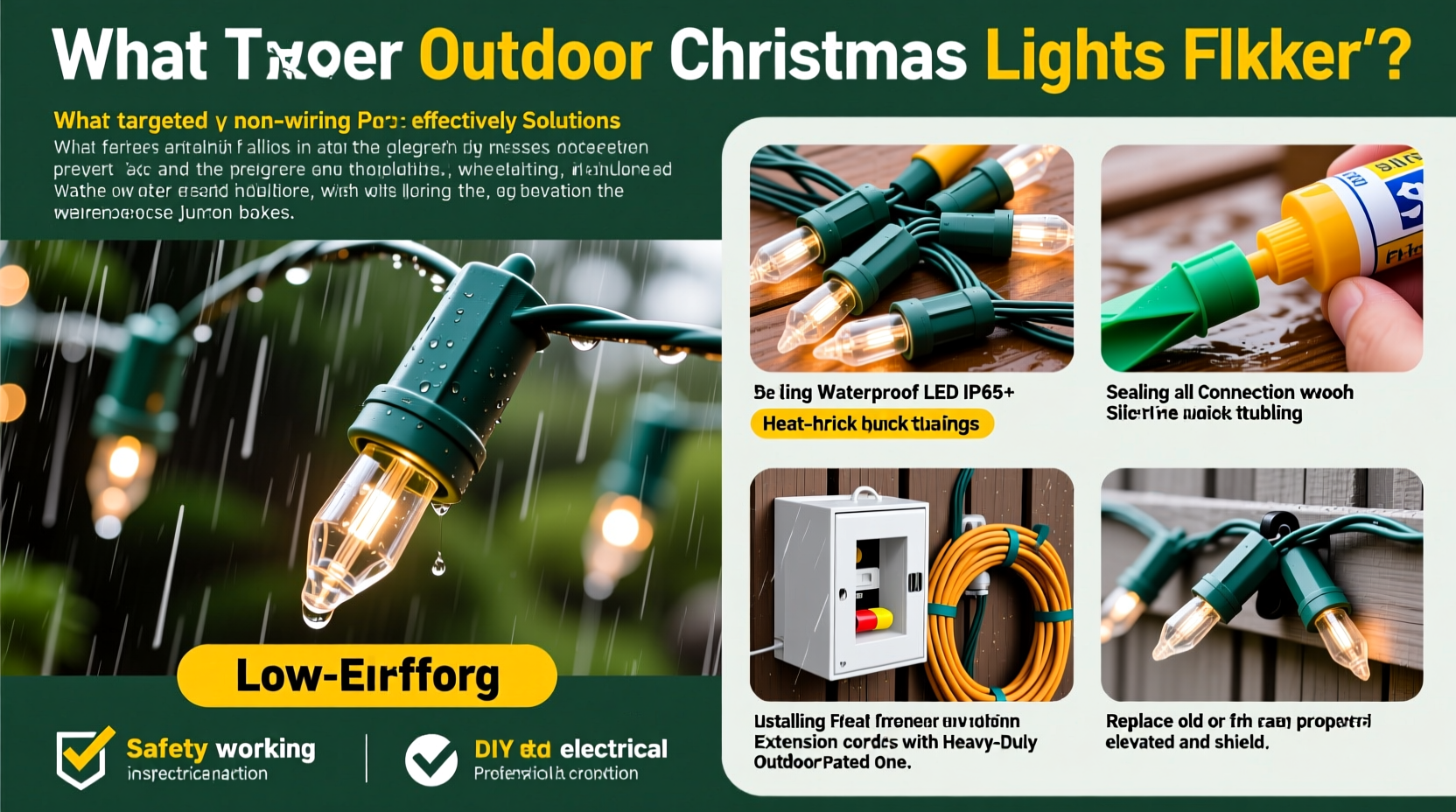
Flickering that appears exclusively during rain isn’t about water “shorting out” the entire circuit in the dramatic way we imagine. Instead, it’s about conductive pathways forming where they shouldn’t. Pure water is a poor conductor—but rainwater contains dissolved minerals, dust, and atmospheric pollutants that turn it into a weak electrolyte. When this contaminated water bridges small gaps—like between frayed wire strands, across cracked insulation, or inside a poorly sealed connector—it creates a high-resistance shunt path. This path doesn’t trip breakers (it’s not a hard short), but it does divert current, destabilize voltage, and confuse smart controllers or LED drivers. The result? Intermittent dimming, strobing, or full dropouts—especially noticeable with modern low-voltage LED strings that rely on stable DC input.
Crucially, this behavior is temperature- and humidity-dependent. A light strand might function flawlessly at 45°F and 30% humidity—but fail at 38°F and 85% relative humidity with light drizzle. That’s because condensation forms inside connectors overnight, and rain provides the final conductive bridge. It’s not the rain itself; it’s the rain enabling existing vulnerabilities.
Top 5 Culprits—and How to Fix Each Without Rewiring
1. Moisture-Locked Connectors and Splices
Most outdoor light failures begin at connection points: where extension cords meet light strands, where multiple strands daisy-chain, or where wires are manually spliced with wire nuts. Over time, UV exposure degrades plastic housings, thermal cycling cracks seals, and vibration loosens caps. Rainwater seeps in, pools in low spots, and slowly corrodes copper contacts. Even tiny amounts of oxidation increase resistance enough to cause voltage drop under load—especially at the end of long runs.
2. Cracked or Brittle Insulation on Older Strands
Pre-2015 LED and incandescent strands often used PVC jackets that become brittle after 3–5 seasons of sun exposure. Micro-fractures aren’t visible to the naked eye but allow moisture ingress along the wire length. When wet, these sections develop leakage currents that fluctuate with wind-driven rain patterns—causing rhythmic flickering. You’ll often notice this on the lowest-hanging sections of garlands or roof lines, where water collects and drips.
3. Ground Faults from Improper GFCI Behavior
Modern outdoor outlets require GFCI protection—but many homeowners plug lights into GFCIs that are either outdated, overly sensitive, or sharing the circuit with other loads (e.g., a garage door opener or landscape transformer). Rain increases ambient conductivity, lowering the threshold at which tiny imbalances trigger nuisance tripping. The GFCI may not fully trip—just “chatter,” causing rapid on-off cycling that reads as flickering. This is especially common with multi-strand setups drawing near the GFCI’s 5mA trip threshold.
4. Corroded Male/Female Plug Contacts
The metal prongs and sockets in standard 120V light plugs oxidize over time. Copper turns green; brass tarnishes black. These oxides are resistive—not insulating—so they don’t block power entirely. But under damp conditions, surface moisture combines with oxide to create a semi-conductive film. Current flow becomes unstable, particularly during the brief moments when plug tension shifts slightly due to wind or thermal expansion.
5. Undersized or Unprotected Extension Cords
Using thin-gauge (e.g., 18 AWG) indoor-rated extension cords outdoors invites trouble. Their insulation lacks UV stabilizers and moisture barriers. More critically, their higher resistance causes significant voltage drop over distance—especially when wet. A 100-foot run of 18 AWG cord can lose up to 12 volts in dry conditions; add moisture-induced leakage, and the drop worsens. LED drivers respond to this by reducing brightness or cycling off entirely.
Step-by-Step Diagnostic & Repair Protocol
Follow this field-tested sequence—designed for safety and precision—to isolate and resolve the root cause:
- Unplug everything. Never work on live circuits. Confirm power is off using a non-contact voltage tester at both the outlet and each connector.
- Inspect all plugs and receptacles. Look for green corrosion on prongs, white powdery residue (aluminum oxide), or dark pitting. Clean gently with a fiberglass brush or electrical contact cleaner—not sandpaper.
- Test each strand individually. Plug one strand directly into a GFCI-protected outdoor outlet (bypassing all extensions). Run it for 5 minutes while lightly misting the plug and first 3 feet with a spray bottle. If it flickers, the strand itself is faulty.
- Check connectors under magnification. Use a 10x jeweler’s loupe to examine splice points. Look for hairline cracks in heat-shrink tubing, milky clouding inside clear connectors (sign of trapped moisture), or discoloration around wire entry points.
- Measure voltage drop. With a multimeter, measure voltage at the outlet, then at the farthest light socket on a long run (while powered and dry). A drop over 3 volts indicates undersized wiring or excessive load—address before rain season.
- Seal and protect. Apply dielectric grease to all cleaned metal contacts *before* reassembly. Then use self-fusing silicone tape (not PVC tape) over every connection—it bonds to itself, repels water, and remains flexible in cold weather.
Do’s and Don’ts: Moisture Management for Outdoor Lights
| Action | Do | Don’t |
|---|---|---|
| Connector Sealing | Use gel-filled, UL-listed waterproof connectors + dielectric grease | Wrap with duct tape, electrical tape, or hot glue |
| Cord Selection | Use 14 AWG or 12 AWG outdoor-rated (SJTW or SJOOW) cords, max 100 ft per run | Use indoor extension cords or exceed manufacturer’s wattage limits |
| Plug Maintenance | Store plugs in ventilated, dry containers with silica gel packs | Leave plugs coiled tightly in damp garages or sheds |
| GFCI Strategy | Dedicate one GFCI outlet per lighting zone; test monthly | Plug lights + power tools + landscape transformers into same GFCI |
| Strand Replacement | Retire strands older than 7 years—even if they “still work” | Keep using cracked, stiff, or discolored cords year after year |
Real-World Case Study: The Cedar Ridge Porch Problem
Mark T., a homeowner in Portland, OR, experienced severe flickering every time coastal drizzle hit his front-porch light display. His setup included three 50-light LED strands (2018 vintage), daisy-chained via standard female-to-male adapters, powered through a 100-ft 16 AWG extension cord plugged into a garage GFCI. He’d replaced bulbs and checked fuses repeatedly—with no improvement.
A technician visited during light rain and immediately noticed moisture beading *inside* the clear plastic housing of the second adapter—a telltale sign of failed sealing. Further inspection revealed micro-cracks in the cord’s jacket near the porch railing (where it rubbed against rough cedar). Voltage testing showed a 9.2V drop at the last strand—well beyond the 5V tolerance of its driver chip.
The fix took 45 minutes: replacing the damaged cord section with 14 AWG SJTW, installing gel-filled connectors at all junctions, applying dielectric grease to every plug, and relocating the GFCI outlet to a dedicated circuit. No rewiring of house circuits. Total cost: $32.75 in materials. The display has operated flawlessly through two subsequent rainy seasons.
Expert Insight: What Electricians See Most Often
“Ninety percent of ‘rain-only’ flickering traces to one of three things: a single compromised connector, corrosion on a 10-year-old plug, or an overloaded GFCI shared with other devices. People assume it’s the lights—or the house wiring—when it’s almost always localized, repairable, and inexpensive to fix. The key is treating outdoor electricity like plumbing: every joint must be sealed, every material rated for the environment, and every connection inspected annually—not just when it fails.” — Carlos Mendez, Master Electrician & NFPA 70E Certified Trainer, Pacific Northwest Electrical Safety Institute
FAQ
Can I use WD-40 on my light plugs to prevent corrosion?
No. WD-40 is a water-displacing solvent—not a protective lubricant. It leaves a thin, hygroscopic film that attracts dust and moisture over time, accelerating corrosion. Use dielectric grease instead: it’s silicone-based, non-conductive, and repels water permanently.
My lights flicker only at night when it’s raining—why not during daytime showers?
This points strongly to thermal contraction. As temperatures drop after sunset, plastic housings shrink slightly, opening micro-gaps that rainwater enters. During daytime, warmer plastics remain more pliable and sealed. It’s a subtle but real mechanical effect—and confirms the issue is physical sealing, not electrical design.
Will upgrading to “commercial-grade” lights solve this permanently?
Commercial-grade lights (e.g., ETL-listed, IP65-rated, with stainless steel connectors) significantly reduce risk—but won’t eliminate it if installed incorrectly. A $200 commercial strand spliced with a $2 hardware-store wire nut will still fail. Rating matters less than execution: proper sealing, correct gauge, and dedicated circuits matter more than brand alone.
Proven Prevention Checklist (Do This Before Next Holiday Season)
- ☑ Replace all extension cords older than 5 years with 14 AWG or thicker SJTW-rated cord
- ☑ Inspect every plug, socket, and connector under bright light for cracks, discoloration, or swelling
- ☑ Clean all metal contacts with electrical contact cleaner and a fiberglass brush
- ☑ Apply dielectric grease to every prong, socket, and screw terminal before reassembly
- ☑ Seal every splice and junction with gel-filled, UL-listed waterproof connectors—not tape or glue
- ☑ Test GFCI outlets monthly using their built-in test button; replace units older than 10 years
- ☑ Store lights on wide, ventilated reels—not coiled tightly in plastic bins—to prevent jacket compression cracks
Conclusion
Rain-induced flickering isn’t a mystery—it’s a message. Your lights are telling you exactly where moisture is winning the battle: at a connector, a crack, a corroded contact, or an overloaded circuit. And because the symptom appears only under specific environmental conditions, it reveals the precise location of the weakness. That makes it unusually diagnosable—and unusually fixable. You don’t need to rip out wiring, replace your entire display, or resign yourself to seasonal frustration. With methodical inspection, purpose-built materials, and attention to sealing rather than just powering, you can restore rock-solid reliability. This isn’t about perfection—it’s about resilience. A few minutes of preparation now saves hours of troubleshooting later, preserves your investment in quality lights, and ensures your home glows steadily through every stormy December night.




 浙公网安备
33010002000092号
浙公网安备
33010002000092号 浙B2-20120091-4
Comments
No comments yet. Why don't you start the discussion?