
If your outdoor lights dim or flicker every time your neighbor fires up a circular saw or pressure washer, you're not imagining things—and it’s more than just an annoyance. This phenomenon points to real electrical dynamics happening behind the scenes in your neighborhood’s power grid. While occasional flickering might seem harmless, repeated voltage fluctuations can shorten the lifespan of your lighting systems, especially if they rely on sensitive LED drivers or smart controls. Understanding the root causes, shared infrastructure limitations, and practical solutions empowers you to take action before damage occurs.
Understanding Voltage Fluctuations and Shared Transformers
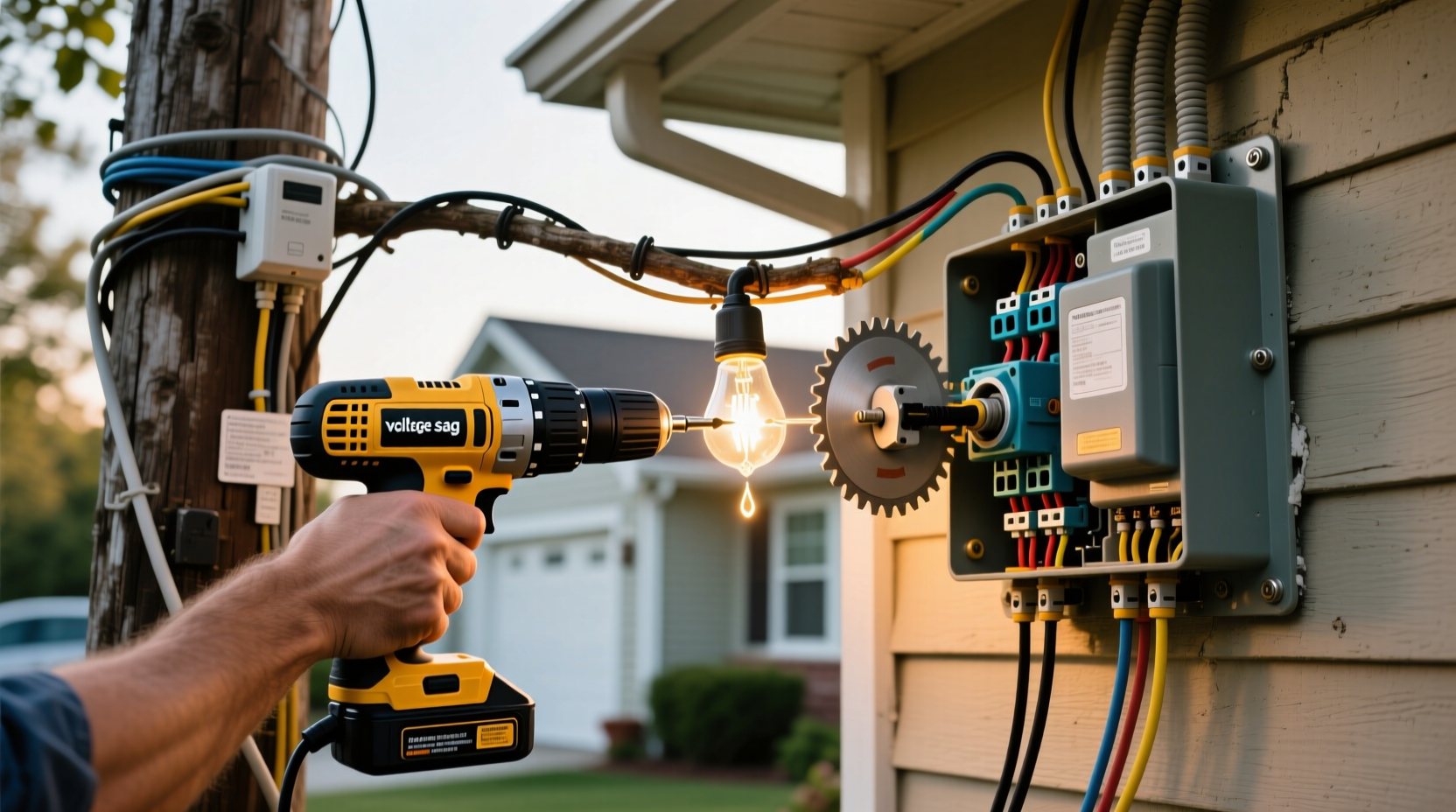
Most residential neighborhoods are powered through shared utility transformers that step down high-voltage electricity for household use. These transformers typically serve anywhere from 3 to 10 homes, depending on local infrastructure and load demands. When one home draws a sudden surge of power—such as when starting heavy-duty power tools like table saws, air compressors, or welders—it creates a temporary drop in voltage across the entire circuit fed by that transformer.
This voltage sag is what causes your outdoor lights to flicker. Lights, particularly LEDs, are highly responsive to changes in voltage. Even a brief dip of 5–10 volts can cause visible dimming or flashing. Incandescent bulbs may simply dim slightly, but modern LED fixtures often interpret low voltage as a signal failure, leading to erratic behavior such as blinking or shutting off entirely.
The effect is amplified with inductive loads—common in motors found in power tools—which require significantly higher current during startup (inrush current) than during normal operation. A 15-amp circular saw, for example, might draw 30+ amps momentarily at startup, creating a momentary overload on the transformer.
“Voltage sags caused by motor startups on shared lines are among the most common complaints we see in suburban electrical service calls.” — Carlos Mendez, Licensed Master Electrician and Utility Grid Consultant
How Power Tool Load Impacts Neighboring Homes
When your neighbor operates a high-draw tool, several electrical principles come into play:
- Inrush Current: Motors require 2–6 times their rated current at startup. This brief spike stresses the transformer.
- Voltage Drop: According to Ohm’s Law (V = I × R), increased current (I) across line resistance (R) results in voltage drop (V).
- Transformer Saturation: Overloaded transformers struggle to maintain output voltage, leading to ripple effects across connected homes.
- Neutral Line Issues: In older multi-wire branch circuits, shared neutrals can become overloaded, worsening flicker symptoms.
The severity of flickering depends on multiple factors: the age and capacity of the transformer, the distance between homes and the pole transformer, wire gauge used in distribution lines, and whether both homes are on the same phase.
In some cases, utilities install undersized transformers to cut costs, especially in rapidly developed areas. As homeowners add EV chargers, heat pumps, and workshops, these transformers operate near or beyond capacity, making voltage instability more frequent.
Diagnosing the Source: Is It Really Your Neighbor?
Before assuming the problem lies with your neighbor, rule out internal issues in your own electrical system. Here’s how to isolate the cause:
- Observe Timing: Do lights flicker precisely when your neighbor starts a tool? Use a log over 2–3 days to correlate events.
- Test Other Appliances: Turn on high-load devices in your home (e.g., microwave, space heater). Do lights flicker then? If so, the issue may be internal.
- Check Circuit Breakers: Inspect for loose connections, buzzing breakers, or signs of arcing in your panel.
- Use a Voltage Monitor: Plug a simple voltmeter or smart plug with voltage logging into an outdoor outlet. Record dips during tool operation.
- Contact Neighbors: Politely ask if others on the same transformer notice similar issues.
A consistent pattern—lights dimming only when the neighbor runs tools—points strongly to shared supply issues rather than internal faults.
Solutions to Prevent or Reduce Flickering
While you can’t control your neighbor’s power usage, several technical and collaborative strategies can reduce or eliminate flickering:
1. Install a Dedicated Voltage Regulator or Stabilizer
A whole-house voltage regulator smooths out incoming voltage fluctuations, ensuring your lights receive a steady 120V supply. These units detect sags and surges and adjust output accordingly using autotransformers or electronic switching.
2. Upgrade Outdoor Lighting Drivers
Many LED flicker problems stem from low-quality or non-regulated drivers. Replace existing fixtures with models featuring wide-input drivers (e.g., 100–130V AC) that tolerate minor voltage swings without blinking.
3. Add Local Surge Protection and Filtering
Install a Type 1 or Type 2 surge protector at your main panel. Some advanced models include filtering capacitors that absorb transient voltage drops, reducing flicker sensitivity.
4. Request a Transformer Load Assessment
Contact your utility provider and request a load study on your local transformer. If it’s operating above 80% capacity during peak times, they may upgrade it—at no cost to residents—under reliability improvement programs.
5. Explore Phase Balancing
If your home and your neighbor’s are on the same leg (phase) of the transformer, the load impact is maximized. A licensed electrician can assess whether your service entry can be moved to the opposite phase—reducing interference.
Checklist: What You Can Do Right Now
- ✅ Log flicker events and match them to neighbor activity
- ✅ Test your own high-draw appliances to rule out internal issues
- ✅ Check for loose wiring in outdoor fixtures and junction boxes
- ✅ Install a plug-in voltage monitor on an outdoor circuit
- ✅ Contact your utility to inquire about transformer load status
- ✅ Consider upgrading to flicker-resistant LED fixtures
- ✅ Discuss concerns politely with your neighbor—some may adjust usage times
Real Example: The Case of Maple Street
In a suburban neighborhood in Portland, OR, homeowner Lisa Tran noticed her new LED pathway lights would blink off every afternoon around 4 PM. After weeks of frustration, she recorded video evidence showing the flicker coincided exactly with her neighbor starting a woodshop table saw.
Lisa contacted the local utility, who sent a technician with a power quality analyzer. Readings showed voltage dropping from 121V to 108V for 1.2 seconds each time the saw started—well within acceptable tolerance but enough to disrupt cheap LED drivers.
The utility confirmed the two homes shared a 25-year-old 25 kVA transformer now serving six homes due to recent infill construction. Though not technically overloaded, the transformer lacked reserve capacity. The solution? The utility upgraded it to a 50 kVA unit under a grid resilience program, resolving flickering for all affected homes.
This case highlights how community-level infrastructure impacts individual experiences—and how data-driven reporting leads to effective resolution.
Do’s and Don’ts: Managing Shared Electrical Loads
| Do | Don’t |
|---|---|
| Keep a log of flicker timing and duration | Assume the issue is your fault without testing |
| Contact your utility with documented evidence | Confront neighbors aggressively |
| Upgrade to high-tolerance LED drivers | Ignore signs of overheating or buzzing in your panel |
| Install point-of-use voltage protection | Attempt to modify service lines or transformer access |
| Work collaboratively on shared solutions | Delay repairs if flickering is accompanied by sparks or burning smells |
Frequently Asked Questions
Can flickering lights cause long-term damage?
Yes. Repeated voltage fluctuations stress LED drivers and ballasts, leading to premature failure. In extreme cases, chronic undervoltage can degrade insulation in wiring over time, increasing fire risk.
Is it safe to ignore occasional flickering?
If flickering is brief, predictable, and tied to known external loads (like neighbor tools), it’s usually not dangerous. However, random or worsening flickering—especially inside the home—should be inspected immediately, as it may indicate loose service conductors or failing connections.
Can solar panels or battery backups help?
Yes. A hybrid solar + battery system with seamless transfer capability can isolate your lighting circuits from grid fluctuations. Even a small backup inverter dedicated to outdoor lighting can eliminate flicker during voltage sags.
Expert Insight: The Role of Modern Grid Design
As homes demand more power for tools, EVs, and HVAC, aging infrastructure struggles to keep pace. Experts emphasize proactive monitoring and investment in smarter distribution networks.
“The future of stable residential power lies in distributed intelligence—transformers with real-time load sensors and automated tap changers that respond instantly to demand shifts.” — Dr. Naomi Reed, Electrical Grid Researcher at MIT Energy Initiative
Until such upgrades become widespread, homeowners must advocate for reliable service and adopt localized protections.
Conclusion: Take Control of Your Power Quality
Flickering outdoor lights triggered by a neighbor’s power tools are more than a nuisance—they’re a symptom of shared electrical constraints in modern neighborhoods. While you can’t stop someone from using a drill press, you can protect your lighting investment and improve reliability through targeted upgrades and informed engagement with utility providers.
Start by documenting the issue, ruling out internal faults, and exploring affordable fixes like voltage-stable LED fixtures or surge suppression. If the problem persists, leverage utility accountability—most providers have obligations to maintain voltage within ANSI C84.1 standards (114V–126V).




 浙公网安备
33010002000092号
浙公网安备
33010002000092号 浙B2-20120091-4
Comments
No comments yet. Why don't you start the discussion?