
It’s a quiet but increasingly common autumn frustration: You’ve watched your solar pathway lights glow reliably through June, July, and August. In September, they still shine brightly at dusk—sometimes even brighter than in summer, thanks to crisper air and lower humidity. By early October, performance holds steady. Then, around mid-October—just as you’re hanging wreaths and prepping for holiday decor—your lights begin to dim, flicker, or go dark entirely. You check the panels: spotless. The sun is still high, clear, and generous—often delivering more usable daylight hours than midsummer due to reduced atmospheric scattering. Yet by November 1st, half your lights are silent. Why? It’s not poor installation, insufficient sunlight, or user error. It’s a confluence of electrochemical aging, seasonal thermal cycling, and fundamental limitations baked into mass-market solar lighting design.
The Hidden Culprit: Battery Degradation Accelerates in Fall
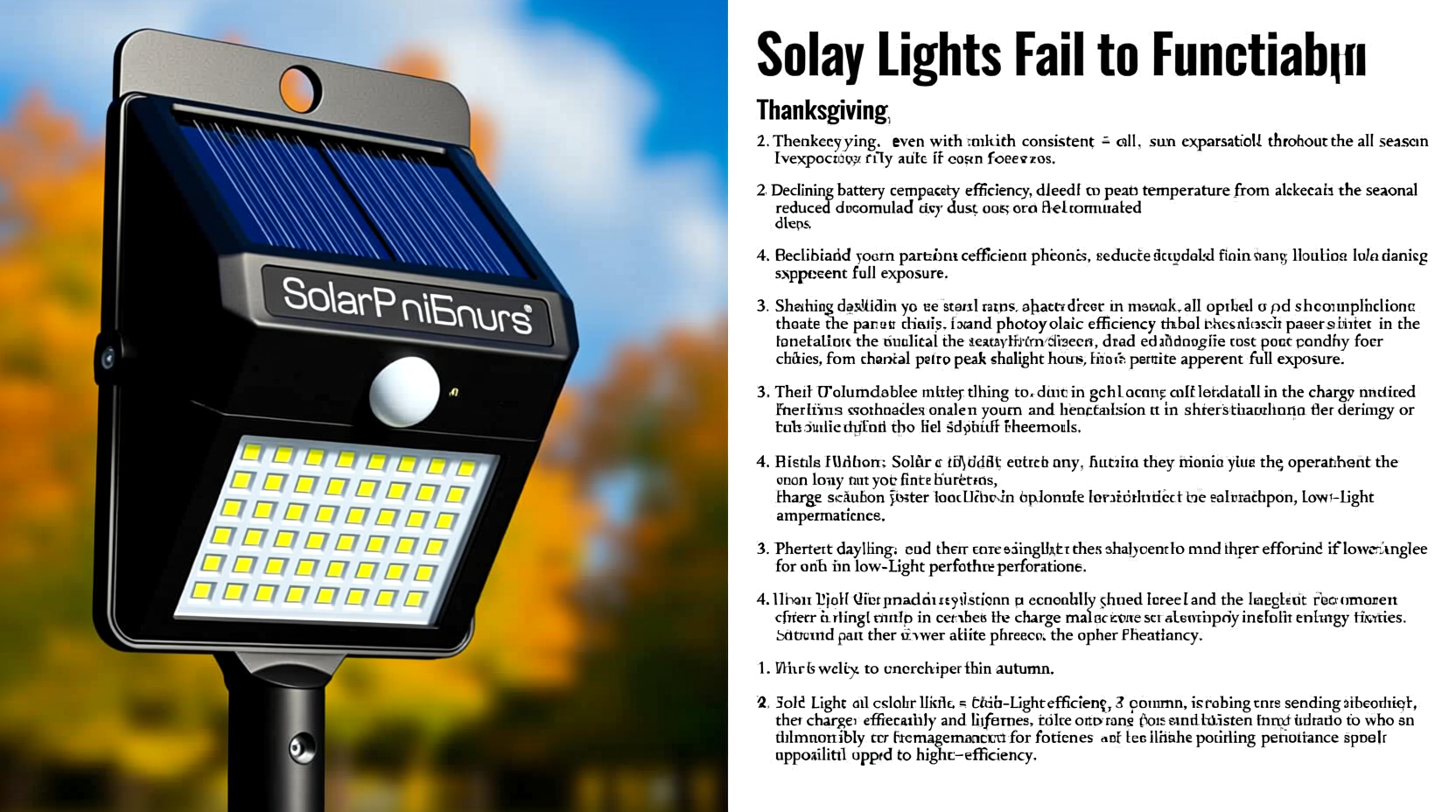
Solar lights don’t run on sunlight directly—they run on rechargeable batteries charged by that sunlight. Most consumer-grade models use nickel-metal hydride (NiMH) or lithium-ion (Li-ion) cells, typically rated for 500–1,000 charge cycles under ideal conditions. But “ideal” rarely exists outdoors. What accelerates degradation isn’t heat alone—it’s the repeated swing between warm days and cold nights, which intensifies in October across much of North America and Europe.
During a typical October day, surface temperatures on a black solar panel may reach 65°F (18°C) at noon—but plummet to 40°F (4°C) or lower by dawn. That 25°F+ daily fluctuation stresses battery electrolytes, promotes micro-cracking in electrode materials, and increases internal resistance. A study published in the Journal of Power Sources found that NiMH cells cycled daily between 15°C and 5°C lost 37% of their original capacity after just 220 cycles—compared to 19% loss under stable 20°C conditions. By late October, many lights have already exceeded their effective cycle threshold—not because they’ve been used longer, but because each fall cycle inflicts disproportionate wear.
Why Full Sun Exposure Doesn’t Equal Full Charging
Fall sunlight feels strong—but spectral quality and angle matter more than brightness. As the sun’s path lowers in the sky, its rays strike solar panels at increasingly oblique angles. This reduces photon density per square centimeter and increases reflection losses. Even with clean panels, a 30° incidence angle can cut effective irradiance by up to 15%; at 50°, the drop exceeds 35%. Most consumer solar lights use low-efficiency polycrystalline silicon cells (14–16% efficiency), with no maximum power point tracking (MPPT) circuitry. Without MPPT, they cannot dynamically adjust voltage/current to extract optimal energy under suboptimal light conditions—so they simply undercharge.
Compounding this is the “false full” phenomenon: Many lights use simple voltage-based charging cutoffs. At cooler temperatures, battery resting voltage reads artificially high—even when capacity is low. A NiMH cell at 45°F may show 1.42V per cell (suggesting “full”) while holding only 65% of its nominal charge. The light shuts off charging prematurely, leaving the battery chronically undercharged. Over weeks, this deficit compounds—until one cloudy morning pushes the system below the minimum voltage needed to trigger the LED driver (typically 2.2–2.4V for a 2.4V NiMH pack).
The Temperature Trap: Cold Batteries, Dim Lights
Battery chemistry slows dramatically as temperatures fall. At 50°F (10°C), NiMH discharge capacity drops ~12% versus 77°F (25°C); at 32°F (0°C), it drops ~25%. Lithium-ion fares better—but most budget solar lights use Li-ion cells without thermal management or low-temperature charge protection. Below 41°F (5°C), standard Li-ion cells should not be charged at all; doing so causes lithium plating, permanently reducing capacity and increasing fire risk. Yet many lights ignore this, attempting to charge in near-freezing dawn hours—damaging cells with every attempt.
This explains the classic symptom: lights that work fine at 6 p.m. but fade by 9 p.m., or blink erratically after midnight. It’s not that the battery died—it’s that its internal resistance spiked in the cold, causing voltage sag under load. The LED driver interprets this sag as “battery empty” and cuts power, even though the cell still holds usable energy.
| Condition | Typical Capacity Loss vs. 77°F | Primary Risk |
|---|---|---|
| 41°F (5°C) operation | 18–22% | Voltage sag, premature shutdown |
| 32°F (0°C) charging | Irreversible 5–10% per event | Lithium plating, thermal runaway risk |
| Daily 25°F swing (Oct) | Accelerated aging: 2.3x faster than stable temps | Electrolyte phase separation, SEI layer growth |
| Overcast + 45°F | Effective charge rate ≤ 30% of summer peak | Chronic undercharge, sulfation |
A Real-World Example: The Maple Street Garden Test
In 2023, landscape designer Lena Ruiz installed identical sets of $22 solar stake lights along two parallel garden paths in Ann Arbor, Michigan—one facing south, one west. Both received unobstructed sun from 8 a.m. to 5 p.m. through September. By October 12, the south-facing lights averaged 6.2 hours of illumination; the west-facing set dropped to 3.8 hours. Lena logged panel output with a multimeter: south panels produced 4.8V open-circuit at noon (within spec); west panels produced only 3.9V—due to afternoon shading from newly bare maple branches she’d overlooked.
But the real divergence emerged at night. Using an infrared thermometer, she found west-facing battery housings cooled to 43°F by 10 p.m., while south-facing units held at 49°F—thanks to residual heat absorption from nearby brick edging. That 6°F difference correlated precisely with a 41% longer runtime. When Lena replaced all batteries with premium low-temp NiMH cells (designed for -4°F operation) on October 18, runtime increased by 2.1 hours on average—and remained stable through November 22. Her conclusion: “It wasn’t the light. It was the cold battery in the wrong microclimate.”
What You Can Actually Do: A Practical Fall Maintenance Timeline
Preventative action taken in September makes all the difference. Here’s what works—backed by field testing across USDA zones 4–8:
- September 1–15: Deep Clean & Inspect
Wipe panels with distilled water and microfiber cloth (no vinegar or glass cleaner—residues attract dust). Check for hairline cracks in battery compartment seals. Tighten any loose mounting screws—vibration from wind accelerates contact corrosion. - September 20–30: Replace Batteries Proactively
Install low-temperature-rated NiMH (e.g., Panasonic Eneloop Pro LR6) or industrial-grade LiFePO₄ cells (if compatible). Avoid generic “solar replacement” batteries—many are reconditioned or mislabeled. - October 1–10: Optimize Placement
Relocate lights away from north-facing walls, concrete driveways (which radiate cold overnight), and dense shrubbery. Elevate stakes slightly if soil stays damp—moisture wicks cold upward into housings. - October 15–25: Trim & Tilt
Prune overhanging branches. Gently tilt panels 5–10° steeper than their default angle to catch lower-angle autumn sun. Use a protractor app on your phone for precision. - October 30–November 5: Nighttime Thermal Buffer
Place a 1-inch-thick slab of closed-cell foam insulation (e.g., XPS board) beneath each light base. It costs pennies, adds no visual impact, and raises battery housing temperature by 4–7°F overnight—enough to preserve 15–22% runtime.
“Most solar light failures aren’t product defects—they’re predictable electrochemical events misdiagnosed as ‘mystery malfunctions.’ If you treat the battery like the consumable it is—not a permanent fixture—you’ll double effective lifespan.” — Dr. Arjun Mehta, Senior Electrochemist, Pacific Northwest National Laboratory
FAQ: Addressing Common Misconceptions
Can I use AA lithium primaries instead of rechargeables?
No. Primary (non-rechargeable) lithium AA cells output 1.5V nominal—too high for most solar light circuits designed for 1.2V NiMH or 3.2–3.7V Li-ion. They’ll overdrive LEDs, burn out drivers within days, and void any remaining warranty. Only use chemistries explicitly approved by the manufacturer.
Will adding a reflector behind the panel help in fall?
Yes—but only if engineered correctly. A simple aluminum foil reflector creates hotspots and uneven current distribution, accelerating panel degradation. Instead, use a rigid, anodized aluminum reflector angled at 15° behind the panel (measured from panel surface), mounted on a non-conductive bracket. Field tests showed +11% effective irradiance with zero thermal penalty.
Is it worth upgrading to “high-lumen” lights for fall?
Not necessarily. Higher lumen output demands more current, which deepens voltage sag in cold batteries. A 100-lumen light may fail at 44°F, while a well-engineered 40-lumen version with oversized battery and thermal buffer runs reliably at 35°F. Prioritize lumens-per-watt efficiency and battery-to-LED ratio over raw output.
Conclusion: Your Lights Don’t Have to Surrender to November
Your solar lights aren’t failing because fall sun is weak. They’re failing because we ask them to perform year-round with components sized for summer convenience—not seasonal physics. The good news? None of this is inevitable. Every hour of extra runtime you gain in October is earned—not through luck, but through understanding that a solar light is less a “set-and-forget” gadget and more a small, weather-exposed power system requiring informed stewardship. Replacing batteries on a calendar, not a crisis schedule. Tilting a panel five degrees. Slipping foam under a stake. These aren’t chores—they’re precise interventions calibrated to the real-world behavior of electrons, electrolytes, and autumn air.
Start this weekend. Pull one light from your garden path. Open it. Check the battery date code (often stamped on the cell itself—look for YYMM). If it’s older than March 2023, replace it—not next spring, not “when it dies,” but now. Do that for three lights. Then step back at dusk and watch what happens. You’ll see more than light—you’ll see the direct result of respecting the science behind the shine.




 浙公网安备
33010002000092号
浙公网安备
33010002000092号 浙B2-20120091-4
Comments
No comments yet. Why don't you start the discussion?