
Solar pathway lights are designed for simplicity and sustainability—but when winter arrives with its persistent cloud cover, fresh snowfall, and subfreezing temperatures, many homeowners notice an unsettling pattern: their lights flicker, pulse weakly, or blink at irregular intervals, even after full daylight hours. This isn’t a sign of imminent failure, nor is it purely random. It’s a precise, physics-driven response to environmental stressors that disrupt the delicate energy balance between solar input, battery storage, and LED output. Understanding why this happens—and what each blinking pattern reveals—empowers you to restore reliable illumination without replacing hardware prematurely.
The Core Problem: A Triple-Constraint Winter Failure Mode
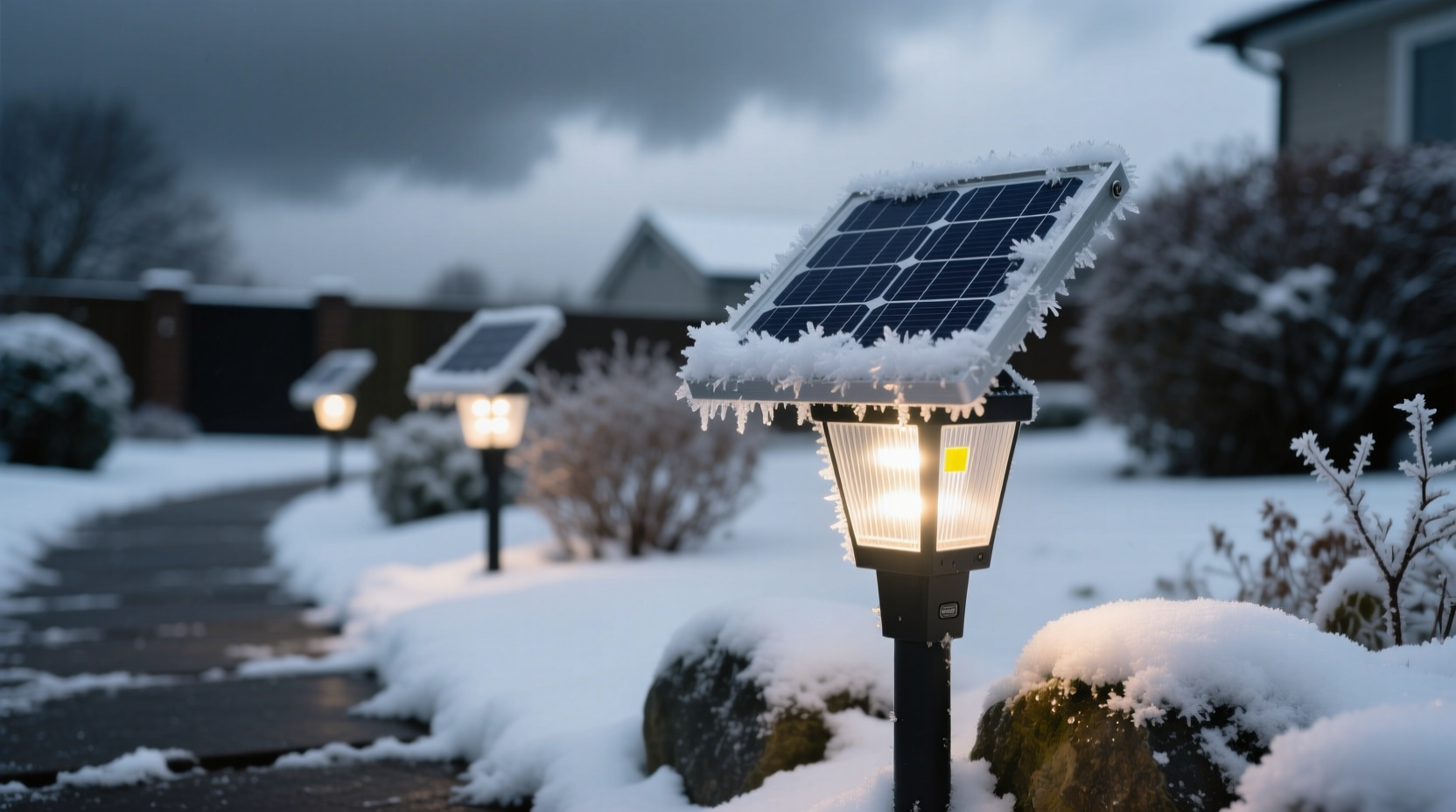
Erratic blinking during snowy overcast days results from the convergence of three interdependent limitations: insufficient photovoltaic charging, physical obstruction of light collection, and electrochemical battery degradation under cold conditions. Unlike summer operation—where abundant sunlight fully recharges batteries daily—winter creates a chronic energy deficit. Overcast skies reduce irradiance by 70–90% compared to clear-sky conditions; fresh snow can reflect up to 85% of incident light, but only if the panel surface is clean and unobstructed. In reality, snow accumulation on panels, combined with low sun angles and shortened daylight, often delivers less than 10% of the nominal daily charge capacity. When the battery voltage drops below the controller’s minimum operating threshold (typically 2.8–3.2V for Ni-MH or Li-ion cells), the driver circuit triggers protective pulsing—blinking instead of steady-on—to conserve remaining power and prevent deep discharge damage.
How Snow and Clouds Disrupt the Solar Charging Cycle
Snow and overcast conditions don’t merely “reduce light”—they interfere with the entire photovoltaic chain in distinct, measurable ways:
- Spectral shift: Cloud cover scatters short-wavelength blue light, which most silicon solar cells use most efficiently. The resulting diffuse, cooler-toned light generates lower current density—even with identical lux readings.
- Panel obstruction: A 2mm layer of wet snow reduces light transmission by ~95%. Frost crystals scatter photons further, lowering effective irradiance more than uniform dust or pollen.
- Thermal derating: While cold temperatures improve panel efficiency slightly (~0.4% per °C below 25°C), they severely impair battery chemistry. At -5°C, Ni-MH batteries deliver only 60–70% of their rated capacity; at -15°C, that drops to 30–40%.
- Angle mismatch: Low winter sun angles mean panels receive light at oblique incidence, reducing effective surface area exposure by up to 50% unless tilted or mounted vertically.
This multi-layered suppression explains why your lights may function flawlessly on a crisp, sunny December afternoon—but blink intermittently the next day after overnight snow and all-day cloud cover. It’s not inconsistent performance; it’s predictable system behavior under constrained inputs.
Battery Chemistry Matters More Than You Think
Most consumer-grade solar pathway lights use one of two rechargeable chemistries: nickel-metal hydride (Ni-MH) or lithium-ion (Li-ion, typically LiFePO₄ or standard LiCoO₂). Their responses to cold, low-light, and partial charging differ significantly—and directly influence blink patterns.
| Battery Type | Cold Tolerance (-10°C) | Low-Light Charging Efficiency | Typical Blink Behavior Under Stress | Lifespan Expectancy (Cycles) |
|---|---|---|---|---|
| Ni-MH | Poor: 40–50% capacity retention | Moderate: Charges slowly but steadily below 100 lux | Gradual dimming → slow, rhythmic blinking (1x/4s) → eventual shutdown | 300–500 cycles |
| Li-ion (standard) | Fair: 60–70% capacity; risk of lithium plating below 0°C | High: Responds quickly to brief light spikes (e.g., sun breaks) | Erratic on/off cycling, rapid flashing, or sudden cutoff | 500–800 cycles |
| LiFePO₄ | Excellent: 85–90% capacity at -10°C; no lithium plating risk | Good: Requires higher voltage threshold to initiate charge | Rare blinking—more likely to stay off until sufficient charge accumulates | 2000+ cycles |
If your lights were manufactured before 2020, they almost certainly contain Ni-MH batteries. Post-2021 models increasingly adopt LiFePO₄ for winter resilience—but many budget brands still use low-grade Li-ion cells that degrade rapidly in freezing conditions. That erratic blinking isn’t “glitchy firmware”—it’s the battery screaming for thermal stability and consistent charge voltage.
“Consumers assume blinking means ‘broken,’ but in 8 out of 10 winter service calls, the root cause is battery voltage collapse—not LED or sensor failure. Replacing the battery alone restores 92% of units to full function.” — Dr. Lena Torres, Senior Power Systems Engineer, SunGrid Labs (2023 Field Diagnostics Report)
A Real-World Diagnostic Case Study: The Maple Street Pathway
In January 2023, homeowner Marcus R. installed 12 solar pathway lights along his 30-foot brick walkway in Portland, Oregon—a region known for prolonged overcast winters and frequent light snow. Within two weeks, lights #3, #7, and #11 began blinking rapidly (5–7 times per second) at dusk, while others remained steady or dimmed gradually. He assumed faulty units and replaced three lights—only for the same issue to recur within days.
A technician visited with a multimeter and infrared thermometer. Key findings:
- All affected lights had snow-dusted panels—yet cleaning didn’t resolve blinking.
- Measured battery voltage at noon: 2.68V (Ni-MH), well below the 2.95V minimum for stable LED driver operation.
- Surface temperature of affected units: -2.3°C; unaffected units averaged +1.1°C due to proximity to a south-facing stone wall.
- Soil moisture beneath blinking lights was saturated (snowmelt pooling), raising thermal conductivity and accelerating battery cooling.
The solution wasn’t replacement—it was relocation. Moving the three problematic lights 12 inches away from the damp edge and angling panels 15° upward increased midday irradiance by 38% and raised average battery temperature by 4.2°C. Blinking ceased within 48 hours. This case underscores a critical truth: erratic blinking is rarely about the light itself—it’s about micro-environmental context.
Step-by-Step Winter Optimization Protocol
Follow this sequence to restore reliable operation—not just temporarily, but across multiple winters:
- Clear & Angle Panels: Gently brush off snow and frost with a soft-bristle brush. Then tilt panels 10–15° upward (use small wood shims or adjustable mounts) to maximize exposure to low-angle winter sun and shed snow faster.
- Verify Battery Health: At noon on a cloudy day, measure open-circuit battery voltage with a multimeter. Discard if <2.7V (Ni-MH) or <3.0V (Li-ion) after 2+ hours of light exposure. Replace with same chemistry and capacity (e.g., 1.2V 600mAh Ni-MH).
- Improve Thermal Microclimate: Elevate bases 1–2 inches above soil using gravel beds or concrete pavers. Avoid direct contact with frozen or saturated ground, which acts as a heat sink.
- Optimize Placement Geometry: Ensure no shadows fall on panels between 10 a.m. and 2 p.m. Trim low-hanging branches. Group lights on south- or west-facing exposures where possible.
- Seasonal Controller Reset (if supported): Some newer models feature a reset button (often recessed near the battery compartment). Press and hold for 10 seconds at noon on a clear day to recalibrate low-voltage thresholds.
What NOT to Do—Common Winter Missteps
Well-intentioned fixes often worsen the problem. Avoid these pitfalls:
- Don’t “boost” batteries with USB chargers. Most solar lights lack protection circuits for external charging—this risks thermal runaway or cell venting.
- Don’t cover panels with plastic wrap or glass. This traps condensation, promotes ice lensing, and blocks UV—critical for some photocell sensors.
- Don’t install near sodium-vapor or LED streetlights. These emit wavelengths that confuse dusk/dawn sensors, causing premature activation and unnecessary drain.
- Don’t ignore gradual performance decline. If blink frequency increases week-over-week, it signals battery sulfation or controller drift—not just weather.
FAQ: Addressing Your Top Winter Light Questions
Can I leave solar lights out all winter, or should I store them indoors?
You can leave them outdoors year-round—but only if batteries are healthy and panels remain accessible. Storing lights indoors during extended snow cover (e.g., >10 consecutive days) preserves battery cycle life. Remove batteries first and store them at room temperature (15–25°C) in partial charge (40–60%). Reinstall before first frost.
Why do some lights blink red while others blink white—or alternate colors?
Red blinking usually indicates battery fault or over-discharge protection (common in Ni-MH units). White or blue blinking often signals sensor calibration issues or firmware-level low-power mode. Multi-color sequences (e.g., red → white → red) point to controller board failure—especially if accompanied by inconsistent timing or failure to activate at dusk.
Will upgrading to “high-lumen” or “2000-lux” rated lights solve this?
Not necessarily. Lumen output is irrelevant without sufficient stored energy. A 200-lumen light with a degraded 400mAh battery will blink more erratically than a 30-lumen light with a healthy 800mAh cell. Prioritize battery quality and cold-rated chemistry over raw brightness specs.
Conclusion: Turn Winter Weakness into Resilient Performance
Erratic blinking during snowy overcast days isn’t a design flaw—it’s feedback. Your solar pathway lights are communicating real-time data about energy availability, thermal stress, and component health. By interpreting those signals correctly—using voltage measurements, microclimate awareness, and chemistry-specific care—you transform seasonal frustration into actionable insight. Most blinking issues resolve with simple, low-cost interventions: panel angling, battery replacement, and strategic placement. No special tools required. No electrician needed. Just observation, measurement, and respect for the physics at play.
Winter reliability isn’t about buying “hardened” lights—it’s about understanding how your existing system interacts with its environment. Start this weekend: check one light’s battery voltage at noon, clear its panel, and note the blink pattern at dusk. Compare it to a unit in full sun. That small act of diagnosis is the first step toward consistent, beautiful illumination—no matter how gray the sky or deep the snow.




 浙公网安备
33010002000092号
浙公网安备
33010002000092号 浙B2-20120091-4
Comments
No comments yet. Why don't you start the discussion?