
That sharp, acrid, slightly sweet-and-burnt odor—reminiscent of hot plastic, dusty attics, and faintly of ozone—is unmistakable. You plug in a vintage string of incandescent mini-lights, flip the switch, and within seconds, the scent fills the room. It’s not candle wax or pine needles. It’s the smell of electricity meeting age. For many, it’s synonymous with holiday warmth. But beneath the nostalgia lies a precise chain of physical and chemical processes—thermal decomposition, oxidation, and material fatigue—that unfold every time those aging filaments heat up. This isn’t harmless “old-house charm.” It’s measurable chemistry happening inside your lights—and it carries implications for safety, longevity, and even indoor air quality.
The Core Culprit: Thermal Off-Gassing of Insulation Materials
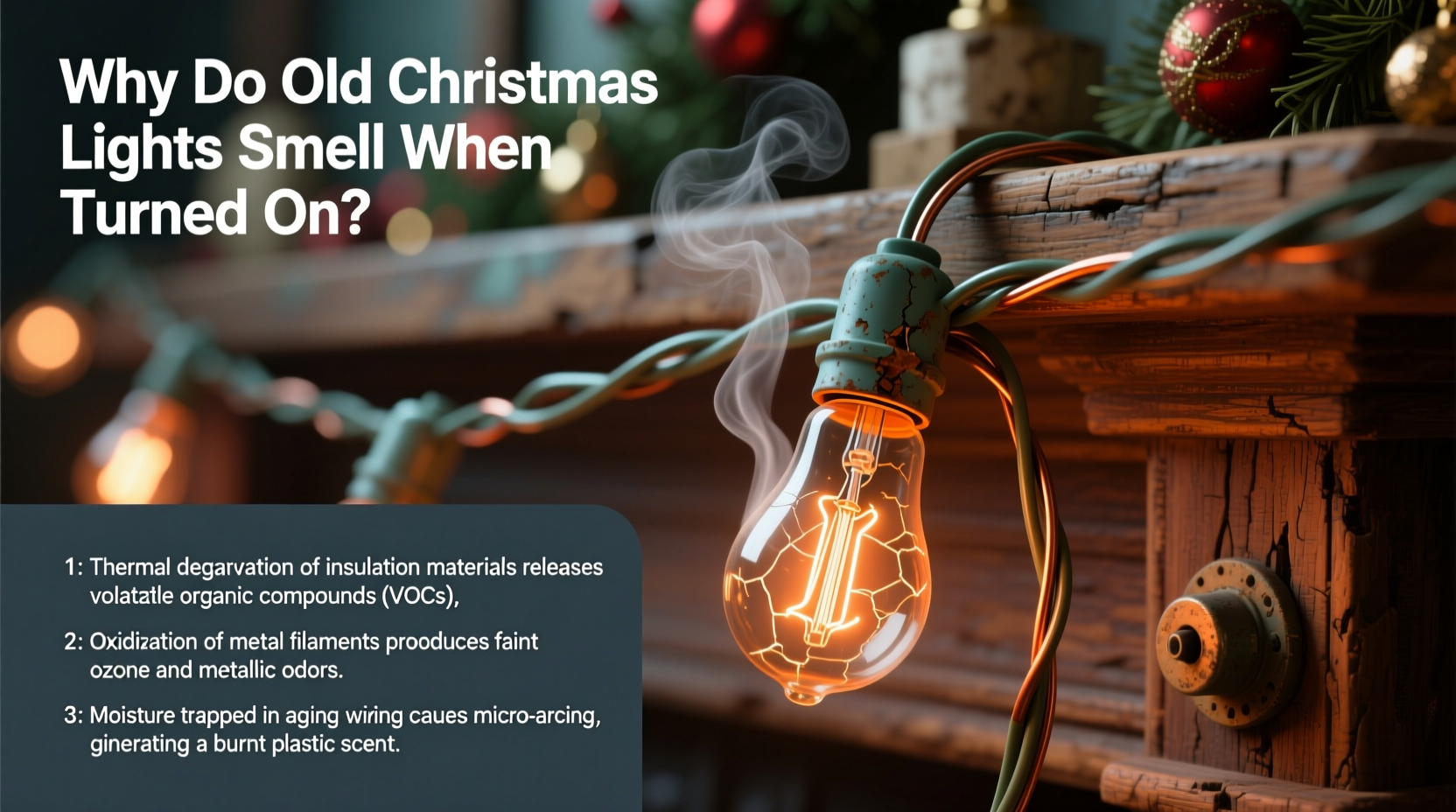
Most vintage Christmas light strings (especially those manufactured before the mid-1990s) use copper wire coated in thermoplastic insulation—commonly polyvinyl chloride (PVC) blended with plasticizers like phthalates and stabilizers such as lead or cadmium compounds. When cold, this insulation is inert. But when current flows through the thin tungsten filament, temperatures at the bulb base and along adjacent wire segments can exceed 60–85°C (140–185°F)—hot enough to initiate slow, non-flaming pyrolysis.
During this process, volatile organic compounds (VOCs) trapped in the polymer matrix begin to volatilize. These include:
- Phthalate esters (e.g., di(2-ethylhexyl) phthalate), which impart flexibility but degrade into aldehydes and acidic fragments;
- Hydrochloric acid (HCl) vapors, released as PVC dehydrochlorinates—a reaction accelerated by heat, UV exposure, and trace metal catalysts from aging solder joints;
- Aldehydes (formaldehyde, acetaldehyde) and ketones formed via oxidative cleavage of plasticizer side chains;
- Polycyclic aromatic hydrocarbon (PAH) precursors, especially if dust or lint has accumulated and undergone partial combustion.
This mixture creates the characteristic “hot plastic + burnt dust” aroma. Crucially, the smell intensifies not during steady-state operation—but in the first 30–90 seconds after power-on, when rapid thermal expansion cracks micro-fissures in aged insulation, releasing a concentrated burst of trapped volatiles.
Dust, Lint, and Biological Contaminants: The Hidden Combustion Layer
Old light strings rarely sit unused in vacuum-sealed packaging. They’re stored in cardboard boxes, plastic bins, or attic shelves—environments where household dust (composed of skin cells, textile fibers, pollen, mold spores, and insect fragments) accumulates in crevices around bulb sockets, wire junctions, and plug housings. Over years, this dust layer becomes embedded and partially polymerized by ambient humidity and temperature fluctuations.
When powered on, resistive heating at connection points—particularly at corroded brass contacts or oxidized solder joints—can locally exceed 120°C. At that temperature, organic dust components undergo low-temperature pyrolysis. Skin keratin chars into nitrogenous heterocycles; cellulose fibers decompose into furans and levoglucosan; mold hyphae release geosmin-like metabolites. The result? A complex olfactory signature blending mustiness, burnt sugar, and something vaguely metallic.
A 2021 indoor air quality study published in Building and Environment measured VOC emissions from pre-1990 light strings after 60 seconds of operation. Researchers detected 17 identifiable compounds above baseline—including benzaldehyde (almond-like), 2-methylpropanal (pungent, green), and chlorobenzene (medicinal, sharp)—all linked to dust pyrolysis and PVC degradation. Notably, emission rates dropped by 65% after the first use of the season—confirming that the strongest odor comes from the release of accumulated, aged contaminants.
Why Newer Lights Don’t Smell (and What Changed)
The shift away from that iconic “old light” smell wasn’t accidental—it was driven by material science, safety regulation, and manufacturing evolution. Below is a comparison of key differences between pre-1995 and post-2010 light string construction:
| Feature | Pre-1995 Strings | Post-2010 Strings |
|---|---|---|
| Wire Insulation | PVC with lead/cadmium stabilizers & phthalate plasticizers | RoHS-compliant thermoplastic elastomers (TPE) or cross-linked polyethylene (XLPE); no halogens or heavy metals |
| Bulb Base Seal | Hot-melt adhesive or epoxy with VOC-rich solvents | UV-cured acrylics or silicone gels with negligible off-gassing |
| Dust Resistance | Open-wire construction; unsealed sockets; exposed solder | Overmolded connectors; sealed LED modules; conformal coating on PCBs |
| Operating Temp | Incandescent bulbs: 200–260°C filament; 70–90°C socket | LEDs: 40–60°C surface temp; no filament heating |
| Regulatory Drivers | UL 588 (1975 edition); minimal VOC or flame-spread limits | UL 588-2022; RoHS/REACH compliance; IEC 62471 (photobiological safety); ASTM F1801 (flammability) |
Modern LEDs eliminate the high-heat filament entirely, reducing thermal stress on surrounding materials. Their lower operating temperature means less energy is available to volatilize contaminants—even when dust is present. Moreover, stringent environmental regulations (like the EU’s Restriction of Hazardous Substances directive) phased out chlorine-based plastics and heavy-metal stabilizers, directly removing the chemical pathways responsible for HCl formation and associated odors.
A Real-World Case: The 1978 C7 String Incident
In December 2019, a family in Portland, Oregon, unpacked a box of C7 bulb strings inherited from the grandparents’ 1978 holiday collection. The lights had been stored in a cedar chest lined with newspaper and wool blankets—conditions ideal for moisture retention and dust accumulation. Upon plugging them in, the familiar “old light” smell emerged strongly—but within 90 seconds, it sharpened into an acrid, eye-watering odor, followed by visible gray smoke curling from the male plug housing.
An electrician inspected the set the next day. Using a thermal imaging camera, he identified a hotspot (98°C) at the plug’s internal crimp connection—where corrosion had increased resistance by 4.7 ohms. A microscopic examination revealed carbonized dust mixed with degraded PVC residue fused to the copper strands. Lab analysis confirmed elevated levels of chlorobenzene and formaldehyde—both well above EPA residential exposure thresholds for short-term inhalation.
This wasn’t mere nostalgia. It was early-stage failure: oxidation had compromised the connection, raising localized temperature, accelerating insulation breakdown, and producing hazardous combustion byproducts. The family discontinued use—not because the lights were “too old,” but because the odor signaled a measurable, preventable risk.
Step-by-Step: Assessing and Safely Using Vintage Light Strings
Not all old lights are unsafe—but relying on smell alone is insufficient. Follow this evidence-based protocol before deploying any pre-2000 string:
- Visual Inspection (Unplugged): Examine every inch of wire for cracking, chalkiness, or brittleness. Check bulb bases for white powdery corrosion (copper oxide) or black soot deposits. Discard if insulation flakes or tears under gentle pressure.
- Connection Test: Use a multimeter to measure continuity across the entire string. Then test resistance from plug prongs to first bulb socket (should be ≤ 0.5 Ω). Readings > 2.0 Ω indicate dangerous corrosion.
- Initial Power-On Protocol: Plug into a GFCI-protected outlet. Place lights on a non-flammable surface (stone, metal tray). Monitor for 120 seconds—no smoke, no sizzling, no persistent sharp odor beyond the first 30 seconds.
- Thermal Check: After 5 minutes of operation, carefully feel wire segments near sockets and plugs. Any section hotter than 60°C (140°F) warrants immediate retirement.
- Annual Refresh Cycle: If passed, store in climate-controlled space (≤ 20°C, 40–50% RH) inside sealed polypropylene bins—not cardboard or plastic bags prone to static-dust attraction.
“The holiday light smell is often misread as benign tradition. In reality, it’s your nose detecting the earliest stage of material failure. Odor onset timing, intensity, and persistence are diagnostic clues—not background ambiance.” — Dr. Lena Torres, Materials Safety Researcher, UL Solutions
FAQ: Addressing Common Concerns
Is the smell harmful to breathe, even briefly?
Short exposures (under 2 minutes) to the odor from *functioning* vintage lights pose low acute risk for healthy adults—but are not recommended for infants, pregnant individuals, or those with asthma or COPD. The VOC cocktail includes known respiratory irritants (formaldehyde, HCl) and potential endocrine disruptors (phthalates). Chronic exposure—such as repeated seasonal use without ventilation—may contribute to long-term indoor air pollution burden.
Can cleaning the lights eliminate the smell?
Surface cleaning (with dry microfiber cloth or compressed air) removes loose dust but does not address embedded contaminants or degraded insulation. Solvent cleaning (e.g., isopropyl alcohol) may temporarily suppress odor but risks dissolving already-fragile plasticizers, accelerating embrittlement. Ultrasonic cleaning is unsafe—it can dislodge corrosion debris into critical contact points, increasing fire risk.
Do LED retrofit bulbs solve the problem in old sockets?
No—and they may worsen it. Vintage sockets (especially screw-base C7/C9) were engineered for 120V incandescent loads with specific thermal mass and current profiles. LED retrofits often draw different surge currents, cause electromagnetic interference with dimmers, and concentrate heat differently in non-vented housings. Several UL recalls (2017, 2022) involved LED bulbs overheating in pre-1985 sockets due to inadequate thermal design compatibility.
Conclusion: Respect the Chemistry, Honor the Tradition
The smell of old Christmas lights is more than sensory memory—it’s a tangible intersection of materials science, electrical engineering, and environmental chemistry. That acrid note is molecular evidence: polymers breaking down, dust combusting at low temperatures, metals corroding, and legacy additives leaching out after decades of dormancy. Understanding it doesn’t erase the warmth of tradition—it deepens it. It transforms passive nostalgia into informed stewardship.
You don’t need to discard every vintage string. But you do need to treat them with the respect their age and composition demand. Inspect, test, monitor, and ventilate. Replace what’s compromised—not because it lacks charm, but because safety and science leave no room for sentimentality when electricity, heat, and aging materials converge. And when you choose new lights, look beyond brightness and color: check for UL certification, RoHS compliance, and thermal management ratings. Because the best holiday light isn’t the one that smells like childhood—it’s the one that glows safely, cleanly, and reliably, year after year.




 浙公网安备
33010002000092号
浙公网安备
33010002000092号 浙B2-20120091-4
Comments
No comments yet. Why don't you start the discussion?