
Christmas lights bring warmth and cheer—but when the strings themselves grow warm, even uncomfortably hot, to the touch, that’s not festive. It’s a red flag. Older incandescent light strings—especially those manufactured before 2010—commonly heat up during operation, sometimes reaching surface temperatures exceeding 140°F (60°C). That’s hot enough to cause minor burns on brief contact and, more critically, signals underlying electrical degradation that dramatically increases fire risk. This isn’t just about discomfort or energy inefficiency; it’s about physics, material fatigue, and decades of cumulative wear that quietly compromise safety margins. In this article, we break down exactly why aging lights overheat, what each temperature threshold means in practical terms, and how to assess, mitigate, or retire at-risk strings—before an incident occurs.
The Physics Behind the Heat: Why Age Makes Lights Hotter
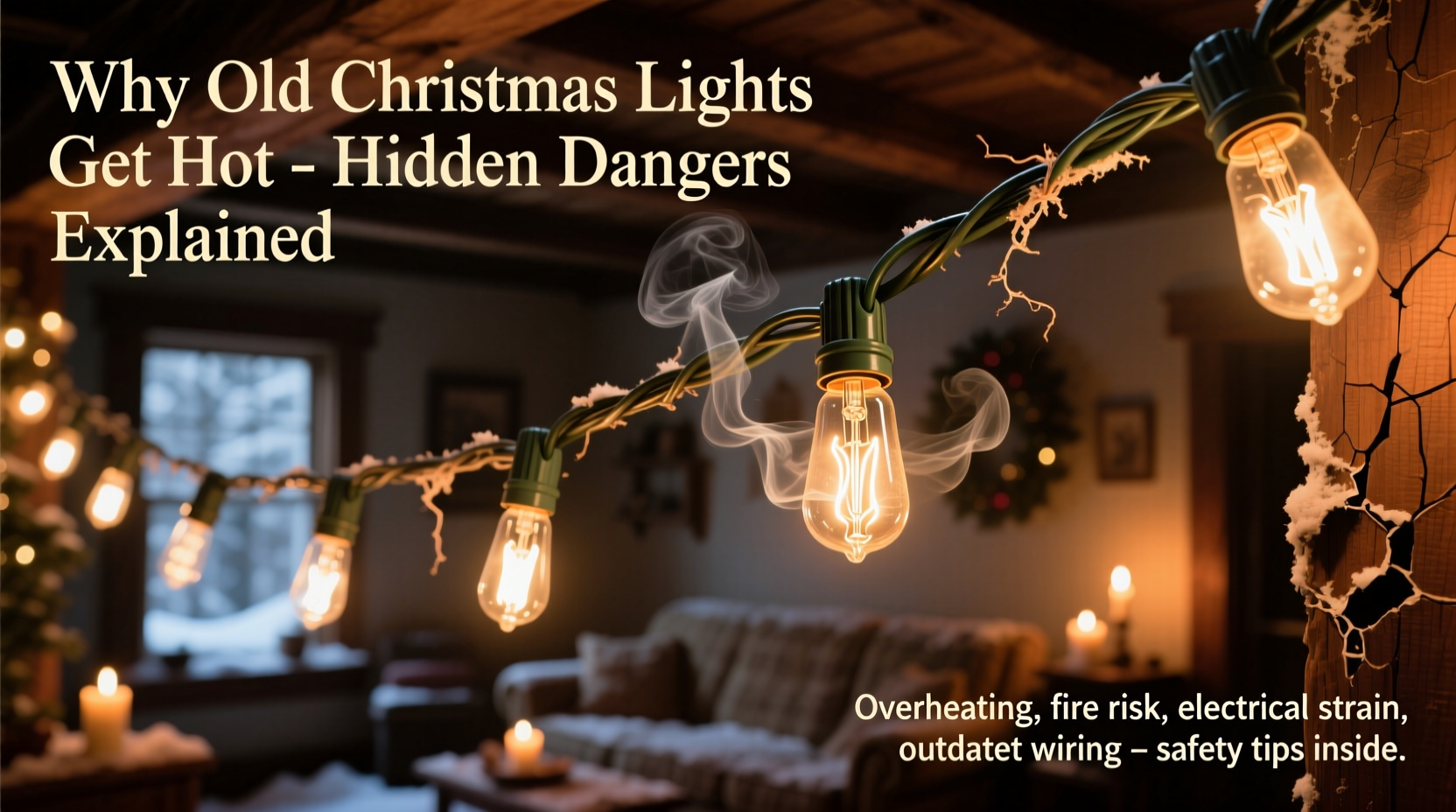
Incandescent Christmas lights generate light by passing current through a thin tungsten filament. As electricity flows, resistance in the filament converts roughly 90% of the energy into heat and only 10% into visible light. That inherent inefficiency is why these bulbs run hot—even when new. But age compounds the problem through three interrelated mechanisms:
- Insulation breakdown: The PVC or rubberized insulation surrounding internal wiring becomes brittle, cracks, and shrinks over time—especially when exposed to UV light, temperature cycling, and moisture. This exposes conductors to micro-abrasions and allows adjacent wires to shift closer together, increasing resistive losses and localized heating.
- Corrosion and oxidation: Moisture ingress (even from seasonal humidity) corrodes copper wire strands and oxidizes solder joints at bulb bases and inline connectors. Oxidized metal has higher electrical resistance—so more voltage drops across degraded connections, generating concentrated heat at those points.
- Filament thinning and hot-spotting: Each time an incandescent bulb is switched on, thermal shock causes microscopic evaporation of tungsten from the filament. Over hundreds of on/off cycles, the filament thins unevenly. Thinner sections have higher resistance per unit length, causing them to glow brighter—and hotter—than surrounding areas. These “hot spots” accelerate further degradation, creating a feedback loop.
Modern LED strings avoid these issues entirely: they use semiconductors with minimal resistive heating, operate at low DC voltage (typically 12–24V), and contain built-in current regulation. But for the estimated 70+ million U.S. households still using legacy incandescent mini-lights—many stored and reused for 15–25 years—the thermal behavior is anything but benign.
Temperature Thresholds and Their Real-World Risks
Not all warmth is equal. How hot a string feels—and where the heat concentrates—reveals critical information about its condition. Below is a field-tested interpretation guide used by fire investigators and electrical safety inspectors:
| Surface Temperature Range | Perceived Sensation (Touch) | Associated Risk Level | Typical Cause |
|---|---|---|---|
| 104–122°F (40–50°C) | Noticeably warm, comfortable for brief contact | Low — normal for vintage incandescents under load | Intact insulation, clean connections, typical filament resistance |
| 122–140°F (50–60°C) | Definitely hot; uncomfortable after 2–3 seconds | Moderate — indicates early degradation; inspect immediately | Oxidized contacts, minor insulation cracking, or overloaded circuit (e.g., daisy-chained beyond rating) |
| 140–160°F (60–71°C) | Painful on contact; potential for first-degree burn in <5 sec | High — immediate replacement required | Severe corrosion, partial shorting, or damaged transformer/rectifier |
| 160°F+ (71°C+) | Instant pain; blistering possible in under 3 seconds | Critical — discontinue use now; fire hazard confirmed | Active arcing, melted insulation, or failing rectifier overheating entire string |
Note: These thresholds assume dry, ambient conditions. Humidity, proximity to flammable materials (curtains, pine boughs, artificial trees), or enclosed spaces (behind furniture, inside glass globes) lower safe operating temperatures significantly.
A Real-World Case: The 2022 Portland Tree Fire
In December 2022, a residential fire in Portland, Oregon destroyed a home’s living room and caused $210,000 in damages. Fire investigators traced ignition to a 22-year-old set of C7 incandescent lights strung on a dried-out artificial tree. The homeowner had replaced only two burned-out bulbs over the years—using mismatched replacements with slightly higher wattage (7W vs. original 5W)—and daisy-chained five strings end-to-end on a single outlet, exceeding the manufacturer’s maximum of three.
Thermal imaging revealed the plug housing reached 187°F (86°C) before failure. Autopsy of the cord showed severe embrittlement of the PVC jacket, copper wire oxidation at the male plug terminals, and carbon tracking inside the molded connector—evidence of sustained arcing. Crucially, the homeowner reported the string “always got warm,” but assumed that was normal because “it worked every year.”
This case underscores a dangerous misconception: functional continuity does not equal safe operation. Degradation is often invisible until catastrophic failure occurs.
Expert Insight: What Electrical Safety Professionals Observe
“The most alarming trend we see in holiday fire investigations isn’t faulty new products—it’s the normalization of heat in legacy lighting. People ignore warmth because the lights still glow. But heat is the number one indicator of energy loss, and energy loss in wiring equals potential ignition. If a light string feels hot, it’s already operating outside its design envelope. Replacement isn’t precautionary—it’s remedial.”
— Dr. Lena Torres, P.E., Senior Fire Investigator, National Fire Protection Association (NFPA)
Dr. Torres’ team reviewed 1,247 holiday-related electrical fires from 2018–2023. Of those involving decorative lighting, 89% involved equipment over 10 years old—and 73% of those cited “excessive heat at connection points” as the primary observable precursor in witness statements.
Actionable Safety Checklist: Assess, Mitigate, or Replace
Don’t guess. Use this evidence-based checklist to evaluate any incandescent light string older than 8 years:
- Inspect the cord jacket: Look for cracks, stiffness, chalky residue, or discoloration (yellowing/browning). Gently bend a 6-inch section—if it cracks or resists flexing, discard.
- Check every bulb base: Remove one bulb and examine the metal socket. If you see green corrosion, white powder (copper oxide), or black soot-like residue, the entire string is compromised.
- Test plug integrity: Plug in the string (unlit) and gently wiggle the male plug while observing the outlet. Any sparking, buzzing, or warmth at the outlet face indicates dangerous contact resistance.
- Verify chain length compliance: Count total strings connected. If more than three are daisy-chained—or if the total length exceeds 210 feet for standard 120V mini-lights—you’re exceeding safe load capacity.
- Smell test (seriously): After running for 10 minutes, unplug and sniff near plugs and connectors. A sharp, acrid, or “burnt plastic” odor means insulation is actively degrading.
Step-by-Step: Safe Transition From Incandescent to LED
Switching isn’t just safer—it saves money and reduces maintenance. Follow this proven transition plan:
- Inventory & categorize: Sort existing strings by type (mini, C7, C9), voltage (120V vs. low-voltage), and condition. Discard any failing the checklist above.
- Calculate replacement needs: Measure linear footage of current displays. Choose LED equivalents with matching base type (E12, E17) and color temperature (2700K for warm white, mimics incandescent).
- Select certified products: Only buy LED strings bearing UL 588 certification (look for the mark on packaging or spec sheet). Avoid uncertified imports—they often skip surge protection and thermal cutoffs.
- Install with spacing: Maintain ≥3 inches between LED strings and flammable surfaces. Never wrap tightly around branches or railings—allow airflow.
- Use smart controls: Install a GFCI-protected outdoor-rated timer or smart plug. Set automatic shutoff after 8 hours—preventing overnight overheating from unnoticed failures.
LED strings consume 80–90% less energy, produce negligible heat, and last 25,000+ hours versus 2,000–3,000 for incandescents. The upfront cost pays back in 2–3 seasons via reduced electricity bills alone.
FAQ: Critical Questions Answered
Can I repair a hot-running incandescent string by replacing the fuse or plug?
No. Replacing the plug or inline fuse addresses only one component. The heat originates from systemic degradation—oxidized wiring, brittle insulation, and filament instability—that cannot be reversed. Repair attempts may temporarily mask symptoms but increase risk of hidden arcing or short circuits downstream.
Are vintage or “retro-style” LED lights safer than old incandescents?
Yes—if they are UL-listed and designed as true LED replacements (not hybrid bulbs with LED filaments inside incandescent-shaped glass). Some retro-LEDs use inefficient drivers or lack thermal management. Always verify UL 588 certification and check reviews for reports of heat buildup at plugs or controllers.
My lights feel warm only near the plug—is that okay?
No. Heat concentrated at the plug indicates high-resistance connections—often from loose terminal screws, corroded blades, or undersized internal wiring. This is the most common point of failure in aging strings. Even mild warmth here warrants immediate retirement.
Conclusion: Warmth Is Not Welcome—Safety Is Non-Negotiable
That familiar warmth from old Christmas lights isn’t nostalgia—it’s physics signaling stress, degradation, and diminishing safety margins. Every degree above normal operating temperature represents lost efficiency, accelerated material failure, and a narrowing path to ignition. You don’t need smoke alarms to detect danger; your fingertips can tell you long before flames appear. Replacing aging incandescent strings isn’t about discarding tradition—it’s about honoring the people and places you protect with thoughtful, informed care. Start tonight: unplug every pre-2015 light string, run the safety checklist, and commit to upgrading at least one display to certified LED before Thanksgiving. Your home, your family, and your peace of mind are worth far more than the few dollars saved by reusing a hot, aging string.




 浙公网安备
33010002000092号
浙公网安备
33010002000092号 浙B2-20120091-4
Comments
No comments yet. Why don't you start the discussion?