
Popcorn strings—hand-strung garlands of popped kernels, often interspersed with dried cranberries—are one of the most evocative, tactile, and quietly meaningful elements of traditional American Christmas decor. They smell faintly nutty and warm when hung near lights; they rustle softly in drafts; and they carry generations of quiet labor—grandmothers threading needles by lamplight, children learning patience one kernel at a time. Yet today, many people see them only in vintage photos or period films, wondering: Is this just a relic? Or does the practice hold enduring value beyond nostalgia? The answer lies not in ornament trends alone, but in cultural memory, accessible craft, ecological awareness, and the human desire for authenticity in an increasingly synthetic season.
The Origins: From Colonial Resourcefulness to Victorian Ritual
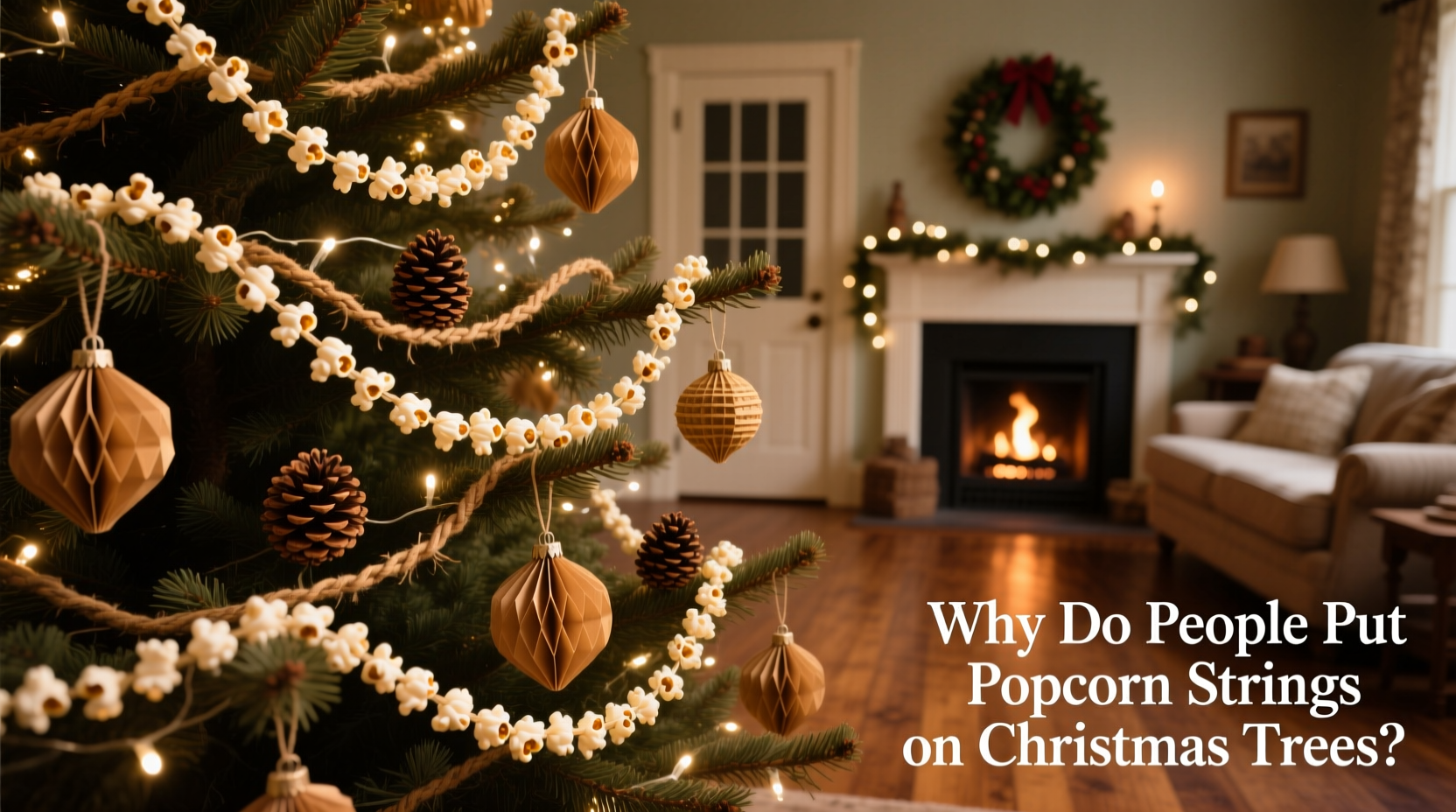
Popcorn strings didn’t begin as festive decoration—they began as practicality. Indigenous peoples in the Americas cultivated and prepared popcorn for millennia, using it for food, ceremony, and even currency. When European settlers arrived, they adopted the grain, and by the 18th century, popcorn was a common pantry staple in rural New England and the Mid-Atlantic. Its light weight, long shelf life, and neutral flavor made it ideal for winter storage.
By the mid-1800s, popcorn gained symbolic resonance during the rise of the domesticated, family-centered Christmas popularized by figures like Clement Clarke Moore and Queen Victoria. With imported glass baubles still expensive and rare in much of the U.S., families turned to what they had: dried apples, pinecones, paper chains—and popcorn. Strung on sturdy thread or twine, popcorn became a versatile, biodegradable, and deeply personal adornment. It wasn’t merely “cheap”; it was intentional. Each strand represented time, attention, and shared effort—a visual echo of the season’s emphasis on presence over purchase.
Historian Dr. Margaret Linwood notes in her 2019 study *Festive Material Culture in Nineteenth-Century America*:
“Popcorn garlands were rarely documented in formal accounts—not because they were unimportant, but because they were so ordinary. They belonged to the domestic sphere: women’s work, children’s participation, and intergenerational teaching. Their absence from elite diaries doesn’t diminish their cultural weight—it confirms how embedded they were in everyday celebration.”
The Symbolism: More Than Just a Snack on a String
Beyond utility, popcorn strings carried layered meaning—some explicit, others absorbed through repetition and ritual:
- Fertility and abundance: The explosive transformation of a hard, dormant kernel into something light and voluminous mirrored ancient agrarian hopes for renewal and provision.
- Impermanence and humility: Unlike glass or tinsel, popcorn would inevitably dry, crack, or attract pests. Its fragility served as a quiet memento mori—a reminder that beauty, like the season itself, is fleeting and meant to be cherished, not preserved indefinitely.
- Community and continuity: Threading popcorn was rarely a solo act. It happened around kitchen tables, during church socials, or as part of school holiday preparations. The act built connection—across ages, abilities, and socioeconomic lines.
- Sensory grounding: In an era before electric lighting dominated interiors, the soft, irregular texture and subtle scent of popcorn added warmth and dimension to a tree’s presence—engaging touch and smell, not just sight.
This symbolism wasn’t codified in manuals or sermons. It lived in practice—in the rhythm of the needle passing through kernel after kernel, in the shared laughter when a strand snapped, in the way children would quietly nibble a stray piece from the lowest loop.
Why Did Popcorn Strings Decline? A Timeline of Displacement
The decline wasn’t sudden, but a slow erosion across decades—driven less by dislike than by shifting material conditions and cultural priorities.
- 1920s–1930s: Mass-produced aluminum tinsel and molded glass ornaments became affordable. Department stores promoted “modern” trees—uniform, shiny, and effortlessly elegant. Popcorn strings began appearing in ads as “old-fashioned,” subtly coded as rustic or unsophisticated.
- 1940s–1950s: Postwar consumer culture emphasized convenience and novelty. Pre-strung garlands, plastic beads, and fiber-optic lights promised ease. Simultaneously, concerns about fire safety (fueled by real incidents involving flammable decorations near incandescent bulbs) led many to avoid organic materials entirely—even though properly strung popcorn posed minimal risk when kept away from direct heat sources.
- 1960s–1980s: Synthetic alternatives exploded—polyester garlands, vinyl berries, glitter-coated foam. Popcorn strings were increasingly associated with poverty or “making do”—a mischaracterization that ignored their deliberate craftsmanship and cultural richness.
- 1990s–2000s: Allergen awareness rose. Though rare, airborne corn proteins could trigger reactions in sensitive individuals—especially in enclosed, heated homes. This concern, while medically valid, further sidelined the tradition without broader context (e.g., proper ventilation, alternative grains like rice or wheat).
The result? By the early 2000s, popcorn strings had largely vanished from mainstream retail and most suburban living rooms—relegated to historical reenactments, craft fairs, or the occasional Pinterest board labeled “vintage charm.”
The Quiet Revival: Why Popcorn Strings Are Returning—Thoughtfully
They’re not back as a retro gimmick. They’re returning as part of a deeper recalibration—toward sustainability, mindfulness, and tactile authenticity. Several converging movements have revived interest:
First, the sustainability imperative. As consumers confront the environmental cost of single-use plastics and non-recyclable ornaments, biodegradable, homegrown, and compostable options gain appeal. A popcorn string decomposes in weeks; a plastic garland may persist for centuries. Second, the slow craft movement has reclaimed hand-stringing not as a chore, but as restorative practice—akin to knitting or journaling. Third, intergenerational education is driving resurgence: schools and libraries now host “heritage craft days” where students learn popcorn stringing alongside oral history interviews of elders who remember doing it.
A compelling real-world example comes from Portland, Oregon, where the nonprofit Evergreen Traditions Project launched its “Tree & Thread Initiative” in 2021. Partnering with five neighborhood elementary schools, they distributed kits containing organic popcorn, natural-dyed cotton thread, and illustrated instructions. Over 1,200 children participated—and more significantly, 87% of families reported continuing the practice at home the following year. One parent wrote in their feedback survey: “My daughter asked why we don’t do this every year. I realized I’d never explained that we stopped—not because it wasn’t beautiful, but because someone told us it wasn’t ‘enough.’ Now our tree feels like it holds our family’s breath.”
How to Make Popcorn Strings Today: A Practical, Modern Guide
Making popcorn strings remains accessible—but benefits from small, evidence-based refinements. Here’s how to do it well in 2024:
Step-by-step guide:
- Select and prepare kernels: Use heirloom white popcorn (e.g., ‘Strawberry’ or ‘Robust’) for uniform popping and mild flavor. Air-pop 4–5 cups; discard unpopped “old maids.” Cool completely (1 hour minimum).
- Choose your thread: Unwaxed, undyed cotton or linen thread (size 8–12). Avoid nylon or polyester—they generate static, making kernels cling unpredictably.
- Thread the needle: Use a blunt-tipped upholstery needle (size 16–18). Knot the end securely. Optional: Dip the tip in beeswax to stiffen and ease passage.
- String with intention: Alternate popcorn and dried cranberries (or whole allspice berries for fragrance and pest resistance). Keep tension gentle—too tight risks cracking kernels; too loose invites tangling. Aim for 12–15 inches between knots if making segmented strands.
- Dry and cure: Hang finished strands in a cool, dry, dark room for 48 hours before hanging on the tree. This prevents premature crumbling.
- Hang safely: Drape—not wrap—around branches. Avoid proximity to LED or incandescent lights (maintain 6+ inches clearance). Never use near open flames or candles.
| Element | Traditional Approach | Modern Best Practice |
|---|---|---|
| Popcorn Type | Any available variety | Organic, heirloom white popcorn (no additives) |
| Binding Agent | Waxed thread or fishing line | Beeswax-dipped cotton thread (static-free, biodegradable) |
| Additives | Cranberries only | Cranberries + allspice berries (natural insect deterrent) or dried orange slices (for scent) |
| Lifespan on Tree | 1–2 weeks before drying out | 2–3 weeks with proper humidity control (40–50% RH ideal) |
| Post-Holiday Disposal | Discarded or fed to birds | Composted (remove thread first) or offered to local wildlife rehab centers |
FAQ: Addressing Real Concerns
Is popcorn string safe for homes with pets or small children?
Yes—with precautions. Popcorn kernels pose a minor choking hazard for toddlers under three, and dogs may ingest strands if left within reach. To mitigate: hang strings high on the tree (out of reach), avoid low-hanging clusters, and supervise closely during initial display. For households with severe corn allergies, substitute cooked, dried rice or barley—though these lack popcorn’s structural resilience and aroma.
Won’t popcorn attract bugs or mold in my home?
Not if properly prepared and displayed. Fully air-dried popcorn has low moisture content (<5%). Mold requires sustained humidity above 60% and organic residue (e.g., butter or oil). Using plain, air-popped kernels and storing strings in dry air prevents issues. If you notice mustiness, remove the strand immediately and inspect for dampness.
Can I make popcorn strings ahead of time and store them?
Yes—but limit storage to 4–6 weeks in an airtight container with silica gel packets to absorb ambient moisture. Refrigeration is unnecessary and may introduce condensation. For best results, string within 3 days of popping.
What It Really Means to Hang Popcorn Today
Choosing to hang popcorn strings isn’t about rejecting modernity. It’s about exercising discernment—selecting which traditions serve present values. In a season saturated with algorithm-driven recommendations, mass-produced sentiment, and digital performances of joy, popcorn strings offer something rare: silence, slowness, and substance. They ask nothing but attention. They reward patience with texture, scent, and quiet pride. They connect us—not to an idealized past, but to the tangible reality of human hands shaping meaning from simple things.
That’s why the tradition endures—not as museum piece, but as living practice. Not because it’s quaint, but because it’s resilient. Not because it’s easy, but because it’s worth the care.




 浙公网安备
33010002000092号
浙公网安备
33010002000092号 浙B2-20120091-4
Comments
No comments yet. Why don't you start the discussion?