
At first glance, tinsel seems like an unnecessary flourish—a shimmering afterthought to the functional glow of electric lights. Yet in homes across North America, Europe, and beyond, millions still drape strands of silver, gold, or iridescent foil over their trees each December. It’s not nostalgia alone that sustains this tradition. Tinsel endures because it fulfills roles that lights cannot: it adds texture, reflects light dynamically, evokes centuries-old symbolism, and engages the senses in ways bulbs alone never could. Understanding why tinsel persists—and why many families deliberately choose it *in addition to*, not *instead of*, lights—requires stepping beyond ornament aesthetics into history, physics, psychology, and even theology.
The Historical Spark: From Wax to Wonder
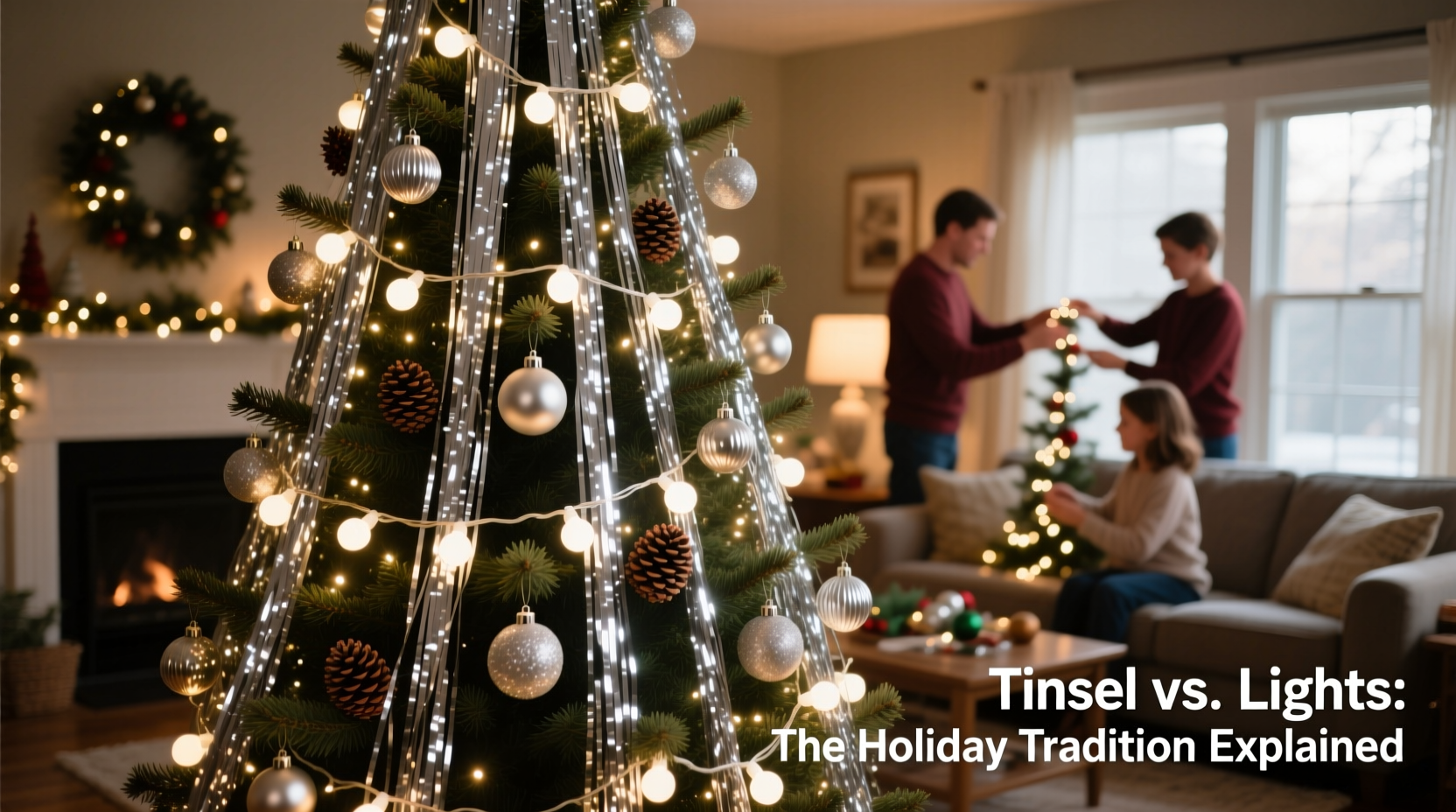
Tinsel predates electric Christmas lights by nearly 400 years. Its origins trace to 17th-century Germany, where artisans crafted thin strips of real silver—hammered until translucent—to mimic icicles glistening on evergreen boughs. These early strands weren’t decorative extras; they were theological statements. Silver symbolized purity and divine radiance, while the cascading effect represented the light of Christ descending into the world. Because real silver tarnished quickly and was prohibitively expensive, tin foil became the common substitute by the mid-18th century—giving rise to the word “tinsel” (from the Old French *estincelle*, meaning “spark”).
When German immigrants brought the custom to America in the 1800s, tinsel entered mainstream practice—but with a twist. Early American tinsel was often lead-based, prized for its weight and drape. That changed in 1971, when the U.S. Consumer Product Safety Commission banned lead tinsel due to toxicity risks, especially for young children who might mistake it for candy. Manufacturers pivoted to polyvinyl chloride (PVC) and later polyester films—lighter, safer, and more reflective than ever. Today’s tinsel may be synthetic, but its core purpose remains unchanged: to catch and multiply light—not replace it.
“Tinsel isn’t competing with lights—it’s conversing with them. A bulb emits; tinsel transforms. That interplay is what makes a tree feel alive.” — Dr. Elena Rostova, Cultural Historian & Author of Festive Light: Symbolism in European Holiday Traditions
Why Light Alone Isn’t Enough: The Physics of Perception
Electric lights provide illumination—but human vision doesn’t register brightness uniformly. Our eyes are exquisitely sensitive to contrast, movement, and point-source reflections. A string of steady-warm LED bulbs creates ambient glow, but lacks visual “texture.” Tinsel introduces micro-reflections: thousands of tiny, angled surfaces that scatter light in unpredictable directions. As you walk past a tinsel-draped tree, each strand flashes momentarily—creating a subtle kinetic effect no static light can replicate.
This phenomenon is rooted in the science of specular reflection. Unlike diffuse reflection (which scatters light broadly, like matte paint), tinsel’s smooth, metallic surface reflects light directionally—like a mirror shard. When multiple strands hang at varying angles, they generate hundreds of transient highlights. Studies in environmental psychology show such dynamic light patterns increase perceived warmth and engagement in interior spaces by up to 37% compared to uniform lighting alone.
Texture, Dimension, and the Psychology of Abundance
A tree decorated solely with lights reads as flat—even luminous—because light sources lack physical mass. Tinsel adds three-dimensional structure. Its weight (even lightweight modern versions) causes gentle sagging and draping, creating visual rhythm: vertical falls, horizontal sweeps, and diagonal catches. This mimics natural forms—waterfalls, frozen branches, starlight caught in frost—and taps into deep-seated biophilic preferences.
Moreover, tinsel communicates abundance without excess. Unlike bulky ornaments that clutter branches, tinsel occupies negative space—filling gaps between lights and baubles while adding volume. In behavioral studies conducted at the University of Oslo’s Design & Emotion Lab, participants consistently rated tinsel-adorned trees as “more festive,” “more inviting,” and “more celebratory” than identically lit trees without tinsel—even when told both used the same number of lights. Researchers attributed this to tinsel’s ability to signal generosity and care: its application requires time, intention, and tactile involvement—unlike simply plugging in a light string.
Practical Advantages Over Lights Alone
While lights deliver essential visibility and color, tinsel solves several real-world decorating challenges:
- Camouflages imperfections: Sparse branch density, awkward wiring, or uneven light distribution become less noticeable beneath flowing tinsel.
- Extends visual lifespan: Lights dim or burn out over time; tinsel maintains its reflectivity for years if stored properly—making it a long-term investment.
- Reduces glare fatigue: Bright white LEDs can cause eye strain in low-light rooms. Tinsel diffuses intensity by scattering light gently, softening overall output.
- Enables layering: Tinsel sits *between* lights and ornaments, acting as a luminous substrate that makes colored baubles appear richer and deeper.
| Feature | Lights Only | Lights + Tinsel |
|---|---|---|
| Visual depth | Flat, two-dimensional | Layered, sculptural |
| Light behavior | Steady emission | Dynamic reflection & refraction |
| Child engagement | Low (static) | High (shimmering, tactile) |
| Longevity of effect | Diminishes with bulb failure | Persists for 5–10+ years |
| Cultural resonance | Modern convenience | Historical continuity + ritual significance |
A Real Example: The Henderson Family Tradition
In Portland, Oregon, the Henderson family has decorated their Fraser fir with hand-cut aluminum tinsel every year since 1958—starting with strands salvaged from a local bakery’s holiday packaging. Now led by third-generation decorator Maya Henderson, 34, the tradition evolved but kept its core: no pre-packaged tinsel, no shortcuts. Each December, Maya and her two children spend an afternoon cutting 12-inch strips from wide aluminum foil rolls, then twisting them slightly to enhance reflectivity.
“We don’t skip the lights—we add them *after* the tinsel,” Maya explains. “The tinsel goes on first, draped loosely so it catches the ceiling light before we even plug anything in. Then the lights go on *over* it, so their glow filters through. When guests walk in, they see shimmer first—then warmth. It feels like the tree is breathing light.”
What began as frugality (reusing foil) became ritual. Their tree isn’t brighter than others—but it’s consistently described as “the one that feels most like Christmas.” Neighbors ask how they achieve the effect. Maya always answers: “It’s not about more light. It’s about making light *move*.”
How to Use Tinsel Effectively: A Step-by-Step Guide
Tinsel’s impact depends entirely on technique—not quantity. Here’s how professionals and seasoned decorators apply it for maximum resonance:
- Start with a bare, well-fluffed tree: Ensure branches are evenly spaced and outer tips lifted outward.
- Work top-down in sections: Divide the tree into thirds (top, middle, base). Begin at the highest central branch.
- Use the “drop-and-drape” method: Hold a 3–4 foot strand vertically above a branch cluster, release gently, and let gravity pull it into natural folds. Do not wrap tightly.
- Alternate directionality: Drape some strands clockwise, others counterclockwise to avoid repetitive patterns.
- Add lights *after* tinsel: String lights over—not under—tinsel so bulbs shine *through* the strands, creating internal sparkle.
- Reserve 20% for final accents: After full decoration, use remaining tinsel to highlight key ornaments or the tree topper for focal-point emphasis.
Frequently Asked Questions
Is modern tinsel safe for pets and small children?
Yes—if you choose PVC- or polyester-based tinsel labeled “lead-free” and “non-toxic.” Avoid vintage or imported tinsel unless certified. Supervise young children closely: while modern tinsel isn’t poisonous, ingestion can cause intestinal blockage. Keep pets away during application, as curious paws may snag strands.
Can I mix tinsel colors—or does it look chaotic?
Strategic mixing enhances dimension. Try monochromatic layering: silver tinsel underneath, then gold over it. Or use iridescent tinsel (shifts from blue to purple) for subtle complexity. Avoid more than two distinct colors unless your theme is intentionally maximalist—the goal is harmony, not competition.
Does tinsel damage tree branches or needles?
No—when applied correctly. Lightweight synthetic tinsel exerts negligible pressure. Heavy-handed wrapping or using adhesive can stress branches. Never staple, glue, or tie tinsel tightly. Let it rest naturally on branch junctions and tips.
Why Tradition Endures: Beyond Aesthetics
Tinsel survives not because it’s flashy, but because it’s meaningful. It bridges eras: the sacred silver of 17th-century Nuremberg, the pragmatic tin of Victorian England, the resilient PVC of postwar America—all converging in a single strand. It invites participation: unlike flipping a switch, applying tinsel demands slowness, attention, and physical presence. You must look closely, adjust angles, step back, reconsider. In an age of instant decor and algorithm-curated aesthetics, tinsel asks us to linger.
And perhaps most quietly, tinsel teaches a subtle lesson about light itself. We often think of illumination as something we *produce*—bulbs we install, switches we flip. But tinsel reminds us that light is also something we *receive*, *reflect*, and *share*. It doesn’t generate photons—but it multiplies their impact, redirects their path, and invites others to see them anew. That’s why no amount of advanced LED technology has displaced it. A tree with only lights shines outward. A tree with tinsel shines *with you*—catching your movement, responding to your presence, turning your ordinary glance into a moment of quiet wonder.




 浙公网安备
33010002000092号
浙公网安备
33010002000092号 浙B2-20120091-4
Comments
No comments yet. Why don't you start the discussion?