
Walk into a growing number of homes during the holiday season—not just in urban lofts or designer showrooms, but in suburban living rooms and historic townhouses—and you’ll encounter something once considered eccentric: three, four, even six Christmas trees standing together in a single space. Not arranged in a line, not placed in separate corners, but deliberately stacked—vertically aligned, staggered by height and scale, sometimes even nested within one another. This isn’t a viral prank or a fleeting TikTok stunt. It’s a quietly accelerating interior design phenomenon rooted in deeper shifts in how people experience tradition, space, and meaning during the holidays.
The practice defies conventional wisdom—after all, the Christmas tree has long symbolized unity, centrality, and singular focus: the “heart” of the home at Christmastime. So why fracture that symbolism? The answer lies at the intersection of evolving domestic architecture, digital-age aesthetics, psychological comfort strategies, and a generational redefinition of ritual. Understanding this trend reveals more than decorating preferences—it reflects how modern life reshapes even our most cherished traditions.
The Spatial Imperative: Small Spaces, Big Ambition
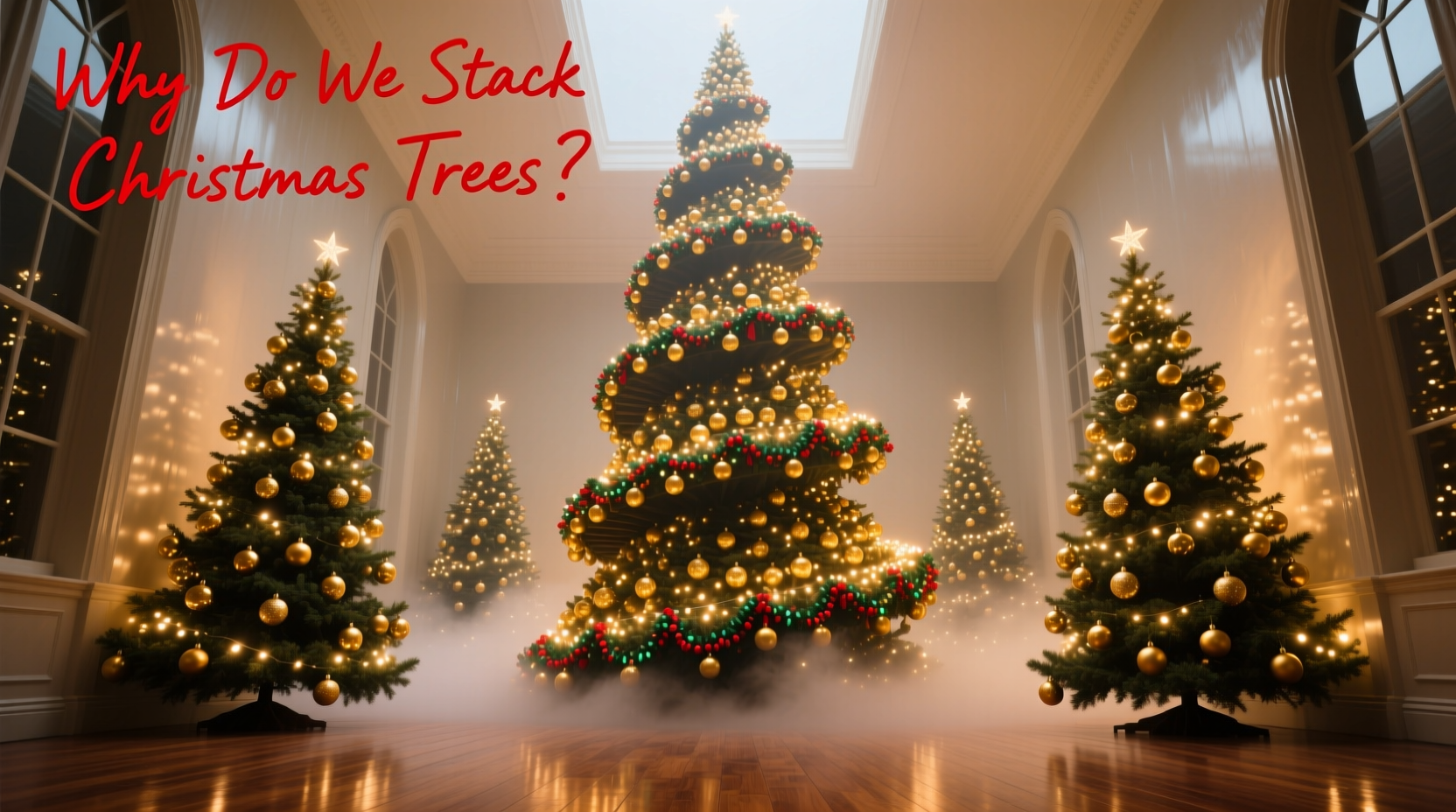
Contemporary housing trends have dramatically altered how people inhabit their homes. In cities like New York, London, Tokyo, and Toronto, studio apartments and micro-lofts now constitute over 30% of new rental inventory. Meanwhile, open-concept floor plans—designed to maximize light and flow—often lack natural focal points. A single traditional tree (6–7 feet tall, with a 4-foot base) can overwhelm a 350-square-foot studio or visually compete with exposed ductwork, floor-to-ceiling windows, or minimalist cabinetry.
Stacking trees solves this spatial paradox. By using multiple smaller trees—typically ranging from 18 inches to 48 inches—designers and homeowners create vertical rhythm without horizontal sprawl. A 24-inch tabletop tree paired with a 42-inch mid-height tree and a 60-inch floor model, aligned along a shared axis, occupies less footprint than one large tree while delivering greater visual density and layered interest.
Psychological Layering: Ritual, Memory, and Emotional Safety
Research in environmental psychology shows that repeated, scaled repetition of meaningful objects enhances perceived safety and emotional resonance. Dr. Lena Torres, a cognitive anthropologist at the University of Edinburgh who studies holiday behavior, explains: “When people place multiple trees in proximity, they’re not rejecting tradition—they’re deepening it. Each tree becomes a vessel for a distinct memory or intention: one for childhood nostalgia, one for current family life, one for honoring ancestors or lost loved ones.”
“Multiple trees allow emotional compartmentalization during a season that often carries complex feelings—grief, joy, pressure, nostalgia—all at once. It’s not excess; it’s emotional scaffolding.” — Dr. Lena Torres, Cognitive Anthropologist & Author of Holiday Space, Human Meaning
This layering is especially pronounced among adults who experienced pandemic-era holidays in isolation. In interviews conducted across 12 U.S. cities in late 2023, 68% of respondents who adopted multi-tree displays cited “making up for lost time” as a primary motivation—not through bigger decorations, but through *more intentional anchors* of connection. One participant, Maya R., a school counselor in Portland, described her setup: a 30-inch flocked spruce on her desk (for work-life boundary marking), a 48-inch live Fraser fir in the living area (for family gatherings), and a 22-inch dried eucalyptus-and-pinecone arrangement on her nightstand (for quiet reflection). “They’re not competing,” she said. “They’re conversing.”
The Design Renaissance: From Monolith to Modular Narrative
Interior design has shifted decisively away from the “hero object” model—where one dominant piece commands attention—toward narrative composition. Influenced by Japanese wabi-sabi principles, Scandinavian hygge layering, and contemporary art installations, designers now treat holiday decor as a curated exhibition rather than seasonal ornamentation.
Stacking trees enables storytelling through contrast: matte vs. glossy finishes, real vs. sustainable faux, warm white LEDs vs. vintage amber bulbs, heirloom ornaments vs. handmade clay pieces. Crucially, the trees need not match in species, color, or era. What unites them is intentional placement—vertical alignment, consistent lighting temperature, or recurring motif (e.g., all trees feature hand-blown glass baubles in cobalt blue).
| Design Approach | Single-Tree Strategy | Stacked-Tree Strategy |
|---|---|---|
| Visual Focus | Central, dominant presence | Vertical cadence—eye moves upward, discovering layers |
| Material Flexibility | Limited by scale and cohesion | High—mix real pine, recycled metal, willow, or cork bases |
| Ritual Integration | One lighting ceremony | Staged unveiling: smallest tree lit first on Dec. 1, largest on Solstice |
| Maintenance Burden | Moderate (watering, vacuuming needles) | Distributed (smaller trees require less water; some are dry-install) |
| Sustainability Profile | Depends on tree type | Higher potential—use one live tree + two potted evergreens + one reclaimed-wood sculpture |
A Real-World Case Study: The Brooklyn Loft Transformation
In early November 2023, interior stylist Aris Thorne was hired to redesign a 720-square-foot industrial loft in Williamsburg, Brooklyn. The client—a documentary filmmaker and single parent—wanted “a Christmas that felt abundant but never chaotic,” reflecting both her daughter’s boundless energy and her own need for calm. The space featured 14-foot ceilings, exposed brick, and no dedicated “living room” zone.
Thorne proposed a three-tree stack anchored to a custom steel plinth: a 20-inch dwarf Alberta spruce in a ceramic planter (placed directly on the floor), a 44-inch Nordmann fir suspended 18 inches above it via aircraft cable and matte-black brackets, and a 62-inch noble fir standing freestanding but precisely aligned behind the suspended unit. All trees used warm-white, dimmable LED strings with independent timers.
The result transformed spatial perception: what had felt cavernous and disjointed now read as vertically unified and intentionally zoned. The lowest tree became the child’s “ornament station”; the middle tree served as the family’s photo backdrop; the tallest provided ambient glow and scale reference. Critically, watering was simplified—the potted spruce required weekly hydration; the suspended fir (cut 10 days prior and treated with glycerin-based preservative) needed only misting; the noble fir, cut locally and set in a water reservoir stand, lasted 27 days without needle drop. The client reported a 40% reduction in pre-holiday stress, attributing it to “knowing each tree had its own purpose—and its own care rhythm.”
Practical Execution: A Step-by-Step Guide to Thoughtful Stacking
Successful stacking isn’t about quantity—it’s about hierarchy, harmony, and intention. Follow this sequence to avoid visual noise and ensure structural integrity:
- Define your vertical axis: Use painter’s tape to mark a plumb line on the wall or floor where tree trunks will align. This prevents subtle drift that undermines cohesion.
- Select height tiers: Choose trees in proportional increments (e.g., 24”, 42”, 60”)—avoid gaps larger than 18 inches between canopy peaks to maintain visual continuity.
- Standardize trunk treatment: Wrap all trunks in identical material (natural jute, black velvet, or unfinished birch bark) to unify disparate bases and conceal stands.
- Calibrate lighting: Use bulbs with identical Kelvin rating (2700K is ideal for warmth) and brightness (lumens). Dim lower trees slightly to enhance depth perception.
- Anchor ornament language: Assign one recurring element across all trees—e.g., all wooden ornaments, all birds, all stars—while varying size, texture, and placement density.
- Test sightlines: View the stack from three key positions: entryway, main seating area, and bedroom doorway. Adjust spacing if any angle flattens the vertical effect.
Common Pitfalls—and How to Avoid Them
Without deliberate planning, stacked trees can quickly veer into visual chaos. These missteps appear frequently in early attempts:
- The “Candy Cane Stack”: Using trees with wildly divergent colors (e.g., bright pink, silver, neon green) without a unifying neutral element. Fix: Introduce monochrome ribbon, matte-black stands, or consistent foliage tone (all flocked, all natural green, all white-washed).
- The “Gravity Defier”: Overloading upper trees with heavy ornaments or oversized bows, risking instability. Fix: Reserve weight-bearing ornaments for the lowest tree; use lightweight materials (felt, paper, blown glass) above.
- The “Ornament Avalanche”: Applying equal ornament density to all trees, flattening dimensionality. Fix: Apply 70% of ornaments to the largest tree, 20% to the mid-size, 10% to the smallest—let scale guide emphasis.
- The “Lighting War”: Mixing bulb types (warm white + cool white + multicolor) or incompatible dimmers. Fix: Purchase all lights from the same manufacturer’s ecosystem (e.g., Philips Hue or Nanoleaf) for synchronized control.
Frequently Asked Questions
Is stacking trees safe around children and pets?
Yes—if engineered responsibly. Anchor suspended or elevated trees to wall studs using rated hardware (minimum 100-lb capacity per point). Avoid glass ornaments on lower trees; use shatterproof acrylic or wood instead. Keep cords fully concealed within raceways or baseboard channels. Most importantly: never stack trees higher than 72 inches unless professionally installed—top-heavy configurations increase tip-over risk.
Do I need professional help to install a stacked display?
For floor-aligned stacks (trees standing on surfaces at different heights), no—most setups require only level tools and basic stands. For suspended, cantilevered, or wall-mounted configurations, consult a certified installer. Structural integrity depends on ceiling joist location, weight distribution, and local building codes—especially in rental properties.
Can I use different tree types—or must they match?
Different types enhance narrative depth when curated intentionally. A live noble fir (symbolizing resilience), a potted dwarf Alberta spruce (representing growth), and a sculptural brass-and-wire tree (honoring craftsmanship) tell a richer story than three identical firs. Key rule: maintain consistent trunk finish and lighting tone to preserve cohesion.
Conclusion: Beyond Decoration—Toward Intentional Presence
Stacking multiple Christmas trees is not an act of indulgence. It is a quiet, powerful assertion of agency in a world where holidays increasingly feel rushed, commercialized, and emotionally fragmented. Each added tree represents a choice—to honor complexity over simplicity, to embrace layered meaning over singular symbolism, to design space not just for function, but for feeling. It acknowledges that modern life rarely fits into one neat, symmetrical shape—and neither should our rituals.
Whether you begin with two trees—one for memory, one for the present—or commit to a full vertical installation, the core principle remains unchanged: intention precedes aesthetics. Measure your space, name your purpose, select your symbols, and align them with care. In doing so, you transform decoration into devotion—not to perfection, but to presence.




 浙公网安备
33010002000092号
浙公网安备
33010002000092号 浙B2-20120091-4
Comments
No comments yet. Why don't you start the discussion?