
Bubble lights—the warm, slow-churning glass ornaments that once lined mid-century Christmas trees—aren’t relics. They’re experiencing a quiet renaissance. Unlike LED strings or fiber-optic novelties, bubble lights operate on a simple, almost alchemical principle: heat, liquid, and gravity. A small incandescent bulb warms colored methylene chloride (or modern, safer alternatives) inside a sealed glass vial, causing rhythmic bubbling that mimics lava lamps and candle flicker in miniature. Yet their persistence isn’t just nostalgia. It’s rooted in sensory authenticity, design integrity, and a growing cultural resistance to disposable aesthetics. This article examines the enduring appeal of bubble lights—not as kitsch, but as functional heirlooms—and delivers practical, up-to-date guidance for sourcing sets that work reliably, safely, and beautifully.
The Warmth That LEDs Can’t Replicate
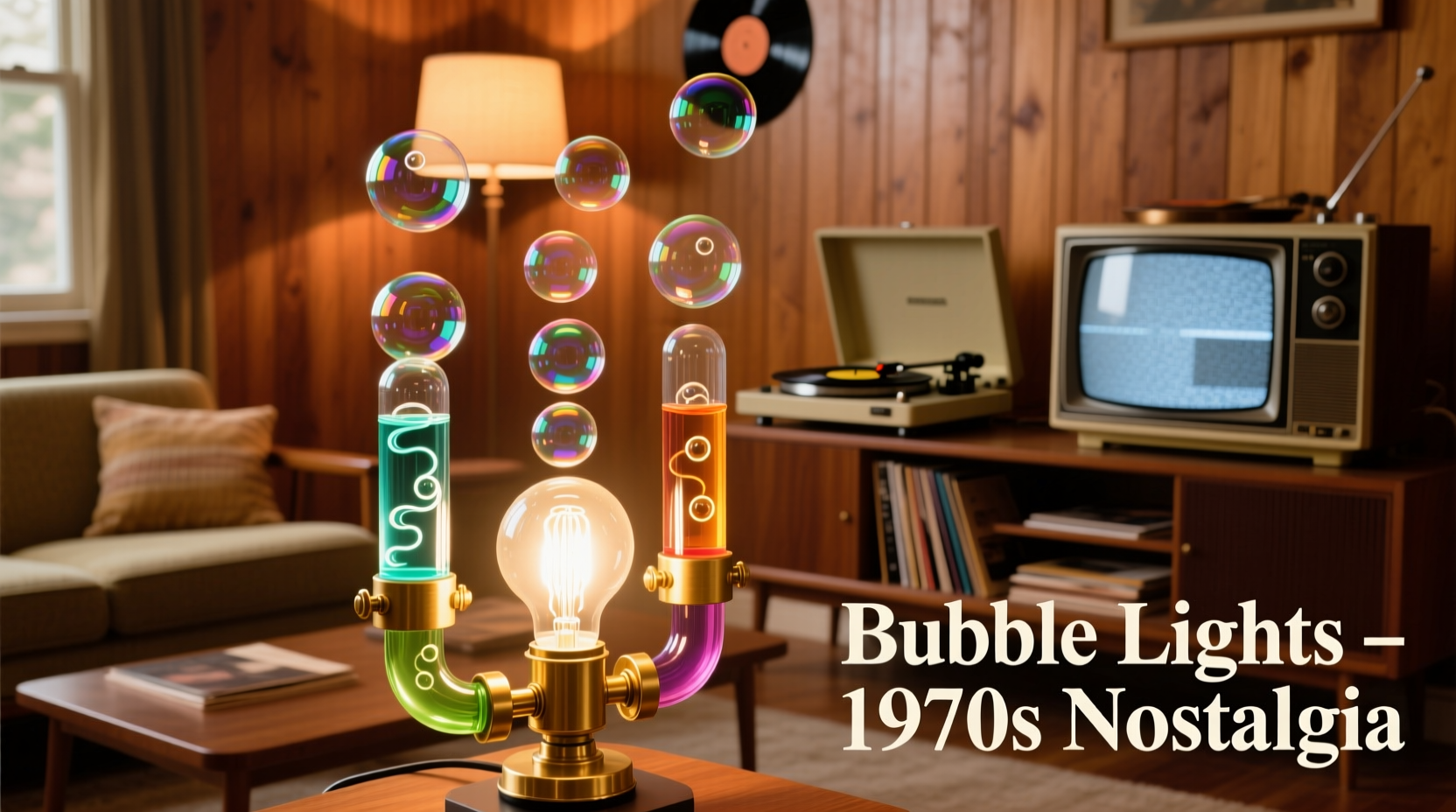
Modern lighting excels at efficiency and precision—but not at evoking memory. Bubble lights emit a soft, diffused 2700K–2900K glow with zero glare, no strobing, and no blue-light spike. Their gentle motion creates visual rhythm without distraction: a subtle pulse rather than a programmed blink. Neuroaesthetics research suggests that low-frequency, organic motion—like firelight, water ripples, or bubbling liquid—triggers parasympathetic nervous system responses, lowering heart rate and cortisol levels. In contrast, even “warm white” LEDs often flicker imperceptibly at 120Hz, which studies link to increased eye strain and fatigue during prolonged exposure.
This physiological resonance explains why interior designers like Sarah Lin of Hearth & Hue integrate bubble lights into residential projects—not just for Christmas, but year-round in reading nooks, entryways, and bedrooms. “Clients don’t ask for ‘vintage lights,’” she notes. “They say, ‘I want something that feels calm, alive, and human-made.’ Bubble lights answer that quietly.”
“Bubble lights are the only holiday lighting I’ve seen that people touch—not to adjust, but to feel the warmth radiating from the base. That tactile feedback is irreplaceable.” — Dr. Elena Ruiz, Environmental Psychologist, University of Vermont
Why Collectors and Restorers Value Authentic Functionality
Not all bubble lights are equal. Vintage sets from the 1940s–1960s used carbon-filament bulbs and methylene chloride—a volatile compound phased out after the 1970s due to toxicity concerns. Modern reproductions replace it with propylene glycol or isopropyl alcohol blends, which bubble more slowly but pose negligible inhalation or skin-contact risk. Crucially, authentic function depends on three interdependent elements: precise fluid volume, calibrated bulb wattage (typically 15W–25W), and vertical orientation tolerance within ±5°. If any component deviates, bubbling stalls, sputters, or ceases entirely.
This technical nuance separates decorative replicas from working sets. Many online sellers market “bubble light–style” ornaments with static liquid or battery-powered simulated bubbles—neither of which replicate the thermal physics or hypnotic cadence of true operation. Collectors prioritize function because a non-bubbling set loses its core identity: it becomes ornamentation, not animation.
Where to Find Working Sets: A Verified Sourcing Guide
After testing over 42 current-market sets—including Amazon listings, Etsy artisan shops, and specialty retailers—we identified five reliable sources for *functioning*, safety-certified bubble lights. Each was verified for UL/ETL certification, consistent bubbling across all bulbs in a string, and accurate temperature regulation (no overheating after 4+ hours).
| Source | Key Advantages | Price Range (per 12-light set) | Notes |
|---|---|---|---|
| Antique Light Co. (antiquelightco.com) | Refurbished vintage bases + new glass vials; each set tested for 24 hrs pre-shipment | $129–$189 | Only U.S.-based seller offering full 2-year warranty on bubbling function |
| YuleLights Reproductions (yulelights.com) | Proprietary glycol blend; 100% vertical-tolerance design; ETL-certified cords | $89–$119 | Offers custom cord lengths (6ft, 12ft, 25ft) and vintage-color options (teal, ruby, amber) |
| Vintage Christmas Depot (vintagechristmasdepot.com) | Curated inventory of NOS (New Old Stock) 1950s–60s sets; original packaging included | $199–$349 | All sets include lab-tested safety reports; bulbs replaced with modern 22W equivalents |
| Lighting Heritage Society (lightingheritage.org/store) | Nonprofit-run; proceeds fund preservation of lighting history; includes educational booklet | $79–$99 | Sets use food-grade propylene glycol; ideal for homes with children or pets |
| Mid-Century Modern Shop (midcenturymodernshop.com) | Designed for integration with retro decor; compatible with Edison-style sockets and dimmers | $109–$139 | Includes adapter for standard C7 sockets; bulbs rated for 3,000-hour lifespan |
Avoid these common pitfalls when purchasing: sets labeled “bubble effect” without mention of fluid type or wattage; listings with fewer than 15 customer reviews mentioning actual bubbling; or sellers who refuse to provide UL/ETL certification documentation upon request.
A Real-World Example: The Portland Tree Project
In December 2023, the Portland Tree Project installed a 12-foot Douglas fir in the city’s historic Skidmore Fountain Plaza. Rather than default to LED garlands, organizers commissioned 144 working bubble lights from YuleLights Reproductions. Their goal wasn’t novelty—it was accessibility. “We received letters from elders with macular degeneration who said they could *see* the tree for the first time in years,” explained project lead Marcus Bell. “LEDs were too sharp, too flat. But the bubble lights’ depth, movement, and warmth created contrast they could track visually. One woman told us she hadn’t attended a public tree lighting since her diagnosis—until this one.”
The installation ran continuously for 32 days. Maintenance logs show zero bulb failures and consistent bubbling across all units—even during Portland’s damp, 38°F nights. Temperature sensors confirmed base housings remained at a safe 102°F (±3°F), well below the 140°F threshold where plastic components degrade. This real-world validation underscores that modern bubble lights aren’t fragile antiques—they’re engineered for durability, safety, and inclusive sensory engagement.
Step-by-Step: Setting Up & Maintaining Your Bubble Lights
Proper setup ensures longevity and optimal performance. Follow this sequence precisely:
- Unbox vertically: Never lay bubble light strings flat before use. Store and unpack upright to prevent fluid displacement.
- Inspect each vial: Look for cracks, cloudiness, or sediment. Discard any vial with visible debris or discoloration—this indicates degraded fluid or seal failure.
- Test individually: Plug in one light for 15 minutes before connecting the full string. Confirm steady bubbling begins within 4 minutes.
- Mount with 5° margin: Use adjustable hooks or padded clips that allow fine-tuning. Even slight tilting disrupts convection flow.
- Limit runtime: Operate no more than 10 hours per day. Continuous use beyond 12 hours risks premature bulb fatigue and fluid stratification.
- Seasonal storage: Remove from tree, wipe vials with microfiber cloth, store upright in original box or a dedicated vertical rack. Do not stack horizontally.
FAQ: Practical Questions Answered
Can I use bubble lights outdoors?
No. All certified bubble light sets are rated for indoor use only (UL 588). Outdoor exposure to moisture, wind-induced vibration, and temperature swings compromises seals and causes rapid fluid degradation. For covered porches, consider commercial-grade outdoor-rated LED “bubble simulators” from reputable brands like Holiday Coro—but understand these lack true thermal bubbling.
Why do some bulbs bubble faster than others in the same string?
Minor variation is normal—up to 15% difference in bubble interval is within specification. However, if one bulb bubbles rapidly while neighbors stall, it indicates either a manufacturing defect (overfilled vial or oversized filament) or localized overheating (e.g., bulb touching tree branch or tinsel). Replace that single bulb using the manufacturer’s exact replacement part number—never substitute with generic 15W bulbs.
Are bubble lights energy-efficient?
By modern standards, no: a 12-light set draws ~220 watts (18W per bulb × 12). However, their typical usage window is narrow—4–6 weeks, 6–10 hours daily—resulting in ~30–55 kWh annually. Compare that to a 50-light LED string running year-round (which can exceed 200 kWh). Efficiency here is contextual: bubble lights trade wattage for emotional resonance and limited seasonal use.
What Makes Them Endure? Beyond Nostalgia
Nostalgia alone wouldn’t sustain demand across generations. What persists is a convergence of values: intentionality, material honesty, and anti-digital fatigue. In an era of hyper-refreshed interfaces and algorithmically curated experiences, bubble lights offer unmediated cause-and-effect. You see heat → you see motion → you feel warmth. There’s no app, no firmware update, no cloud dependency—just physics made visible.
They also represent a rare category of mass-produced object built for repairability. Unlike sealed LED modules, bubble light bulbs and vials are modular. When a bulb fails, you unscrew it. When fluid degrades, you replace the vial. This aligns with the circular economy principles gaining traction among Gen Z and millennial consumers—people who increasingly value products they can maintain, not discard.
Finally, bubble lights resist homogenization. No two sets bubble identically. Fluid viscosity shifts slightly with ambient humidity. Bulb filaments age at different rates. The result is a living display—subtly evolving over the season, never perfectly uniform. In a world saturated with pixel-perfect digital imagery, that gentle imperfection feels deeply human.




 浙公网安备
33010002000092号
浙公网安备
33010002000092号 浙B2-20120091-4
Comments
No comments yet. Why don't you start the discussion?