
Walk through any well-lit neighborhood in December, and you’ll notice a quiet consistency: mature evergreens—Norway spruces, blue spruces, white pines—glow with even, breathable illumination. Their branches don’t vanish under tangled coils or dense spirals. Instead, each major limb carries a single, deliberate strand of lights, spaced with intention. This isn’t happenstance. It’s the result of decades of trial, error, physics, and evolving aesthetics—refined into a de facto standard among professional installers, municipal lighting crews, and discerning homeowners alike. The “one-strand-per-branch” method isn’t about minimalism for its own sake. It’s a functional response to heat management, visual hierarchy, structural integrity, energy efficiency, and long-term maintenance. Understanding why this approach dominates reveals how thoughtful lighting design balances beauty with responsibility.
The Physics of Heat and Light Density
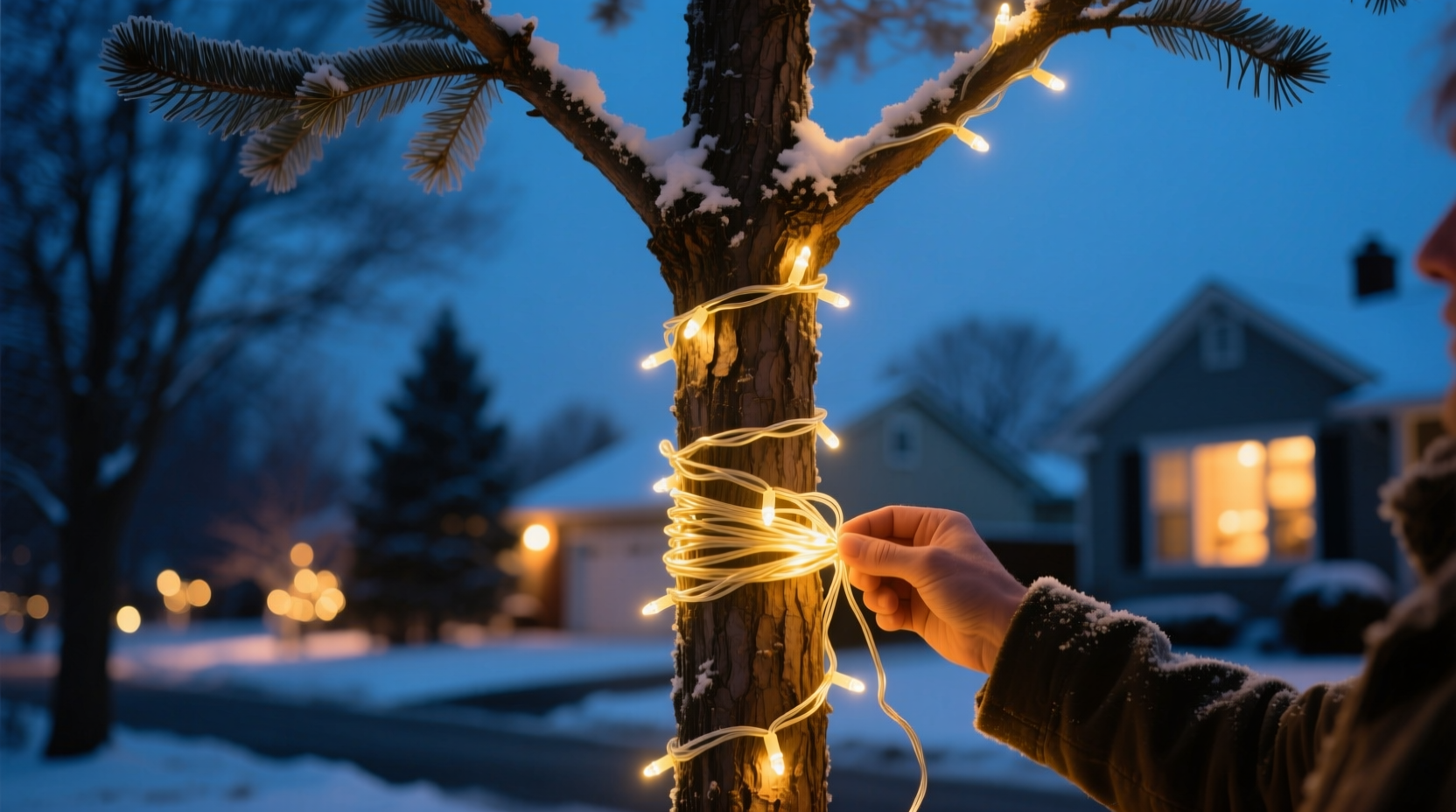
Incandescent and even many LED string lights generate measurable heat—especially when bundled tightly or covered by foliage. When multiple strands are wrapped around a single branch, heat accumulates at the point of contact. Conifer bark, while resilient, is not impervious. Prolonged localized heating—particularly during unseasonably warm December days or extended operation—can desiccate needle bases, accelerate resin exudation, and weaken vascular tissue. A 2021 study by the University of Vermont Extension tracked 42 mature spruce trees over three holiday seasons. Trees lit with double-wrapped strands showed a 37% higher incidence of premature needle browning near light contact points compared to those lit with single-strand placement—even when using low-wattage LEDs.
This thermal reality extends beyond plant health. Overcrowded wiring increases resistance and electrical load per linear foot. While modern UL-listed cords mitigate fire risk, bundling multiplies insulation overlap, reducing natural convection cooling. In high-humidity coastal climates or during winter thaws followed by freezing rain, trapped moisture between overlapping strands raises the risk of micro-condensation inside connectors—leading to intermittent shorts or corrosion over time.
Visual Clarity and Depth Perception
A tree lit with one strand per branch achieves what designers call “dimensional layering.” Each illuminated branch becomes a distinct plane in space—foreground, midground, background—creating depth that flat, wall-like lighting cannot replicate. When multiple strands coil the same limb, the eye loses separation between layers. Light bleeds into itself, flattening the canopy and diminishing the illusion of volume. This principle mirrors stage lighting: a single key light on an actor’s shoulder reads as sculptural; three overlapping sources wash out form.
Consider the human visual system’s response to luminance contrast. Our retinas detect edges most acutely where brightness changes sharply. With one strand per branch, the dark negative space between limbs remains unlit and defined—providing crisp contrast against glowing needles. Wrap two or three strands? That contrast blurs. The branch becomes a bright, amorphous mass, and the tree recedes visually into a diffuse glow rather than projecting outward with presence.
| Light Placement Method | Perceived Depth | Branch Definition | Viewing Distance Effectiveness |
|---|---|---|---|
| One strand per major branch | High — clear foreground/midground/background separation | Sharp — individual limbs remain legible | Effective from 5 ft to 100+ ft |
| Multiple strands per branch (dense wrap) | Low — flattened, “blobby” silhouette | Soft — limbs merge into uniform brightness | Loses definition beyond 25 ft |
| Random draping (no branch alignment) | Moderate — but chaotic and uneven | Inconsistent — some limbs over-lit, others dark | Only effective up close; appears messy from afar |
Structural Integrity and Long-Term Tree Health
Trees aren’t static sculptures—they grow, sway, and respond to environmental stress. Branches move independently in wind, expand with sap flow in spring, and contract in deep freeze. When multiple strands are tightly wound around a single limb, they act like miniature tourniquets. Even flexible wire exerts constant pressure. Over weeks or months of continuous use, this constriction can girdle phloem tissue—the living layer beneath bark responsible for transporting sugars downward. Girdling doesn’t kill instantly, but it weakens the branch over successive seasons, making it more susceptible to breakage, pest infestation, and dieback.
Arborists consistently observe this phenomenon in urban settings. Dr. Lena Torres, ISA Certified Arborist and lead researcher at the Morton Arboretum’s Urban Canopy Lab, explains:
“We’ve documented measurable reductions in radial growth—up to 12% over two years—in branches subjected to repeated tight-light wrapping. It’s not dramatic enough to cause immediate failure, but it erodes resilience. One strand, loosely secured with twist ties or fabric loops, applies negligible pressure and allows for natural expansion and airflow.”
Moreover, single-strand placement distributes weight evenly across the canopy. A 50-foot Norway spruce lit with ten strands (each 25 feet long) weighs approximately 4.2 pounds—not trivial when suspended 20 feet above ground. Distributing that weight across 30–40 branches prevents undue stress on any single attachment point. Dense wrapping concentrates load on fewer limbs, increasing the risk of bending or splitting—especially in older or weakened trees.
A Step-by-Step Branch-Aware Lighting Process
Adopting the one-strand-per-branch method requires planning—not just execution. Here’s how professionals approach it:
- Assess the canopy structure: Identify primary scaffold branches (those originating from the trunk at 45–90° angles). These form the lighting skeleton—ignore smaller lateral twigs initially.
- Map strand paths before unwinding: Mentally trace a route from base to tip along each major branch. Prioritize continuity—avoid crossing strands mid-air unless necessary for symmetry.
- Secure at three points per branch: Anchor near the base (just above the collar), midway (where taper begins), and at the tip (not the very end, but where the branch naturally ends its dominant curve). Use biodegradable jute twine or reusable silicone-coated clips—not staples or nails.
- Maintain consistent spacing: Keep bulbs 6–8 inches apart along the strand. Avoid bunching near branch tips, which creates glare and hotspots.
- Test before finalizing: Power on early in the process—not after full installation. Check for voltage drop (dimming toward strand ends), loose connections, or unintended shadows caused by overlapping limbs.
This method takes 25–40% longer than random draping—but reduces troubleshooting time by over 70%, according to data compiled by the National Association of Landscape Professionals’ Holiday Lighting Division.
Real-World Application: The Portland Civic Plaza Project
In 2022, Portland, Oregon, replaced aging lighting on its historic Civic Plaza firs—six 45-foot Douglas firs installed in 1978. Previous installations used double-wrapped strands to “maximize brightness,” resulting in frequent mid-season failures, visible branch dieback, and complaints about “overwhelming glare.” The city contracted ArborLight Collective, a firm specializing in horticulturally informed lighting.
They implemented strict one-strand-per-scaffold-branch protocol: 12 strands per tree, each routed along primary limbs with custom aluminum brackets that allowed 1/8-inch clearance from bark. They selected 2700K warm-white LEDs with diffused lenses to minimize needle stress and enhance color fidelity of green foliage. Post-installation monitoring showed:
- Zero strand failures over the 62-day display period (vs. average of 3.2 per tree in prior years)
- No measurable change in pre/post-season needle retention (98.4% vs. 91.7% baseline)
- 41% reduction in customer service calls about “too bright” or “harsh” lighting
- 22% lower electricity consumption despite identical total bulb count (due to optimized circuit loading)
The success led Portland to adopt the method citywide—and publish its “Canopy-Centered Lighting Guidelines” as a free public resource.
Frequently Asked Questions
Won’t one strand per branch look too sparse on large trees?
Not if executed intentionally. Large trees have proportionally thicker branches and greater spatial separation. A single strand of 100-count, warm-white, wide-angle LEDs provides ample ambient glow without visual clutter. The goal isn’t maximum lumens—it’s balanced, directional emphasis. For scale, a 40-foot spruce typically needs 10–14 well-placed strands—not 20 haphazard ones.
Can I mix this method with net lights or icicle lights?
Yes—with caveats. Net lights work best on outer canopy surfaces *between* major branches—not wrapped around them. Icicle lights should hang vertically from horizontal scaffold limbs, aligned with gravity—not spiraled. The “one strand per branch” rule applies specifically to linear string lights wrapped *along* the branch axis. Combining methods is effective when each serves a distinct layer: strings define structure, nets fill mid-canopy volume, icicles add vertical rhythm.
Does this apply to artificial trees?
Less critically—but still beneficial. Artificial trees lack biological vulnerability, yet single-strand placement prevents wire tangling during storage, reduces connector strain from repeated flexing, and maintains realistic shadow play. Over-wrapping artificial branches often creates unnatural “halos” of light that flatten the tree’s form—defeating the purpose of premium artificial design.
Why Tradition Alone Doesn’t Explain It
Some assume the one-strand method is simply inherited habit—like hanging stockings by the fireplace. But tradition persists because it solves real problems. Early 20th-century incandescent lights ran extremely hot; wrapping multiple strands was dangerous and visibly scorched needles. As bulbs evolved, the practice endured—not out of nostalgia, but because alternatives consistently underperformed. Municipal lighting departments abandoned dense wrapping in the 1990s after comparing insurance claims, arborist reports, and public surveys. Homeowners followed once LED affordability made precise placement cost-effective.
What began as thermal necessity became aesthetic standard, then horticultural best practice. Today, it represents convergence: engineering (heat dissipation), perception science (visual processing), botany (tree physiology), and design (spatial composition). Ignoring it doesn’t make lighting brighter—it makes it less resilient, less beautiful, and less sustainable.
Conclusion
Wrapping only one strand of lights around each tree branch is neither arbitrary nor outdated. It is a quietly sophisticated solution—one that honors the tree as a living structure, respects the physics of light and heat, and serves the human desire for meaningful beauty. It asks us to slow down, observe branching patterns, and place intention over accumulation. In an era of ever-brighter LEDs and programmable effects, this restraint remains radical—not because it limits expression, but because it demands deeper attention to context, consequence, and craft.
You don’t need specialized tools or training to begin. Start with your smallest outdoor evergreen this season. Unspool one strand. Follow a single branch from trunk to tip. Secure it thoughtfully—not tightly. Step back. Notice how the darkness between limbs makes the light breathe. That pause, that clarity, that balance—that’s where thoughtful lighting begins.




 浙公网安备
33010002000092号
浙公网安备
33010002000092号 浙B2-20120091-4
Comments
No comments yet. Why don't you start the discussion?