
Pets don’t just “notice” twinkling lights—they process them fundamentally differently than humans do. A string of holiday LEDs, a flickering candle flame, or even the strobing effect of sunlight through moving leaves can trigger alertness, anxiety, fixation, or avoidance in dogs and cats. These reactions aren’t whimsical quirks; they’re rooted in sensory biology, evolutionary history, and neurobehavioral wiring. Understanding why helps owners create safer, lower-stress environments—and avoid unintentionally triggering fear or overstimulation during festive seasons, home renovations, or even routine lighting upgrades.
The Flicker Fusion Threshold: Why Pets See What We Miss
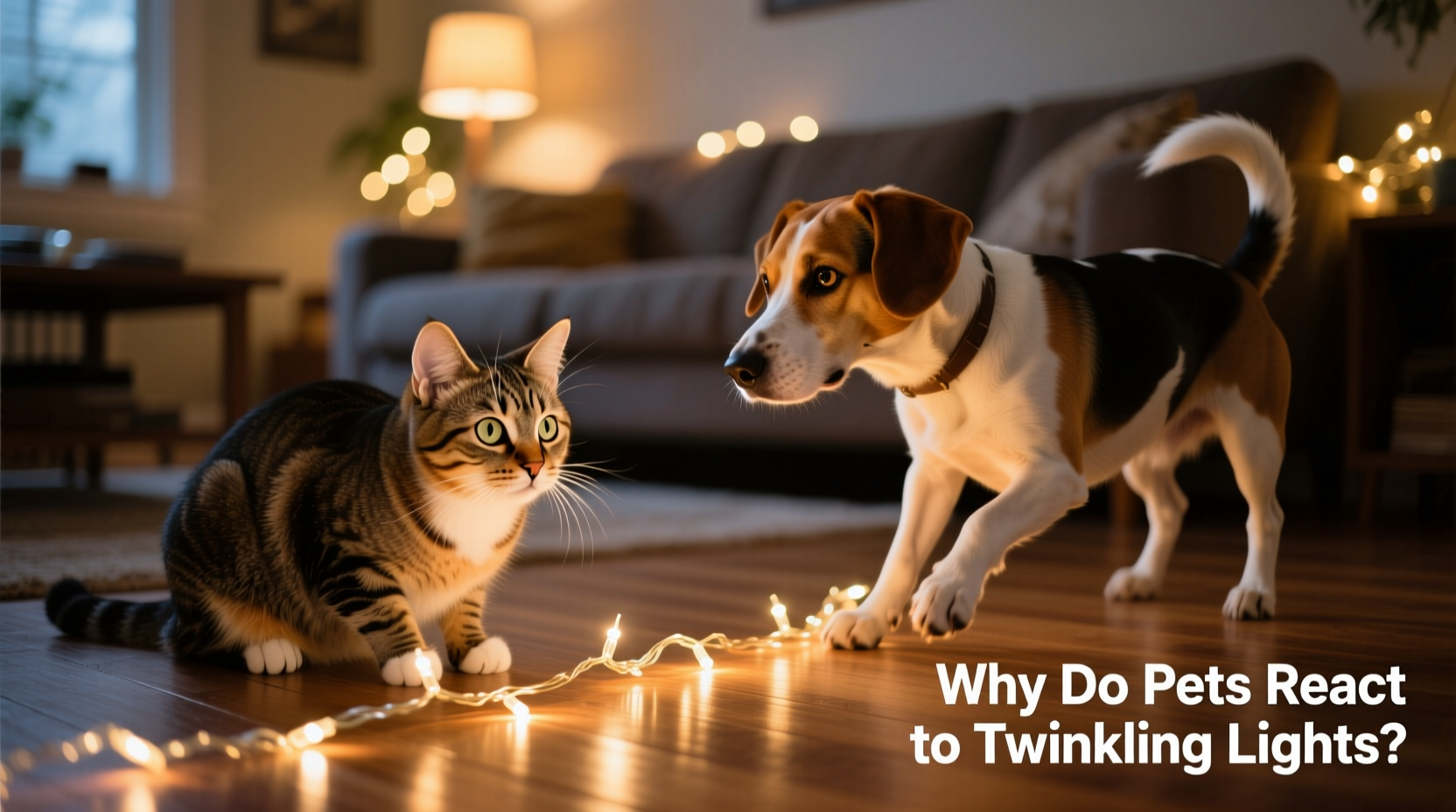
Humans perceive continuous light when it flashes at about 50–60 times per second (Hz). This is our flicker fusion threshold—the point at which discrete flashes merge into apparent smoothness. Most modern LED and fluorescent lights operate above this threshold, so we see steady illumination. But dogs typically have a flicker fusion threshold of 70–80 Hz, and cats as high as 90–100 Hz. That means many energy-efficient bulbs, smart lights with dynamic modes, and even some dimmed incandescents emit perceptible flicker to pets—like a silent, rapid strobe only they can detect.
This isn’t theoretical. In controlled studies at the University of Pennsylvania’s Veterinary Behavior Clinic, researchers used high-speed video synchronized with electroretinography (ERG) to measure retinal response. They found that 73% of cats exposed to standard 120-Hz PWM (pulse-width modulated) LED holiday lights exhibited sustained pupillary constriction and head-tracking movements—indicating active visual processing—not passive observation. Dogs showed increased orienting behavior (ear pricks, sustained gaze, micro-freezing) at frequencies up to 78 Hz, especially in low ambient light where contrast was heightened.
Evolutionary Echoes: Predation, Prey, and Survival Wiring
Twinkling lights mimic high-contrast, unpredictable motion—precisely the visual signature of small prey (fluttering insects, rustling rodents) or environmental threats (shifting shadows near dens, sudden reflections signaling predator movement). For cats, whose ancestors hunted in dawn/dusk light where contrast and motion detection were paramount, flickering stimuli activate ancient neural pathways in the superior colliculus—the midbrain region governing reflexive orientation and pursuit. In dogs, particularly herding or terrier breeds, similar circuitry supports tracking fast-moving objects across variable terrain.
But not all reactions are predatory. Some pets freeze or retreat—not because they’re afraid of the light itself, but because the erratic pattern violates expectations of environmental stability. In ethological terms, this is a violation of contingency: animals rely on predictable cause-effect relationships (e.g., light turns on → stays on). Twinkling disrupts that predictability, triggering vigilance as a precautionary response.
“Flicker isn’t ‘just light’ to a cat—it’s biologically ambiguous signal: Is it food? A threat? A broken part of reality? Their nervous system defaults to attention until it resolves.”
— Dr. Sarah Lin, DVM, DACVB, Director of Clinical Ethology, Cornell Feline Health Center
Individual Variability: Breed, Age, Health, and History
Why does one dog ignore a disco-ball effect while another whines and paces? Four key variables shape response intensity:
- Breed disposition: Herding dogs (Border Collies, Australian Shepherds) show heightened sensitivity to intermittent motion due to selective breeding for visual tracking. Siamese and Oriental cats demonstrate greater cortical responsiveness to flicker in fMRI studies.
- Age: Puppies and kittens under 6 months often exhibit curiosity or playful stalking—neural plasticity allows rapid habituation. Senior pets, however, may develop increased reactivity as vision declines and contrast perception becomes more effortful.
- Neurological health: Dogs with epilepsy or idiopathic vestibular disease can experience photic-induced agitation. A 2023 study in Journal of Veterinary Behavior linked unexplained episodic anxiety in older cats to undiagnosed retinal degeneration—where flicker creates disorienting afterimages.
- Learning history: A dog startled by a strobing security light during a thunderstorm may later associate *any* flicker with fear. Conversely, positive reinforcement (treats offered calmly near gentle twinkle lights) can build tolerance.
| Factor | Typical Behavioral Response | Underlying Mechanism |
|---|---|---|
| High flicker sensitivity + prey drive | Stalking, pawing, intense focus, vocalizing | Superior colliculus activation + dopamine release in pursuit circuitry |
| Low visual acuity + anxiety history | Freezing, hiding, trembling, avoiding the room | Heightened amygdala response to unpredictable stimuli |
| Neurological impairment (e.g., CCD) | Confusion, circling near light source, disorientation | Reduced cortical filtering of visual noise |
| Positive conditioning history | Calm observation, relaxed posture, no avoidance | Habituation + prefrontal cortex inhibition of threat response |
A Real-World Case: Luna the Rescue Cat and the “Haunted” Christmas Tree
Luna, a 3-year-old domestic shorthair adopted from a rural shelter, began hissing and swatting at the base of her family’s artificial Christmas tree each December. Her owners assumed she disliked ornaments—until they replaced the original LED string (advertised as “warm white, 60 Hz”) with a certified flicker-free 120 Hz alternative. Within 48 hours, Luna sat calmly beneath the tree, even napping nearby. No other changes were made: same ornaments, same placement, same room lighting.
Follow-up consultation with a board-certified veterinary behaviorist revealed Luna’s early life involved frequent exposure to failing fluorescent barn lights—likely conditioning her to associate flicker with instability and stress. The original tree lights, operating at sub-threshold frequency, reactivated that learned association. Replacing them didn’t erase the memory—but removed the persistent trigger, allowing her natural curiosity to resurface. This case underscores a critical principle: behavior is rarely about the object itself, but about what the object *signifies* to the animal’s nervous system.
Practical Action Plan: Reducing Stress & Supporting Calm
When twinkling lights are unavoidable—during holidays, celebrations, or architectural lighting—you can mitigate impact without eliminating aesthetics. Here’s a step-by-step approach grounded in applied behavior analysis and veterinary guidance:
- Assess your lights: Use your smartphone camera. Point it at the light source and look at the screen—if you see banding, pulsing, or rolling dark lines, the light is flickering (even if invisible to your eye).
- Measure ambient light: Keep room brightness above 150 lux where pets rest. Flicker is most disruptive in low-light conditions where pupils dilate and contrast sensitivity peaks.
- Create flicker-free zones: Designate at least one quiet room (e.g., bedroom or crate area) with incandescent or high-frequency LEDs—no twinkling elements allowed.
- Introduce gradually: For new lighting, turn it on for 5 minutes on Day 1, then increase by 5 minutes daily while offering high-value treats or play. Never force proximity.
- Provide visual control: Place pet beds away from direct line-of-sight to light sources. Use sheer curtains to diffuse outdoor twinkle lights visible through windows.
Frequently Asked Questions
Can twinkling lights cause seizures in pets?
True photosensitive epilepsy is rare in dogs and cats—but not impossible. Documented cases involve dogs with pre-existing idiopathic epilepsy exposed to high-intensity, high-frequency strobes (e.g., club lighting, malfunctioning security systems). Standard holiday lights pose minimal risk for seizure induction in neurologically healthy pets. However, any pet showing muscle twitching, lip-smacking, or vacant staring near lights warrants immediate veterinary neurology evaluation.
My dog barks at the TV when sparkles appear—is that the same mechanism?
Yes. Modern TVs refresh at 60–120 Hz, but motion interpolation, compression artifacts, and bright specular highlights (e.g., sunlight glinting off water) can create localized flicker-like effects. Dogs with strong visual orientation respond similarly—though the flat screen lacks depth cues, reducing predatory intensity. Training with “look away” cues paired with rewards helps redirect attention constructively.
Are battery-operated twinkle lights safer than plug-in ones?
Not inherently. Flicker depends on driver circuitry—not power source. Many inexpensive battery lights use basic resistive drivers that produce significant 100–120 Hz ripple. Check manufacturer specs for “constant current” or “PWM-free” operation. When in doubt, test with your phone camera first.
Conclusion: Seeing the World Through Their Eyes
Recognizing that pets experience twinkling lights not as decoration—but as dynamic, biologically salient events—transforms how we coexist with them in human-designed spaces. It shifts our role from passive observers to informed stewards of sensory well-being. You don’t need to eliminate sparkle from your home to honor your pet’s needs. You simply need to choose intentionally: select lights with higher flicker thresholds, design environments with predictable visual anchors, and respond to reactions with curiosity—not correction. Every time you replace a flickering bulb or reposition a bed away from glare, you affirm a deeper truth—that respect for another species begins with honoring how they perceive reality. Start tonight: scan one room with your phone camera, identify one flickering source, and swap it. That small act is both science-informed and deeply compassionate.




 浙公网安备
33010002000092号
浙公网安备
33010002000092号 浙B2-20120091-4
Comments
No comments yet. Why don't you start the discussion?