
Every December, thousands of pet owners face the same anxious ritual: untangling strands of lights—only to find frayed wires, melted plastic casings, or worse, a lethargic dog or trembling cat showing signs of electrical injury. Chewing on Christmas lights isn’t “just a phase” or harmless holiday mischief. It’s a behavior rooted in biology, environment, and unmet needs—and it carries real, potentially life-threatening risks. According to the ASPCA Animal Poison Control Center, electrical cord injuries spike 300% between Thanksgiving and New Year’s, with dogs accounting for 72% of reported cases and cats for 19%. This isn’t about discipline. It’s about understanding motivation, mitigating danger, and meeting your pet’s needs in ways that keep everyone safe.
The Science Behind the Spark: Why Pets Target Lights
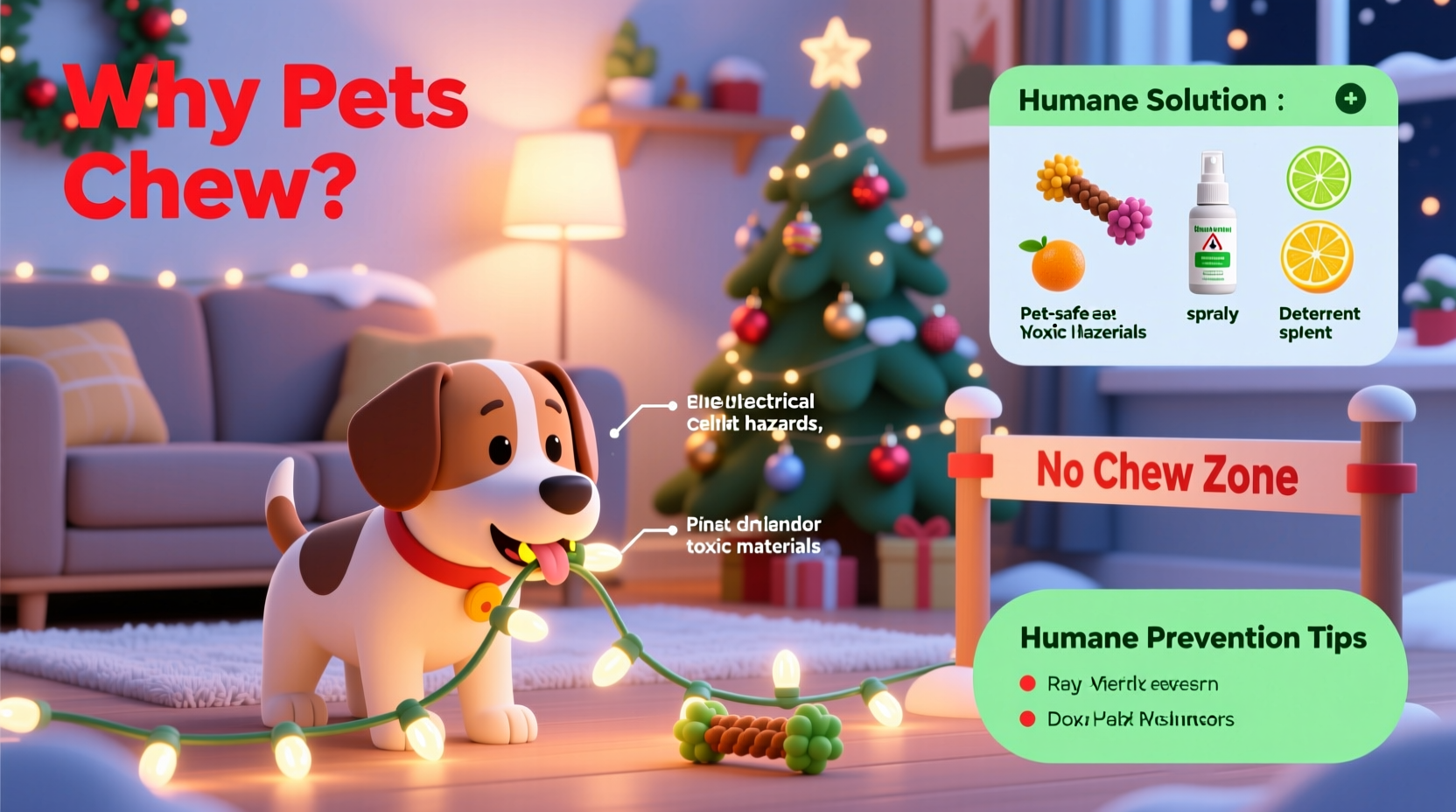
Pets don’t chew lights because they’re “naughty” or “testing boundaries.” They respond to sensory, developmental, and physiological cues humans often overlook. Three primary drivers explain this behavior:
- Sensory stimulation: The faint hum of low-voltage current (especially in older incandescent strands), the cool, smooth texture of PVC-coated wires, and even the subtle warmth emitted by bulbs create a compelling multi-sensory experience. For dogs with high prey drive or oral fixation, the vibration mimics live prey movement; for kittens, dangling cords trigger innate pouncing instincts.
- Teething and oral development: Puppies under 6 months and kittens under 4 months are actively cutting teeth. Chewing relieves gum pressure and strengthens jaw muscles. Holiday lights—often left within easy reach on lower branches or floor-level trees—become convenient, novel chew objects when appropriate teething toys aren’t readily available.
- Boredom, anxiety, and under-stimulation: The holiday season disrupts routine—more guests, altered schedules, unfamiliar scents, and heightened household energy. For pets sensitive to environmental change, chewing becomes a self-soothing mechanism. A 2023 study published in Frontiers in Veterinary Science found that 68% of dogs exhibiting destructive chewing during holidays showed elevated cortisol levels correlated with schedule unpredictability—not disobedience.
This isn’t willful destruction. It’s communication—a signal that something is missing: mental engagement, physical outlet, or environmental security.
Why “Just Saying No” Doesn’t Work—and Can Make It Worse
Scolding, yelling, or using punishment-based deterrents (like bitter apple spray applied *after* chewing begins) rarely resolve the root cause. In fact, aversive methods can backfire:
- They erode trust, increasing anxiety-driven behaviors.
- They teach pets to hide chewing—not stop it—leading to unsupervised access and higher risk.
- They ignore the underlying need: a puppy chewing due to teething won’t stop because you shout; she’ll just wait until you’re out of the room.
Veterinary behaviorist Dr. Lisa Radosta emphasizes this distinction:
“Chewing is not defiance—it’s a functional behavior. If you punish the symptom without addressing the cause, you’re not solving the problem. You’re just making your pet afraid of you while leaving the motivation intact.” — Dr. Lisa Radosta, DACVB, Founder of Florida Veterinary Behavior Service
Humane, Evidence-Based Prevention Strategies
Effective prevention combines environmental management, enrichment, and proactive training. These methods work because they respect your pet’s biology while redirecting behavior into safe channels.
Step-by-Step Light-Safe Setup Timeline
- Weeks before decorating: Assess your pet’s baseline behavior. Is chewing escalating? Are they restless or vocalizing more? Note patterns—time of day, triggers (e.g., guests arriving), and preferred chew targets.
- 3 days before setup: Introduce new, high-value chew toys (e.g., frozen Kongs, food puzzles) on a consistent schedule—twice daily, 20 minutes each session—to build positive association with alternatives.
- Day of decorating: Install lights *before* bringing the tree indoors—or do it while your pet is securely crated or in another room. Use cord concealers *first*, then drape lights.
- First 48 hours: Supervise all interactions near the tree. Reward calm observation with treats; gently redirect chewing attempts toward approved toys—no scolding.
- Ongoing (through Jan 5): Rotate chew toys weekly, add 10 minutes of daily interactive play (e.g., wand toys for cats, tug for dogs), and maintain lighting boundaries using baby gates or freestanding barriers.
What Works (and What Doesn’t): A Safety Comparison Table
| Strategy | Effectiveness | Safety Risk | Notes |
|---|---|---|---|
| Cord covers (rigid plastic or braided sleeves) | High — physically blocks access | None | Use split-sleeve varieties for easy installation over existing cords. Avoid soft silicone sleeves—they’re easily chewed through. |
| Tension-mounted baby gates around tree base | High — creates consistent barrier | Low (if gate is stable and pet can’t climb) | Choose gates rated for pets >20 lbs. For cats, add a 24\" mesh extension at the top. |
| Bitter apple or citrus sprays | Low-Moderate — short-term only | None (if pet-safe formulation) | Apply to cord ends *only*. Reapply every 2–3 days. Never use on LED strands with exposed micro-connections—moisture can cause shorts. |
| Taping cords to walls/floor with double-sided tape | Moderate — works best for low-energy pets | Low (tape residue may irritate paws) | Use PET-safe, non-toxic tape (e.g., 3M Command Strips). Avoid duct tape—adhesive can damage fur and skin. |
| Unplugging lights when unattended | Critical — eliminates electrocution risk | None | Non-negotiable for households with puppies, kittens, or known chewers. Use smart plugs with scheduling for convenience. |
Real-Life Scenario: How the Chen Family Protected Their Rescue Terrier Mix
Milo, a 7-month-old Jack Russell terrier mix adopted in October, began chewing baseboard cords within weeks. When the Chens brought home their first Christmas tree, Milo targeted the lower light strands—despite previous obedience training. Instead of reprimanding, they consulted their veterinarian, who recommended a three-pronged approach: environmental control, enrichment escalation, and behavioral conditioning. They installed rigid cord covers on all light strings, placed a tension gate 3 feet from the tree trunk, and introduced a daily “chew rotation”: one frozen peanut butter Kong at breakfast, a puzzle toy stuffed with kibble at lunch, and 15 minutes of flirt pole play each evening. Within five days, Milo stopped investigating the tree entirely. By New Year’s, he’d learned to settle on his bed beside the tree—rewarded quietly with gentle praise and occasional treats. His chewing didn’t vanish; it shifted to appropriate outlets. As his owner noted: “We stopped seeing him as ‘the chewer’ and started seeing him as ‘a dog who needed more structure and less boredom.’ That changed everything.”
Essential Humane Prevention Checklist
- ✅ Unplug all decorative lights whenever no adult is actively supervising the room.
- ✅ Cover every inch of accessible cord with rigid plastic sleeves—not tape or fabric wraps.
- ✅ Place the tree in a low-traffic zone, away from windows (to reduce external stimuli) and heat sources (which attract cats).
- ✅ Provide at least three species-appropriate chew options per day—rotated daily to maintain novelty.
- ✅ Schedule two 10-minute interactive play sessions daily (laser pointers for cats must end with a tangible “catch” toy; tug games for dogs should include release cues).
- ✅ Use motion-activated deterrents *only* as a last resort—and never in place of supervision. Choose ultrasonic devices (inaudible to humans) over spray-based ones.
Frequently Asked Questions
Can I use LED lights instead of incandescent to reduce risk?
Yes—but with caveats. LEDs operate at lower voltage (typically 12V vs. 120V), reducing—but not eliminating—electrocution severity. However, many LED strands still connect to standard outlets via transformers, and damaged wiring can still deliver dangerous current. More importantly, LEDs often have thinner, more flexible cords that are easier to chew through. Prioritize physical barriers over bulb type.
My cat loves batting at lights—will trimming her claws help?
No. Trimming claws doesn’t address the motivation behind the behavior. Cats bat at moving lights due to predatory instinct—not sharpness. Redirect with wand toys that mimic erratic movement, and use vertical space (cat trees near—but not touching—the tree) to satisfy climbing urges safely.
Is there a safe “chew deterrent” I can make at home?
Not reliably. Homemade cayenne or vinegar sprays lack consistency, may irritate mucous membranes, and offer no advantage over commercial pet-safe products. More critically, they distract from what truly works: preventing access and fulfilling needs. Invest time in management—not DIY chemistry.
Conclusion: Safety Begins With Understanding, Not Suppression
Protecting your pet from Christmas lights isn’t about creating a fortress of tape and sprays. It’s about recognizing that every chew, every pounce, every curious nudge is data—information about your pet’s physical comfort, emotional state, and environmental fit. When you replace frustration with observation, and punishment with planning, you do more than safeguard against shocks and burns. You deepen trust. You honor your pet’s nature. And you reclaim the season—not as a series of anxious interventions, but as an opportunity to meet your companion’s needs with consistency and compassion. Start tonight: unplug the lights in the living room, install one cord cover, and fill a Kong with something delicious. Small actions, grounded in science and empathy, compound into lasting safety. Your pet isn’t ruining the holidays. They’re asking—quietly, urgently—for your help in navigating them well.




 浙公网安备
33010002000092号
浙公网安备
33010002000092号 浙B2-20120091-4
Comments
No comments yet. Why don't you start the discussion?