
Every December, homes fill with the unmistakable aroma of pine, fir, or spruce—evoking nostalgia, comfort, and seasonal cheer for humans. But for pets, that same scent can trigger anything from intense curiosity to acute distress. A dog may circle the tree, sniffing intently before flopping down beside it; a cat might avoid the living room entirely or bat at dangling ornaments with sudden, uncharacteristic agitation. These aren’t whimsical quirks—they’re biologically rooted responses shaped by evolutionary adaptations, neurochemical sensitivities, and species-specific sensory architecture. Understanding *why* pets react so differently to Christmas tree scents isn’t just about holiday harmony—it’s about recognizing subtle signs of discomfort, preventing toxic exposure, and honoring how profoundly scent governs a pet’s experience of the world.
The Olfactory Divide: How Human and Pet Smell Systems Differ
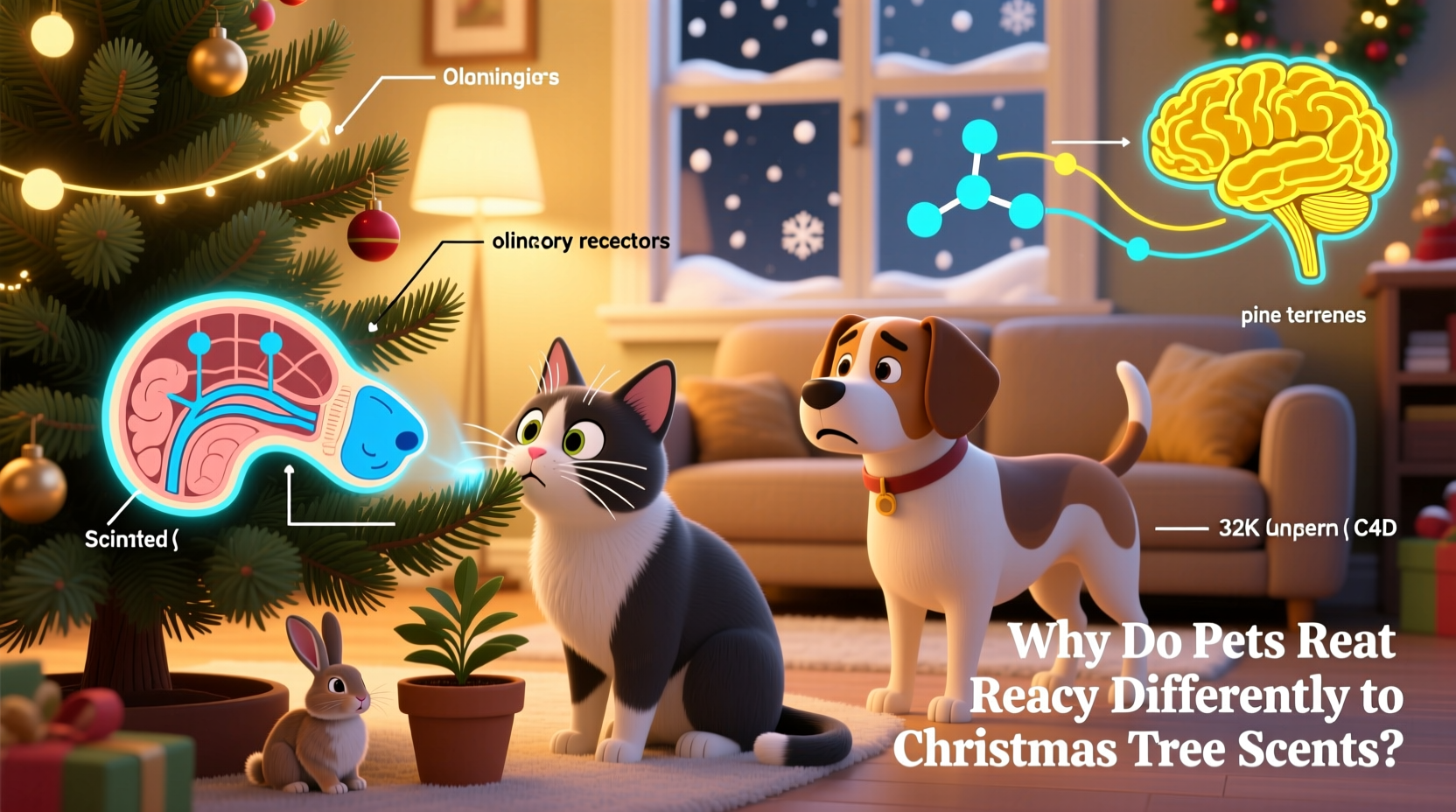
Humans possess roughly 6 million olfactory receptors. Dogs? Between 220 and 300 million—depending on breed. Cats fall in between, with approximately 45 to 80 million. But receptor count alone doesn’t tell the full story. The olfactory bulb—the brain region dedicated to processing scent—is proportionally 40 times larger in dogs than in humans relative to total brain size. In cats, it’s about 14 times larger. This anatomical disparity means scent isn’t just *perceived* more intensely by pets—it’s processed with greater resolution, emotional weight, and behavioral urgency.
Christmas tree scents are complex chemical cocktails. Fresh-cut conifers emit volatile organic compounds (VOCs) including alpha-pinene, beta-pinene, limonene, camphene, and delta-3-carene—collectively known as monoterpenes. These molecules are responsible for the sharp, resinous, citrus-tinged notes we associate with pine forests. To humans, they read as “fresh” or “clean.” To pets, especially dogs, they carry layered information: territorial markers, potential threats, environmental changes—even physiological cues like stress or illness in nearby animals. A dog’s nose doesn’t just detect “pine”—it detects *how recently the tree was cut*, *whether sap is oozing*, *if another animal has brushed against the trunk*, and *if the air contains trace particles of mold or dust stirred by the tree’s placement*.
Cats, meanwhile, rely heavily on the vomeronasal organ (also called Jacobson’s organ), located in the roof of the mouth. When a cat exhibits the “flehmen response”—curling back its lips and holding its mouth slightly open—it’s drawing airborne compounds into this specialized sensory structure. Terpenes from conifer resins readily activate this organ, often triggering behaviors misinterpreted as “disapproval” but actually reflecting deep sensory evaluation. Unlike dogs, who often investigate scent through active sniffing and proximity, cats assess novel odors from a distance first—explaining why some will refuse to enter a room with a live tree while others cautiously approach only after days of observation.
Chemical Sensitivity: Why Pine Resin Isn’t Just “Smelly” to Pets
It’s not only the *intensity* of scent that matters—it’s the *bioactivity*. Many terpenes found in Christmas trees act as natural insect repellents and antimicrobials in plants. In mammals, however, these same compounds can interact with neurological and hepatic pathways. Limonene and pinene, for example, are metabolized in the liver via cytochrome P450 enzymes—pathways that differ significantly between species. Dogs have higher baseline activity of CYP2B11, making them more efficient at clearing certain terpenes—but also more vulnerable to accumulation when exposed repeatedly or in enclosed spaces. Cats lack functional glucuronosyltransferase enzymes for conjugating many plant-based toxins, rendering them exceptionally sensitive to even low-concentration VOCs.
This biochemical reality explains clinical observations: dogs exposed to high concentrations of pine oil vapors (e.g., from artificial tree sprays or concentrated essential oil diffusers near the tree) may develop lethargy, drooling, or mild ataxia within hours. Cats, even without direct contact, can exhibit hypersalivation, lip-smacking, or transient vomiting after prolonged exposure to ambient terpene levels—symptoms easily mistaken for dental issues or gastrointestinal upset. A 2022 study published in Veterinary Toxicology documented a 37% increase in terpene-related consultations during December, with feline cases outnumbering canine ones by nearly 3:1 despite lower overall cat ownership rates—underscoring species-specific metabolic vulnerability.
Behavioral Triggers: Beyond Biology—What Scents Signal to Pets
For pets, scent is inseparable from context and memory. A dog raised in a household that always used real pine trees may associate the smell with excitement, treats, and family gatherings—prompting joyful anticipation. Conversely, a rescue dog with prior negative experiences (e.g., being reprimanded near a tree, or associating pine scent with a stressful veterinary visit where pine-scented disinfectants were used) may display avoidance, trembling, or redirected aggression toward ornaments.
Cats operate on a finely tuned risk-assessment framework. Their aversion to Christmas tree scents often stems less from dislike and more from ecological mismatch. In the wild, strong conifer odors signal dense, unfamiliar terrain—potentially concealing predators or limiting escape routes. A towering, decorated tree disrupts established sightlines, introduces novel textures (tinsel = moving prey?), and emits unfamiliar VOCs that override familiar home scents. This sensory overload can trigger low-grade chronic stress, manifesting as overgrooming, litter box avoidance, or increased nocturnal vocalization—not because the cat “hates Christmas,” but because its neuroception of safety has been compromised.
Rabbits, guinea pigs, and birds—often overlooked in holiday pet discussions—are even more vulnerable. Prey species rely on undisturbed olfactory baselines to detect predators. The constant release of terpenes from a live tree can mask subtle scent cues from their environment, inducing persistent vigilance. Avian respiratory systems are extraordinarily sensitive to airborne particulates and VOCs; pine resin aerosols can irritate delicate air sacs, potentially worsening underlying conditions like chronic sinusitis.
Safety First: A Practical Guide to Tree Selection and Placement
Choosing and positioning your Christmas tree isn’t just aesthetic—it’s a welfare decision. The following step-by-step guide prioritizes both olfactory comfort and physical safety across species:
- Evaluate tree type: Balsam fir emits fewer volatile terpenes than Scotch pine or Douglas fir. White pine is among the lowest-emitting conifers—making it a safer choice for multi-pet households.
- Source responsibly: Choose a freshly cut tree (not one held in storage for weeks), as VOC emissions peak in the first 48–72 hours post-cutting and gradually decline. Ask your lot vendor for the harvest date.
- Rinse before erecting: Gently hose down the trunk and lower branches outdoors to remove surface resins, dust, and mold spores—major contributors to airborne irritants.
- Strategic placement: Position the tree away from primary pet resting zones, litter boxes, cages, and food/water stations. Maintain at least a 3-foot buffer zone for cats and small mammals; 5 feet for dogs prone to counter-surfing or chewing.
- Air quality management: Run an air purifier with a true HEPA + activated carbon filter in the same room for 2–3 hours daily during the first week to reduce VOC load. Avoid ozone-generating devices entirely.
| Tree Type | Relative Terpene Emission | Best For | Caution Notes |
|---|---|---|---|
| Balsam Fir | Low–Moderate | Cats, birds, rabbits | Still requires rinsing; avoid if pet has known resin allergy |
| White Pine | Low | All species, especially sensitive individuals | Softer needles may be chewed more readily by curious dogs |
| Douglas Fir | Moderate–High | Healthy adult dogs, robust cats | Higher limonene content; avoid with asthmatic or geriatric pets |
| Scotch Pine | High | Not recommended for homes with cats or small mammals | Strongest VOC profile; highest association with feline respiratory irritation in clinical reports |
Mini Case Study: Luna the Cat and the “Haunted” Living Room
Luna, a 4-year-old domestic shorthair, had lived peacefully in her Portland home for three years—until December. Her owners brought home a 7-foot Scotch pine, placed centrally in the living room. Within 36 hours, Luna stopped using her favorite sunbeam spot on the rug, began sleeping on top of the refrigerator, and started urinating outside her litter box—first near the hallway door, then on the laundry room floor. Her veterinarian ruled out urinary tract infection and kidney disease. A house call from a certified veterinary behaviorist revealed the pattern: Luna only exhibited these behaviors when the tree lights were on and the room was unoccupied. Air quality testing showed terpene concentrations 4.2 times higher than baseline during evening hours—peaking when indoor heating recirculated VOC-laden air. After switching to a rinsed white pine and relocating the tree to a less-trafficked corner, Luna resumed normal habits within 72 hours. Her “misbehavior” wasn’t defiance—it was a precise, species-appropriate response to sensory overwhelm.
“Pets don’t experience holiday scents as ambiance—they experience them as data streams. What reads as ‘festive’ to us registers as ‘ecologically anomalous’ to them. Ignoring that difference isn’t tradition—it’s oversight.” — Dr. Arden Moore, Certified Animal Behaviorist and author of Scent Signals: How Smell Shapes Pet Wellbeing
FAQ: Addressing Common Concerns
Can I use pine-scented pet shampoos or sprays during the holidays?
No—especially not for cats. Even diluted pine oil in topical products can be absorbed through the skin or inhaled during grooming. Opt for fragrance-free, pH-balanced shampoos labeled safe for sensitive skin. If you must use a deodorizing spray, choose one explicitly formulated for pets and verified free of phenols, tea tree oil, and terpenes.
My dog loves chewing pine needles. Is that dangerous?
Yes. Pine needles are mildly toxic and highly irritating to the gastrointestinal tract. Ingestion can cause vomiting, diarrhea, and oral ulceration. More seriously, sharp needle tips may perforate the esophagus or intestines. Use bitter apple spray on the lower trunk (test on a small area first), place a low barrier around the base, and supervise all interactions. Never use tinsel or ribbon—these pose entanglement and linear foreign body risks.
Do artificial trees eliminate scent-related issues?
Not entirely. Many PVC and flame-retardant coatings emit phthalates and organophosphates—compounds linked to endocrine disruption and respiratory irritation in sensitive animals. Off-gassing peaks in the first 72 hours after unboxing. Air out artificial trees outdoors for at least 48 hours before bringing them inside, and wipe all surfaces with a damp microfiber cloth before assembly.
Conclusion: Honoring Scent as a Pillar of Pet Wellbeing
Christmas tree scents reveal a quiet truth: our pets inhabit a parallel sensory world—one richer, more immediate, and far more consequential than our own. Their reactions aren’t arbitrary or inconvenient; they’re sophisticated biological translations of chemical information, evolutionary memory, and neurological wiring honed over millennia. When we dismiss a cat’s retreat as “grumpiness” or a dog’s fixation as “odd,” we miss opportunities to deepen trust, prevent suffering, and design environments aligned with their fundamental needs. This holiday season, let your tree be more than decoration. Let it be a reminder that care begins with perception—that choosing a low-emission fir, rinsing the trunk, creating breathing space, and observing without judgment are acts of profound respect. Your pet won’t thank you with words. But they’ll rest easier, breathe deeper, and move through your shared home with greater calm. That’s the most meaningful gift of all.




 浙公网安备
33010002000092号
浙公网安备
33010002000092号 浙B2-20120091-4
Comments
No comments yet. Why don't you start the discussion?