
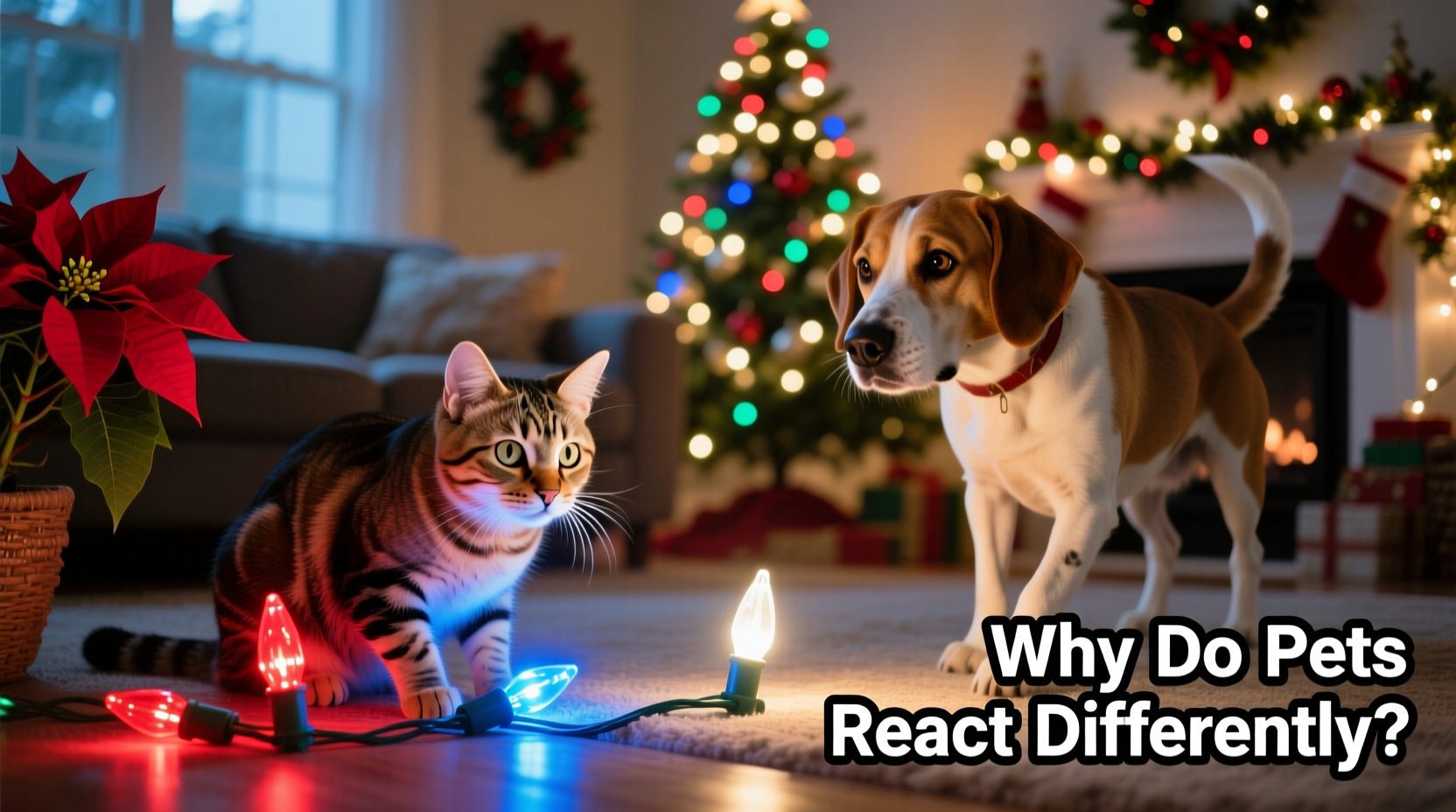
As holiday decorations go up each December, many pet owners notice something curious: their dog freezes mid-sniff when a string of lights pulses red and green, while their cat stares intently—or flees—as strobing LEDs flicker across the wall. Others report calm acceptance of warm-white fairy lights but visible distress when animated light displays activate. These aren’t quirks or “just being dramatic.” They reflect fundamental differences in how dogs, cats, birds, and even rabbits see and process visual information—differences rooted in anatomy, neurology, and evolutionary adaptation. Understanding why pets react differently to flashing versus steady lights isn’t just about holiday safety; it’s about respecting how another species experiences the world.
How Animal Vision Differs from Human Vision
Humans have trichromatic vision—we see red, green, and blue wavelengths thanks to three types of cone photoreceptors. Most dogs are dichromatic: they possess only two cone types (sensitive to blue and yellow), making reds and greens appear muted or indistinguishable. Cats also have dichromatic vision, though with slightly broader spectral sensitivity and far greater rod density—giving them superior low-light capability but less color discrimination.
More critically, animals differ from humans in flicker fusion threshold (FFT)—the frequency at which a flashing light appears continuous rather than intermittent. Humans typically fuse flicker at around 50–60 Hz. Dogs? Between 70–80 Hz. Cats? Up to 90 Hz. That means a light pulsing at 75 Hz—which looks perfectly smooth to us—may still register as distinct, jarring flashes to a cat. Even modern “flicker-free” LED strings can emit subtle high-frequency modulation invisible to human eyes but perceptible to pets, especially under certain dimming circuits or low-quality drivers.
This isn’t theoretical. A 2022 study published in Applied Animal Behaviour Science measured behavioral responses in 42 domestic cats exposed to identical LED strings operating at 50 Hz (perceived as steady by humans) versus 75 Hz (still within detectable flicker range for felines). Over 68% exhibited increased vigilance, ear-twitching, or retreat behavior only during the 75 Hz condition—despite no change in brightness or color.
The Neurological Impact of Flashing Light
Flashing light doesn’t just trigger visual perception—it activates deeper neural pathways. In mammals, rapid visual transients stimulate the superior colliculus, a midbrain structure governing orienting responses, startle reflexes, and predator-prey detection. For species whose survival once depended on spotting a rustling leaf or darting insect, hyper-responsiveness to motion—even artificial motion—is biologically conserved.
Dogs’ visual cortex contains proportionally more neurons dedicated to motion detection than humans’. Their peripheral vision is exceptionally sensitive to movement: a flickering light at the edge of their field may register not as decoration, but as an ambiguous, potentially threatening stimulus requiring assessment. This explains why some dogs track individual bulbs across a garland or bark at shifting reflections on the floor—behavior that seems disproportionate until you consider their sensory reality.
Cats take this further. Their retinas contain up to eight times more rods per square millimeter than humans, and their tapetum lucidum—a reflective layer behind the retina—amplifies available light but also prolongs photoreceptor stimulation. When combined with high FFT, this means flashing lights create stronger afterimages and temporal “ghosting,” increasing perceptual load. As Dr. Sarah Lin, veterinary neurologist and author of Sensory Worlds of Companion Animals, explains:
“Flashing lights don’t just look different to pets—they feel different neurologically. It’s not anxiety in the human sense; it’s sustained sensory arousal. The brain stays in ‘monitor mode,’ elevating cortisol and suppressing rest behaviors. Steady lights allow neural downregulation. Flashing lights prevent it.” — Dr. Sarah Lin, DACVIM (Neurology)
Species-Specific Reactions Explained
Not all pets respond the same way—and the variation isn’t random. It reflects ecological niche, domestication history, and individual temperament.
- Dogs: Often display alertness (pricked ears, head tilting), vocalization (barking, whining), or displacement behaviors (pacing, licking). Herding breeds may fixate intensely, interpreting rhythmic pulses as erratic movement needing control. Senior dogs with cognitive decline may show confusion or agitation, mistaking flicker for visual hallucinations.
- Cats: Typically exhibit one of three patterns: intense visual tracking (slow blinks, dilated pupils), avoidance (hiding, leaving the room), or predatory fixation (crouching, tail flicking)—even toward static lights if they generate shimmering reflections. Indoor-only cats, lacking environmental enrichment variety, may over-attend to any novel visual stimulus.
- Birds (especially parrots): Highly sensitive to UV and rapid flicker. Many avian species perceive light up to 100+ Hz. Flashing LEDs can induce stress-related feather plucking, screaming, or refusal to eat near decorated areas. Their tetrachromatic vision also detects UV emissions from some “white” LEDs—adding an invisible, disorienting layer.
- Rabbits & Guinea Pigs: Prey animals with nearly 360° panoramic vision rely heavily on motion detection. Flashing lights across walls or ceilings simulate overhead predators or falling debris, triggering freeze-or-flee responses. Unlike dogs or cats, they rarely habituate—repeated exposure often increases vigilance.
Practical Lighting Strategies for Pet-Friendly Holidays
Protecting your pet’s well-being doesn’t mean sacrificing festive cheer. It means choosing lights with intention—and understanding what “pet-safe” truly means beyond marketing claims.
| Light Type | Pet Risk Level | Why & What to Do |
|---|---|---|
| Incandescent Mini-Lights (steady) | Low | Warm, continuous glow; minimal flicker. Best for rooms where pets spend time. Avoid overheating near fabrics or bedding. |
| High-Quality DC-Driven LEDs (steady) | Low–Moderate | Look for “flicker-free” certification (IEEE 1789 compliant). Use only with stable power sources—not dimmer switches designed for incandescents. |
| AC-Powered LEDs with Triac Dimmers | High | Common cause of imperceptible 100–120 Hz flicker. Avoid entirely in pet zones. Test with smartphone camera—if you see banding or strobing, so does your pet. |
| Programmable RGB Strings (flashing/chasing) | High | Multiple frequencies, abrupt color shifts, and motion effects compound sensory load. Reserve for outdoor use or rooms pets never enter. |
| Fiber Optic or Electroluminescent Wire | Very Low | No flicker, cool operation, soft diffusion. Ideal for tree bases, shelves, or pet beds (if securely anchored). |
A Real Example: How One Family Adjusted for Their Anxious Rescue Dog
When Maya adopted Leo, a 3-year-old German Shepherd mix from a rural shelter, she noticed he’d tremble near her living room TV—especially during sports broadcasts with rapid cuts and bright graphics. She assumed it was noise sensitivity—until Christmas. After hanging traditional blinking icicle lights on her front porch, Leo refused to step onto the deck, whined continuously indoors, and began avoiding the entire west side of the house.
Her veterinarian suggested testing light sensitivity. Using a smartphone slow-motion video (240 fps), Maya recorded the lights—and discovered they pulsed at 58 Hz with irregular intensity spikes. She replaced them with steady-warm LED rope lights (verified flicker-free via oscilloscope app) and moved the tree away from his primary resting area. Within 48 hours, Leo resumed napping in his favorite sunspot. Crucially, Maya didn’t stop there: she kept holiday lights confined to the dining room (a space Leo rarely entered) and used blackout curtains to prevent spill into hallways. “It wasn’t about removing joy,” she shared in a local pet wellness forum. “It was about giving him predictability. When the lights weren’t a surprise threat, his whole nervous system relaxed.”
Step-by-Step: Creating a Calm Holiday Environment for Your Pet
- Assess current lighting: Film suspected problem lights with your phone’s slow-motion mode (120+ fps). If you see strobing, banding, or inconsistent brightness, your pet sees it too.
- Relocate or restrict access: Move decorative lights out of direct line-of-sight from pet beds, crates, litter boxes, and feeding stations. Use baby gates or closed doors to define “low-stimulus zones.”
- Choose steady over dynamic: Prioritize warm-white (2700K–3000K), non-dimmable, DC-powered LEDs. Avoid “twinkling,” “chasing,” or sound-activated modes—even if turned off initially, remotes can accidentally trigger them.
- Add visual buffers: Place fabric screens, frosted glass vases, or sheer curtains between lights and pet spaces. Diffused light reduces contrast and minimizes reflection-triggered reactions.
- Maintain routine rigorously: Feed, walk, and play at consistent times. Predictability lowers baseline stress, making pets more resilient to unavoidable stimuli.
- Observe and document: Keep a 3-day log noting light usage times, pet location, and observed behaviors (e.g., “8 p.m.: kitchen lights on → dog paces for 12 min”). Patterns reveal triggers faster than memory alone.
FAQ
Can flashing lights trigger seizures in pets?
Photosensitive epilepsy is rare in dogs and extremely rare in cats—but not impossible. Documented cases involve specific frequencies (often 15–25 Hz) combined with high contrast and full-field stimulation (e.g., a strobe light filling their entire vision). While holiday lights rarely meet these criteria, any pet with known neurological conditions should avoid flashing displays. When in doubt, consult a board-certified veterinary neurologist before introducing new lighting.
My pet ignores the lights—does that mean they’re unaffected?
Not necessarily. Some animals mask stress through stoicism, especially cats and prey species. Absence of obvious reaction doesn’t equal absence of physiological impact. Monitor resting heart rate (normal dog: 60–140 bpm; cat: 140–220 bpm), respiratory rate, and sleep continuity. Increased nocturnal wakefulness or reduced REM sleep—detectable via pet activity trackers—can indicate subclinical stress.
Are battery-operated lights safer than plug-in ones?
Not inherently. Battery voltage fluctuations can increase flicker in low-cost LEDs. What matters is circuit design—not power source. Look for batteries powering DC-regulated drivers, not raw battery voltage fed directly to diodes. High-quality battery lights often include flicker suppression; cheap ones rarely do.
Conclusion
Holiday lights are meant to evoke wonder—not alarm. Yet for our companion animals, the difference between a gentle, steady glow and a chaotic, pulsing display isn’t aesthetic preference. It’s the difference between safety and uncertainty, calm and chronic arousal, belonging and withdrawal. Recognizing that flashing lights aren’t merely “brighter” but neurologically distinct—and that steady light offers genuine physiological relief—transforms holiday preparation from decoration to care. You don’t need to eliminate festivity to honor your pet’s sensory needs. You simply need to choose deliberately, observe attentively, and adjust compassionately. This season, let your lights shine warmly—not startlingly. Let them illuminate joy, not anxiety. And when you switch on your first string of steady, flicker-free lights, watch closely: that sigh of relaxation from your dog, the slow blink from your cat, the quiet return to napping—they’re not just tolerating the season. They’re finally able to celebrate it, too.




 浙公网安备
33010002000092号
浙公网安备
33010002000092号 浙B2-20120091-4
Comments
No comments yet. Why don't you start the discussion?