
It’s a familiar holiday scene: tinsel glints, carols play softly—and your dog freezes mid-sniff, ears pricked toward the tree. Or your cat crouches low, pupils dilated, tail twitching as multicolored LEDs pulse in rhythmic bursts. Some pets stare intently; others flinch, bark, or even attempt to “hunt” the light. These reactions aren’t whimsy or seasonal mischief—they’re rooted in fundamental biological differences between human and animal visual systems. Understanding why blinking lights captivate—or unsettle—our pets requires stepping outside our own perceptual framework and into theirs: a world shaped by faster motion detection, heightened sensitivity to flicker, and evolutionary priorities that prioritize survival over aesthetics.
How Animal Vision Differs from Human Vision: The Flicker Fusion Threshold
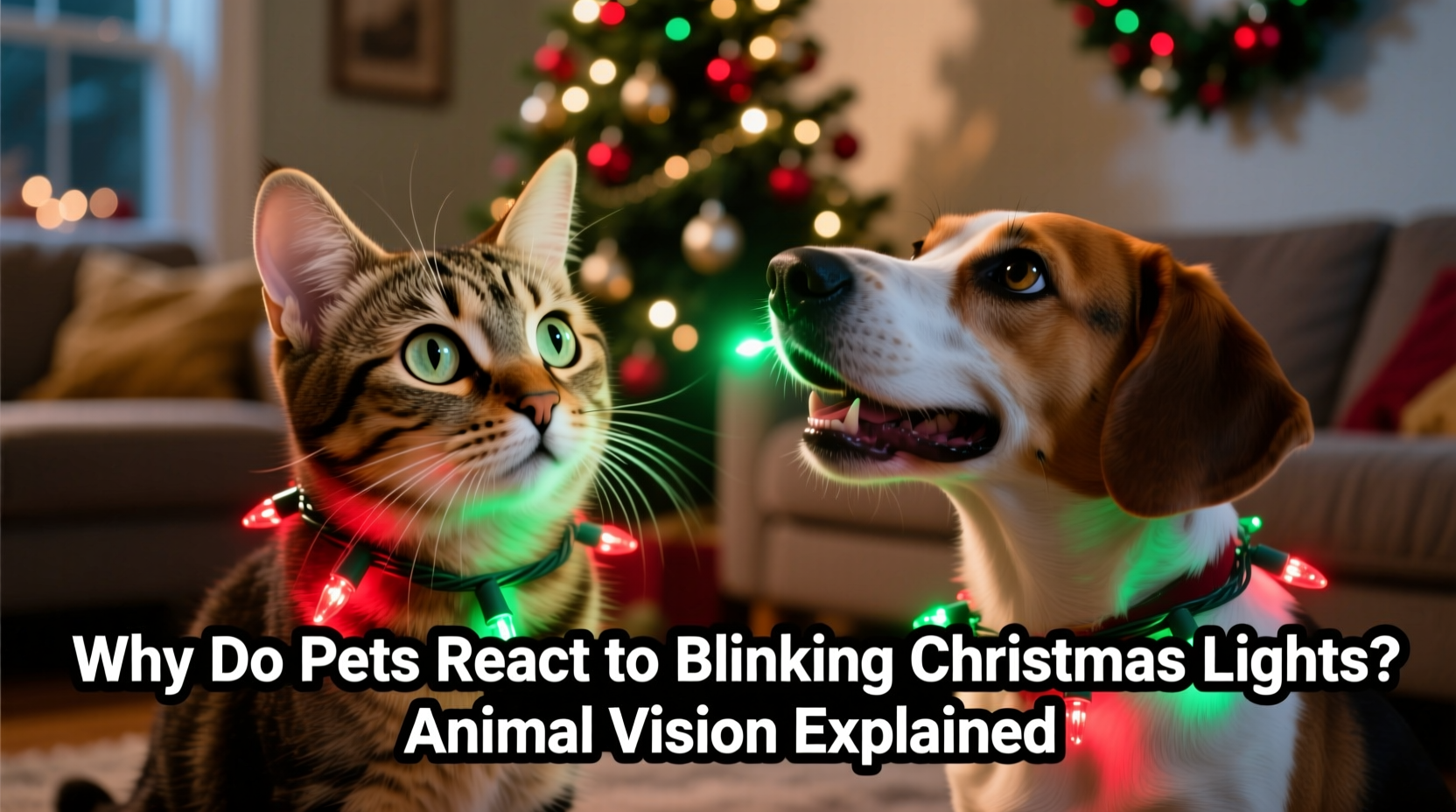
At the heart of pet reactions to blinking lights lies a physiological metric called the flicker fusion threshold (FFT)—the frequency at which a flashing light appears continuous rather than intermittent. Humans typically perceive light as steady at around 50–60 Hz (flashes per second). That’s why standard incandescent bulbs and most LED strings designed for human environments appear smoothly lit, even though they may flicker imperceptibly at the AC line frequency (50 Hz in Europe, 60 Hz in North America).
Dogs and cats operate on a different timescale. Dogs have an FFT of approximately 70–80 Hz; cats, even higher—around 90–100 Hz. This means what looks like a steady glow to us may register to them as distinct, rapid pulses—like a strobe effect. A typical inexpensive LED string may flicker at 100–120 Hz due to poor driver circuitry, sitting right at or above the threshold where many cats begin to perceive discontinuity. For them, the “blinking” isn’t just decorative—it’s physiologically salient, visually arresting, and potentially startling.
This difference arises from retinal structure. Both dogs and cats possess a higher density of rod photoreceptors than humans—cells specialized for low-light sensitivity and motion detection—but fewer cone cells, which mediate color vision and fine detail. Their retinas also contain a reflective layer behind the photoreceptors called the tapetum lucidum, which amplifies available light but can also enhance temporal contrast, making rapid changes in illumination more pronounced.
What Pets Actually See: Color, Contrast, and Motion Prioritization
Color perception adds another layer. Humans are trichromatic—we have three types of cone cells sensitive to red, green, and blue wavelengths. Dogs are dichromatic: they see primarily in shades of blue and yellow, with reds and greens appearing as muted yellows or grays. Cats also lack robust red-green discrimination, though their cones are tuned slightly differently, emphasizing blues and greens more strongly than dogs.
Crucially, both species see far better in low light and detect motion at greater distances than humans—but with lower spatial resolution. A blinking red light may appear dim and indistinct to a dog, while a pulsing blue or white LED may pop with high contrast against a dark background. That’s why many pets ignore warm-white string lights but fixate on cool-white or blue-tinted ones. It’s not preference—it’s visibility.
Motion perception is especially acute. A study published in Journal of Vision demonstrated that cats detect moving stimuli at distances up to 20% farther than humans under equivalent lighting. When lights blink asymmetrically—say, chasing patterns or random twinkle modes—their visual system interprets it as unpredictable movement: a potential prey cue, threat signal, or environmental anomaly demanding attention.
“Cats don’t ‘see’ blinking lights the way we do—they experience them as dynamic events in their visual field. That flicker isn’t decoration; it’s data. Their brain treats each pulse as a discrete sensory input, triggering orienting responses honed over millions of years.” — Dr. Krista Shirey, Comparative Neuroethologist, University of Guelph
Species-Specific Reactions: Dogs, Cats, and Small Mammals
Reactions vary predictably across species—not just due to vision, but temperament, domestication history, and neural wiring.
- Dogs: Often exhibit curiosity or mild startle. Herding breeds (Border Collies, Australian Shepherds) may track light patterns obsessively—a carryover from motion-tracking instincts. Noise-sensitive dogs may react more strongly if lights are paired with buzzing transformers or erratic power fluctuations.
- Cats: Display the widest range: intense staring, slow stalking, paw swiping, or sudden darting away. Their natural hunting sequence—orient → fixate → stalk → pounce—is easily triggered by rhythmic, high-contrast flicker. Indoor-only cats, lacking daily environmental novelty, may find blinking lights unusually stimulating.
- Small mammals (rabbits, guinea pigs, birds): Are especially vulnerable. Rabbits have nearly 360° vision but poor depth perception and high FFT (~85 Hz). Flickering lights can induce chronic stress, suppressing immune function. Parrots—tetrachromatic with UV sensitivity—may perceive LED spectra invisible to us, including ultraviolet leakage from cheap diodes, adding another layer of visual complexity.
Practical Safety & Welfare Checklist for Pet Owners
Decorating for the holidays shouldn’t compromise your pet’s well-being. Use this evidence-informed checklist before hanging lights:
- ✅ Choose high-frequency, low-flicker LEDs: Look for “flicker-free” or “120+ Hz” specifications on packaging. Avoid dollar-store strings with unregulated drivers.
- ✅ Minimize motion-based effects: Skip chasing, twinkling, or strobing modes—opt for steady-on or gentle fade patterns instead.
- ✅ Position strategically: Keep lights above pet eye level and out of direct line of sight from favorite napping spots. Avoid placing near litter boxes, feeding stations, or sleeping areas.
- ✅ Observe baseline behavior: Record your pet’s normal resting posture, blink rate, and alertness for 2–3 days pre-decorating to spot subtle stress cues (e.g., flattened ears, lip licking, excessive grooming).
- ✅ Provide visual refuge: Ensure access to at least one dim, light-free room or covered crate where pets can retreat without exposure.
Real-World Case Study: Managing Light Sensitivity in a Senior Cat
When 14-year-old Luna, a formerly outdoor barn cat, began pacing at night and vocalizing near the living room tree, her owner assumed cognitive decline. But after consulting a veterinary behaviorist, the pattern revealed itself: Luna only reacted during evening hours, specifically when the multi-color LED garland cycled through its “rainbow burst” mode. The vet observed Luna’s pupils remained fully dilated even in moderate room light—a sign of persistent visual stimulation—and noted she’d blink less frequently than usual when facing the tree.
The solution was methodical: First, the garland was replaced with a warm-white, non-blinking LED string. Second, a lightweight cotton drape was hung behind the tree to diffuse ambient light. Third, Luna’s evening routine shifted—play sessions moved earlier, and her sleeping area was relocated to a quiet bedroom with blackout curtains. Within 72 hours, nocturnal vocalization ceased. Luna still watched the tree—but calmly, with normal blink rates and relaxed posture. This wasn’t about “getting used to” the lights; it was about aligning the environment with her neurobiological reality.
Do’s and Don’ts: Holiday Lighting for Pet-Friendly Homes
| Action | Do | Don’t |
|---|---|---|
| Light Selection | Choose LEDs certified to IEEE 1789-2015 standards for low-risk flicker | Use unbranded, ultra-cheap strings with no flicker rating |
| Placement | Mount lights high on trees or walls, away from pet pathways | String lights along baseboards, low furniture edges, or floor-level garlands |
| Timing | Turn lights off when pets are unsupervised or during rest periods (e.g., 9 PM–6 AM) | Leave lights on 24/7, especially in rooms pets use overnight |
| Monitoring | Check for signs of stress hourly during first 48 hours of display: panting, hiding, refusal to eat | Assume “no reaction = no issue”—subtle cues often precede overt distress |
| Alternatives | Use battery-operated flameless candles or fiber-optic trees with smooth, non-pulsing light | Substitute with mirrors or shiny ornaments alone—they reflect flicker and amplify visual chaos |
Frequently Asked Questions
Can blinking lights cause seizures in pets?
Photosensitive epilepsy is extremely rare in dogs and cats—far rarer than in humans. However, persistent, high-contrast flicker (especially at 15–20 Hz) can trigger abnormal neural activity in predisposed individuals. If your pet exhibits tremors, disorientation, or collapsing near lights, consult a veterinary neurologist immediately. Most commercial holiday lights operate outside this danger zone, but caution remains warranted for pets with known neurological conditions.
My bird seems fascinated by the lights—should I be concerned?
Yes. Birds perceive flicker more acutely than mammals due to higher FFT (can exceed 100 Hz) and tetrachromatic vision—including UV. Prolonged exposure to artificial flicker disrupts circadian rhythms and increases corticosterone (stress hormone) levels. Keep birds in a separate, light-controlled room during holiday displays, and avoid using UV-emitting “full-spectrum” lights near cages.
Will my pet get used to the lights over time?
Not necessarily—and adaptation isn’t always desirable. Habituation may occur, but underlying visual processing doesn’t change. What looks like “getting used to it” could mask chronic low-grade stress: elevated heart rate, suppressed immunity, or redirected behaviors like overgrooming. Prioritize prevention over acclimatization. If lights must stay, ensure ample downtime in calm, low-stimulus environments.
Conclusion: Seeing the World Through Their Eyes
Understanding why pets react to blinking Christmas lights isn’t about anthropomorphizing their experience—it’s about honoring the biology they were born with. Their vision evolved for survival in shifting light, detecting the flicker of a vole’s ear in tall grass or the shadow of a hawk overhead. Our festive lights, however joyful to us, introduce an unnatural, high-frequency visual stimulus that their nervous systems interpret with instinctive urgency. This isn’t misbehavior. It’s fidelity—to evolution, to physiology, to perception.
You don’t need to forgo holiday cheer to protect your pet’s peace. Choose thoughtfully, observe deeply, and adjust intentionally. Swap one flickering string for a warm, steady alternative. Rearrange a room to create sanctuary space. Notice the micro-expressions—the half-blink, the ear pivot, the pause before a leap—that reveal how profoundly light shapes their world. In doing so, you do more than safeguard their comfort. You practice interspecies empathy: seeing not just with your eyes, but with theirs.




 浙公网安备
33010002000092号
浙公网安备
33010002000092号 浙B2-20120091-4
Comments
No comments yet. Why don't you start the discussion?