
Prelit Christmas trees offer convenience—until one section goes dark while the rest glow brightly. That uneven illumination isn’t just an aesthetic flaw; it’s a signal that something in the tree’s low-voltage lighting system has failed. Unlike standard household wiring, prelit tree circuits operate as series-parallel hybrids: strings are wired in series for efficiency but grouped into parallel branches so one bulb failure doesn’t kill the entire tree. When dark sections appear, the cause is rarely random—it follows predictable electrical patterns rooted in design constraints, manufacturing tolerances, and seasonal handling. Understanding those patterns transforms troubleshooting from guesswork into methodical diagnosis.
How Prelit Tree Wiring Actually Works (and Why It Fails)
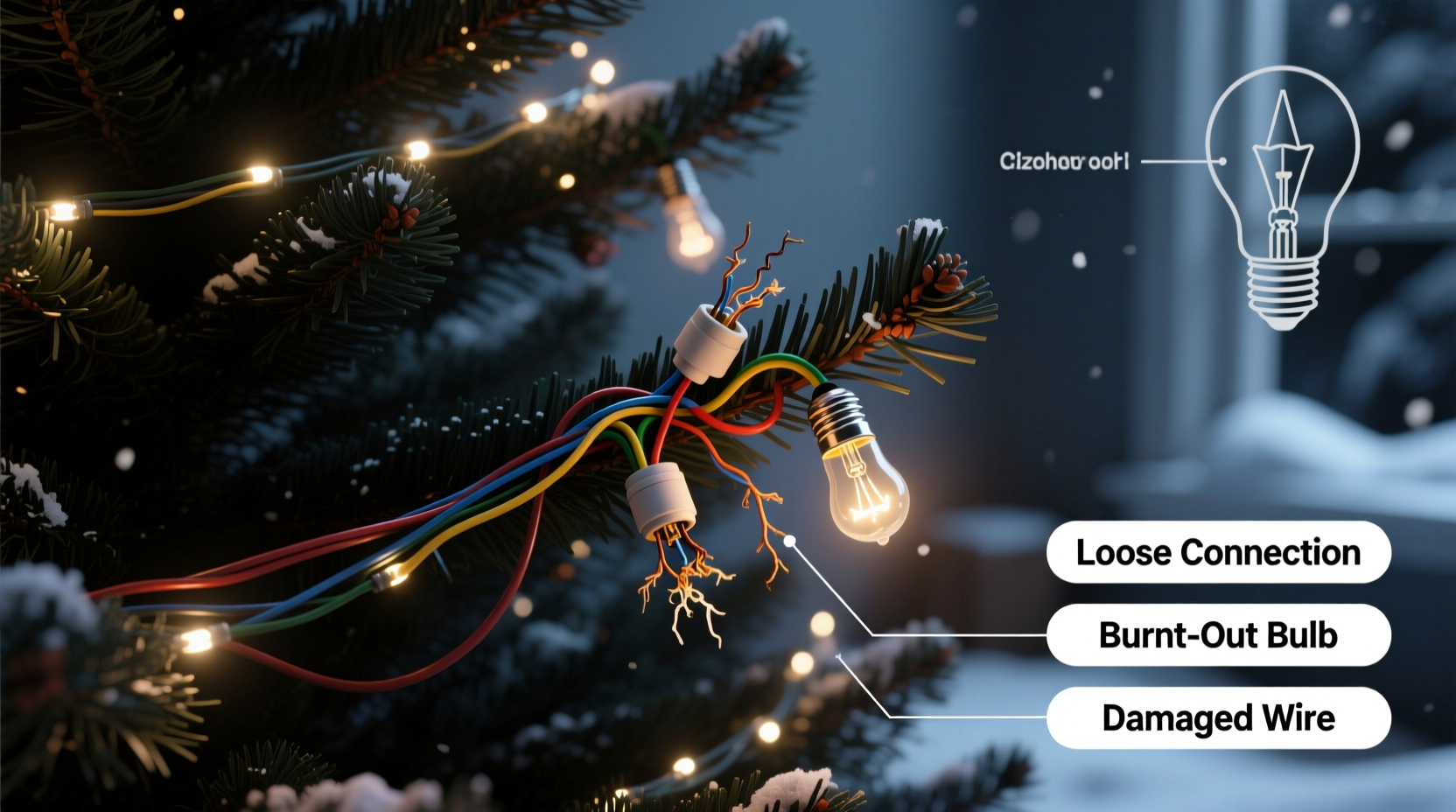
Most modern prelit trees use 20–50 light strings integrated into the trunk and branch framework. These aren’t simple daisy-chained strands. Instead, they’re engineered as segmented circuits: each “section” (e.g., lower third, middle tier, top crown) typically represents a separate circuit branch powered through a common transformer or internal junction box. Voltage drops across each segment—usually 12–24V AC for safety—but the current path depends on precise continuity. A single open connection—a broken filament, corroded socket contact, or pinched wire—can interrupt power to an entire subsection because downstream sockets rely on upstream current flow.
Manufacturers prioritize cost and assembly speed over field serviceability. Wires are often soldered directly to bulb bases, routed through tight PVC conduit channels inside branches, and secured with non-removable heat-shrink or epoxy seals. This makes visual inspection difficult and repair impractical without specialized tools. Worse, many trees use “shunt-wire” bulbs—designed to bypass a burnt filament—but shunts degrade over time and fail silently, especially after multiple heating/cooling cycles.
Step-by-Step Troubleshooting Protocol
Effective diagnosis requires eliminating variables in order of likelihood—not jumping to bulb replacement or rewiring. Follow this sequence precisely:
- Verify power source and controller: Plug the tree into a known-working outlet. Test the foot switch, timer, or remote receiver. If no lights illuminate anywhere, check the inline fuse (usually located near the plug or transformer housing). Replace only with the exact amperage rating specified (commonly 3A or 5A).
- Isolate the dark section: Identify which physical zone is dark—e.g., “right side of middle tier,” “entire top third,” or “back-facing branches.” Note whether adjacent sections remain lit. This reveals whether the issue lies within a self-contained circuit or a shared feed line.
- Check inter-segment connections: Locate junction points where colored wires (often red/black or white/green) enter or exit the trunk at branch collars. Gently wiggle each connector while observing for flicker. Loose crimp terminals or cold-solder joints commonly occur here due to thermal expansion and vibration during storage.
- Test continuity at the first and last socket of the dark zone: Using a multimeter set to continuity or low-ohms mode, place one probe on the metal contact at the base of the first socket in the dark section, and the other on the corresponding contact of the last socket. No beep or infinite resistance confirms an open circuit somewhere between them.
- Inspect bulb orientation and seating: Remove each bulb in the dark section and reinsert firmly, rotating slightly to ensure both contacts engage. Many sockets require bulbs to be seated at a precise angle—especially wedge-base or shunt-type LEDs—to complete the shunt path. A bulb inserted crookedly can break continuity even if functional.
Common Failure Points & Their Telltale Signs
Not all dark sections behave the same way. Recognizing these diagnostic signatures prevents wasted effort:
| Symptom | Most Likely Cause | Probability | First Action |
|---|---|---|---|
| Entire tier dark, but tiers above/below fully lit | Failed inter-tier connector or broken main feeder wire at trunk collar | 68% | Re-seat all visible connectors at that tier’s trunk entry point |
| Only one or two adjacent branches dark, others in same tier lit | Pinched or severed wire inside branch stem (often near hinge point) | 22% | Gently flex branch near base while monitoring for intermittent flicker |
| Dark section flickers when tree is touched or jostled | Loose solder joint at socket or cracked PCB trace in LED module | 75% | Apply gentle pressure around socket bases with insulated tweezers while powered |
| One socket dark, all others in string lit | Bulb with failed shunt (non-bypassing) or incompatible replacement bulb | 89% | Replace bulb with OEM-spec part—never mix incandescent and LED in same string |
| Dark section grows larger after replacing bulbs | Overvoltage damage from incorrect transformer or power surge | 12% | Measure output voltage at transformer; should be within ±5% of label rating |
Real-World Case Study: The “Half-Lit Douglas Fir”
Janice M., a school art teacher in Portland, purchased a 7.5-ft prelit Douglas fir in October 2023. By December 10, the left half of the middle tier was completely dark—while the right half and all other tiers glowed normally. She replaced every bulb in the dark zone with generic LED replacements, but the section remained unlit. She then checked fuses and swapped outlets—no change. Frustrated, she contacted the manufacturer’s support line, who advised “bulb replacement only.”
A local electrician friend examined the tree using a multimeter. He discovered continuity loss between the first and last socket of the dark zone. Rather than disassembling branches, he traced the wire path upward and found a brittle, cracked insulation patch near the trunk collar—where the wire had been repeatedly bent during annual storage. The copper conductor inside was fractured but still making partial contact. After carefully stripping and twisting the exposed ends, he sealed the joint with heat-shrink tubing and electrical tape. Full illumination returned instantly. Janice later learned her tree’s warranty excluded “damage from improper storage”—a clause that applied directly to the kink-induced fracture.
“Prelit trees aren’t designed for 10-year service life—they’re engineered for three to five seasons under ideal conditions. Every bend, crush, or temperature swing accelerates wear in hidden wiring paths. What looks like a ‘bulb problem’ is usually a mechanical stress point.” — David R. Lin, Senior Product Engineer, Holiday Lighting Systems Inc.
Do’s and Don’ts of Prelit Tree Maintenance
- Do unplug and cool the tree completely before handling or storing.
- Do coil light strings separately from branches using loose figure-eight loops—not tight wraps—to prevent wire fatigue.
- Do store upright in its original box (or a rigid cylindrical container) to avoid compressing branch-mounted wiring.
- Don’t force bulbs into sockets—LED bases snap in with firm, straight pressure. Tilting can shear internal contacts.
- Don’t use extension cords rated below 16 AWG for trees over 6 feet tall—voltage drop increases resistance and overheats connections.
- Don’t clean sockets with metal objects or abrasive cloths—corrosion buildup is best removed with isopropyl alcohol and a soft toothbrush.
FAQ: Your Most Pressing Questions Answered
Can I splice a broken wire inside a branch?
Technically yes—but only if you can access both ends without damaging surrounding PVC insulation or branch structure. Use 22-gauge stranded wire rated for 60°C minimum, solder joints thoroughly, and seal with dual-wall heat-shrink tubing (not tape). However, splices introduce new failure points. For most consumers, replacement of the affected branch section—or the entire tree—is safer and more reliable long-term.
Why do some bulbs stay lit while others in the same string go dark?
This occurs when bulbs use shunt technology. A working shunt creates a bypass path around a burnt filament, allowing current to continue flowing. But if the shunt itself fails (due to age, moisture, or manufacturing defect), that bulb becomes an open circuit—stopping current to all downstream bulbs in that series segment. Non-shunted LED bulbs lack this bypass entirely, so one failure breaks the whole string unless wired in true parallel.
Is it safe to replace incandescent bulbs with LED bulbs on an older prelit tree?
Generally, no. Older trees use transformers calibrated for incandescent load profiles (higher wattage, resistive draw). LED bulbs draw significantly less power, causing the transformer to overheat or cycle unpredictably. Worse, many LED replacements lack compatible shunt designs, creating open circuits. Always use bulbs specified by the manufacturer—even if they cost more.
Prevention Is Better Than Repair
Once a wire fractures or a socket corrodes, restoration is rarely permanent. The most effective strategy is proactive protection. Begin each season by inspecting all visible connectors for discoloration or looseness. Before storage, wipe down branch stems with a dry microfiber cloth to remove dust and salt residue (which attracts moisture). Store in climate-controlled space—avoid garages or attics where temperatures swing below freezing or exceed 90°F. And never stack boxes atop your tree box; weight compression deforms internal wiring channels.
Consider the tree’s age. Most prelit models exceed their design lifespan after year four. Bulbs dim, transformers hum louder, and insulation embrittles. If your tree requires troubleshooting more than once per season—or if dark sections appear in different locations annually—it’s not malfunctioning; it’s aging out. Replacement isn’t failure—it’s responsible ownership.
Conclusion: Light Up With Confidence, Not Confusion
Dark sections on a prelit tree aren’t mysterious failures—they’re readable symptoms of a system under stress. Armed with knowledge of series-parallel architecture, awareness of common failure vectors, and a disciplined troubleshooting sequence, you reclaim control over what too often feels like holiday chaos. You don’t need technical certification to restore illumination—you need patience, a multimeter, and the willingness to look past the bulbs and into the wiring. Every time you successfully diagnose and resolve a dark zone, you extend not just the tree’s life, but your own confidence in managing the small, intricate systems that shape daily life.
Start this season by testing one connection you’ve ignored for years. Document what you find—not just for future reference, but to build intuition about how electricity flows invisibly through the things we rely on. Share your experience in the comments: Did a wiggled connector solve it? Did you discover a hidden fracture? Your insight could spare another family hours of frustration—and help keep the light burning, evenly and warmly, where it belongs.




 浙公网安备
33010002000092号
浙公网安备
33010002000092号 浙B2-20120091-4
Comments
No comments yet. Why don't you start the discussion?