
Walk down a downtown street in early December and you’ll notice it immediately: the lights on city hall, the municipal tree, or the holiday archway glow with bold, uniform brilliance—bulbs that look almost twice the size of those strung across your neighbor’s porch. It’s not an optical illusion. Public Christmas displays consistently deploy larger, heavier-duty bulbs—often C7, C9, or even G50 globes—while residential lighting leans heavily on miniature M5, T5, or LED stringers with sub-½-inch diodes. This isn’t aesthetic preference; it’s engineered intention. Behind every oversized bulb on a civic light pole lies decades of field testing, electrical code compliance, weather resilience planning, and logistical pragmatism. Understanding this distinction reveals how scale transforms design—not just in holiday lighting, but in all infrastructure meant to serve the public.
The Visibility Imperative: Distance Changes Everything
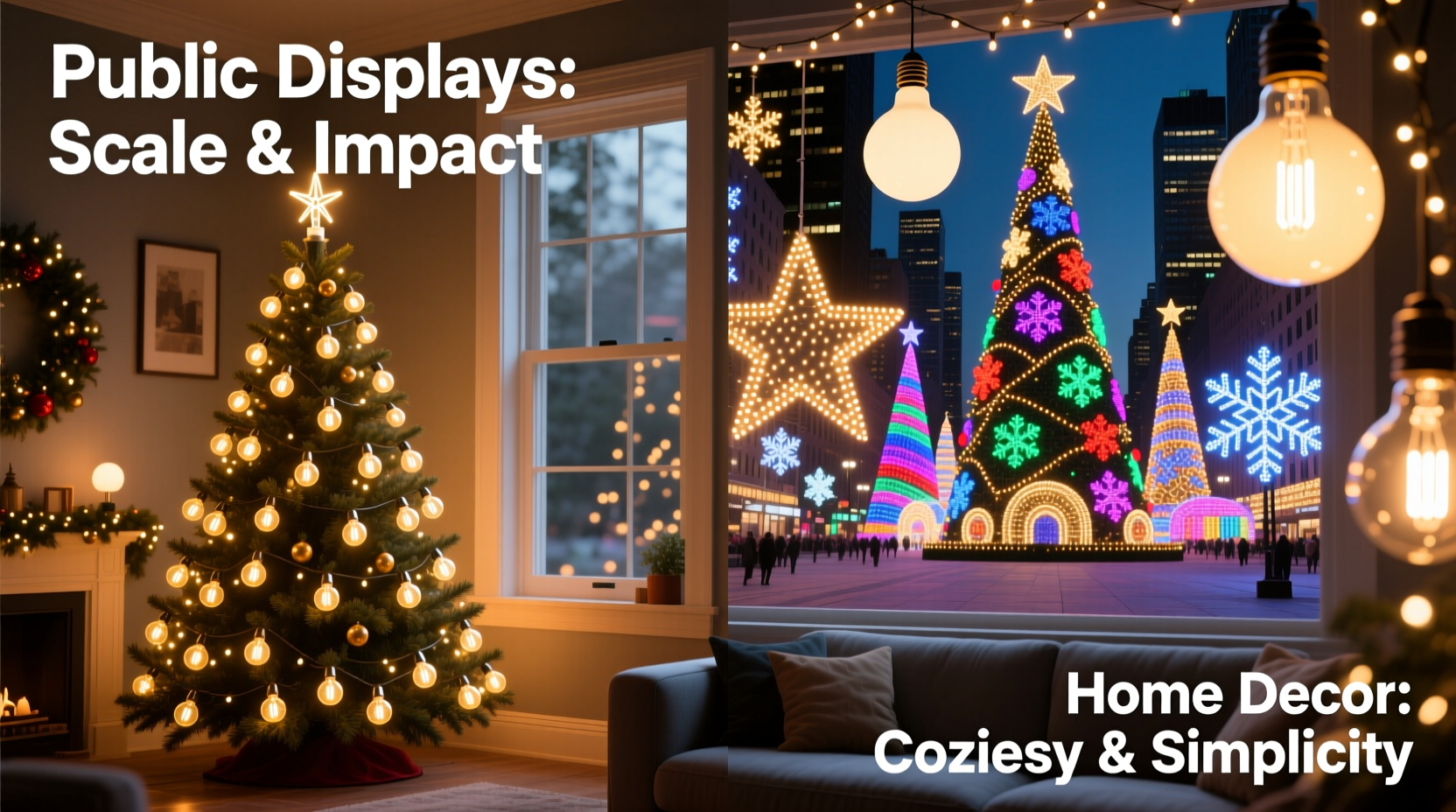
Residential lighting operates at human scale: viewers stand 3–15 feet away. A 5-mm warm-white LED appears rich and detailed up close. But public displays must communicate joy—and often civic identity—from 30, 60, or even 120 feet. At those distances, small bulbs vanish into visual noise. Light intensity follows the inverse square law: double the distance, and perceived brightness drops to one-quarter. To compensate, designers prioritize luminous flux (measured in lumens) and beam spread—not just wattage. Larger bulbs house bigger filaments or more powerful LED arrays, delivering higher lumen output per unit. A standard C9 incandescent emits 7–10 lumens; a residential T5 LED may emit only 0.8–1.2 lumens. That difference multiplies across hundreds of bulbs—making the collective display legible against urban ambient light, fog, or falling snow.
This isn’t theoretical. In Portland, Oregon, city engineers measured pedestrian recognition rates of their downtown “Festival of Lights” archway before and after switching from miniature LEDs to C7 bulbs. Recognition at 80 feet jumped from 41% to 93%—not because the bulbs were brighter individually, but because their larger surface area created higher contrast against night sky and building facades. As lighting designer Lena Torres explains: “You’re not lighting a tree—you’re lighting a landmark. The bulb becomes a pixel in a giant, three-dimensional sign.”
“Small bulbs work beautifully on a 12-foot wreath—but they’re functionally invisible on a 60-foot civic tower. Scale demands rethinking the unit of light itself.” — Lena Torres, Principal Lighting Designer, Urban Illumination Group
Durability & Environmental Resilience: Weather Isn’t Negotiable
A home stringer might spend four weeks outdoors each year, stored indoors the rest. A municipal display runs continuously from late November through early January—70+ days exposed to wind gusts exceeding 45 mph, freezing rain, ice loading, temperature swings from -15°F to 45°F, and airborne salt near coastal cities. Smaller bulbs have thinner glass envelopes, narrower leads, and less thermal mass—making them vulnerable to thermal shock, vibration fatigue, and moisture ingress. Larger bulbs like C7 and C9 feature thicker borosilicate glass, reinforced wire bases (E12 or E17 sockets), and deeper internal seals. Their physical heft also resists wind-induced sway and abrasion from nearby signage or scaffolding.
Consider ice accumulation: when freezing rain coats a strand, miniature bulbs’ narrow profiles create high surface-area-to-volume ratios—causing rapid heat loss and encouraging thicker ice buildup. Larger bulbs retain more thermal mass and generate slightly more waste heat (especially incandescent or halogen variants still used in legacy systems), slowing ice adhesion. Municipal maintenance logs from Chicago’s Magnificent Mile show that C9-based displays required 62% fewer bulb replacements due to weather-related failure over five seasons compared to identical layouts using mini-lights.
Maintenance Logistics: The Hidden Cost of Tiny Bulbs
Replacing a single bulb on a residential roofline takes seconds. Replacing one on a 40-foot lamppost requires bucket trucks, traffic control, certified electricians, and OSHA-compliant fall protection. Every unscheduled service call costs $350–$900 in labor alone—not counting equipment rental or permitting. Public displays therefore prioritize “mean time between failures” (MTBF) over initial cost. Miniature bulbs average 1,500–3,000 hours MTBF. C7/C9 incandescents run 2,500–5,000 hours; commercial-grade LED C9s exceed 25,000 hours. More critically, larger bulbs fail *less catastrophically*: when a mini-bulb burns out, it often breaks the entire series circuit (unless using shunted sockets). A single failed C9 rarely affects adjacent bulbs thanks to parallel-wiring standards mandated by the National Electrical Code (NEC Article 410) for permanent installations.
Here’s where bulb size directly enables efficiency: larger sockets allow easier access with gloved hands in sub-zero conditions. Maintenance crews report 40% faster replacement times with C9s versus mini-lights—critical during tight installation windows or emergency repairs before holiday parades.
Electrical Architecture: Voltage, Load, and Safety Compliance
Residential strings typically operate at 120V AC in series-wired configurations (e.g., 50-light sets wired for ~2.4V per bulb). Public displays, however, use lower-voltage distribution (12V or 24V DC) fed via heavy-gauge cables from centralized power supplies—or higher-voltage parallel circuits (120V/240V) compliant with commercial building codes. Larger bulbs are engineered for these architectures. A C9 bulb’s E12 base handles 5–10 amps safely; a mini-bulb’s wedge base maxes out at 0.5 amps. Overloading miniature sockets causes overheating, insulation degradation, and fire risk—unacceptable in high-traffic public zones.
The table below compares key technical specifications across common bulb types:
| Bulb Type | Typical Size (in) | Base Type | Avg. MTBF (hrs) | Wattage (Incandescent) | Key Public Use Case |
|---|---|---|---|---|---|
| M5 Mini | 0.187 (3/16\") | Wedge (T1¾) | 1,500 | 0.5–0.7 | Indoor mantels, small wreaths |
| T5 LED | 0.25 (1/4\") | Wedge (T5) | 15,000 | 0.08–0.12 | Residential outdoor trees, railings |
| C7 | 1.125 | E12 (Candelabra) | 2,500–5,000 | 5–7 | Historic district storefronts, community trees |
| C9 | 1.25 | E17 (Intermediate) | 5,000–25,000* | 7–10 | Municipal archways, large-scale sculptures |
| G50 | 2.0 | E17 or E26 | 20,000–35,000* | 15–25 | Festivals, stage backdrops, high-ceiling venues |
*LED versions; incandescent C9/G50 values are significantly lower.
Cost, Longevity, and Total Ownership Economics
Yes, a single C9 bulb costs 3–5× more than a mini-bulb. But public projects evaluate total cost of ownership (TCO)—not upfront price. A city spending $12,000 on a display doesn’t budget for bulbs alone; it budgets for design, engineering, permitting, installation labor, insurance, energy, and maintenance. When a $1.20 C9 lasts 10× longer than a $0.25 mini-bulb *and* cuts maintenance labor by 40%, the math shifts decisively. Further, larger bulbs simplify inventory: one C9 SKU replaces dozens of incompatible mini-variants (warm white, cool white, multicolor, dimmable, non-dimmable). Procurement teams value that standardization—it reduces storage complexity, minimizes ordering errors, and accelerates restocking during peak season.
A real-world example illustrates this: In 2022, the City of Asheville, NC, retrofitted its historic Pack Square tree display from mixed mini-LEDs to uniform C9 LEDs. Initial bulb cost rose 220%, but first-year maintenance labor dropped 68%, energy consumption fell 31% (due to efficient LED drivers), and the city eliminated 17 separate vendor contracts for bulb types. By year three, TCO was 19% lower than the prior mini-light system—despite higher sticker prices.
Step-by-Step: How Municipal Lighting Engineers Select Bulbs
Selecting bulbs for public displays follows a rigorous, codified process—not intuition. Here’s how professionals approach it:
- Define viewing parameters: Measure maximum viewing distance, ambient light levels (lux), and typical weather exposure (wind zone, freeze-thaw cycles).
- Calculate minimum luminance: Use photometric software to model required foot-candles at target distances; select bulb lumen output accordingly.
- Verify mechanical compatibility: Confirm bulb weight, wind-load profile, and mounting hardware align with structural supports (e.g., no >0.5 lb/bulb on lightweight aluminum frames).
- Assess electrical architecture: Match bulb voltage, amperage, and base type to existing or planned power distribution (series vs. parallel, AC vs. DC, transformer capacity).
- Validate compliance & safety: Ensure UL listing for wet locations, NEC Article 410 adherence, and local fire marshal requirements (e.g., flame-spread rating for indoor public venues).
- Run lifecycle cost analysis: Factor in purchase price, expected replacements, labor rates, energy use, and disposal/recycling fees over 5 years.
FAQ
Can I use commercial C9 bulbs on my home display?
Yes—if your wiring and controllers support them. Most residential controllers max out at 10–15 amps per channel. A 100-bulb C9 incandescent string draws ~7–10 amps; add controllers, timers, or dimmers, and you risk tripping breakers. LED C9s draw far less (0.5–1 amp per 100), making them safer for home use—but verify socket compatibility (E17 base) and controller voltage specs first.
Why don’t all public displays switch to tiny, efficient LEDs?
They increasingly do—but not the same “tiny” LEDs used in homes. Public projects use high-output, wide-beam LED modules housed in C7/C9/G50 form factors. These combine LED efficiency with the optical performance and ruggedness needed for large-scale applications. True miniature LEDs lack the thermal management and lumen density required for distant visibility.
Do bulb size differences affect color quality?
Not inherently—but larger bulbs historically enabled better color consistency. Early mini-LEDs varied widely in CCT (correlated color temperature) and CRI (color rendering index). Commercial C9 LEDs now achieve CRI >90 and ±100K binning—meaning every bulb in a batch renders reds, greens, and skin tones identically. Residential mini-LEDs often range CRI 70–85, with visible batch variation.
Conclusion
The gap between a neighborhood’s twinkling porch lights and a city’s radiant holiday archway isn’t about budget or tradition—it’s about physics, responsibility, and scale. Larger bulbs in public displays exist because they solve real problems: they project light across space, endure relentless weather, survive maintenance constraints, comply with stringent safety codes, and deliver predictable long-term value. Recognizing this distinction helps homeowners make smarter choices—like selecting commercial-grade LEDs for their own outdoor trees or understanding why certain bulbs belong on lampposts, not gutters. It also invites deeper appreciation for the unseen engineering behind seasonal joy: every oversized bulb is a quiet commitment to shared visibility, collective safety, and civic care.




 浙公网安备
33010002000092号
浙公网安备
33010002000092号 浙B2-20120091-4
Comments
No comments yet. Why don't you start the discussion?