
Drive through any city in December, and you’ll likely see towering trees wrapped in thousands of twinkling lights, entire buildings draped in glowing wreaths, and parks transformed into winter wonderlands—all powered by miles of miniature bulbs. Public Christmas displays have become more elaborate every year, but one thing remains consistent: the overwhelming use of mini lights over larger alternatives. Why do cities, municipalities, and event organizers overwhelmingly choose these tiny bulbs for large installations? The answer lies not just in aesthetics, but in a detailed cost-benefit analysis involving energy consumption, durability, installation logistics, and long-term maintenance.
This article breaks down the economic and practical reasons behind the dominance of mini lights in public holiday displays, comparing them with traditional C7 or C9 bulbs, analyzing real-world usage, and offering insights from lighting professionals who design and maintain these spectacles each season.
The Rise of Mini Lights in Public Displays
In the past, public holiday decorations relied heavily on large incandescent bulbs—C7s (7-inch) and C9s (9-inch)—mounted on poles, trees, and rooftops. While bold and visible from a distance, these bulbs had significant drawbacks: high power draw, short lifespans, and fragile filaments. Over the last two decades, LED mini lights have replaced them across nearly all municipal and commercial installations. The shift wasn’t driven by trend alone—it was a calculated move based on operational sustainability.
Mini lights, typically 5mm in size, are now available in both incandescent and LED versions, though LED dominates professional applications. Their small size allows for higher density coverage, creating a \"glow\" effect that larger bulbs can’t replicate. But beyond visual appeal, their scalability and cost-efficiency make them ideal for large projects where thousands of lights are required.
Cost Breakdown: Mini Lights vs. Traditional Bulbs
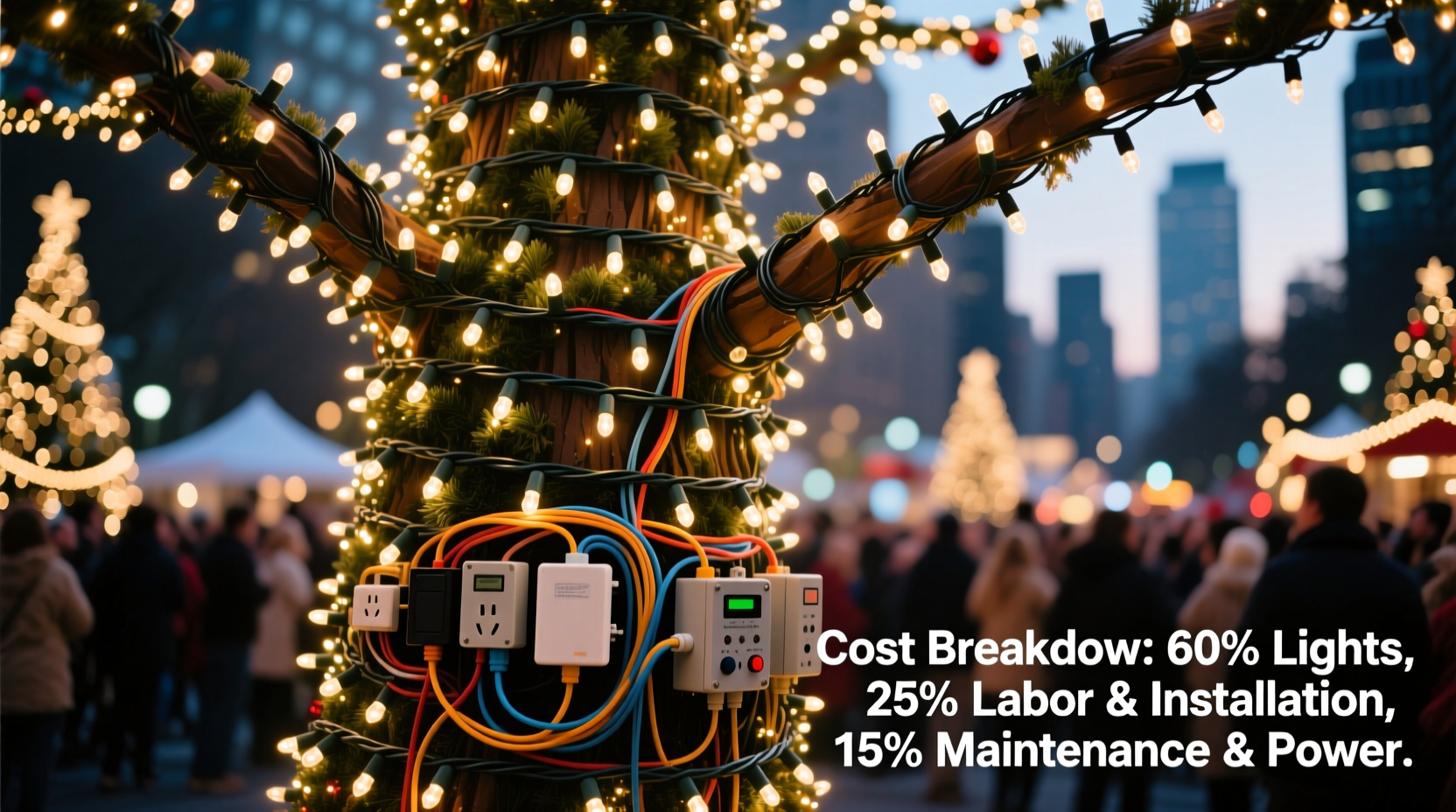
To understand why mini lights dominate public displays, it’s essential to compare total costs—not just purchase price, but also energy, labor, replacement, and disposal. Below is a realistic cost comparison for a mid-sized municipal tree display using 10,000 lights over a 6-week holiday season.
| Cost Factor | LED Mini Lights (10,000) | C9 Incandescent (10,000) |
|---|---|---|
| Purchase Cost | $1,200 ($0.12 per bulb) | $3,000 ($0.30 per bulb) |
| Energy Use (6 weeks @ 8 hrs/day) | 120 kWh ($18 at $0.15/kWh) | 3,000 kWh ($450 at $0.15/kWh) |
| Lifespan (average hours) | 50,000 hours | 3,000 hours |
| Replacement Rate (annual) | 2% (200 bulbs) | 25% (2,500 bulbs) |
| Replacement Cost (Year 2) | $24 | $750 |
| Installation Labor (hours) | 20 hrs (flexible wire, lightweight) | 35 hrs (rigid cords, heavier support) |
| Total First-Year Cost | $1,218 | $3,450 |
| Total Five-Year Cost | $1,338 | $7,200+ |
The data reveals a stark contrast. While C9 bulbs may appear brighter individually, their energy inefficiency and fragility drive long-term costs far beyond initial savings. In contrast, LED mini lights offer a lower upfront investment, minimal operating costs, and dramatically reduced maintenance. For public budgets—where transparency and fiscal responsibility matter—this makes LED mini lights the only viable option.
Why Density Matters: The Visual Advantage
Beyond economics, there’s an artistic reason for the preference: light density. A single C9 bulb spaced every foot creates a dotted outline. In contrast, mini lights can be spaced every 4 inches, producing a continuous glow that enhances depth, texture, and motion. This is especially important for wrapping trees, archways, and complex architectural features.
Consider a 50-foot evergreen used in a downtown plaza. Wrapping it with C9s at 1-foot intervals requires about 1,500 bulbs. To achieve full coverage with mini lights, you might use 5,000–7,000 bulbs—but due to their low wattage, the total power draw remains under 100 watts. The result? A tree that appears to shimmer from within, rather than just outlined in lights.
“With mini LEDs, we’re not just lighting structures—we’re creating atmospheres. The density allows us to sculpt light like paint.” — Marcus Lin, Public Lighting Designer, Cityscapes Illuminated
Denser lighting also improves visibility in urban environments where ambient light pollution can wash out sparser displays. Municipalities aim for displays that feel immersive, not merely decorative. Mini lights deliver that experience at scale.
Operational and Safety Benefits
Safety and ease of operation are critical when installing lights in public spaces. Mini LED strings offer several advantages over traditional bulbs:
- Lower heat output: LED bulbs remain cool to the touch, reducing fire risk near dry foliage, wooden structures, or temporary installations.
- Lightweight cords: Easier to handle during installation, requiring fewer support brackets and less structural reinforcement.
- Weather resistance: Most commercial-grade mini LEDs are sealed against moisture, making them suitable for snow, rain, and freeze-thaw cycles.
- Voltage flexibility: Many systems operate on low-voltage DC power, improving safety for ground-level displays and pedestrian zones.
Additionally, modern mini light strings come in pre-connected reels up to 100 feet long, reducing splice points and potential failure zones. Some systems even integrate smart controllers for remote dimming, color shifting, and scheduling—features impractical with older bulb types.
Real-World Example: The Grandville Winter Festival
The Grandville Winter Festival in Michigan attracts over 100,000 visitors annually. In 2018, the city upgraded its entire display system from C9 incandescents to commercial LED mini lights. The project included lighting 12 city blocks, a 60-foot tree, and multiple park installations—totaling approximately 250,000 bulbs.
Prior to the switch, the festival consumed over 15,000 kWh annually and required a crew of 12 workers to install and repair lights over two weeks. After switching to mini LEDs:
- Energy use dropped to 600 kWh—a 96% reduction.
- Installation time fell to 8 days with a team of 8.
- Burnout replacements decreased from ~30% of bulbs to under 3%.
- Total annual operating cost dropped from $4,200 to $920.
“We were replacing bulbs daily during peak season,” said Sarah Nguyen, the city’s events coordinator. “Now, we plug them in, turn them on, and they last the whole run. The savings let us invest in interactive elements like music sync and projection mapping.”
The success of the upgrade prompted neighboring towns to follow suit, proving that mini lights aren’t just cheaper—they enable more ambitious public programming.
Step-by-Step: How Cities Plan a Mini Light Display
Planning a large-scale public display involves careful coordination. Here’s how municipalities typically approach it:
- Assessment: Survey the site—trees, buildings, walkways—and identify key focal points.
- Design: Create a lighting plan using CAD software, specifying bulb count, spacing, color scheme, and power distribution.
- Budgeting: Calculate material, labor, and energy costs using historical data and vendor quotes.
- Procurement: Order commercial-grade LED mini lights with UL certification and weatherproof ratings.
- Installation: Deploy crews in early November; use lifts, harnesses, and cable management systems for safety.
- Testing: Run full diagnostics before public launch, checking for dead sections or voltage drops.
- Maintenance: Schedule weekly inspections; keep spare strings and connectors on-site.
- Decommissioning: Remove lights carefully, clean, label, and store in climate-controlled containers for reuse.
Reusability is a cornerstone of cost control. High-quality mini light strings can last 10–15 seasons if properly maintained, amortizing the initial investment to pennies per year.
Frequently Asked Questions
Are mini lights really brighter than C9s?
Individually, no—C9 bulbs are brighter. But because mini lights can be packed more densely, the overall luminosity and visual impact are often greater. Additionally, LED technology allows for high-lumen output in small packages, closing the brightness gap.
Can mini lights be used outdoors in cold climates?
Yes. Commercial-grade LED mini lights are designed for temperatures as low as -20°F (-29°C). Unlike incandescent bulbs, which can crack under thermal stress, LEDs perform efficiently in cold weather and actually last longer in low-heat environments.
Do mini lights require special wiring?
Most standard mini light strings operate on 120V AC and can be plugged into regular outlets. However, large installations often use centralized power supplies with daisy-chained runs and GFCI protection. Low-voltage systems (12V or 24V) require transformers but offer enhanced safety and compatibility with solar or battery backups.
Checklist: Key Considerations for Public Display Planners
- ✅ Choose LED mini lights with a minimum 50,000-hour lifespan
- ✅ Verify UL listing and IP65 or higher waterproof rating
- ✅ Plan for 4–6 inch spacing to maximize glow effect
- ✅ Use color-consistent batches to avoid hue variations
- ✅ Include surge protectors and timers in electrical setup
- ✅ Train staff on safe installation and fall protection
- ✅ Label and organize storage bins by location and color
- ✅ Budget for 2–5% annual replacement due to handling damage
Conclusion: Smart Investment, Lasting Impact
The widespread use of mini lights in public Christmas displays isn’t a matter of fashion—it’s a strategic decision grounded in performance, safety, and fiscal responsibility. From massive energy savings to reduced labor demands and superior visual quality, LED mini lights offer a compelling return on investment for cities and organizations aiming to deliver memorable holiday experiences.
As technology advances, we’ll likely see even greater integration of smart controls, solar-powered systems, and dynamic color programming—all built on the foundation of these tiny, efficient bulbs. The next time you marvel at a glowing town square or a forest of lit trees, remember: it’s not magic, but meticulous planning and smart economics that make the season shine.




 浙公网安备
33010002000092号
浙公网安备
33010002000092号 浙B2-20120091-4
Comments
No comments yet. Why don't you start the discussion?