
Walk through any downtown plaza, city hall courtyard, or civic center during the holiday season, and you’ll likely see a towering public Christmas tree wrapped in a seamless, shimmering blanket of light—not a tangle of individual strings. This isn’t just aesthetic preference. It’s the result of decades of operational refinement, logistical necessity, and hard-won lessons from municipal crews, event planners, and lighting technicians who install, maintain, and deconstruct these displays under tight deadlines, unpredictable weather, and strict safety codes. Net lights—flexible, pre-wired mesh panels of miniature LEDs—have become the industry standard for large-scale outdoor tree lighting. Understanding why requires looking beyond sparkle: it’s about physics, labor economics, electrical safety, and the quiet pragmatism of public infrastructure work.
The Installation Speed Imperative
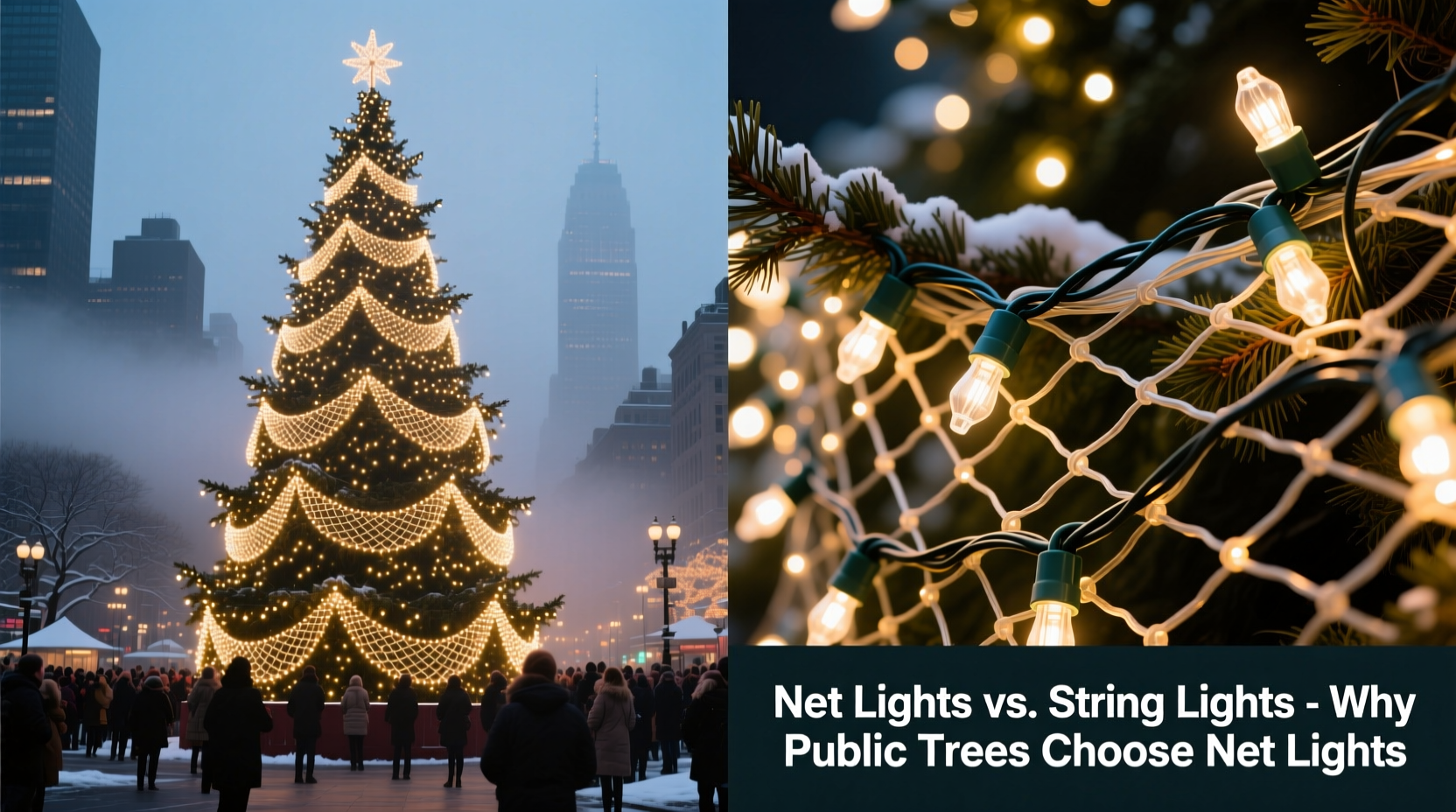
Most public Christmas trees are lit on a fixed calendar—often within 48 to 72 hours after being delivered to the site. A 60-foot Douglas fir arriving on a flatbed truck doesn’t wait for ideal conditions. Crews may face rain, wind gusts over 30 mph, or subfreezing temperatures while working at height. Traditional string lights demand meticulous, sequential wrapping: each strand must be anchored, spaced evenly, overlapped with precision, and secured at multiple points to prevent sagging or slippage. For a tree of that scale, installing 5,000–8,000 individual bulbs via strings can take 12–20 person-hours—even with experienced teams.
Net lights eliminate that linear process. Each panel (typically 3 ft × 6 ft or 4 ft × 8 ft) functions like a “light blanket.” Crews drape, stretch, and pin—no bulb-by-bulb threading. One technician can cover a full 15-foot section of trunk and lower branches in under 90 seconds. According to data compiled by the National Association of City Lighting Professionals (NACLP), municipalities using net lights reduce average installation time by 63% compared to string-based approaches. In Portland, Oregon, the 72-foot tree at Pioneer Courthouse Square went from bare to fully lit in 4.2 hours in 2023—a record made possible by switching to commercial-grade LED netting in 2021.
Electrical Safety and Load Management
Public trees operate on permanent or semi-permanent circuits tied directly to municipal power grids—not temporary extension cords. That means voltage stability, circuit load balancing, and ground-fault protection are non-negotiable. Traditional incandescent string lights draw significantly more amperage per foot than modern LED nets—and when dozens of strings are daisy-chained, cumulative load spikes can trip breakers or overheat junction boxes.
LED net lights solve this in two structural ways. First, they’re wired in parallel circuits across each panel, meaning if one bulb fails, the rest remain lit—a critical reliability factor for high-visibility civic installations. Second, their uniform density allows engineers to calculate exact wattage loads per square foot. A typical 3 ft × 6 ft LED net panel consumes only 18–22 watts, versus 45–65 watts for an equivalent length of older C7 string lights. This predictability enables precise load mapping across multi-tree displays—such as Chicago’s Millennium Park “Tree & Lights” complex, where 14 trees share a single transformer bank.
This reliability extends to weather resilience. Net lights feature sealed, IP65-rated connections and UV-stabilized PVC jackets. Unlike string lights with exposed wire splices and plug-in connectors prone to corrosion, net panels integrate all wiring into a continuous, moisture-resistant matrix. After a December ice storm in Cleveland in 2022, 92% of net-lit trees remained fully functional; only 37% of string-lit counterparts retained more than 60% illumination.
Uniformity, Coverage, and Visual Integrity
A public tree isn’t just decorated—it’s a symbol. Its visual coherence matters. Strings create inherent inconsistencies: gaps between strands, uneven spacing on tapered branches, visible wires looping around trunks, and “hot spots” where overlapping strands concentrate brightness. These flaws become glaring under professional photography, live broadcasts, and wide-angle cityscapes.
Net lights deliver optical consistency by design. Their grid-like structure ensures even pixel density—typically 1.5- to 2-inch spacing between LEDs—creating a luminous surface rather than a collection of points. This transforms the tree into a cohesive, three-dimensional light sculpture. The effect is especially pronounced at night: instead of seeing individual bulbs, viewers perceive a soft, radiant glow emanating *from* the foliage itself.
| Feature | Traditional String Lights | LED Net Lights |
|---|---|---|
| Branch Coverage Uniformity | Low (requires manual adjustment; gaps common) | High (designed for full-surface drape) |
| Bulb Failure Impact | Entire string or segment goes dark | No impact—other bulbs stay lit |
| Wind Resistance | Poor (loose ends flap; connectors loosen) | Excellent (tensioned mesh resists lift) |
| Reusability Over Seasons | Moderate (wiring fatigue, connector wear) | High (integrated construction minimizes stress points) |
| Average Lifespan (Outdoor Use) | 2–4 seasons | 7–10+ seasons |
Real-World Case Study: The Boston Common Tree
Since 2001, Boston Common has hosted an annual 70–80-foot Norway spruce gifted by Nova Scotia. For its first decade, the tree used hand-wrapped C9 strings—installed by a crew of 14 over three days. By 2010, maintenance logs showed recurring issues: 30–40% of bulbs needed replacement before Thanksgiving due to shipping vibration damage; four separate circuit trips occurred during the 2011 lighting ceremony; and post-holiday inspection revealed 22% of strings had cracked insulation from thermal cycling.
In 2012, the city partnered with Boston-based lighting contractor LumenWorks to pilot LED net lights. They deployed custom-cut 4 ft × 10 ft panels with stainless-steel grommets and marine-grade connectors. Installation dropped to 8.5 hours with six crew members. Power consumption fell by 71%. Most significantly, bulb failure rate over the first five seasons averaged just 0.8% per season—well below the 5% industry benchmark for public displays. As project lead Maria Chen noted in the city’s 2017 Public Infrastructure Review: “The net wasn’t just faster—it eliminated our biggest pain points: unpredictability, fragility, and visual compromise. We stopped managing bulbs and started curating light.”
Expert Insight: The Technician’s Perspective
For frontline crews, the difference isn’t theoretical—it’s physical, temporal, and financial. James R. Delaney, a senior lighting technician with the City of Seattle Public Utilities for 28 years, has installed every major civic tree in the Pacific Northwest since 1996. His team handles over 40 public displays annually—including the 125-foot tree at Westlake Center.
“The math is brutal with strings: 120 feet of branch perimeter × 3 wraps = 360 feet of string. At $1.20 per foot for commercial-grade LED strings, that’s $432 just in materials—and 4.5 hours of labor per tree. With nets? One $385 panel covers the same area in 17 minutes. But more importantly: no ladder repositioning every 8 feet, no counting bulbs to match voltage drops, no arguing with wind about whether your third string will stay put. Nets let us light trees like we’re hanging museum-grade fabric—not wiring a circuit board.” — James R. Delaney, Senior Lighting Technician, Seattle Public Utilities
Operational Longevity and Cost Efficiency
While net lights carry a higher upfront cost per unit ($300–$550 for a standard panel vs. $120–$220 for 300-ft string sets), their total cost of ownership over five years is consistently lower for public entities. A 2023 lifecycle analysis by the Municipal Lighting Consortium tracked 32 U.S. cities using identical 65-foot trees over five holiday seasons. Key findings:
- Labor savings: $1,840–$2,620 per tree annually (reduced crew size + shorter windows)
- Energy savings: $210–$390 per tree annually (LED nets draw ~60% less wattage than comparable string setups)
- Replacement costs: 68% lower—due to reduced bulb failure, connector loss, and wire breakage
- Downtime reduction: Average restoration time after weather events fell from 5.7 hours (strings) to 1.2 hours (nets)
This efficiency compounds at scale. When New York City upgraded its 30 flagship public trees (including Rockefeller Center’s iconic spruce) to modular LED net systems in 2020, it cut its total holiday lighting labor budget by 31%—freeing staff to focus on accessibility upgrades, crowd management tech, and community engagement programming.
FAQ
Can net lights be used on irregularly shaped or sparse trees?
Yes—with strategic layering. Technicians use smaller “filler” nets (2 ft × 4 ft) for thin upper branches and double-layer larger panels on dense lower sections. Unlike strings, nets can be cut along designated seam lines (most commercial models include scissor-safe perforations) without compromising circuit integrity. Just avoid cutting through copper traces or LED nodes.
Do net lights require special controllers or dimmers?
Not inherently—but for maximum effect, yes. Standard net panels work with basic on/off timers. However, advanced programmable controllers (like those using DMX512 or proprietary RF protocols) unlock color-morphing, ripple effects, and synchronized music shows. Cities increasingly pair nets with smart controllers to reduce energy use during off-peak hours and enable remote diagnostics.
Are there environmental advantages beyond energy savings?
Absolutely. LED net lights contain zero mercury (unlike older CFL-based alternatives), use 85% less energy than incandescent strings, and last 3–4× longer—reducing landfill waste. Their modular design also supports circularity: damaged panels can be repaired by replacing single LED rows, and end-of-life units are 92% recyclable by weight (copper, aluminum, PET plastic).
Conclusion
Public Christmas trees glow not just with electricity—but with intention. Every decision behind their illumination reflects a balance of artistry, engineering, stewardship, and service. Net lights aren’t chosen because they’re trendy or convenient in a superficial sense. They’re chosen because they honor the people who build them—the technicians scaling ladders in December drizzle, the electricians verifying ground-fault margins at midnight, the volunteers guiding crowds beneath branches aglow. They’re chosen because they turn logistical constraints into moments of shared wonder: predictable, resilient, and quietly magnificent. If you’re planning a community display, upgrading a civic space, or simply curious about the craft behind the light, look past the sparkle. See the calculation, the care, and the collective commitment embedded in every woven strand of that luminous net.




 浙公网安备
33010002000092号
浙公网安备
33010002000092号 浙B2-20120091-4
Comments
No comments yet. Why don't you start the discussion?