
In a world where language evolves rapidly, the continued use of archaic pronouns like \"thee\" and \"thou\" by some Quakers stands out as both curious and meaningful. To the uninitiated, hearing someone say, “How art thou today?” or addressing another as “thee” may sound theatrical or outdated. Yet for members of the Religious Society of Friends—commonly known as Quakers—this form of speech is neither performance nor affectation. It is a deliberate linguistic choice rooted in deep spiritual, historical, and ethical principles.
The use of \"thee\" in Quaker speech dates back to the 17th century and reflects more than just grammatical preference. It embodies core values such as equality, sincerity, and plainness. Understanding this practice offers insight not only into Quaker theology but also into how language can be a vehicle for social change and moral clarity.
A Brief History of Thee and Thou
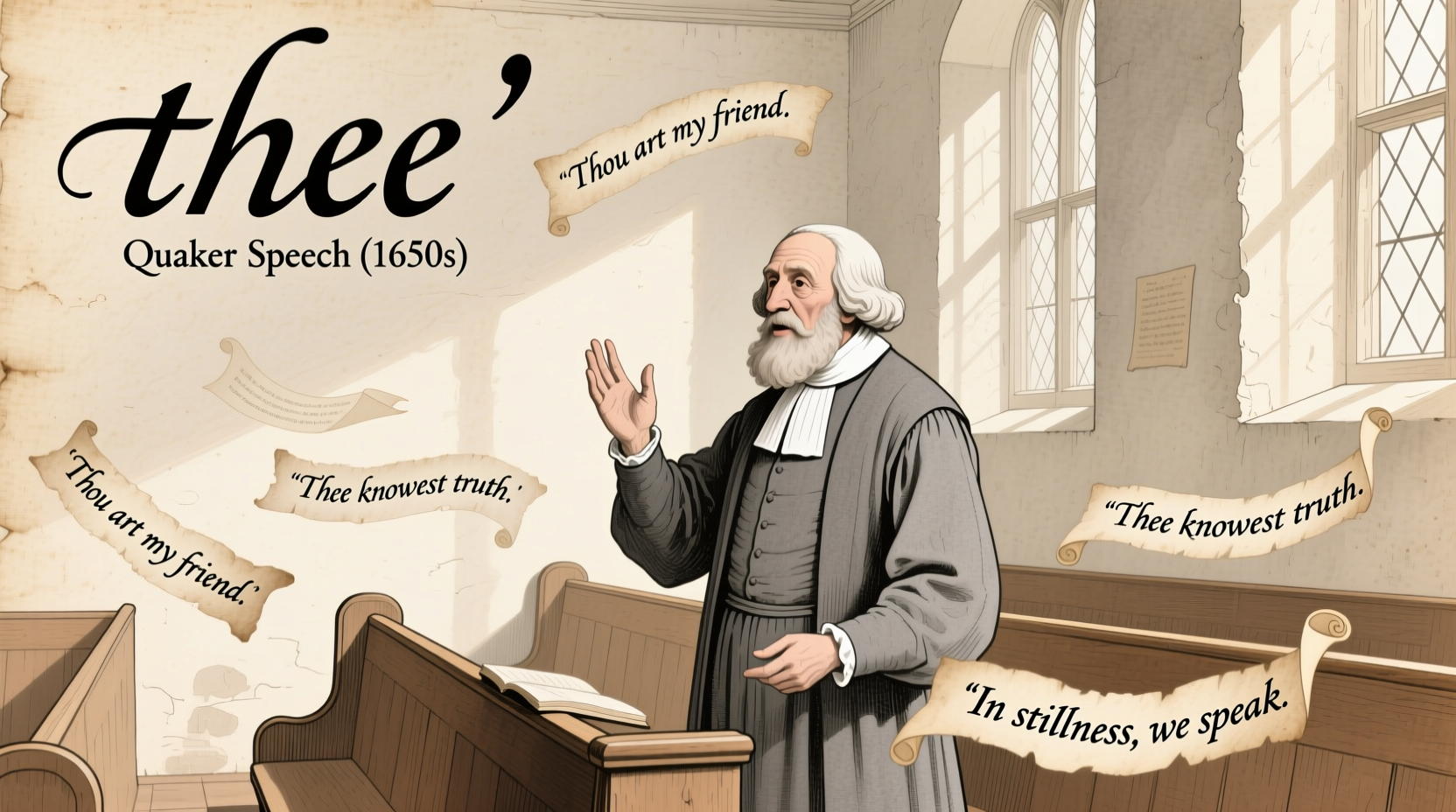
In Early Modern English, pronouns were used with specific social distinctions. \"You\" was the formal plural or polite singular form, while \"thou\" (subject) and \"thee\" (object) were informal singular forms used among equals, family, or subordinates. Over time, \"you\" became the standard in all contexts, and \"thou/thee\" faded from everyday use—except in religious texts and certain dialects.
When the Quaker movement emerged in mid-1600s England under George Fox, its followers rejected hierarchical customs—including the elaborate language of deference. Addressing a nobleman as \"you\" while using \"thou\" with a servant reinforced class divisions. Quakers refused this double standard. Instead, they addressed everyone—rich or poor, powerful or humble—as \"thee,\" using the singular form to affirm that all people are equal before God.
“We utterly deny the use of titles of honor… and we do not use ‘you’ to any person, but ‘thee,’ to witness against the vanity and flattery of the world.” — Robert Barclay, 17th-century Quaker theologian
This wasn’t merely linguistic conservatism—it was radical egalitarianism expressed through grammar. By speaking plainly and consistently, Quakers bore testimony to their belief that no individual deserved special honor based on status, wealth, or title.
The Spiritual Significance of Plain Speech
Plainness is one of the central testimonies of Quaker faith, alongside peace, integrity, equality, and simplicity. This principle extends beyond dress and lifestyle into communication. For Quakers, language should reflect truth and avoid pretense. Using \"thee\" is part of a broader commitment to plain speech—avoiding exaggeration, euphemism, or manipulative rhetoric.
Choosing \"thee\" over \"you\" removes the ambiguity of formality. There’s no need to guess whether someone is being respectful or distant; the same form is used universally. In doing so, Quakers aim to strip away social posturing and meet others in spiritual authenticity.
Modern Usage: Who Still Uses Thee?
Today, most Quakers—especially in liberal yearly meetings—use standard English in daily life. However, the use of \"thee\" persists in certain branches, particularly among Conservative and some Holiness Quakers. It's also common during worship, minutes read aloud, or when quoting traditional texts.
In programmed Quaker services (those with pastors and sermons), the language may remain modern. But in unprogrammed meetings—where silence is central and anyone may speak as moved by the Spirit—the occasional use of \"thee\" adds a sense of continuity and reverence.
Even among those who don’t speak in archaic terms, the *principle* behind \"thee\" remains influential. It reminds Quakers to treat every person with equal dignity, regardless of background. That legacy lives on, even if the pronunciation has changed.
Quaker Speech Practices Across Branches
| Quaker Tradition | Use of \"Thee\" | Language Style | Context of Use |
|---|---|---|---|
| Conservative | Common | Archaic/Plain | Daily conversation, worship |
| Holiness | Frequent | Traditional | Worship, preaching |
| Unprogrammed (Liberal) | Rare | Modern | Historical references, poetry |
| Evangelical | Occasional | Mixed | Sermons, scripture reading |
Why Language Matters: A Testimony in Grammar
The Quaker insistence on \"thee\" was never about clinging to old ways for nostalgia’s sake. It was—and remains—a form of silent protest against systems of inequality. In refusing to elevate one person linguistically over another, Quakers challenged the very fabric of class-based society.
Consider this: in 17th-century England, removing your hat to a superior was expected. Quakers refused. They believed that true honor belonged only to God. Similarly, using \"thee\" for everyone dismantled the subtle power dynamics embedded in address forms. It said, clearly and quietly: “I do not acknowledge your superiority, nor do I claim my own.”
This practice aligns with other Quaker testimonies. Just as they oppose war (peace), live simply (simplicity), and act honestly (integrity), so too do they speak plainly (truth). Language becomes an act of witness.
Mini Case Study: Elizabeth Watson’s Stand in Court
In 1656, Elizabeth Watson, a Quaker woman, was brought before a magistrate for refusing to address him as “your honor.” She insisted on saying “thee” and explaining that she could not give titles to any man. The court fined her and had her imprisoned. Her refusal wasn’t rudeness—it was conscience.
Watson’s story illustrates how something as small as a pronoun could become an act of civil disobedience. Her use of \"thee\" was not disrespectful; it was a declaration that divine worth resides equally in all people. Today, her courage is remembered not just for its defiance, but for its quiet consistency with Quaker beliefs.
Practical Guide: How to Respond When You Hear “Thee”
If you’re new to Quaker communities and hear someone use \"thee,\" it’s natural to wonder how to respond. Here’s a step-by-step approach to navigate the moment with respect and understanding:
- Listen without judgment. Recognize that the speaker isn’t mocking old English—they’re expressing deeply held values.
- Respond naturally. You don’t need to mirror \"thee\" unless you feel comfortable. A simple “I’m well, thank you” suffices.
- Ask respectfully. If curious, say, “I’ve noticed you use ‘thee’—could you tell me more about that?” Most Quakers welcome sincere questions.
- Observe context. Is this a formal meeting? A pastoral setting? The level of traditional language often depends on the group.
- Respect differences. Some Quakers cherish this tradition; others see it as outdated. Both perspectives exist within the wider community.
FAQ
Is using \"thee\" required to be a Quaker?
No. While historically significant, the use of \"thee\" is not a doctrinal requirement. Many Quakers today use modern English entirely. What matters most is living out the testimonies of equality, peace, and integrity—not grammatical form.
Does \"thee\" mean the same as \"you\"?
Yes, in meaning. \"Thee\" is the objective form of \"thou,\" equivalent to \"you\" as the person being spoken to. For example, “I greet thee” means “I greet you.” The difference lies in tone and intention, not definition.
Are Quakers the only group that still uses \"thee\"?
No. Some other Christian groups, such as the Amish and certain Mennonites, also use archaic language forms. Additionally, \"thee\" appears in Shakespeare, the King James Bible, and liturgical traditions. But Quakers are unique in adopting it specifically as a statement of equality.
Tips for Engaging with Quaker Language and Values
- Practice active listening in conversations—let silence have space.
- Avoid titles like “Mr.,” “Dr.,” or “Reverend” unless necessary; many Quakers prefer first names.
- Reflect on how your own speech might reinforce or challenge social hierarchies.
- Read early Quaker writings to understand the mindset behind plain speech.
- Attend a Quaker meeting for worship to experience the culture firsthand.
Conclusion
The use of \"thee\" among Quakers is far more than a linguistic curiosity—it is a living echo of a radical vision: that every human being possesses inherent worth. Though the word has largely vanished from everyday English, its persistence in Quaker circles serves as a reminder that language shapes perception, and grammar can carry moral weight.
Whether or not one chooses to adopt \"thee,\" the underlying principle remains vital: to speak and live in ways that honor equality, reject empty formality, and seek truth in simplicity. In a world still marked by division and hierarchy, that message is as urgent now as it was in the 1600s.




 浙公网安备
33010002000092号
浙公网安备
33010002000092号 浙B2-20120091-4
Comments
No comments yet. Why don't you start the discussion?