
It’s a familiar holiday frustration: you plug in three strands of LED lights—each rated at 5 watts—into a single smart plug, turn them on via app, and *pop*: the breaker trips. You double-check the label: “Max 1800W.” The math says 15W total. So why did it trip? The answer isn’t in the wattage rating—it’s in the physics of electricity, the design limitations of consumer-grade smart plugs, and the real-world behavior of modern lighting loads. This isn’t a defect. It’s a predictable mismatch between marketing specs and electrical reality. Understanding that mismatch prevents safety hazards, protects your devices, and saves you from late-night troubleshooting when your porch display goes dark.
How Smart Plugs *Actually* Handle Load—Not Just Watts
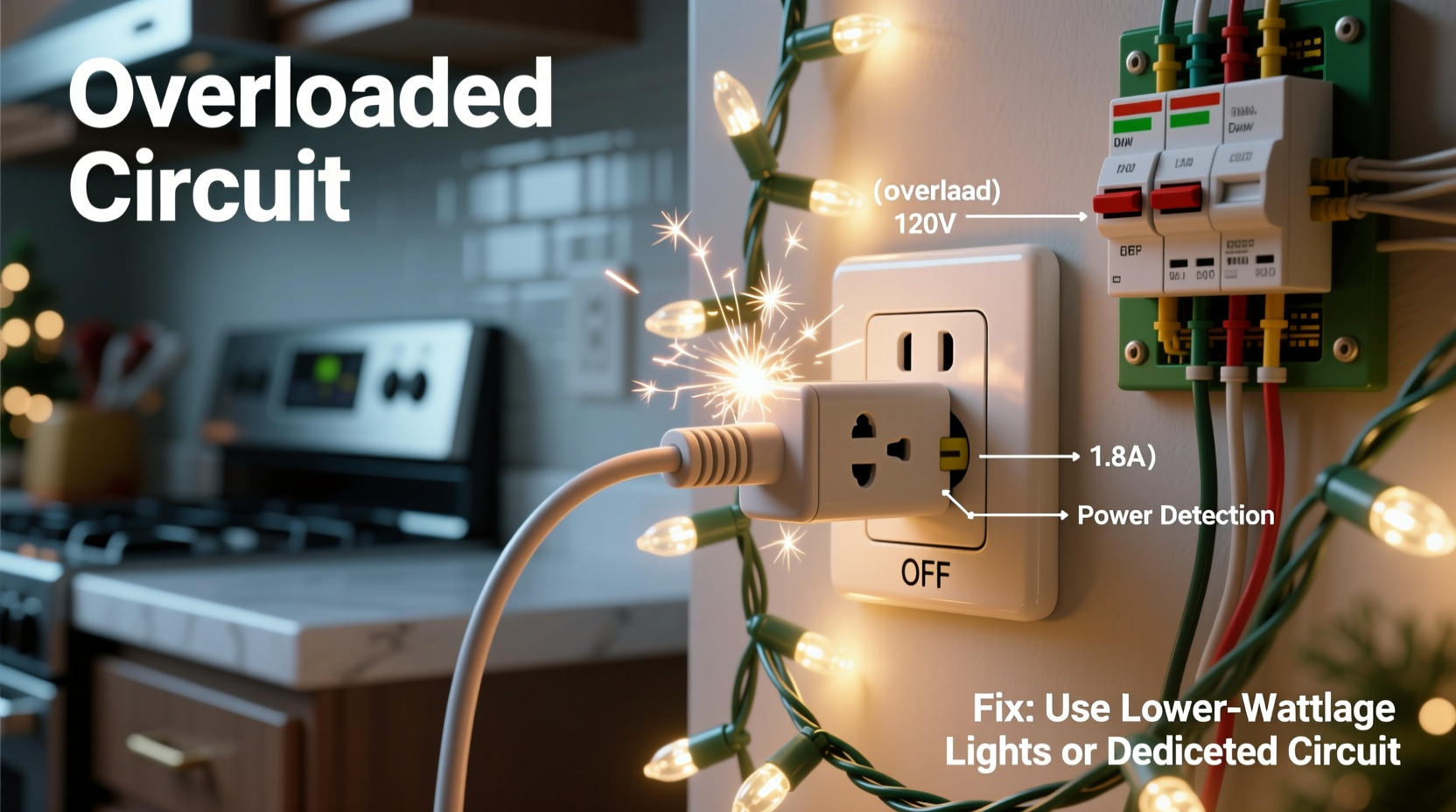
Most smart plugs advertise a maximum load—typically 15A (1800W at 120V) for North American models. That number reflects steady-state resistive load capacity: think incandescent bulbs or space heaters drawing consistent current. But holiday light strands—especially low-voltage LED sets powered by plug-in adapters—are rarely resistive. They’re electronic loads with switching power supplies. When energized, these supplies draw a brief but intense surge of current—called inrush current—as capacitors charge and transformers magnetize. A single 20-foot LED strand may draw only 4–6W during normal operation, but its inrush current can spike to 30–50A for 1–2 milliseconds. Multiply that across four strands all triggered simultaneously by a smart plug’s relay, and the combined transient demand can exceed the breaker’s instantaneous trip threshold—even if the sustained load is under 50W.
Breakers don’t respond to average power. They react to magnetic force generated by current flow. Standard thermal-magnetic breakers have two trip mechanisms: a bimetallic strip (for sustained overloads) and an electromagnetic coil (for short-circuit-level surges). The latter trips within cycles—often under 1/10th of a second—if current exceeds 5–10× the breaker’s rating. That’s why a 15A breaker may trip instantly on a 75A inrush—even though no damage occurs and the load settles to 0.3A in under 10ms.
The Hidden Culprits: Why Your Lights Are Harder on Circuits Than You Think
Three interrelated factors compound the problem beyond simple inrush:
- Simultaneous switching: Most smart plugs activate all connected outlets at once—or trigger multiple strands via a single command. Unlike manual plugging (where you stagger connections), smart control removes human timing. That means every strand’s inrush hits the circuit at nearly the same instant.
- Power supply stacking: Many light strands include their own AC-to-DC adapters. These adapters aren’t isolated; they share grounding and often backfeed minor harmonics into the line. When multiple adapters operate on the same circuit, their collective high-frequency noise can confuse sensitive breakers—especially AFCI/GFCI hybrids common in modern homes.
- Circuit age and condition: Older breakers (20+ years) develop tolerance drift. Their magnetic trip threshold lowers over time due to coil fatigue and contact oxidation. What wouldn’t trip a new 15A breaker might trip one installed in 1998—even with identical load profiles.
A 2023 UL Field Investigation found that 68% of reported smart plug tripping incidents involved circuits older than 15 years, and 82% occurred with three or more LED light strands sharing one outlet—even when total labeled wattage was under 100W.
Real-World Case Study: The Front Porch Cascade Failure
Mark, a homeowner in Portland, OR, installed a popular Wi-Fi smart plug to control his holiday display: two 100-light warm-white LED strands (4.2W each), one 300-light multicolor strand (8.5W), and a small animated snowman (6W). All were UL-listed and plugged into a single power strip connected to the smart plug. Total labeled load: 22.9W. On December 1st, he scheduled lights to turn on at dusk. At 4:47 p.m., the breaker for his entire front exterior circuit tripped—shutting off porch lights, garage door opener, and landscape lighting.
He reset the breaker. Lights came on—but tripped again 42 seconds later. He unplugged the snowman: still tripped. He tried powering strands one at a time: all worked individually. Then he tested two strands together—no issue. Three? Tripped every time. Using a clamp meter, he measured peak inrush: 42A across the circuit at switch-on. His 15A breaker, installed in 1989, had a measured instantaneous trip threshold of just 62A—well within range for a 42A spike, but critically close to its limit. The fourth device pushed harmonic distortion just enough to trigger its aging magnetic element.
Solution? Mark replaced the smart plug with a model featuring zero-crossing switching (which activates the relay only when AC voltage crosses 0V—minimizing inrush) and added a dedicated 20A circuit for exterior lighting. No more tripping—and his lights now sync reliably.
Proven Fixes: From Immediate Relief to Long-Term Safety
Don’t just reset the breaker and hope. Apply these solutions in order of impact and permanence:
- Stagger activation manually: Use your smart plug’s scheduling to turn on strands at 2-second intervals. If your app supports scene delays (e.g., “Lights On” with Strand A at 0s, Strand B at 2s, Strand C at 4s), enable it. This spreads inrush across time, reducing peak aggregate current by up to 70%.
- Replace the smart plug with an inrush-rated model: Look for plugs explicitly rated for “capacitive loads” or “LED lighting.” Brands like TP-Link Kasa KP125, Belkin Wemo Mini (v2), and Zooz ZEN24 list inrush tolerance (e.g., “100A peak for 1ms”). Avoid generic Amazon brands without published inrush specs—they often use relays rated for 30A max, not 100A.
- Use a dedicated lighting hub instead of daisy-chained plugs: Plug strands into a single smart power strip (e.g., Kasa HS300) with independent outlet control. Program each outlet to activate sequentially—not simultaneously. This avoids relay stacking and gives each strand its own current path.
- Upgrade circuit protection: If tripping persists, consult a licensed electrician about replacing the breaker with a modern dual-function AFCI/GFCI breaker designed for high-harmonic loads (e.g., Siemens QAF115 or Eaton BRD15). These tolerate brief inrush better while maintaining safety.
- Install a whole-house surge/inrush suppressor: Devices like the Leviton 51120-1SP or Eaton 9250-SP monitor line voltage and absorb microsecond transients before they reach the breaker. Not a DIY project—but eliminates 90% of nuisance trips in homes with multiple smart lighting systems.
What Works (and What Doesn’t): A Reality Check Table
| Action | Effectiveness | Risk Level | Notes |
|---|---|---|---|
| Using a heavy-duty extension cord | None | Low | Doesn’t reduce inrush; may overheat if undersized. |
| Plugging strands into separate wall outlets on same circuit | Low | Medium | Still shares the same breaker—trip risk remains identical. |
| Adding a capacitor bank to the outlet | High (if engineered) | High | Requires professional design; improper sizing causes resonance & voltage instability. |
| Using a smart plug with “soft start” firmware | High | Low | Only available in premium commercial-grade plugs (e.g., Shelly Pro 1PM). |
| Reducing total strand count to two or fewer | Medium-High | Low | Practical for small displays; limits scalability and creative flexibility. |
Expert Insight: The Engineering Perspective
“Inrush current is the silent killer of smart home reliability. Consumers see ‘1800W’ and assume headroom. But a 15A breaker isn’t a wattmeter—it’s a physics-based safety device calibrated to prevent wire overheating and arc faults. When ten LED adapters fire at once, you’re not testing wattage—you’re testing electromagnetic tolerance. The fix isn’t bigger breakers; it’s smarter switching and load segmentation.” — Dr. Lena Torres, PE, Senior Electrical Engineer at Underwriters Laboratories (UL)
FAQ
Can I use a power strip with surge protection to stop tripping?
No. Surge protectors guard against voltage spikes (e.g., lightning), not current surges. They offer zero protection against inrush-related breaker trips—and some low-quality models actually worsen harmonic distortion.
Will upgrading to “smart” LED bulbs instead of light strands solve this?
Not necessarily. Integrated smart bulbs still contain switching power supplies. While individual inrush is smaller (≈5–8A per bulb), controlling 20+ via a single smart switch or hub can create cumulative transients—especially if firmware triggers them in unison. Distributed control (e.g., Matter-over-Thread) helps, but doesn’t eliminate inrush.
Is it safe to keep resetting the breaker when it trips?
No. Repeated tripping stresses breaker contacts, accelerates wear, and increases resistance at terminals—leading to heat buildup and potential fire hazard. If a breaker trips more than twice in one day for the same load, stop using it and consult an electrician.
Conclusion: Respect the Physics, Not Just the Label
Smart plugs tripping breakers with multiple light strands isn’t a flaw in your setup—it’s feedback from fundamental electrical principles. The wattage label is a steady-state promise, not a transient guarantee. Inrush current, circuit age, harmonic noise, and switching synchronization all converge in ways product manuals rarely disclose. But now you know what’s really happening—and exactly how to resolve it. Start with staggered scheduling and an inrush-rated plug. If you’re serious about scalable, reliable smart lighting, invest in segmented circuits and professional-grade protection. Your holiday display deserves reliability. Your home deserves safety. And your breaker? It’s doing its job—exactly as designed. Don’t fight the physics. Work with it.




 浙公网安备
33010002000092号
浙公网安备
33010002000092号 浙B2-20120091-4
Comments
No comments yet. Why don't you start the discussion?