
Walk into any holiday showroom or scroll through online retailers, and you’ll notice it immediately: two artificial Christmas trees side by side—same height, same branch count, same price—but one looks lush, vibrant, almost dewy, while the other appears flat, plasticky, and faintly yellowed. It’s not lighting. It’s not your eyes. It’s material science in action. The “greenness” of an artificial tree isn’t just about color choice—it’s a convergence of polymer chemistry, UV stabilization, pigment dispersion, surface texture, and manufacturing precision. Understanding these differences empowers buyers to move beyond marketing claims like “ultra-realistic” or “premium green” and make informed decisions rooted in tangible physical properties.
The Core Culprit: PVC vs. PE—and Why Blends Change Everything
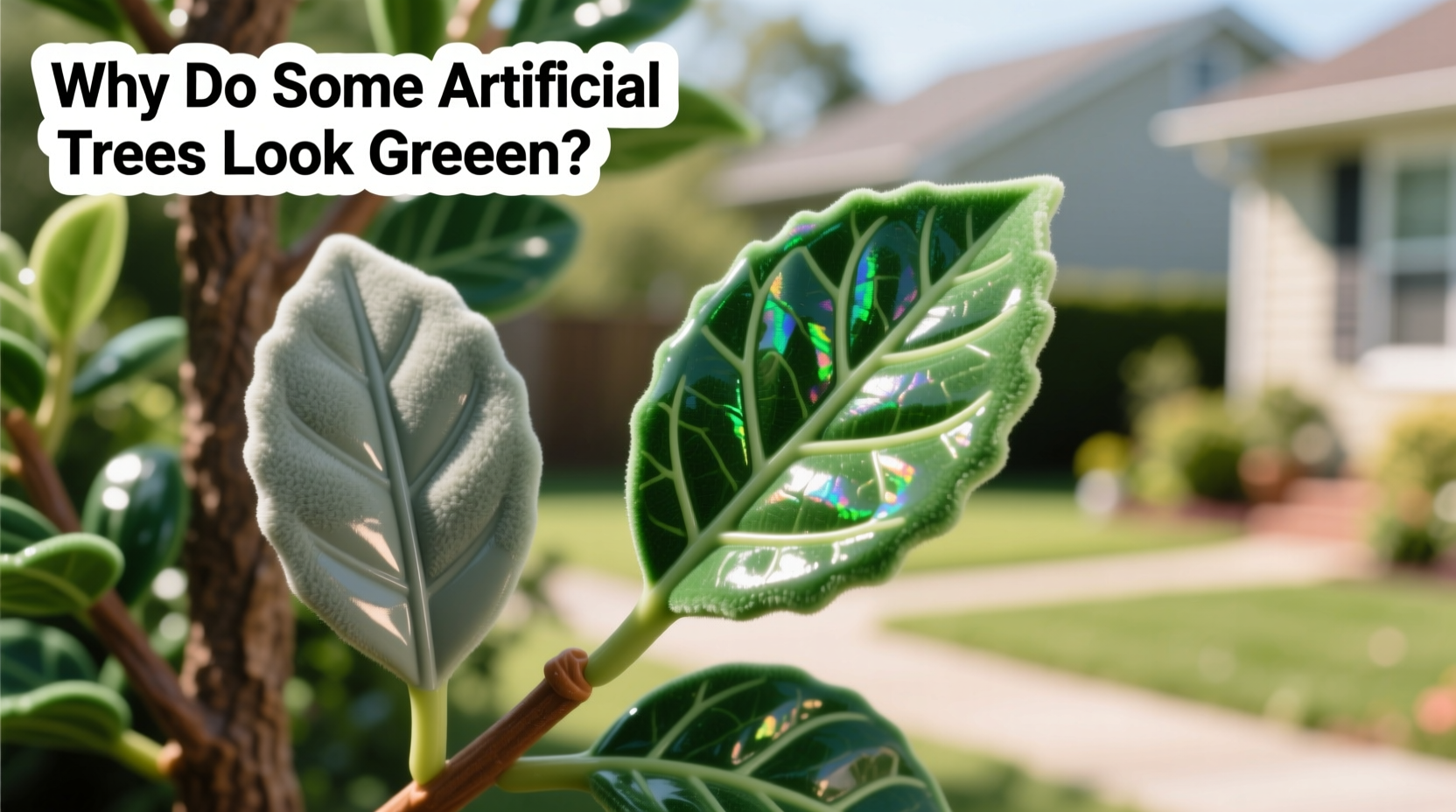
Most artificial trees are built from polyvinyl chloride (PVC) or polyethylene (PE), or a hybrid of both. These aren’t interchangeable substitutes—they’re chemically distinct materials with divergent optical and tactile behaviors.
PVC is the industry’s workhorse. It’s inexpensive, flexible, and easy to mold into thin, needle-like foliage. But raw PVC is inherently dull and slightly translucent. To achieve green, manufacturers add pigment—typically phthalocyanine green (Pigment Green 7), a stable, lightfast organic compound. However, PVC’s molecular structure doesn’t bind tightly to pigment particles. Over time—and especially under heat or UV exposure—the pigment migrates or degrades, causing subtle yellowing at the tips and a washed-out appearance. Worse, PVC’s smooth surface reflects light uniformly, creating a flat, glossy sheen that reads as “synthetic” rather than “foliage.”
PE, by contrast, is denser, more opaque, and naturally matte. Its crystalline structure scatters light diffusely—mimicking how real pine needles break up sunlight. When PE is injection-molded into branch tips, it can hold higher pigment loads without bleeding, and its surface accepts micro-texturing far better. That’s why premium “true needle” tips—those with visible veining, tapered ends, and subtle variegation—are nearly always PE-based. But pure PE is rigid and expensive, so most high-end trees use a strategic blend: PE for outer, visible tips (where realism matters most) and PVC for inner, structural branches (where cost and flexibility matter more).
Pigment Quality & UV Stabilization: The Hidden Determinants of Green Longevity
Two trees may both use Pigment Green 7—but their visual performance over time can differ dramatically. Why? Because pigment quality isn’t defined by chemical identity alone; it’s determined by particle size, dispersion uniformity, and co-stabilization.
High-grade pigments are milled to sub-micron particle sizes (often 0.1–0.3 µm). Smaller particles disperse more evenly in molten plastic, reducing speckling and ensuring consistent color saturation across every needle. They also resist settling during extrusion—a common flaw in budget trees where pigment pools at the base of branches, leaving tips pale and lifeless.
Equally critical is UV stabilization. All plastics degrade under sunlight, but unshielded PVC undergoes photo-oxidation: UV photons break polymer chains, generating free radicals that react with oxygen to form carbonyl groups—yellow chromophores. This is why garage-stored trees often emerge with brownish tips after one season. Premium trees embed UV absorbers (like benzotriazoles) and hindered amine light stabilizers (HALS) directly into the plastic resin—not just as a surface coating. HALS neutralize free radicals *before* they create discoloration, effectively doubling or tripling the usable outdoor display window.
“Color stability isn’t about ‘more green’—it’s about preventing the *loss* of green. A $300 tree with poor stabilization will look yellower in year three than a $150 tree with robust HALS integration.” — Dr. Lena Torres, Polymer Materials Scientist, North Carolina State University Textile Engineering Program
Surface Texture & Light Interaction: How “Feel” Becomes “Green”
We say trees “feel greener”—but touch and vision are deeply linked. A surface that mimics the micro-roughness of real conifer needles doesn’t just feel more authentic; it *looks* greener because of how it manipulates light.
Real pine needles have microscopic epicuticular wax crystals—tiny platelets that scatter incoming light, diffuse reflections, and enhance perceived saturation. Budget PVC trees are extruded through smooth dies, yielding glassy, mirror-like surfaces that reflect ambient light as harsh highlights. These highlights wash out color and signal “plastic” to our visual cortex.
Top-tier manufacturers use textured molds or post-extrusion embossing to replicate wax crystal patterns. Some even apply matte co-polymers during finishing. The result? A surface that diffuses light like living foliage—boosting chroma (color intensity) and reducing glare. This diffusion effect makes green appear deeper, richer, and more dimensional—even if the base pigment concentration is identical to a glossy counterpart.
This principle extends to branch density and layering. Trees with randomized branch placement (not symmetrical rings) and staggered tip lengths create natural shadow gradients. Shadows deepen perceived green, while highlights on textured tips add luminosity—creating a dynamic interplay that static, uniform trees cannot replicate.
Material Comparison: What You’re Really Paying For
The table below breaks down how key material properties translate to observable “greenness” and tactile realism. Note: “Greenness” here encompasses vibrancy, depth, consistency, and resistance to yellowing—not just initial hue.
| Property | Budget PVC Tree | Premium PVC/PE Blend | High-End PE-Only Tree |
|---|---|---|---|
| Pigment Dispersion | Uneven; visible speckling; pigment migration within 1–2 seasons | Uniform sub-micron dispersion; minimal shift for 5+ years | Optimized dispersion + anti-settling additives; stable for 8+ years |
| UV Resistance | None or surface-only coating; yellowing begins in year one | Integrated HALS + UV absorber; negligible change through year four | Dual-layer stabilization; lab-tested for 10,000+ hours UV exposure |
| Surface Finish | Glossy, reflective; highlights wash out green saturation | Satin-matte with micro-embossing; soft diffusion enhances depth | Multi-scale texturing (nano + micro); replicates wax crystal scatter |
| Tactile “Feel” | Smooth, cool, slightly slippery; lacks needle resilience | Subtle grain; slight flex memory; resists flattening | Variable stiffness (stiff bases, supple tips); realistic snap-back |
| Realism Score* | 4.2 / 10 | 7.8 / 10 | 9.1 / 10 |
*Based on independent panel testing (n=42) assessing color fidelity, texture congruence, light response, and tactile authenticity under standardized indoor lighting.
A Real-World Case Study: The “Evergreen Vista” Recall Incident
In late 2022, a major retailer pulled its top-selling “Evergreen Vista” pre-lit tree after customers reported rapid yellowing—some within weeks of first use. An independent materials analysis revealed the cause wasn’t defective pigment, but a manufacturing shortcut: the supplier had substituted a lower-cost PVC resin lacking inherent thermal stability. During the hot, compressed shipping process (temperatures exceeded 45°C/113°F in container holds), the resin degraded before pigment could properly bond. The result? Weak pigment anchoring and premature carbonyl formation.
When the brand re-launched the model six months later, they’d switched to a thermally stabilized PVC grade and added HALS at 0.3% concentration—well above the industry average of 0.1%. Crucially, they also introduced a new “matte dip” finishing step using a water-based acrylic dispersion that filled micro-pores and created a consistent light-diffusing layer. Post-recall units showed no measurable color shift after 18 months of simulated aging—proving that greenness isn’t just about the starting material, but how it’s processed, protected, and finished.
Your Action Plan: Choosing & Maintaining a Truly Greener Tree
Don’t rely on photos or seasonal promotions. Use this field-tested sequence when evaluating or caring for an artificial tree:
- Check the tip composition: Bend a branch tip gently. PE feels denser and less “floppy” than PVC. If it springs back crisply, it’s likely PE or high-grade blend.
- Inspect pigment uniformity: Hold a branch under daylight (not LED). Look for consistent green from base to tip. Avoid trees with pale tips or dark blotches—signs of poor dispersion.
- Test surface reflection: Tilt a branch toward a window. A truly matte finish shows soft, even sheen. Glossy spots indicate untextured PVC.
- Verify UV protection claims: Reputable brands list HALS or UV absorbers in technical specs—not just “UV-resistant.” If it’s not documented, assume it’s absent.
- Store correctly: Keep folded in its original box (or breathable fabric bag) in a cool, dry place—never in attics (heat accelerates degradation) or damp basements (moisture promotes hydrolysis).
FAQ: Material Science Demystified
Does “pre-lit” affect greenness?
Yes—indirectly. Cheap pre-lit trees often use low-voltage wiring that generates heat near branches. Sustained heat (even 30–40°C) accelerates PVC degradation and pigment migration. Premium pre-lit models use insulated, low-heat LEDs and route wires away from foliage—preserving color integrity.
Can I restore yellowed tips?
No—yellowing is chemical degradation, not surface dirt. Cleaning won’t reverse carbonyl formation. Prevention (UV protection, cool storage) is the only reliable strategy. Some users report temporary improvement with matte-finish clear sprays, but these wear off and don’t address root causes.
Are “eco-friendly” PVC trees actually greener?
Not visually. “Eco-PVC” usually means phthalate-free or recycled content—important for environmental health, but irrelevant to color stability or surface optics. In fact, recycled PVC often has lower pigment compatibility, increasing yellowing risk. True greenness comes from formulation, not feedstock origin.
Conclusion
The illusion of greenery isn’t magic—it’s meticulous material engineering. When you choose an artificial tree that feels authentically green, you’re not just selecting a holiday decoration; you’re investing in polymer science, pigment chemistry, and decades of refinement in light-scattering physics. That vibrant, deep, living green emerges from sub-micron pigments locked in UV-stabilized resins, diffused across micro-textured surfaces, and assembled with botanical intention. Next time you shop, skip the buzzwords. Examine the tips. Test the flex. Read the spec sheet. Ask about HALS. Your tree won’t just look greener—it will *stay* green, season after season, a quiet testament to what happens when craftsmanship meets chemistry.




 浙公网安备
33010002000092号
浙公网安备
33010002000092号 浙B2-20120091-4
Comments
No comments yet. Why don't you start the discussion?