
Walk into any home during the holiday season, and you’re likely to see an artificial tree standing proudly in the corner. But not all of them look—or feel—the same. Some appear stiff, plastic-like, and obviously synthetic, while others are so lifelike they fool even seasoned decorators. The difference isn’t magic—it’s material science, engineering precision, and thoughtful design. Understanding why certain artificial trees feel more realistic than others comes down to a detailed breakdown of construction materials, leaf structure, branch formation, and overall craftsmanship.
The realism of an artificial tree hinges on how closely it mimics the sensory experience of a natural one—not just visually, but tactilely. High-end models engage multiple senses: sight, touch, and even movement when brushed by air. This article dissects the key factors that separate convincing replicas from cheap imitations, focusing on the materials used, their structural integrity, and the design philosophies behind premium products.
Material Composition: The Foundation of Realism
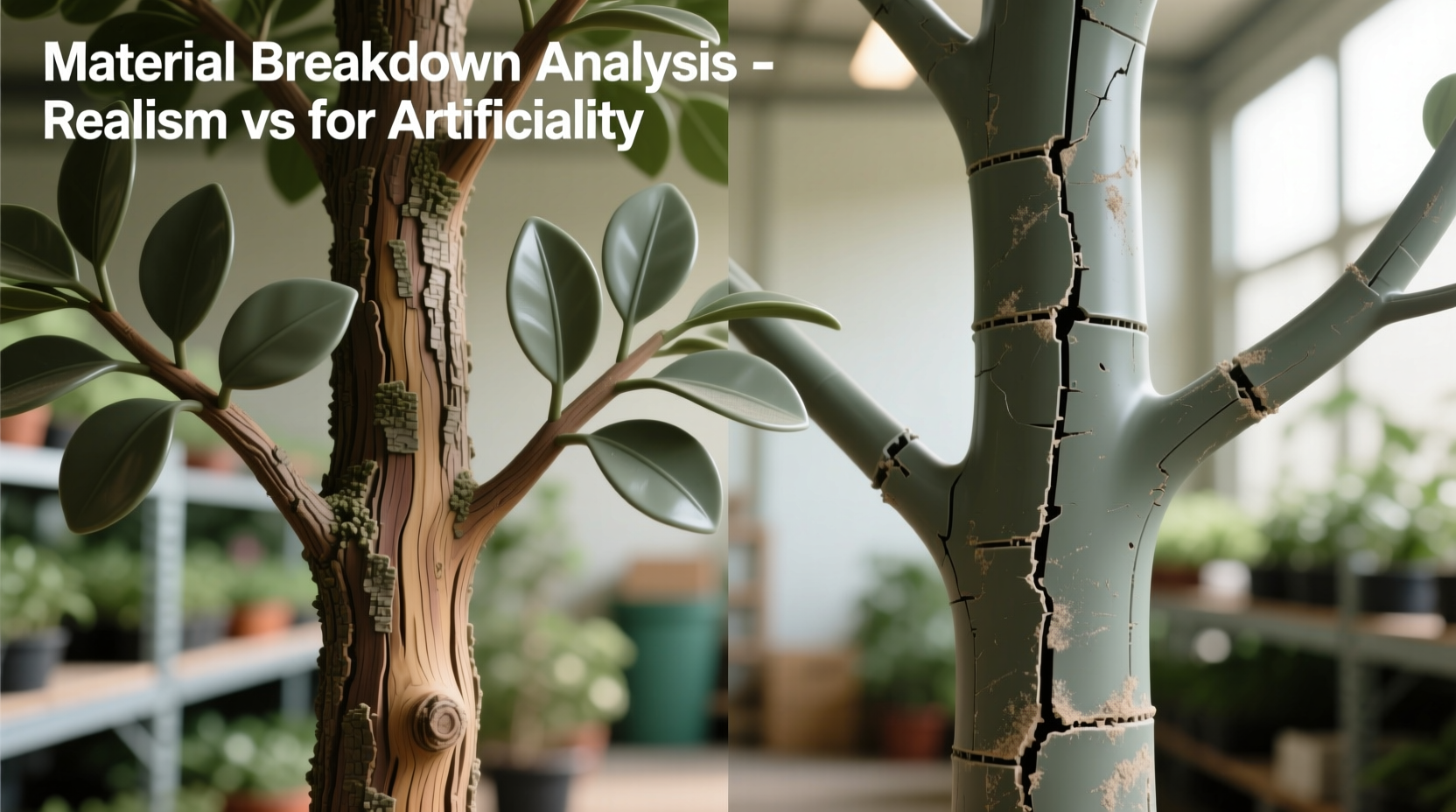
The primary materials used in artificial trees—PVC (polyvinyl chloride), PE (polyethylene), and metal or plastic cores—vary significantly in quality and application. It's not just *what* the tree is made of, but *how* those materials are engineered and assembled.
PVC has long been the standard for artificial foliage due to its low cost and flexibility. However, traditional PVC needles tend to be flat, uniformly colored, and lack dimension. When touched, they often feel rubbery or overly smooth—nothing like real pine, fir, or spruce. These trees may look passable from a distance, but up close, their artificial nature becomes obvious.
In contrast, polyethylene (PE) is molded from actual tree branches using a process called injection molding. This allows manufacturers to replicate the exact shape, texture, and arrangement of real needles. PE needles have depth, variation in color, and subtle imperfections that mirror nature. They also retain rigidity without being brittle, offering a more authentic hand-feel.
The core of the branch matters too. Cheaper trees use thin wire or hollow plastic stems that bend easily and create a sparse, unnatural silhouette. Premium models incorporate solid plastic or reinforced composite cores that allow for layered branching, supporting heavier foliage and enabling a fuller, more organic spread.
Branch Design and Density: Mimicking Nature’s Chaos
Natural trees don’t grow in perfect symmetry. Their branches twist, turn, and vary in length and fullness. Realism in artificial trees depends heavily on replicating this organic irregularity.
Lower-end models use a “feather” technique: strips of PVC are wrapped around a central stem at regular intervals, creating a uniform, repetitive pattern. This results in a dense but monotonous appearance. Touch these branches, and you’ll notice a lack of resistance and variation—each section feels identical.
Higher-quality trees employ a method known as “hinged branch” or “dual-poly” construction. Individual PE tips are attached to flexible yet sturdy sub-branches, which are then joined to larger limbs. This modular approach allows for strategic placement of foliage—denser near the trunk, sparser toward the ends—mirroring how light and wind shape real evergreens.
Moreover, branch density is measured in “tips per foot.” While marketing often touts high numbers, what matters more is distribution. A 7.5-foot tree with 1,200 well-placed PE tips can look fuller and more realistic than one with 2,000 poorly arranged PVC tips.
“Realism isn’t about volume—it’s about verisimilitude. The best artificial trees don’t just look real; they move like real trees when someone walks past.” — Daniel Reeves, Senior Designer at EverGreen Home Accents
Color Layering and Texture: Beyond Solid Green
One of the most overlooked aspects of realism is color variation. Natural evergreens aren’t a single shade of green. Needles range from deep forest tones to silvery-blue tips, with hints of yellow or brown on older growth. Sun exposure creates gradients across the canopy.
Premium artificial trees use multi-tone dyeing processes to replicate this complexity. Instead of coating every needle in flat green, manufacturers apply multiple pigments—often through dip-dyeing or airbrushing—to achieve subtle shifts in hue. Some high-end models even include UV-reactive elements that mimic how sunlight affects real foliage.
Texture plays an equally important role. Real pine needles have micro-grooves, slight waxy coatings, and variable thickness. Advanced PE molds capture these microscopic details, giving the surface a matte finish that diffuses light naturally—unlike glossy PVC, which reflects harshly under indoor lighting.
Additionally, some manufacturers add crushed walnut shells or fine particulates to the mold to simulate the slightly rough, organic feel of aged bark on trunks and main limbs. This attention to haptic detail enhances the illusion, especially when guests brush against the tree while decorating.
Structural Engineering and Assembly Logic
A tree’s frame influences not only stability but also realism. Cheap models use thin, telescoping poles that wobble and limit branch angles. This forces branches into rigid, radial patterns that scream “artificial.”
Better-engineered trees feature segmented, angled arms that lock into place at varying elevations and orientations. This allows for a dynamic silhouette—one side might sweep downward like a snow-laden bough, while another reaches upward with youthful vigor. The result is a tree that casts natural shadows and interacts convincingly with ambient light.
Assembly method also impacts final appearance. Pre-lit trees with integrated wiring must route cords through branches without compromising aesthetics. In premium models, wires are embedded within the core, leaving no visible traces. In cheaper versions, cords bulge beneath PVC sleeves, creating unnatural lumps.
Step-by-Step: How to Evaluate Realism Before Buying
- Inspect the needle texture: Run your fingers along several branches. Do they feel varied and slightly resistant, or uniformly soft and flat?
- Check for color depth: View the tree under both warm and cool lighting. Does it show multiple shades, or is it one-dimensional?
- Observe branch articulation: Are limbs positioned at different heights and angles, or do they radiate evenly like spokes?
- Assess tip distribution: Look inside the canopy. Is there layering, or does it feel hollow beneath the outer shell?
- Test the trunk presence: Does the base taper naturally? Is there bark texturing or just a smooth plastic column?
Material Comparison Table: PVC vs. PE vs. Hybrid Trees
| Feature | PVC Trees | PE Trees | Hybrid (PVC + PE) |
|---|---|---|---|
| Needle Realism | Low – flat, uniform | High – molded from real branches | Moderate – PE on outer tips, PVC inside |
| Tactile Feel | Rubbery, smooth | Slightly rigid, textured | Mixed – realistic outside, softer within |
| Color Variation | Single tone, prone to fading | Multi-dip dyed, UV-stable | Dual-tone options common |
| Lifespan | 3–5 years | 10+ years | 6–8 years |
| Price Range (6–7 ft) | $40–$80 | $180–$400+ | $100–$200 |
| Best For | Budget users, rentals | Permanent display, photography | Families wanting balance of cost and quality |
Mini Case Study: From Office Lobby to Magazine Spread
A corporate interior designer in Portland was tasked with upgrading the holiday decor for a luxury hotel chain. Previous years had relied on mid-range PVC trees—serviceable but forgettable. For the latest redesign, she sourced two 9-foot hybrid PE/PVC firs with dual-trunk bases and custom bark texturing.
Upon installation, staff and guests alike assumed the trees were real. One guest even asked where they were delivered from—a nursery in the Pacific Northwest. The illusion held up under scrutiny: the trees cast dappled shadows, responded subtly to HVAC airflow, and retained their scent-free cleanliness—ideal for allergy-sensitive environments.
The key difference? The hybrid model used 70% PE outer tips for visual and tactile authenticity, backed by durable PVC inner layers to reduce cost without sacrificing appearance. Combined with staggered limb placement and hand-applied pigment variation, the result was indistinguishable from nature—at least until someone tried to snap a needle.
Expert Tips for Long-Term Realism Maintenance
Even the most realistic tree will degrade if stored improperly. Dust accumulation, compression, and UV exposure dull colors and flatten needles over time.
- Always store in a climate-controlled space—avoid attics and garages where temperature swings cause material fatigue.
- Use a compartmentalized tree bag with padding to prevent branch crushing.
- Before unpacking, gently shake each section to restore natural needle spread.
- For dust removal, use a microfiber cloth or handheld vacuum with a brush attachment—never water or chemicals.
“Most people think realism is fixed at purchase. But how you care for the tree year after year determines whether it still looks convincing five seasons later.” — Lena Cho, Sustainable Holiday Stylist
FAQ: Common Questions About Artificial Tree Realism
Can artificial trees smell like real ones?
No—but many come with optional scent diffusers or sprays that mimic pine, fir, or cedar. Some manufacturers infuse PE with micro-encapsulated fragrance beads that release when touched. However, true aroma requires external solutions, as plastics don’t naturally emit terpenes like live trees.
Do realistic trees require more assembly time?
Generally, yes. Trees with articulated branches and layered foliage take longer to shape and fluff. A high-end 7.5-foot model might require 45–60 minutes to fully assemble and style, compared to 15–20 minutes for basic models. The extra effort pays off in appearance and longevity.
Are fire-retardant materials less realistic?
Not necessarily. Most reputable manufacturers treat PE and PVC with flame-resistant coatings that don’t alter texture or color. Always check for certification labels (e.g., UL-listed), but know that safety features rarely compromise realism in modern designs.
Final Checklist: Choosing a Realistic Artificial Tree
- ✅ Prioritize PE or hybrid construction
- Especially for outer branches and tips.
- ✅ Examine color variation up close
- Look for at least two shades of green, ideally with weathered or sun-kissed accents.
- ✅ Test branch flexibility and core strength
- They should bend slightly but hold shape under ornament weight.
- ✅ Verify tip placement strategy
- Avoid trees with perfectly radial or feather-wrapped patterns.
- ✅ Confirm storage compatibility
- Ensure you have space and proper containers to preserve structure off-season.
Conclusion: Realism Is a Craft, Not a Coincidence
The gap between a convincing artificial tree and a forgettable one lies in deliberate design choices—from molecular-level material selection to macro-scale branch architecture. Consumers often assume price alone dictates quality, but understanding the breakdown of materials reveals a deeper truth: realism is earned through engineering, not markup.
Whether you're furnishing a home, styling an event, or simply seeking a lasting holiday centerpiece, choosing a tree that feels authentic means investing in PE construction, intelligent branching, and nuanced coloring. With proper care, such a tree won’t just last for years—it will become a tradition in itself.




 浙公网安备
33010002000092号
浙公网安备
33010002000092号 浙B2-20120091-4
Comments
No comments yet. Why don't you start the discussion?