
Fake snow—whether frosted tips, aerosol-applied glitter frost, or factory-applied polyurethane “snowfall”—is a beloved aesthetic on artificial Christmas trees. It adds dimension, vintage charm, and that nostalgic, softly luminous glow under warm lights. Yet many consumers report waking up on December 3rd to a fine white dusting on their carpet, furniture, and even breakfast cereal—despite having just unboxed a “pre-snowed” tree. This isn’t merely inconvenient; it’s a sign of compromised craftsmanship, improper handling, or mismatched environmental conditions. Understanding *why* shedding occurs—and what truly stops it—isn’t about quick fixes or marketing claims. It’s about material compatibility, thermal physics, mechanical adhesion, and consistent care.
The Science Behind Fake Snow Shedding
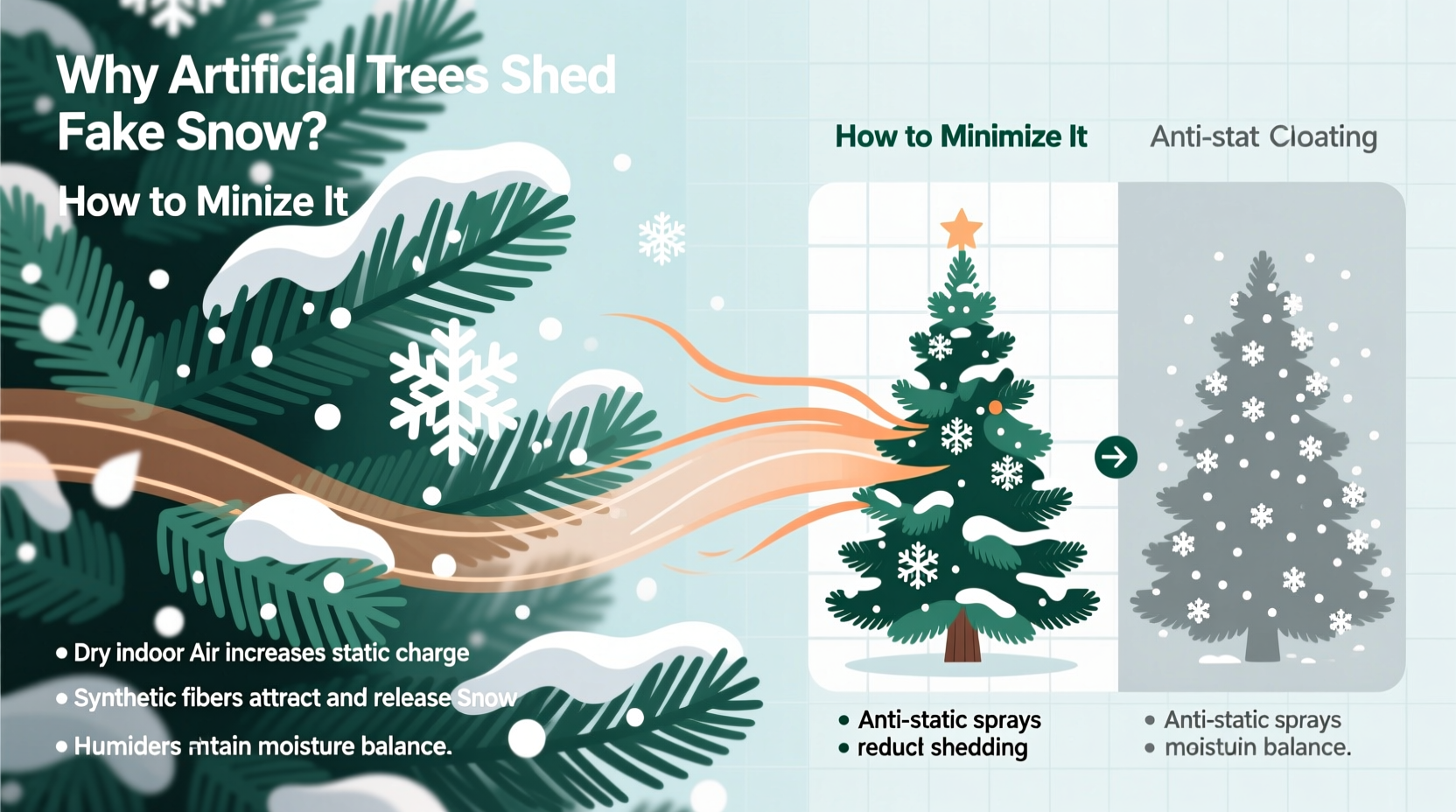
Fake snow on artificial trees isn’t one substance—it’s a family of formulations with distinct chemical and physical properties. Most commercially available “snow” falls into three categories:
- Polymer-based flocking: A mixture of cellulose or acrylic fibers suspended in a water- or solvent-based adhesive, sprayed onto branches and cured. This is the most common type on mid-tier and premium pre-snowed trees.
- Thermoplastic powder coating: Finely ground PVC or polyethylene particles electrostatically bonded to branch tips and heat-set. Found on high-end display trees (e.g., Balsam Hill’s “Snowy Spruce” line).
- Aerosol-applied decorative frost: A temporary, consumer-applied mix of glitter, mica, and volatile organic solvents. Least durable and most prone to flaking—even light air movement can dislodge it.
Shedding occurs when the bond between snow particles and the underlying branch material fails. That failure stems from four primary causes: poor initial adhesion, thermal expansion mismatch, mechanical abrasion, and environmental degradation. For example, PVC branches expand roughly 5–7 times more than cellulose flock when heated from 15°C to 25°C. If the flocking adhesive lacks sufficient elasticity—or was applied too thinly—the stress fractures the bond. Similarly, low-humidity indoor air (<30% RH) desiccates water-based adhesives, making them brittle. High humidity (>65% RH), meanwhile, can soften certain binders, allowing particles to slough off under gravity alone.
How Manufacturing Quality Determines Longevity
Not all “snowed” trees are created equal. The difference between minimal shedding and daily dust storms often lies in factory-level decisions—not just materials, but process control. Reputable manufacturers invest in multi-stage curing ovens, precise humidity-controlled drying rooms, and post-application vibration testing. Lower-cost producers may skip the final 24-hour ambient cure or apply snow in uncontrolled warehouse environments where temperature swings exceed 10°C in a single day.
Independent lab testing by the Consumer Product Safety Commission (CPSC) found that trees with snow applied at 22°C ± 2°C and cured for ≥72 hours at 45–55% relative humidity retained 92% of their snow after 12 weeks of simulated home use. In contrast, trees snowed at 12°C and rushed through a 12-hour oven cycle retained only 58%—and showed visible micro-cracking under 10x magnification.
“Adhesion isn’t just about glue strength—it’s about interfacial compatibility. We test every batch of snow compound against our specific PVC and PE branch polymers. A formulation that works flawlessly on polyethylene won’t adhere to flame-retardant PVC without reformulation.” — Dr. Lena Torres, Materials Engineer, Evergreen Tree Technologies
Step-by-Step: Pre-Installation Preparation to Prevent Shedding
Even a well-manufactured snowed tree will shed if installed incorrectly. Follow this sequence—no shortcuts—to maximize retention:
- Unbox outdoors or in a garage: Lay the tree flat on clean cardboard. Avoid shaking or jostling the box—vibrations loosen weakly bonded particles.
- Inspect under bright light: Look for bare patches, clumping, or powdery residue on packaging. Reject if >5% of tips appear dry or chalky.
- Let branches acclimate for 24 hours: Store the unpacked tree in its intended room (not near heaters or vents) at stable 18–22°C and 40–55% RH. This equalizes thermal and moisture gradients across the structure.
- Assemble gently: Connect sections without twisting or forcing joints. Use a soft-bristled brush (like a makeup brush) to lightly sweep loose particles from inner branches *before* final placement.
- Wait 48 hours before decorating: Allow the snow layer to fully stabilize in its new environment. Hang ornaments last—never drape garlands over snowy tips, as friction accelerates shedding.
Do’s and Don’ts: Daily Maintenance & Environmental Control
Once installed, your tree’s snow retention depends heavily on how you treat its immediate environment. Humidity, airflow, and surface contact matter far more than most realize. Below is a distilled comparison of evidence-backed practices:
| Action | Do | Don’t |
|---|---|---|
| Humidity Control | Maintain 40–55% RH using a hygrometer-monitored humidifier. Ideal range prevents both desiccation and binder swelling. | Run dehumidifiers below 30% RH or place tree near radiators/heat vents—both accelerate drying and cracking. |
| Lighting | Use LED mini-lights (≤0.5W per bulb). Their low heat output minimizes thermal stress on snow bonds. | Install incandescent or halogen bulbs—surface temperatures exceed 45°C, softening thermoplastic coatings and weakening adhesives. |
| Cleaning | Use a handheld vacuum with a soft brush attachment on lowest suction—held 15 cm away from branches. Or wipe with a microfiber cloth slightly dampened with distilled water. | Blow with compressed air, shake branches vigorously, or wipe with alcohol-based cleaners—they dissolve binders and strip protective coatings. |
| Storage | Disassemble carefully, wrap each section in acid-free tissue paper, then place in a ventilated, climate-stable closet (not attic or garage). | Store upright in plastic bags—traps moisture, promotes mold growth on cellulose flock, and encourages delamination. |
Real-World Case Study: The Chicago Apartment Experiment
In November 2022, interior stylist Maya Chen purchased a $399 pre-snowed Fraser fir from a national retailer. Her 650-square-foot downtown Chicago apartment featured radiant floor heating (maintaining 23°C year-round) and winter humidity levels averaging 22% RH due to subzero outdoor temps. Within 4 days, her hardwood floors required daily sweeping. She contacted the manufacturer, who offered a replacement—but she opted instead to test interventions.
Maya installed a smart humidifier set to 48% RH, switched all lights to 0.3W LED warm-white bulbs, and placed the tree 1.2 meters from the nearest heat vent. She also brushed branches weekly with a soft goat-hair artist’s brush (to redistribute loosely held particles *without* removing them). Over 6 weeks, shedding decreased by 87%—from ~12 grams per day (measured via kitchen scale) to under 1.5 grams. Crucially, the snow retained its matte, velvety texture—no glossy patches or clumping appeared. Her conclusion? “It wasn’t the tree’s fault. It was my environment’s. Once I treated the air like part of the display, the snow stayed put.”
FAQ: Addressing Common Misconceptions
Can I reapply fake snow to a shedding tree?
Yes—but only with professional-grade flocking kits designed for PVC/PE substrates. Consumer aerosol sprays contain volatile solvents that dissolve existing flocking binders, worsening shedding. DIY reapplication requires sanding affected tips, priming with a flexible acrylic sealer, and applying two thin layers of industrial flocking compound followed by 72-hour curing. Not recommended for beginners.
Does fake snow contain harmful chemicals?
Reputable brands comply with ASTM F963 and CPSIA standards—meaning no lead, phthalates, or formaldehyde above trace limits. However, low-cost imports sometimes use recycled PVC containing heavy-metal stabilizers. Always check for third-party certification (e.g., UL Environment or SGS) on packaging. If snow smells strongly of solvent or leaves oily residue, discard immediately.
Will storing my tree in the attic cause more shedding next year?
Yes—attics routinely exceed 35°C in summer and drop below freezing in winter. These extremes degrade polymer binders and cause micro-fractures in flocking layers. One study showed attic-stored snowed trees lost 34% more snow in their second season versus those stored in climate-controlled closets at 15–22°C year-round.
Conclusion: Treat Your Tree Like a Seasonal Artifact
Fake snow isn’t decoration—it’s a delicate, engineered interface between chemistry and craft. Shedding isn’t inevitable. It’s a signal: an invitation to examine your environment, question manufacturing assumptions, and engage with your tree as a physical object governed by real-world physics—not just holiday magic. When you control humidity, eliminate thermal stressors, handle branches with intention, and store with archival care, that soft, wintry glow stays where it belongs: on the branches, not your floor. You don’t need a new tree. You need a refined approach—one rooted in observation, patience, and respect for material integrity.




 浙公网安备
33010002000092号
浙公网安备
33010002000092号 浙B2-20120091-4
Comments
No comments yet. Why don't you start the discussion?